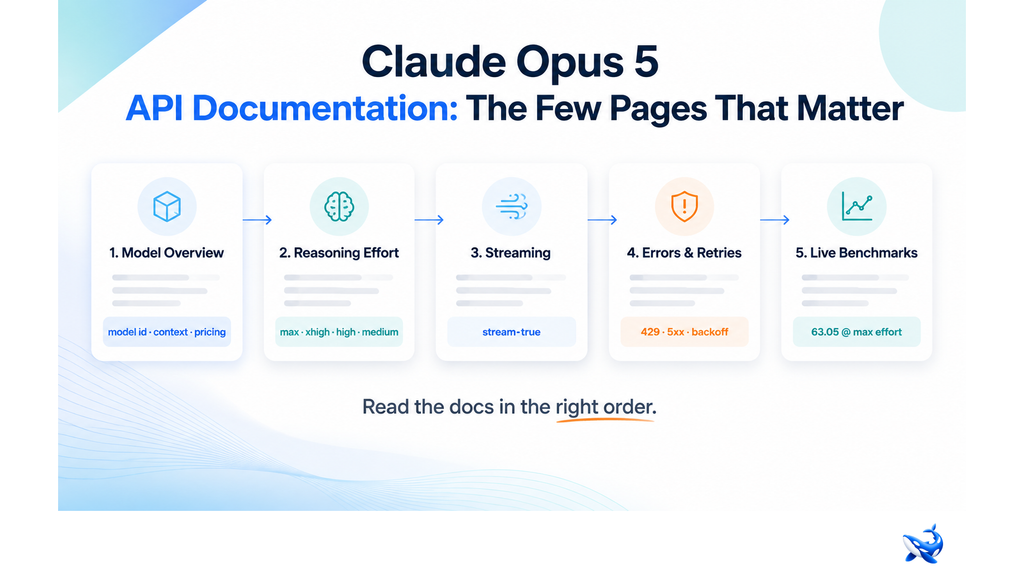
The Claude Opus 5 API API documentation is short, and it rewards a specific reading order: the model ID, the reasoning-effort parameter, and the output-budget and streaming pages carry almost every decision, while most of the rest you can skip. The fast summary is that Anthropic’s flagship reasoning model — released July 24, 2026, per Artificial Analysis — is priced at $5 per million input tokens and $25 per million output tokens on the vendor’s list, verified by Orcarouter and checked against its own pricing blog; it carries a 1,000,000-token context window, and it is reached through an OpenAI-SDK-compatible endpoint under the model ID anthropic/claude-opus-5; Claude Opus 5 carries the current spec sheet and telemetry. This article is the ten-minute path through the official pages: what to read first, what to test rather than trust, and the two places where the numbers quietly mislead you.
This piece exists because most readers open the wrong pages first. Anthropic’s docs are organized around general API mechanics — authentication, the message shape, tool use, batch endpoints — none of which is Opus-5-specific. The pages that actually change what you ship are the three above, plus the error semantics and the live benchmark board. What follows is how to read them in the order that takes the least time.
Start with the model ID and the context window
The first thing to verify is that you are calling the right string. The model ID on the vendor’s own API surface is anthropic/claude-opus-5, confirmed by OrcaRouter when it added the model to its catalog. The prefix matters: if a snippet you are reading shows a different identifier, you are on the wrong page and possibly a different model. The second thing to verify is the context window — it is 1,000,000 tokens, a figure Artificial Analysis confirms independently on its model page. Be suspicious of any article quoting a smaller window; that number belongs to a different Claude family model, and it is the most common copy-paste error in the secondary literature.
The window also changes the economics of what you send. A full 1M-token input at $5 per million tokens is a $5 call before the model says a word, so the cached-input rate becomes the number that matters: $0.50 per million cached input tokens, an 80% reduction on Anthropic’s list pricing as verified by OrcaRouter. That is where a stable, resubmitted codebase context starts being the point of the model. Artificial Analysis positions the model as “near-frontier at half the price of Claude Fable 5,” and the gap between a cached call and a fresh one is exactly where that comparison plays out.
The parameter that decides what you bought: reasoning effort
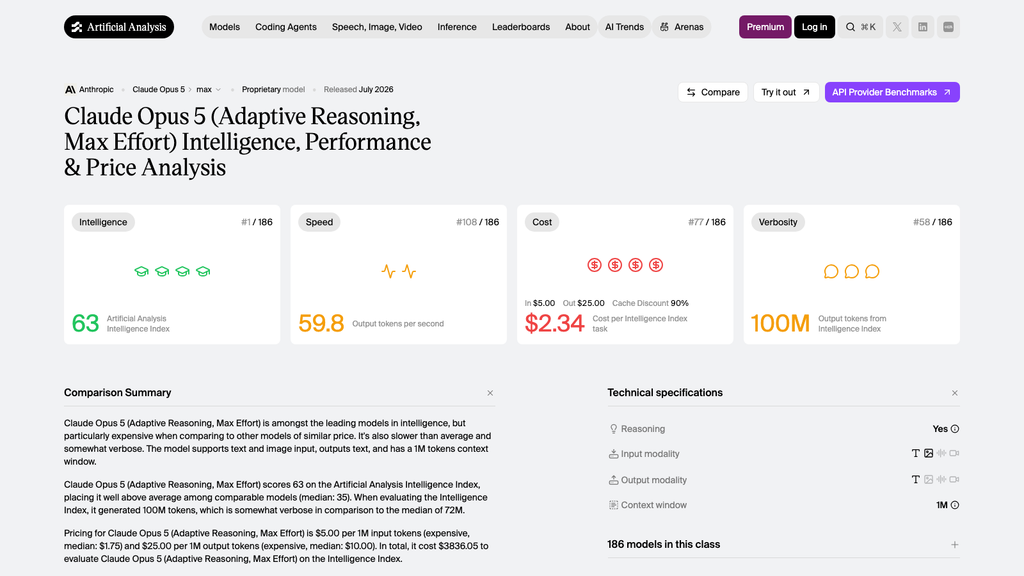
Claude Opus 5 always reasons — there is no non-reasoning mode — but it reasons at the effort level you choose. Artificial Analysis runs the model at four settings: max, xhigh, high and medium. This is the single most consequential field in the documentation, because every headline number about this model is measured at max effort. On the independent board, checked August 22, 2026, the Intelligence Index reads 63.05 at max — the top score among the 185 models currently listed — but the ladder below it tells the real story: xhigh 62.52, high 61.48, medium 58.64. Deploy on a lower effort and compare against a published benchmark, and you are comparing two different models. The vendor’s own price tag for that exercise, as measured by Artificial Analysis, is $2.34 per Intelligence Index task at current list pricing.
Temperature is where the docs most often mislead people coming from non-reasoning models. On a reasoning model, temperature mostly stops being the dial that trades determinism for variety; the vendor’s guidance steers behavior control toward the effort setting instead. If your temperature sweeps return nothing, that is not a bug in your code. The other budget to respect is output: reasoning tokens bill as output at $25 per million, so long thinking chains consume your max-output-token budget before a single answer token arrives. Treat the max-output field as a cost guardrail, not a formality, and confirm the current ceiling on the official model card rather than trusting a blog quote.
Streaming: read the latency, not the feature list
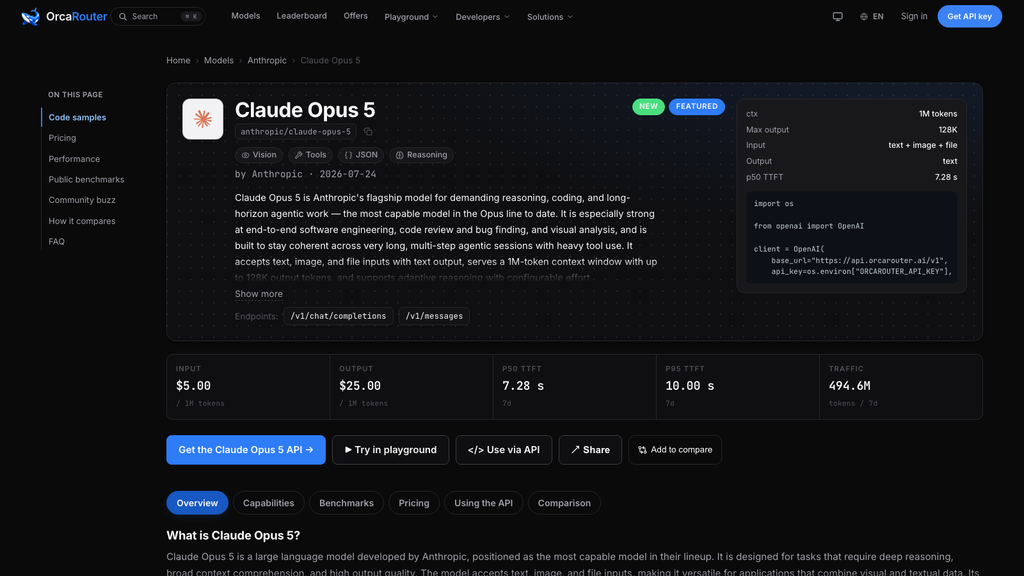
Streaming is documented the same way for Opus 5 as for every other Anthropic model — the stream flag, the chunk shape, the deltas — and there is nothing novel to learn there. The novel part is what the stream tells you about the model’s temperament. Median output speed on the independent board is 61.8 tokens per second, which is not a fast model. On OrcaRouter’s own seven-day telemetry, the p50 time to first token is 7.34 seconds and the p95 is 10.00 seconds — a flagship that thinks before it speaks. That is the difference between this model and a volume model: Claude Opus 5 is an output-quality purchase, not a latency purchase, so design the product surface around it — background jobs, batch review, agent loops — rather than around interactive autocomplete.
Errors, retries, and rate limits
The error section is the page people skip and then regret skipping. The official docs define the status-code semantics — the 429 rate-limit response, the 5xx overload family, and the retry-after window you should respect rather than fight — and the practical rule is exponential backoff with jitter, capped, with a hard stop after a few attempts. Two reasoning-model wrinkles belong in the default playbook. First, a retry is not free: every re-sent request that triggers thinking bills the effort-level output you chose. Second, if a request dies mid-stream, reconnecting is cheap but re-running the reasoning is not, so prefer resumable work and idempotent prompts. Rate limits depend on your account tier; treat quoted limits as vendor-reported and check the official page against your own account before scaling, because they change.
Where the numbers quietly mislead
Two traps cost people the most time. The first is silent re-scoring: the independent benchmark board re-scores models on its own schedule, and Claude Opus 5 has been quoted at different figures at different times. When you read 63.05, treat it as the current Artificial Analysis reading on the day you checked — and re-check it on the day you publish. The second is effort-configuration confusion: the widely-quoted score is the max-effort run, and a default-or-medium deployment is a 58.64 model on the same index. That gap of just over four points is larger than the gap between Opus 5 at max and the next two competitors on the same board, which is a roundabout way of saying the configuration you deploy is a bigger decision than the model you choose.
A practical reading order
If you have ten minutes, this is the order that pays for itself. The overview settles the identity of the model, the reasoning page settles your bill, the streaming page settles your product shape, the error page settles your retry policy, and the live board settles the number you actually cite.
| # | Page | What it settles | Time |
| 1 | Model overview | model ID, context window, pricing | 5 min |
| 2 | Reasoning / effort | effort levels, what bills as output | 10 min |
| 3 | Streaming | stream flag, chunk shape, deltas | 5 min |
| 4 | Errors & rate limits | status codes, retry-after, backoff | 5 min |
| 5 | Live benchmark board | current score, and the effort config behind it | 5 min |
One shortcut for the model page itself: a router catalog shows the same ID, list price and call shape on a single screen.
The takeaway
The documentation for Claude Opus 5 is not long, but it is dense in the wrong places: the general API mechanics are boilerplate, while the three decisions that shape your bill and your product — the effort level, the output budget, and the latency profile — sit under a headline score that assumes max effort. If you need a model for hard, one-off analysis where a seven-second first token is acceptable, this is a strong fit; if you need sub-second interactive latency, this is the wrong model no matter what the docs say. For testing it, one key on a platform that passes the $5 / $25 list price through at 0% markup puts Claude Opus 5 and cheaper models on the same account with automatic failover — but the reading order above is what actually saves you the week. Read the ID, set the effort deliberately, and re-check the score on the day you cite it.
Sourcing note: Pricing, the 0% markup pass-through, the model ID and the latency figures are OrcaRouter’s own data — list pricing verified against the vendor on August 18, 2026, telemetry from a seven-day window checked August 22, 2026. Release date, context window, benchmark scores, the effort ladder, output speed and the cost-per-task figure are independent measurements from Artificial Analysis, checked August 22, 2026. Anthropic’s documentation, reasoning-effort guidance and account-tier rate limits are vendor-reported; verify them against your own account before scaling.