Most people never think about asbestos until a builder points at a ceiling or a boiler cupboard and says the work has to stop. At that point the question changes from “is it asbestos?” to “who is allowed to deal with it?”, and the answer is not as simple as finding the nearest firm with a van and a protective suit. In Britain, the law decides who can touch which materials, and the line between licensed and non-licensed work is where homeowners, landlords and business owners most often get caught out.
Three Categories, One Set of Regulations
The Control of Asbestos Regulations 2012 split asbestos work into three groups. The group a job falls into depends on the type of material, its condition and how much the work will disturb it.
Licensed work covers the higher-risk materials. Sprayed coatings, pipe and boiler lagging and most work on asbestos insulating board fall into this group. Only contractors holding a licence from the Health and Safety Executive can carry it out.
Notifiable non-licensed work sits in the middle. A licence is not required, but the work has to be notified to the enforcing authority before it starts, records have to be kept and the workers involved need regular medical checks.
Non-licensed work covers short, lower-risk tasks on materials such as asbestos cement in good condition. Workers still need training and the right controls, but there is no notification requirement.
The category is not a matter of opinion. It follows from what the material is and what is being done to it, which is why a survey or sample analysis usually comes first.
Why the Licence Matters
A licence is not a badge a company buys once. The HSE assesses a contractor’s procedures, training, equipment and track record before granting one, and licences are time-limited, so firms have to show they still meet the standard each time they renew.
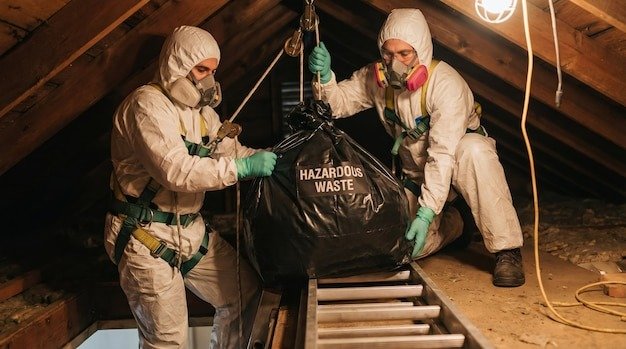
Licensed work also comes with obligations that unlicensed firms cannot meet. The contractor has to notify the enforcing authority at least 14 days before starting. Work on the most dangerous materials is carried out inside a sealed enclosure kept under negative pressure, so fibres are drawn into filters rather than escaping into the rest of the building. Once the work is finished, an independent analyst inspects the area, tests the air and only then issues a certificate saying it is fit to be used again.
Each of those steps exists because the higher-risk materials release fibres far more easily than cement products do. Skipping them does not make a job cheaper so much as move the cost onto whoever breathes the air afterwards.

How to Check a Contractor’s Licence
The HSE publishes a list of current licence holders on its website, and checking it takes a couple of minutes. Search by company name and confirm that the licence is current rather than lapsed. A legitimate licensed contractor will give you their licence details without hesitation.
It is also worth asking for the paperwork you should expect to receive. For licensed work, that means a written plan of work before anything starts, confirmation that the job has been notified, the analyst’s certificate at the end and waste consignment notes showing the material went to a permitted disposal site. Asbestos waste is classed as hazardous, so it cannot go in a general skip or to a household tip, and a proper paper trail is the only proof it was disposed of correctly.
Homeowners looking at asbestos removal in Hampshire and across the south of England often compare a handful of quotes, which is sensible. The useful comparison is not just price but what each quote includes: the enclosure, the air testing, the analyst’s clearance and the disposal documentation.
Warning Signs Worth Taking Seriously
Most firms working in this field do things properly. The ones that do not tend to give themselves away in the same few ways.
- A quote that is far below the others with no explanation of what has been left out.
- An offer to “bag it up” and take it away without any mention of consignment notes.
- No written plan of work, or vague answers about how the area will be sealed off.
- Reluctance to share licence details, or a licence that does not appear on the HSE list.
- Pressure to start the same day on material that should be licensed, when notification requires 14 days.
Any one of these is a reason to ask more questions. Two or more is usually a reason to look elsewhere.
Where Responsibility Sits
For anyone responsible for non-domestic premises, from offices and shops to the shared parts of blocks of flats, the duty to manage asbestos already applies. Choosing a contractor who is not licensed for the work does not move that responsibility onto the contractor. If something goes wrong, the people who commissioned the job may also have to explain how they chose who did it.
Private homeowners are not covered by the duty to manage in the same way, but they are still the ones living with the result. A careless removal can spread fibres into carpets, soft furnishings and loft spaces, turning one contained job into a much bigger clean-up.
A Short Checklist Before You Say Yes
Before agreeing to any asbestos work, it helps to have clear answers to a handful of questions:
- Has the material been identified by a survey or laboratory analysis?
- Does the work fall into the licensed, notifiable or non-licensed category, and who decided?
- If licensed, is the contractor on the HSE’s current list of licence holders?
- Will you receive a plan of work, a clearance certificate and waste consignment notes?
- How will the work area be sealed, and how will air quality be checked afterwards?
None of those questions are difficult, and a reputable contractor will expect them. The few minutes spent asking them are a small price next to the cost of putting right a removal that was done by the wrong people.