Ask five engineers what “good test coverage” means and you’ll get five different numbers, usually expressed as a percentage. That number is almost always the wrong thing to optimize. A codebase can sit at ninety percent line coverage and still ship a critical bug every quarter, because coverage percentage says nothing about whether the tests are checking the parts of the system that actually matter if they break.
A better starting point for software testing strategies is risk, not percentage. The question worth asking about every part of the system isn’t “is this tested” but “what happens to users and to the business if this breaks, and how likely is that.” Strategy follows from the answer.
Coverage Percentage Is a Symptom, Not a Goal
Coverage tools count lines executed, not outcomes verified. A test can execute every line of a function and still assert nothing meaningful about its behavior, and that test will still count toward the percentage. Chasing the number rewards writing tests that are easy to write, which tend to be tests for simple, low-risk code, while the complex, high-risk logic that actually causes incidents stays thin on real verification because it’s harder to test.
The healthier question is: if this specific function or endpoint fails silently in production, how long before someone notices, and how bad is it when they do? Payment processing, authentication, and anything touching data integrity deserve test investment disproportionate to their line count. A five-line permission check can matter more than a five-hundred-line reporting module.
Where Different Test Types Actually Pay Off
The classic test pyramid holds up well as a mental model, but the reasoning behind it matters more than the shape itself. Each layer trades off speed, confidence, and blast radius differently, and a strategy that ignores those tradeoffs ends up either too slow to run often or too shallow to catch real issues.
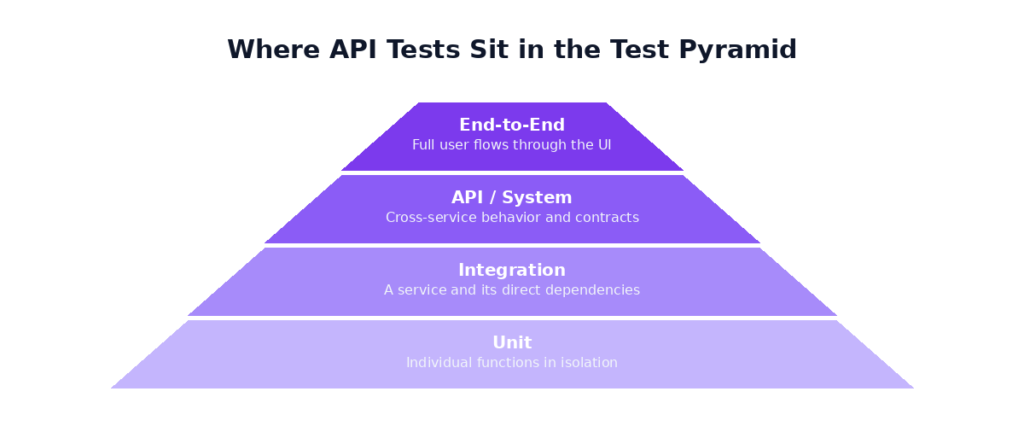
Unit tests are fast and cheap, which is exactly why they should carry the bulk of the suite. Their weakness is that they verify logic in isolation and say nothing about whether components actually work together.
Integration tests close that gap by checking a service against its real, direct dependencies, catching the class of bug that only shows up when two pieces of code that were each individually correct don’t agree with each other.
API and system-level tests verify contracts and cross-service behavior from the outside, which is often the layer closest to how a real failure actually presents itself: a consumer gets an unexpected response shape, not a stack trace.
End-to-end tests give the highest confidence per test but are the slowest and most brittle, which is exactly why they should be reserved for the handful of flows where nothing less than the full path being verified will do.
Matching Investment to the Pyramid, Not Ignoring It
Teams get into trouble in two opposite ways. Some over-invest in end-to-end tests because they feel the most reassuring, and end up with a suite that takes an hour to run and gets skipped under deadline pressure. Others stay entirely at the unit level because it’s fast, and ship integration failures that no unit test could have caught since each unit was, in isolation, doing exactly what it was told.
The middle layers, integration and API-level testing, tend to be the most underinvested relative to how much risk they actually cover. They catch the failures that happen between components, which is where distributed systems spend most of their time failing, and they run faster than a full end-to-end suite because they skip the UI entirely.
Turning This Into an Actual Plan
Start by listing the five or six things that would hurt the most if they broke silently. For most products that list includes authentication, payment or billing logic, and whatever core action defines the product’s value. Rank the rest by a rough combination of traffic and consequence, not by how interesting or easy they are to test.
Then assign each item on that list to the pyramid layer where it’s actually best verified, rather than defaulting to the layer your team is most comfortable writing. A contract between two services belongs at the API layer even if your team has historically only written unit tests. Forcing it into a unit test just because that’s familiar tooling tends to produce a test that passes for the wrong reasons.
Tooling Follows the Strategy, Not the Other Way Around
It’s tempting to pick tooling first and let it shape the strategy, but that tends to produce a suite optimized around whatever the chosen tool is good at rather than around actual risk. Once the risk ranking and pyramid assignment are settled, evaluate api testing tools against those specific gaps: which ones can enforce the contracts identified at the API layer, which integrate cleanly into the CI pipeline without slowing it to a crawl, and which reduce the manual authoring burden for the highest-risk endpoints without sacrificing the specificity a good test needs. Keploy, for instance, generates that API-layer coverage directly from captured traffic rather than hand-written assertions, which is worth weighing against the middle layers of the pyramid specifically. The tool that wins should be the one that closes the gaps the strategy already identified, not the one with the most familiar interface.
The Real Point
A testing strategy succeeds or fails based on whether it protects the things that matter, not based on a coverage percentage in a dashboard. Rank by risk, assign each risk to the layer of the pyramid that actually verifies it, and revisit that ranking periodically as the product changes, since what mattered most a year ago is rarely what matters most today.