Introduction
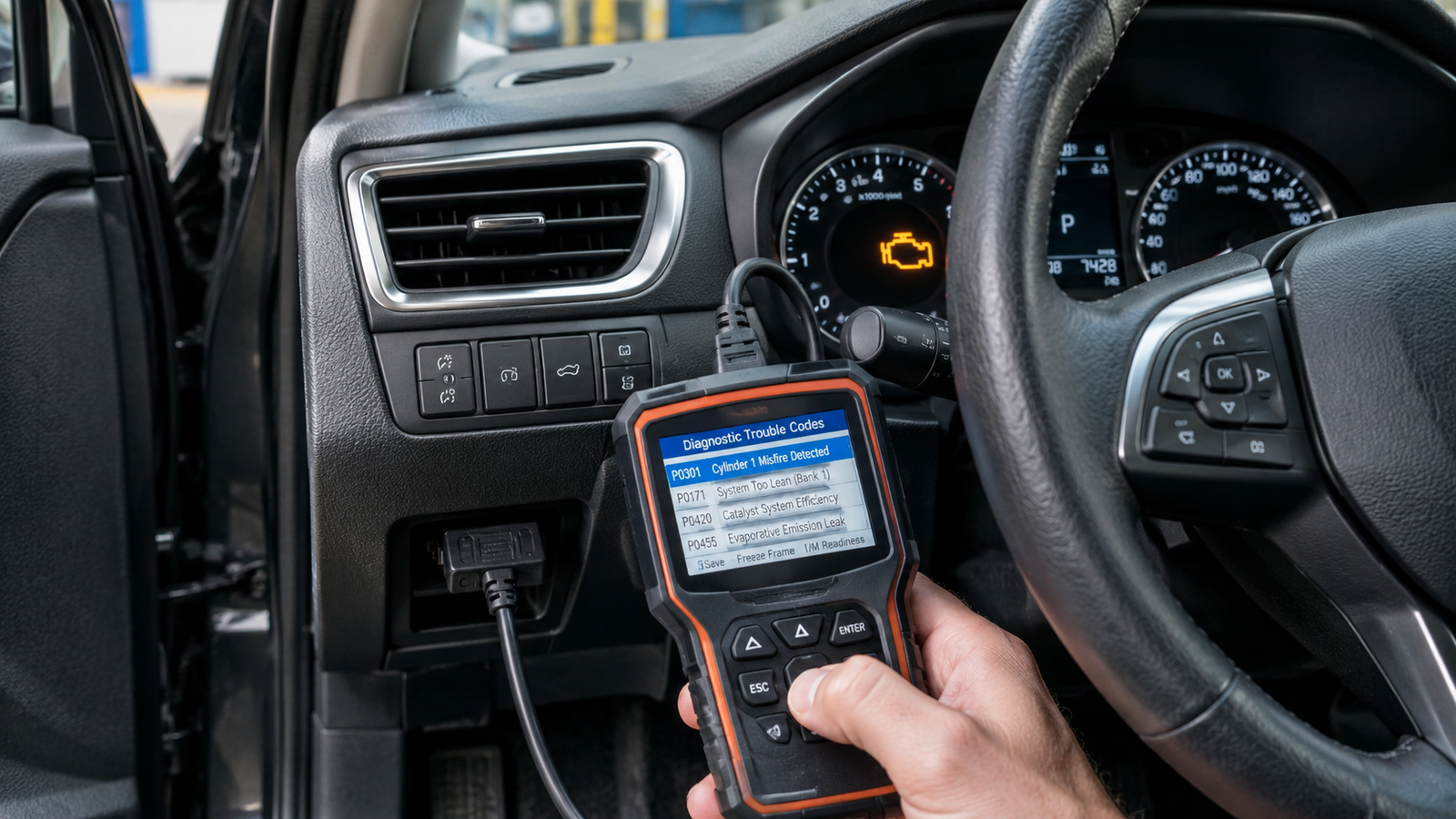
A check engine light codes may indicate a variety of issues, from a loose fuel cap to engine, emissions system, ignition system, fuel system, or sensor issues. The warning light does not specifically identify what is wrong. Instead, it states that the computer in the vehicle has identified an unusual situation and has stored diagnostic data. An OBD2 scanner can assist the vehicle owner in potentially finding out more about the warning by obtaining the diagnostic trouble code (DTC). This will provide you with a good indication of which system may require maintenance.
An OBD2 scanner isn’t a tool that can tell you where to go to replace the part. A code is a condition that is detected, and multiple different conditions may lead to a condition. So, it is important to look at the code in conjunction with the vehicle’s symptoms, inspection results, and other diagnostic information. Understanding these codes can prevent you from making needless repairs and indicate if the mechanic’s help is required.
What Are the Check Engine Light Codes?
The check-engine light is an integral component of the vehicle’s self-diagnostic system. If the computer detects a problem that occurs with any monitored engine, emissions, or related systems, it will alert the driver. A steady light typically indicates that the vehicle has identified a fault that requires attention, but this doesn’t necessarily mean it’s a serious problem, and it may be much less serious than it seems. For instance, a loose fuel cap can cause a warning to occur, and other issues, such as engine performance or emissions, could be impacted.
A check-engine light that is flashing is usually a more serious issue that needs to be addressed sooner rather than later and can be a sign of an active misfire in the engine. Other symptoms can be severe shaking, significant amounts of power loss, overheating, strange sounds, or other warning lights, and they should not be ignored by the driver. If the light continues to stay steady, it’s easy to see that the problem could be relatively small, but if the issue is ignored for too long, other parts of the system could be affected and cause more issues.
What Is an OBD2 Scanner?
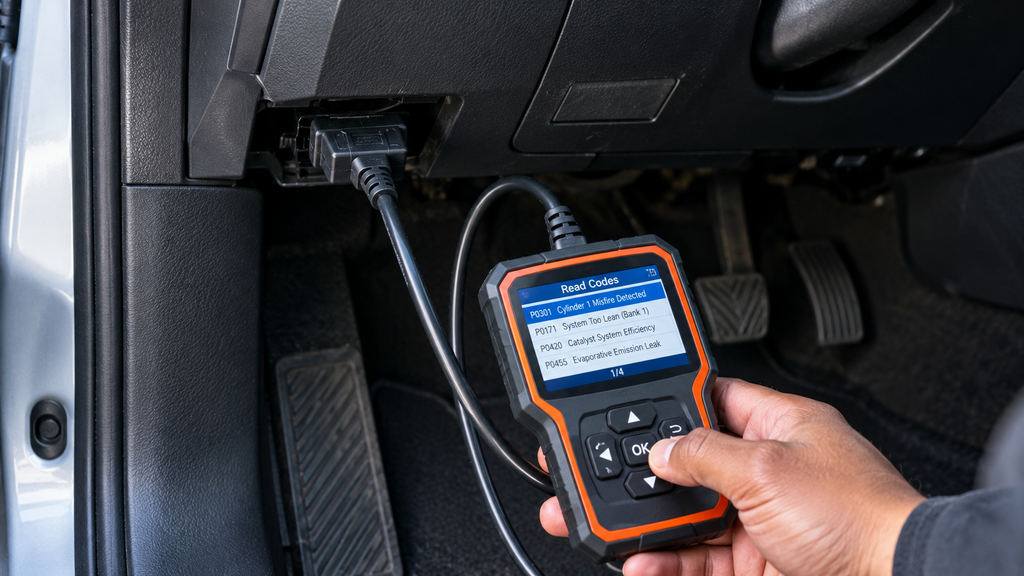
An OBD2 scanner is a diagnostic tool that has the ability to connect to the vehicle’s onboard computer via its OBD2 diagnostic connector. The port is usually found at the bottom of the dashboard to the driver’s left. Simple scanners can retrieve and clear diagnostic trouble codes, and more sophisticated scanners can show live sensor data, freeze-frame data, readiness monitors, and codes from other vehicle systems.
When using one, plug the scanner into the diagnostic port and, according to the instructions on the device, turn on the ignition and communicate with the vehicle. Choose the “read diagnostic trouble codes” option and make note of all the codes that appear before clearing any codes. Also, note the operating conditions that were recorded in the freeze frame, if one was available, as it can indicate what the operating conditions were when the fault was detected. This data can be helpful during diagnosis of a recurring issue and/or conversation with a mechanic.
Different Types of OBD2 Codes
OBD2 codes usually start with a letter indicating the overall area of the vehicle which is being addressed. P codes are mostly about the powertrain, such as engine, transmission, and emission systems. B codes are more likely to be related to body systems, and C codes are more likely to be related to chassis systems, like braking or steering. U codes are typically related to communication between vehicle control modules and the vehicle’s electronic system or network.
The numbers that follow the first letter give more details about the condition detected. There are different codes, some of which are standard and can be applied to a wide range of car manufacturers, and others that are manufacturer-specific. This means that an online code description may provide a general description of a code, but the actual procedure to diagnose it might vary based on make, model, engine, and control system. Service information from the manufacturer might be needed to know how to test.
Common OBD2 Codes
There are a number of diagnostic codes that are common to a variety of vehicles. Codes P0300 normally refer to multiple or random misfire detection, and codes like P0301 and P0302 mean misfire detection was detected for a particular cylinder. There are a number of possible causes for a misfire: ignition issues, fuel delivery problems, air leaks, wiring problems, and/or mechanical engine problems. The P0171 code is often caused by an engine that is too lean due to issues with air leaks, fuel delivery, engine-management sensors, or other engine-management parts.
Another frequently seen code is P0420, which is typically a sign of lower-than-expected efficiency in the catalytic converter. This doesn’t necessarily indicate that the catalytic converter is broken. Sometimes, the condition is exacerbated by an exhaust leak, engine misfire, oxygen-sensor problem, or fuel-mixture problem. P0455 in general is associated with a large evaporative emission leak. Again, the code points to a condition, not necessarily to the particular component to be replaced.
Why a Code doesn’t Always Identify the Failed Part
A vital aspect of vehicle diagnostics is being able to understand that a trouble code may not be a direct conclusion that a specific part has failed. The car computer keeps track of the sensors and system behavior and stores a code if either do not correspond to what they’re supposed to. If, for instance, a vehicle has an oxygen-sensor-related code, it can be due to a sensor problem, but it could also be a wiring problem, exhaust leak, or another problem with the readings of the sensor.
It is therefore expensive to replace parts only according to the code and may not solve the problem. The word “misfire” doesn’t necessarily imply that the ignition coil is faulty. This may be caused by a spark plug, fuel injector, vacuum leak, compression problem, fault in the wiring, or other problem. To make the proper diagnosis, the possible causes should be tested before replacing the component involved in the code.
Tracing the Code
Typically, the best course of action is to first record the diagnostic codes and then clear them. The codes can be erased, which can cause the loss of valuable information and can reset emissions readiness monitors. If it is not resolved, the warning light will come on again after the vehicle has met the necessary monitoring conditions. Clearing a code does not fix the issue; it simply eradicates the diagnostic data stored in the computer and, in some cases, will temporarily disable the warning.
If a repair is identified and confirmed, then clearing the code may be included in the diagnosing process. The technician can clear the code and retest-drive the vehicle to see if the code reappears. But it’s not a dependable solution to repeatedly remove the warning without ever figuring out what’s causing it. When it turns back on, the system is pointing to the fact that the underlying issue has yet to be adequately addressed.
When to Call for Professional Inspection
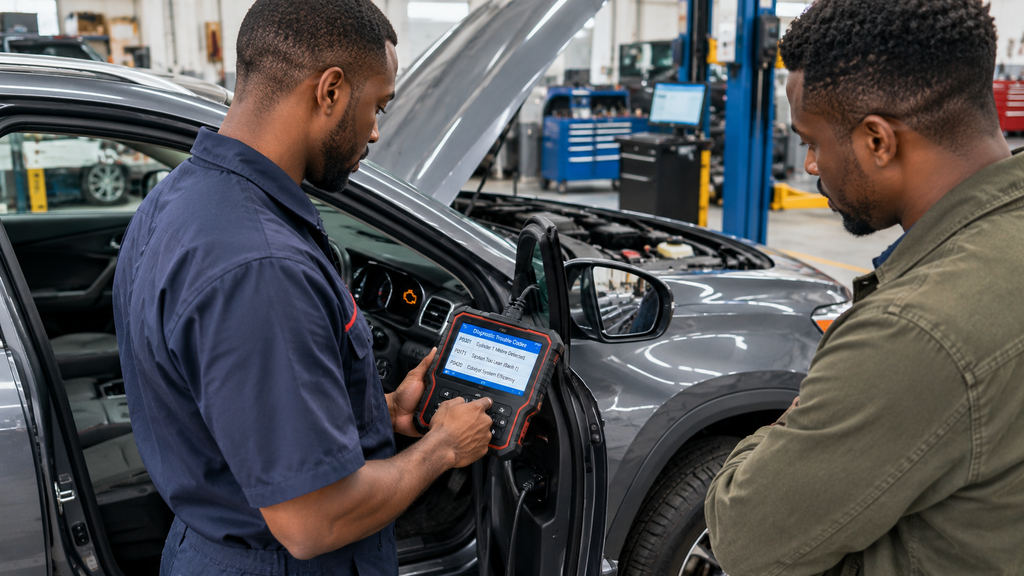
When the check-engine light comes on, or when the vehicle is showing severe symptoms, or when a simple check can’t be done to determine the issue, it’s time to see a professional technician for a mechanical inspection. If there is any significant power loss, or if the engine is overheating, or if other warning lights appear, or if the engine starts to behave in an unusual way, this is no time to just read the code. A mechanic has special tools that allow him to do tests on the electrical system, pressure tests, and use the manufacturer’s service information to determine what is causing the problem.
It is especially crucial for professionals to make a diagnosis when there are multiple possible causes of a code. The scan-tool information can be compared to the actual symptoms and can be used to conduct specific tests before recommending repair work by a trained technician. This helps to minimize the cost of replacing costly parts needlessly. The OBD2 scanner is thus a great way to begin, but should only be used to supplement mechanics’ work and should not replace that work completely.
Conclusion
An OBD2 scanner can help you to understand why the check-engine light is on by providing the computer-generated diagnostic trouble codes. These codes can pinpoint the overall nature or condition of the system and give a helpful clue to conduct further investigation. Misfires, fuel-mixture issues, catalytic-converter efficiencies, oxygen sensors, and evaporative emissions are just some of the common codes that can be used to describe issues. A code, however, doesn’t always indicate that the component described in the code has failed.
It is best practice to write the code, look at the symptoms of the vehicle, check simple possibilities, and not replace parts from the scanner description. In the event of a warning light flashing, poor performance, or if advanced testing is needed, it is a good idea to get a professional mechanical inspection. If used the right way, an OBD2 scanner can save time, increase your knowledge of your car, and enhance your ability to communicate with your mechanic.