Introduction
The financial institutions are revolutionizing the way they record transactions, transfer assets and share information across networks with the help of blockchain technology. Traditionally, banks and other financial organizations have depended on centralized data sources, middlemen and individual recordkeeping process to confirm transactions and account balances. While these are useful for the global finance, they may lead to delays, administrative expenses and reconciliation issues. Blockchain has a solution: It could provide a way to maintain and verify a shared digital record for multiple authorized parties. Distributed ledger technology, especially in the banking sector, is pertinent in which institutions are looking at methods to boost payment processing, transparency within transactions and the movement of financial information. But financial problems do not have a universal solution in terms of blockchain. It has a lot of value if used for the right applications, in the proper network design, implemented well, and in a legal and regulatory framework that is in place.
Blockchain and Distributed Ledger Technology
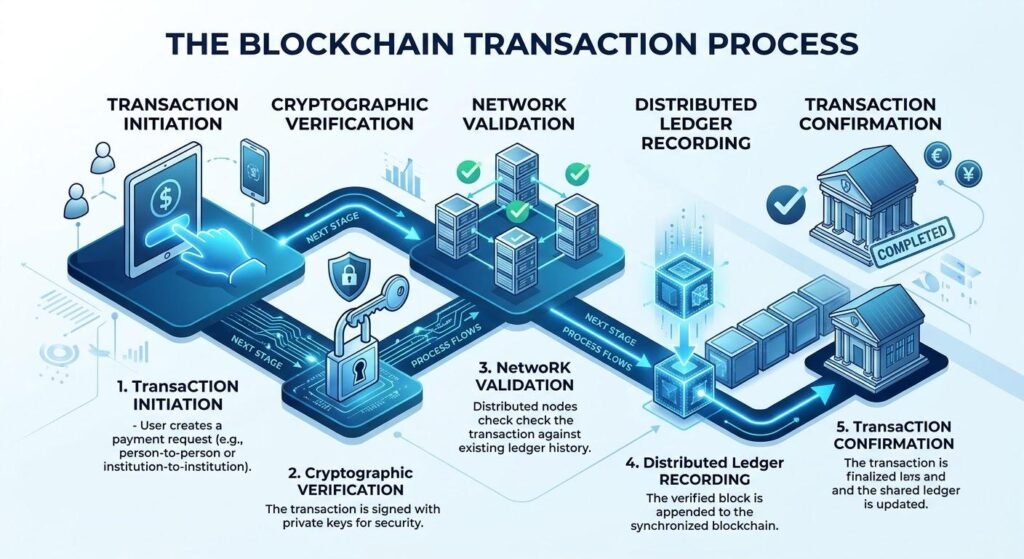
Distributed ledger technology (DLT) is a technology that enables sharing and synchronizing the trade data between several computers or organizations. A distributed ledger is similar to a single central ledger except that each authorized participant stores a copy of the common ledger under the guidelines that have been agreed upon. One form of DLT is blockchain, which arranges records in blocks, connected using cryptographic methods. As new transactions are added to the network, it keeps updating its ledger, making it easier to spot any unauthorized changes. The transactions can be verified by an independent entity of the network or by an approved entity. Not all distributed ledger systems have the same consensus mechanism, nor are all blocks publicly-accessible. Permissionless networks are open to anyone, whereas permissioned networks are limited to approved networks. These disparities affect transaction speed, governance, privacy, operational costs, and the amount of trust that is needed between the transaction participants.
Application of Blockchain to the Finance Industry.
International Payments and Banking
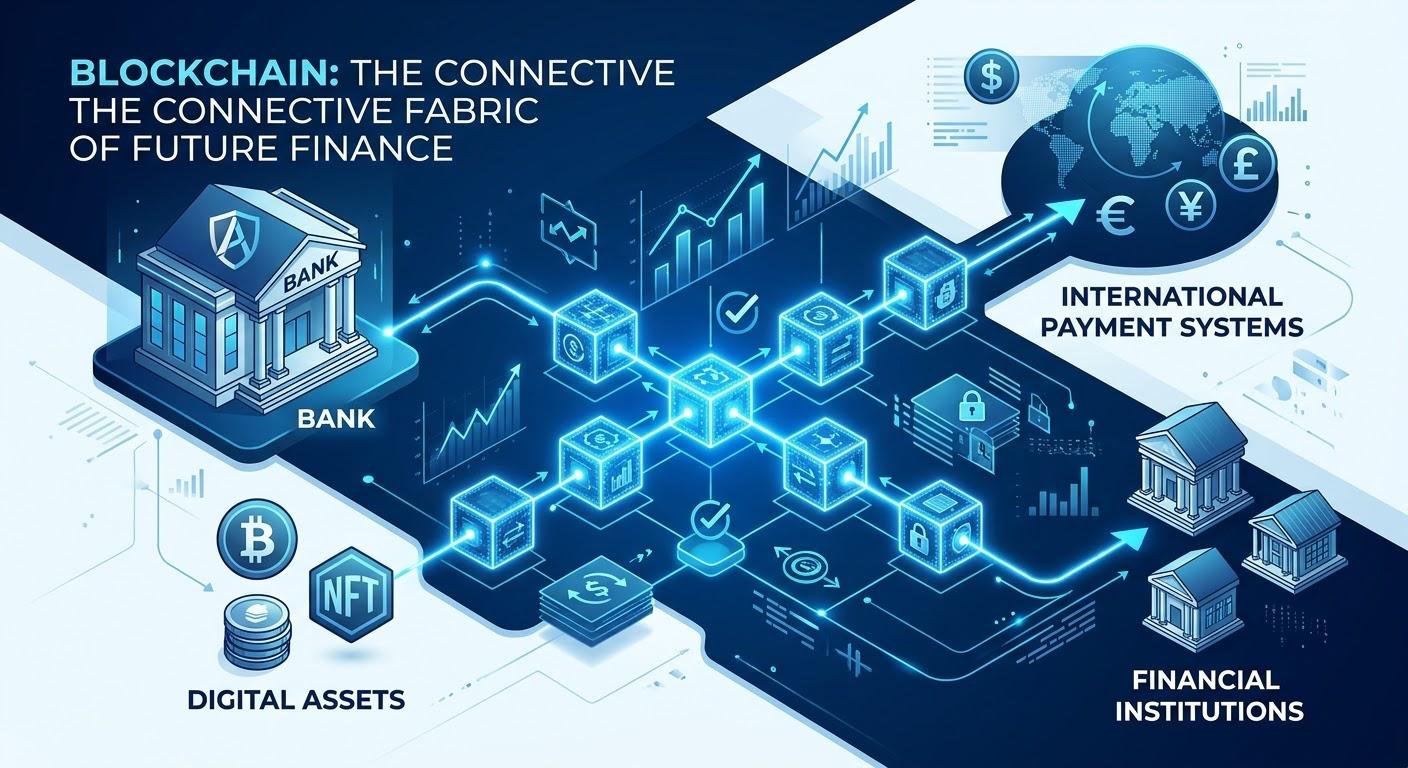
Blockchain-based systems can facilitate banks in sharing payment information, verifying payment transactions, and coordinating payments between banks. Traditional international fund transfers can go through correspondent banks and other intermediaries and have their own records and compliance processes. The arrangements may lead to processing time delay, extra cost and doubts about the status of a payment. By connecting to a shared ledger, participating institutions can access a consistent set of information about transactions, and will not need to manually exchange information. Numerous other networks also offer near real-time settlement, with settlement time depending on the payment system, the institutions involved, currency system and regulatory requirements. However, the use of blockchain does not replace correspondent banks, foreign exchange fees or compliance procedures. However, if properly built and fit with the current banking system, it can help to enhance coordination and make some cross-border payments more efficient.
Digital Assets and Tokenization
Blockchain is used to ensure digital assets are owned and transferred through a shared ledger. Financial applications aren’t limited to cryptocurrencies either, but can include tokenized shares, bonds, investment fund interests and other assets. The tokenization process is the method by which information relating to an ownership interest or financial claim is transformed into a digital token, which can be issued, transferred and tracked via compatible technology solutions. For instance, a token could be an investor’s interest in a bond or regulated investment fund. Depending on the legal structure, tokenization can make ownership more easily transferable, maintain improved record keeping, and allow for smaller amounts of investment. But a token does not necessarily convey legal ownership of the underlying asset. The issuer will have to establish the rights of the token, keep reliable records of token ownership, and abide by securities and financial regulations. Custodial services, transfer limitations, and potentially losing access to digital assets are other things investors need to be aware of.
Security Transactions and Practices
The traditional securities markets consist of a number of phases such as order processing, trade confirmation, clearing, and settlement. The records held at each institution may be different and records must be compared to ensure that Securities are delivered to buyers and payment is received by the seller. A shared record of transactions and alteration of ownership could serve to tie specific elements of this process together via distributed ledgers. With some designs, securities and payment assets may be swapped concurrently, lessening the time from delivery to payment. Smart contracts can also include the agreed terms of settlement. These features may help mitigate some of the risks associated with operation and streamline post trade administration. But blockchain can’t replace all of exchange’s, broker’s, custodians’, clearinghouse’s or settlement system’s roles. However, the market liquidity, legal finality, dispute resolution and regulatory oversight are still important. For blockchain-based records to be able to facilitate large-scale trading reliably, institutions will also need to define how blockchain-based records will relate to existing securities depositories and financial market infrastructure.
Transaction Reconciliation and Financial Recordkeeping
Financial institutions often do cross-references between different departments, payment providers, banks, custodians and accounting systems. Long investigations are sometimes required due to discrepancies in transaction reference, processing time or balance. Some of these discrepancies can be minimized by having authorized participants keep a synchronized ledger of the kind that is shared distributed. A permissioned network could, for instance, record transactions, verify payments and match transaction histories, without having to send multiple copies of the same information. This can enhance the auditability and manual reconciliation tasks. However, a ledger only has the information placed there and does not ensure that all the original information is accurate or honest. Even if data is incorrect, it could be recorded, and there should be protocols to correct it in case of disputes or transactions not made in the network. Seamless connection with accounting and reporting systems is essential.
Automation of Financial Process through Smart Contracts
Smart contracts are computer codes which run programs when a set of conditions is met. They can automate certain tasks on suitable blockchain networks without having to process each activity individually by a central administration. For example, a smart contract could emit a digital asset upon receiving a payment or use the rules set to distribute the investment proceeds, or impose conditions on a financial transaction. This automation can help to increase consistency, decrease repetitive administrative work and allow for easier auditing of certain processes. Smart contracts can’t read contracts or act in real-world events, though. They rely on well-coded logic and when they need to get data from an outside source, an oracle is a reliable data source. The programming can fail, inputs can be corrupted and conditions can be poorly designed to cause unwanted results.
How Blockchain is Impacting Financial Services.
Blockchain applications are many and rely on multiple interrelated technologies, not just blockchain. Cryptography is used to ensure integrity of transactions and to implement digital signatures ensuring the authorization. Consensus mechanisms enable network participants to reach a consensus on valid transactions, and application programming interfaces (APIs) enable blockchain platforms to interface with banking software, brokerage systems, payment providers, and customer applications. Cloud infrastructure can be used for transaction monitoring, data processing and hosting of applications; however, some networks may rely on dedicated or institution-managed infrastructure. Data analytics can be used to detect an unusual transaction pattern, track performance, and aid compliance reporting. Identity verification systems can determine users’ eligibility for financial services, and authentication can be used to ensure the security of the financial service’s accounts and administration. In real-world scenarios, a financial blockchain platform must also have backup and recovery protocols, software updates, system availability, and processes for recovery. The effectiveness of its use will rely on the interoperability of these elements and the security and reliability of the communication between that system and the existing financial infrastructure.
Advantages and Disadvantages of Blockchain in the Financial Industry
Some of the possible features of blockchain are to share the transaction record, enhance the traceability of transactions, minimize duplication, and automate certain processes. A well-managed distributed ledger can minimize the need for data re-entry between multiple organizations and simplify the auditing of transaction history when multiple parties have to access the same data. The protocols of tokenization can also enable new ways to transfer some financial interests, and smart contracts can execute repetitive instructions. These benefits are however not guaranteed. Certain blockchains may take a long time to confirm transactions, or impose fluctuating network fees; permissioned blockchains involve everyone in governance and access regulations. The integration of new systems with existing banking systems can be costly and the use of both systems at first can make things more complex. Additionally, a traditional centralized database could be quicker, less expensive, and more manageable if it is a single trusted entity that manages it. When it comes to blockchain, financial institutions need to consider all possible alternatives, and not assume that decentralization is necessarily more efficient.
Securing the Network, Privacy and Regulatory Issues
Ensuring the security of blockchain is more than just safeguarding the blockchain ledger. Digital wallets, private keys, exchanges, smart contracts, user accounts, or applications that are connected to the wallet can all be targeted by criminals. Once a transaction is entered on a blockchain, it cannot be reversed and unauthorized transfers can have a significant impact. These are all key protections that are necessary for a strong authentication system: Strong authentication, secure key management, independent code auditing, transaction monitoring, and tested recovery plans. Some public blockchains also reveal transaction histories, posing a challenge for privacy, even if the parties are addressed by pseudonymous addresses. Financial institutions need to safeguard both personal and commercially sensitive data and fulfill the requirements for data protection. Regulatory requirements differ jurisdictionally and can include anti-money-laundering, customer ID, securities issuance and custody, consumer protection and reporting requirements. Different definitions of the term cross-border services and different supervisory requirements in different countries can lead to further uncertainty for cross-border services. Institutions also need to decide what to do in the event of errors on the records, court orders and legal liability for automated systems.
Distinguishing Practical Applications from Speculation
The best examples of blockchain’s financial applications are problems that are defined as a coordination, verification or recordkeeping problem. When multiple separate institutions require the same information for their transactions, shared transaction records may be helpful, and when some interest in the asset is tied to a legal right that is clearly defined, tokenization may be beneficial for a digital representation of the financial interest. Smart contracts can also streamline processes that have clear rules, such as those in finance. Contrary to this, consumer claims that blockchain transactions are free of cost, fraud, guarantee investment returns and will eliminate need for trusted institutions are false. Distributed ledgers can’t remove market risk, stop all cyber-attacks, or ensure that assets have the value that their issuer states. There are several projects that are only attempting to benefit from blockchain for marketing purposes but fail to show any real operational benefits. Financial organizations should, therefore, review the measurable outcomes, such as settlement times, transaction costs, error rates, security performance, legal enforceability and customer and counterparty experience.
Conclusion
Selected financial processes such as international payments, digital asset ownership, securities settlement, transaction reconciliation and financial record keeping are being impacted by blockchain and distributed ledger technology to create practical opportunities for improvements. Smart contracts can be used to program tasks that are already set, and tokens can be used to convey specific rights to ownership in a digital asset. However, these are only possible with a secure infrastructure, accurate data, effective governance, and adherence to relevant laws. The use of blockchain is not the solution for the financial system as a whole, not a promise of increased efficiency. Its worth comes into play when the technology solves a real need that cannot be met using an existing solution. Going forward the costs, privacy, security, legal rights, and operational impact of these distributed systems must be assessed to identify which can be sustained within the financial system and which are just sellouts.
Get more well researched information about Blockchain in Finance here.