Introduction
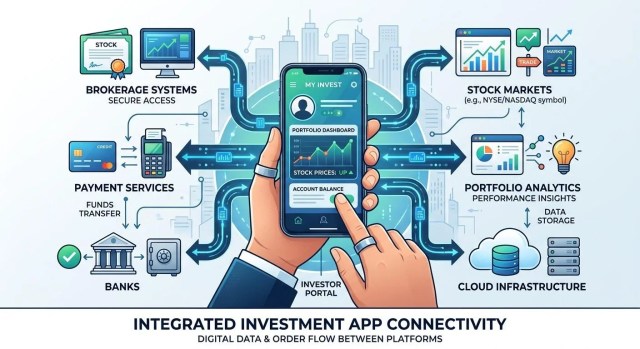
Investment applications have transformed the way that people are able to interact with financial markets and are able to purchase stocks, invest in mutual funds, keep track of their portfolios or manage their financial objectives by means of their phones or computer. Users can access investment services via digital platforms (as opposed to a traditional brokerage office) which interface with brokers, banks, fund managers, payment providers and market data systems. The complexities of creating accounts, verifying identities, processing transactions, monitoring portfolios, and complying with regulations lie behind their easy-to-use interfaces. Such as portfolio dashboards, this can show the information of the portfolio in a structured way in a digital dashboard. Investment apps use similar principles to dashboard to make it easy for users to see what they own, how much of it they have, their investment performance, and their financial progress without having to go through a series of disjoined systems.
Knowing what these applications do will assist investors to make better decisions in choosing an application. They are dependent on a variety of factors that are related to each other, such as application programming interfaces (APIs), cloud infrastructure, payment integration, automated reporting, and security authentication. To get the information and process instructions correctly, these systems should be coordinated to work together. While applications are different in terms of markets, investment products, pricing models and regulatory requirements, most of them have a similar technology path. Knowing this process can help you understand what you are doing when you open an account, deposit funds, invest in a security, or view your investment returns, and can help you identify some of the security (type of investment), fee, and product availability considerations that are important when deciding what investment platform to use.
The Account Onboarding Process
Typically the investment process starts with a new user becoming a registered customer, known as account onboarding. Depending on the jurisdiction and the type of account, an application gathers data including those of the user’s name and contact information, residential address, date of birth, tax data, and financial experiences. Another requirement for users is to submit identification documents, proof of address or income and investment goals. Then the identity verification systems validate the information submitted by comparing it with trusted databases, document records, or specialized identity verification providers. Some systems employ optical character recognition to read information from identification documents and biometric to compare a selfie against an identification photograph. These checks are used to help with know-your-customer and anti-money-laundering checks. Consistent and complete information and suspicious activity can result in further checks and manual review before the trading privileges are awarded, or automated systems can approve a simple application quickly.
APIs and the Link between Investment Apps and Financial Institutions
Application programming interfaces (APIs) are sets of standardized rules that enable different software systems to communicate with each other and request services. An investment app can connect with the brokerage firms, banks, payment processors, identity verification providers, stock exchanges, and investment fund administrators via APIs. The application can call a backend data store for this information or ask for the updated information from an external financial service when a customer is looking at the balance in an account. The platform issues the appropriate directive to the platform’s brokerage system via a permitted connection when a user places an order. The broker validates and processes the request as per his rules and the market conditions. APIs will also be able to return transaction confirmations, account balances and execution details. These communications are protected through authentication, encryption, permission and error handling. But not all platforms offer the same API capabilities and certain services may not be available or may run slower due to specific partnerships and operating methods.
Access to the Cloud, Data Management and Data Sharing
Cloud infrastructure supplies a lot of the computing power that’s needed for contemporary investment programs. Rather than having to host all of the servers at one physical site, services such as cloud-based computing, databases, storage, and networking can be used to power application workloads. These resources can scale to meet fluctuating demand when thousands of customers log-in, check the prices or place orders at once. Cloud systems can also be used to store account data, transaction histories, portfolio information and reporting data as applicable based on data protection requirements. Different services can handle user authentication, order processing, notifications, analytics, etc., thereby eliminating the need for a single service to handle all aspects. Monitoring tools are used to identify performance issues and backups and recovery arrangements are used to ensure the continuity of services. However, cloud infrastructure is not necessarily reliable or secure. There is still a need to implement proper access control, encryption, tested recovery plan, vendor monitoring, and protection from outages, data loss and unauthorized access for investment platforms.
Understand Portfolio Dashboards and Investment Data Analytics
A portfolio dashboard is a platform that offers investors a single location to check his or her financial situations. It can show total account value, cash, holdings, purchase prices, current market values, daily price changes and overall returns, depending on the applications. The sum of these figures is based on the account records, the transactions that have been executed, the market data feeds and calculations made on the platform. Data analytics systems can present this information on charts, show performance comparisons, provide breakdowns of allocations and risk indicators. For instance, a dashboard could reflect an abundance of technology based investments or a single investment dominating a portfolio’s value. This information can indicate what users are exposed to, and if there is a possible imbalance. But the returns shown are subject to careful interpretation as they may be influenced by fees, taxes, dividends, currency movements and the period of time used to calculate the returns.
Placing an Order by Investors
Buying a stock via an investing application is more than simply a buy button. The very first, the application gathers the details of the order, such as its security, quantity and type. Market order usually would execute at the best prices available to the market, and a “limit” order would set the highest price a buyer is willing to pay or the lowest price a seller is willing to accept. The initial checks the platform does may consist of the available cash, account permissions, trading restrictions, and order limits. It then sends its instructions to its broker or to a different appropriate place for them to execute. The order can be filled all or in part, be queued, be rejected or remain unfilled and in the order, depending on the liquidity of the market, the price of the order, and the rules applicable. The system confirms the execution after it has been executed and updates the user with the details of the confirmation and updates the user’s transaction history and holdings. Once an order has been submitted, it doesn’t have to be executed and the final price at which the order is executed may not be the same price as the price the order was submitted at.
Providing Services to Customers like Mutual Funds, Recurring Investments, and Robo Advisory Systems
Mutual funds and automated investing applications can also be used to invest in mutual funds. There might be a different procedure to make mutual fund deals than those of exchange traded stocks. Unlike many of the more modern mutual funds, many traditional mutual funds do not trade at fluctuating exchange rates but rather at specified times, typically once a business day. Depending on its operating model, the electronic application is submitted by the application to the fund provider or transfer agent or intermediary to which the fund provides services for the purchase or redemption. When processing is required, this can be contingent upon cut-off times, arrangement of settlement, the minimum investment amount and availability of funds. There are platforms that also have a recurring fee investing function, which makes automatic instructions, based on the user’s picked schedule as long as the necessary funds and authorizations are available. Robo-advisory systems are algorithms, questionnaires and portfolio models that suggest and/or execute investment based on certain criteria, including goals, time horizon, and risk tolerance. Depending on the service these systems might rebalance portfolios automatically, but whilst they can offer recommendations, the assumptions used by the models, the quality of the data, its cost and the circumstances of the user all influence the recommendations.
The Integration, Clearing, and Settlement Process for Payments
Investment apps need to be able to tie money deposits and withdrawals to a secure payment system. Users can fund their accounts via bank transfers, payment cards, mobile payments, or other accepted payment methods, depending on the country/region and/or platform. Payment processors and banking partners validate and pass payment instructions; once validated payment instructions are received by the investment platform the investment platform updates the account. While the success of a deposit can be indicative of the availability of funds for all investments, other restrictions such as fraud checks, bank processing and withdrawal restrictions may come into play. After a stock sale, the clearing and settlement systems aid in determining the responsibilities of the buyer and seller and facilitate the movement of cash and stock. Brokers and clearing houses, central securities depositories, custodians and settlement banks can be involved in this process. The length of time to settle will differ depending on the market and instrument. Generally, for example, all transactions in the United States in the stock market settle on the next business day under the T+1 regime, though other products and jurisdictions have different regimes. The status of the transaction should thus be clearly differentiated from the settlement status, which is displayed in the app.
A Robust Financial Reporting and Record Keeping System
Automated reporting systems utilize account data and transaction documents to present valuable accounting records. Account statements, dividend summaries, trade confirmations, realized and unrealized gain reports, fee breakdowns, and tax-related documents are examples of investment applications that can produce these documents. These reports allow users to check their activity, balance, assess their investment performance and generate information for tax return if applicable. Reporting Engines gather information from the transaction databases, broker confirmations, corporate action records and portfolio calculations. Reliable systems maintain a back trace of transactions, transaction identifiers and time stamps, allowing for discrepancies to be traced back. Alerts can also be generated when an order is placed, dividends are paid, money arrives in the account or changes to the account information. Investors should note, however, that not all reports will necessarily be for settled deals and it is important to understand how returns are calculated, as well as if currency conversion or withholding taxes are included or not. While automated reports may help make financial management easier, there are certain records that are important and must be reviewed by the user and reporting requirements that must be fulfilled.
Securing the Authentication of Security Transactions and Protecting Investors.
Security for investment applications should not be limited to a password, as this has the potential to contain personal information, and can grant access to the user’s financial assets. Multi factor authentication is an additional step of verification, like approval from a device, authenticator app or one time code. Biometric logins could make access more convenient, and encryption can help to safeguard information when it’s being sent over the Internet and, with proper implementation, stored. Fraud detection systems can detect if someone is logging in from an unusual location or sending suspicious transfers, multiple failed logins, or trading activity that needs to be investigated. There are extra-layers of protection with regards to device recognition, session management, withdrawal controls and transaction alerts. Investors should employ different passwords, have any multi-factor authentication they are offered, secure their email accounts and not access financial services via links that don’t seem to belong to the service provider or by logging in on untrusted networks. They should also look into how a platform handles personal information, the response and procedure to breaches, and how to recover their account. Although no security system is foolproof, the security that the provider offers in addition to individual users is also important, as is an incident response plan, the provider’s regulatory position and operational security measures.
Regulations and Product Availability
When selecting an application to invest in, there are more factors to consider than the interface or promised commission rate. Commission on trading, currency conversion, deposit and withdrawal fees, account maintenance fees, fund expense ratios, advisory fees or any other service fees may apply. There are various costs that can be attributed directly to the application and there are other costs that are a result of the investment product or the investment process. Investors need to review all aspects of the fee schedule and become aware of the impact of fees on long term returns. The protection is equally necessary from the regulatory point of view. Users are advised to check the legal entity that runs the service, the regulator supervising the service, the way customer funds are treated and if applicable, the compensation and/or protection for investors’ particular accounts. The protections vary from country to country, and are not usually intended to cover the normal investment losses. The availability of the product is also dependent on residency, eligibility, local regulations, brokerage relationships and exchange access. A national stock or mutual fund site might not have the same types of offerings in another country. Before investors make their investment, they should ensure that they are able to buy the products they’re interested in, what dangers they include, and how they can withdraw their cash and settle disputes.
Conclusion
Investment apps are user interface, APIs, cloud-based, financial data, payment systems, brokerage systems, and automated reporting combinations for making digital investing possible. They all serve different functions, such as verifying the identity of a customer, routing orders, updating portfolio values and recording transactions. However, convenience is not an excuse for not taking care of the evaluation. It is important for investors to know about how orders are carried out, when it takes, any limitations on products, fees, and the security of their accounts. They should also know how to differentiate technology that will help with investment management and the financial risks of investments. Users are able to assess the platform based on its infrastructure, regulations, transparency and products and decide which one is suitable for their requirements.
Get more well researched information about How investment apps work here.