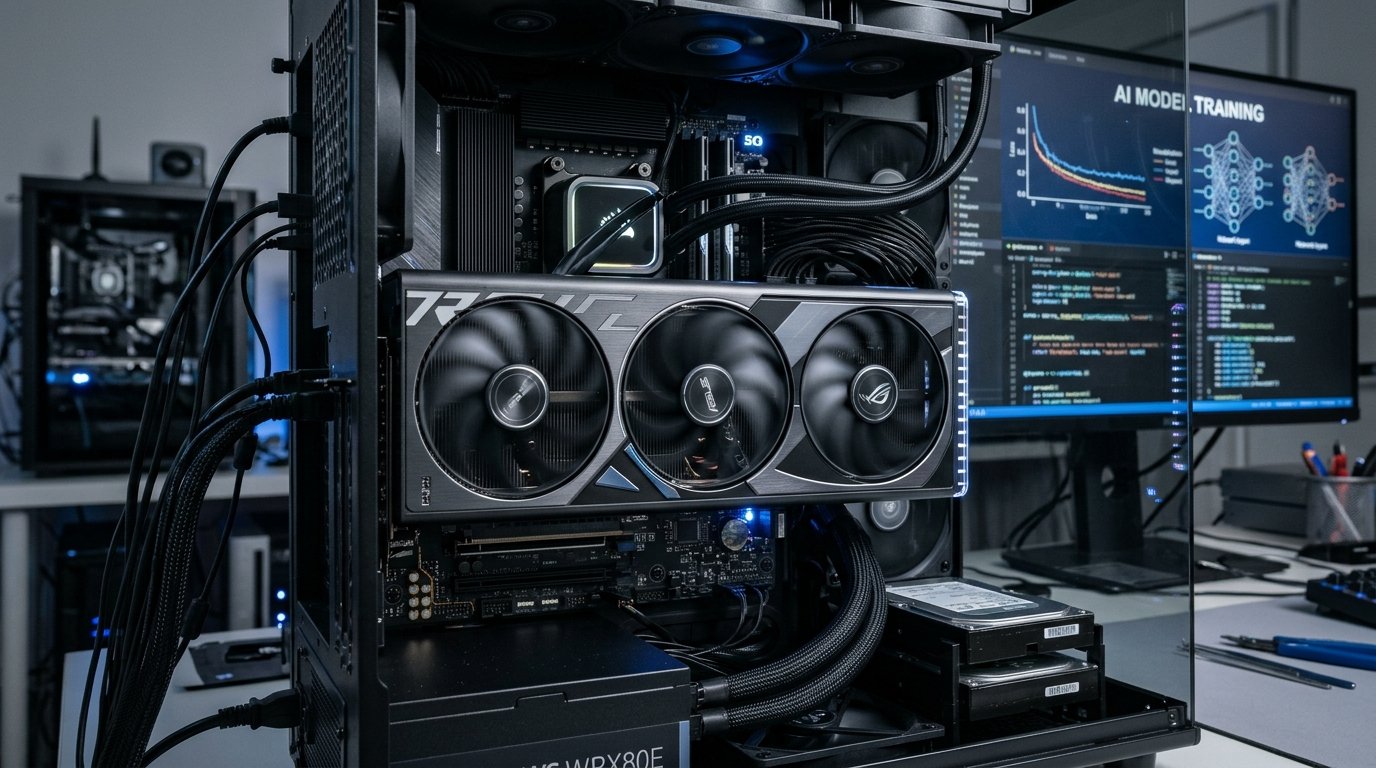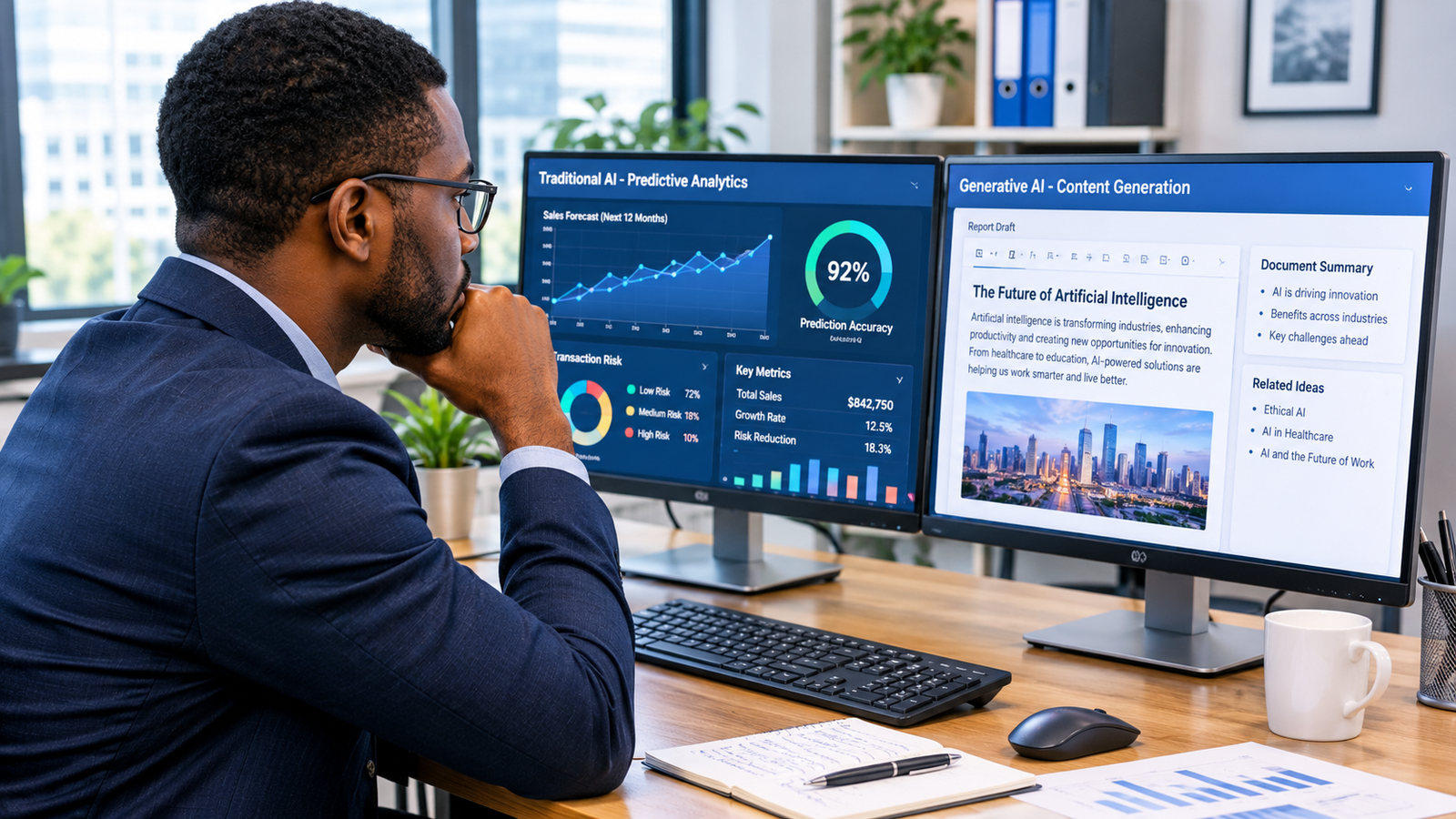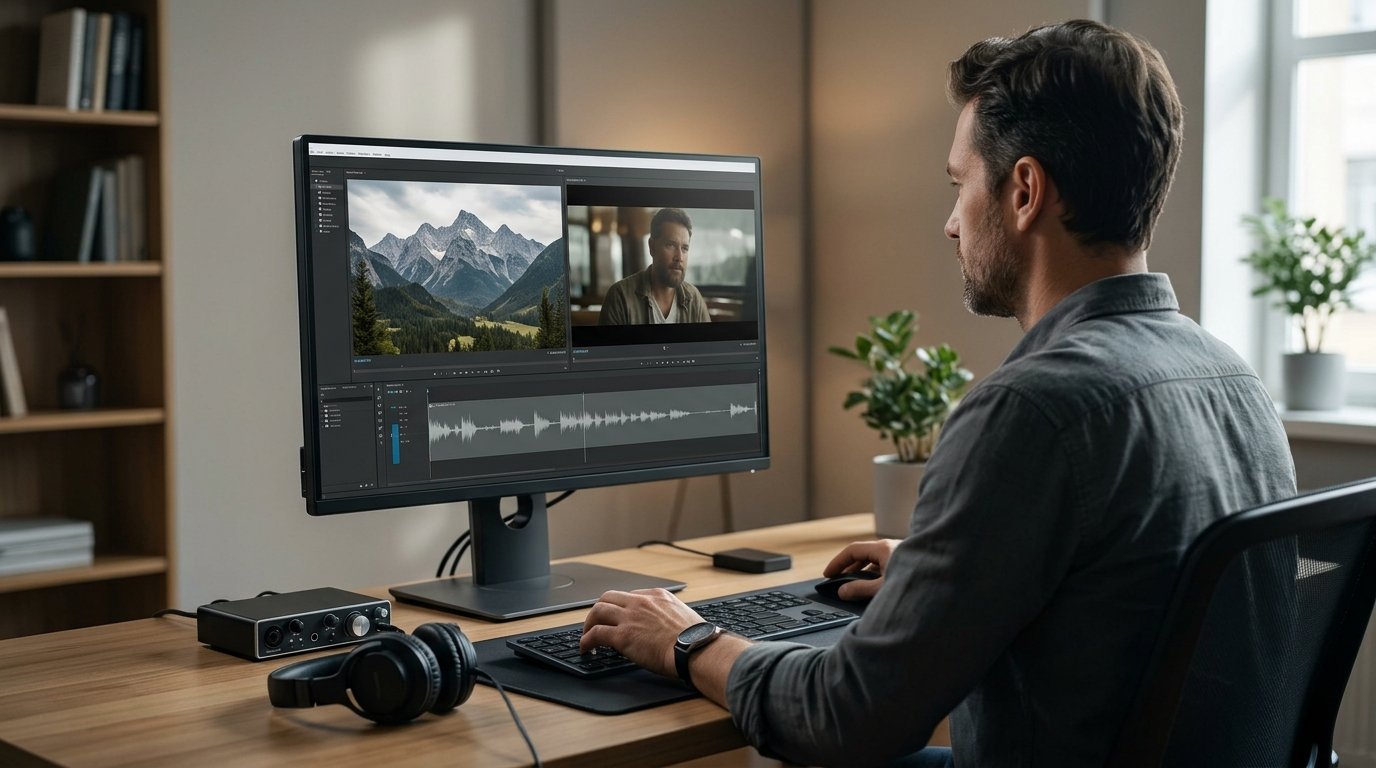
Generative AI media creation is reshaping the production of digital content. Users can create images, videos, music, sound effects, and realistic speech with just a simple written description, even if they are not technically or artistically advanced. These technologies are now starting to be applicable to designers, marketers, educators, businesses, and common creators.
Text-to-image, text-to-video, and text-to-audio systems take in written instructions and generate digital media using patterns they have learnt from training data. While they may create realistic looking results, they are not always accurate. An awareness of the operation of such systems can enable users to exploit their creative advantages, but also acknowledge their limitations, copyright issues and potential misuse.
What Is Generative AI Media Creation?
Generative AI is a type of AI that produces new content, like images, videos, audio and text. Whereas traditional software has a set of instructions to execute for specific tasks, generative models learn patterns from a large set of examples and then generate an output in response to a user prompt.
The process starts by the user stating what they want to achieve. The AI reads the instruction, finds patterns that match and creates text that tries to mimic the description. The quality is dependent on the type of model, the prompt and the complexity of the request. As these systems are pattern-driven, they can produce inaccurate results or some surprising information.
How Text-to-Image AI Makes Images

Data creative AI, AI generation, data experts, artificial intelligence and AI services are all located in West Sussex.Data creative AI is located in West Sussex, as is AI generation, data experts, AI services and artificial intelligence.
The AI technology of text-to-image converts written content into digital images. The user may want to produce a sunset over a mountain, a modern office or a product advertisement with particular lighting and colors. Uses relationships between language and visual features that have been learned to produce a picture that illustrates the directions.
The diffusion models are many of the modern image generators that transform random noise into a structured image. The model learns the inverse of a process that injects noise into visual information during training. It continually calculates how to remove that noise in line with the prompt during generation. There are other ways of generating images as well, but diffusion is an important method.
Visual Composition and Image Quality
Visual composition refers to the way things are composed, from the subject, lighting, colours, perspective, and background. Having detailed prompts can assist users in directing these features through descriptions of camera angles, artistic style, texture, and the placement of objects.
But AI image generation could suffer from inaccuracies in the images, text, or arrangement of objects. Users are expected to check their output and correct it if any errors are found, particularly in the production of educational images, advertising or commercial products.
The process of how text-to-video AI creates moving images.The mechanism of text-to-video AI generating moving images.
Text-to-video systems convert written descriptions into sequences of video. A user can ask for a short video of someone strolling through a city, waves crashing against a beach or a product spinning in a studio. The model produces frames which try to describe the requested scene and movement.
Video production is more complicated than single image production, as the subject/character needs to be consistent with the frame. The characters’ behavior, the objects, the lights and camera movements should be fairly consistent. Some create a video directly from text, others animate pictures or enlarge pre-existing videos. There can be mistakes, such as unnatural movements, inconsistent looks or unexpected transitions.
Motion, Camera Angles, and Scene Design
Specific camera movements, shot types, light, atmosphere and event order can be detailed in the video prompts. For instance, a marketer may want a slow camera zoom-in to a product with a dim lighting background.
Shorter clips can facilitate editing and quality control of complicated scenes. The user is responsible for checking the final video for inconsistencies in the video and for ensuring the content conveys the desired message.
The process by which Text-to-Audio AI creates speech and music.The working mechanism of Text-to-Audio AI in generating speech and music.
Kintari is a website that allows users to sell digital products, services and bookings online.
Instrumental Generator | Free AI No Vocal Music Online helps you create instrumentals with no vocals or lyrics.
The Music Identification Offensive Reshapes AI Audio by Sony.Sony’s Music Identification Offensive Reshapes AI Audio.
Text to Audio AI will convert text into speech, music, and sound effects. These systems acquire patterns in the speech, rhythm, pitch and other features of audio. The user can ask for a lesson narrated, for relaxation of background music or for the sounds of the environment (rain, traffic, etc.).
Each tool is dedicated to various audio functions. There are some who emphasize the speech synthesis, and others who create musical pieces or sound effects. The technology can be used to produce audio directly or produce an intermediate representation that is later converted to audio.
Synthetic Voices and AI-Generated Music
Text-to-speech systems render written texts into audio with various voices, accents, pacing and intonation. They can be used for online courses, advertising, audiobooks and multilingual content. But pronunciation and delivery of emotion is not always natural.
AI music generators can also generate music according to the genre, mood, tempo, and instrumentation. These tools enable creators to play around with background tunes and musical concepts. Users should ensure that audio generated under these procedures is used for commercial purposes in compliance with the licensing conditions and that the audio contains no unwanted artifacts or inconsistencies.
The Use of Multimodal AI for connecting various media.
Multimodal AI allows for systems that can interpret or integrate multiple data modalities (text, images, video, and audio). This enables AI systems to understand the connections between text and non-text elements such as visuals and audio information.
For instance, a creator could write a script, draw sketches, record video clips and add artificial dialogue. Integrated systems may be able to help to coordinate these elements into a more consistent presentation. To learn more, check out IBM’s guide to multimodal AI.
These capabilities extend to education, marketing, entertainment and business communication. However, the users must verify that the pictures made are in line with the narration and the finished material is correct and suitable.
Importance of Well-Detailed Prompts
A prompt is the written direction that a model uses to generate a response. In generative AI media creation, vague descriptions often produce less precise results than clear, specific instructions that identify the subject, style, setting, mood, and other important details. Using detailed prompts can help creators communicate their intentions more effectively and improve the quality of the resulting images, videos, and other digital content.
A classroom image is a loftier request than a description of a sunlit classroom with students doing a science experiment and posters on the walls. Video prompts include movement and camera angles, and audio prompts include musical style, voice characteristics and speaking speed.
Fine-tuning Prompts for Better Outcomes
Prompt refinement is a process of making adjustments to instructions based on the output produced. You may have a designer alter the lighting to suit a different taste, a video creator ask for clarification on camera movement or an audio creator ask for a slower narration.
The key points should be emphasized and the tips and directions should not contradict. Repeated testing, reference images, editing tools can help to enhance results. Even with well-crafted prompts, though, the degree of accuracy and complete control of the final product cannot be guaranteed.
Many creative and professional tasks are helped by the use of Generative AI. Advertising ideas, product pictures, promotional videos, and narration can be created by businesses. Designers can brainstorm ideas fast, and teachers can develop illustrations, animation and audio explanations to aid in learning.
It could also be utilised by independent creators to utilize these devices for experimentation with multimedia projects without needing any comprehensive production devices. But, AI content is not human proofread content. Products need to be checked by businesses, factual information by educators and quality by creators.
Copyright, Privacy and Ethical Concerns
However, generative AI brings in concerns regarding the ownership of the output and copyright issues involving training data that are used. The relevant rules are applicable based on the law, context of use and conditions of the service. Users must check the licensing of AI-generated images, videos, or recordings for free usage instead of taking their content for granted.
Privacy and consent are important considerations in generative AI media creation. Providing personal photos, recordings, or confidential information to an AI service could create risks if the service stores or processes that information in unexpected ways. Using synthetic representations of real people’s faces or voices without permission may also lead to impersonation and other harmful uses. Understanding privacy and consent is therefore an important part of using AI responsibly, protecting personal information, and respecting the rights of others.
Protecting Against Deepfake and Checking Media Authenticity.
Deepfakes: synthetic or manipulated media that simulate real people or events. They can be used for a proper form of entertainment and visual effects, but can also be used to spread misinformation or to give a false impression of what someone has said or done.
It is important for users to check out these sources, find independent reliable reporting and look at the context where it is suspicious. It can help to use reverse image search and/or technical verification, but not in all circumstances.
While AI-generated media can be highly accurate, there is still a need for human involvement to ensure accuracy and quality, especially when dealing with subtitles, sign language interpretations, or other communications that require precise timing and delivery. Key content should be reviewed in the light of reliable evidence before being published or used for decision-making.
The Future of Generative AI
Generative AI is poised to become even more deeply embedded in creative applications, learning, and business processes. Enhancements could allow for easier creation of uniform visual sequences, synced audio, and content creation in multiple languages.
But with their technological advancement, there should always be a sense of responsibility. When synthetic media becomes more convincing, it’s important that there will still be clear licensing, consent requirements, transparency of content, and reliable verification mechanisms. HUMAN JUDGMENT WILL STILL BE USED TO ASSESS QUALITY, ACCURACY AND PROPER USE.
Conclusion
Generative AI generates images, video and audio by identifying patterns and relationships in data and learning them. There are many models of images that are generated using diffusion, models of videos that try to preserve the animation between frames, and models of sounds, music, and speech that are generated. Multimodal AI bridges various media and detailed prompts assist users in directing the content.
These technologies have tremendous creative, educational, marketing, and communication potential. But copyright issues, concerns about privacy, deepfakes and inaccuracies need to be minded. Users can leverage generative AI to improve prompts, review generated content, check key facts, and respect consent and licensing requirements, while minimizing potential risks with synthetic media.