Introduction
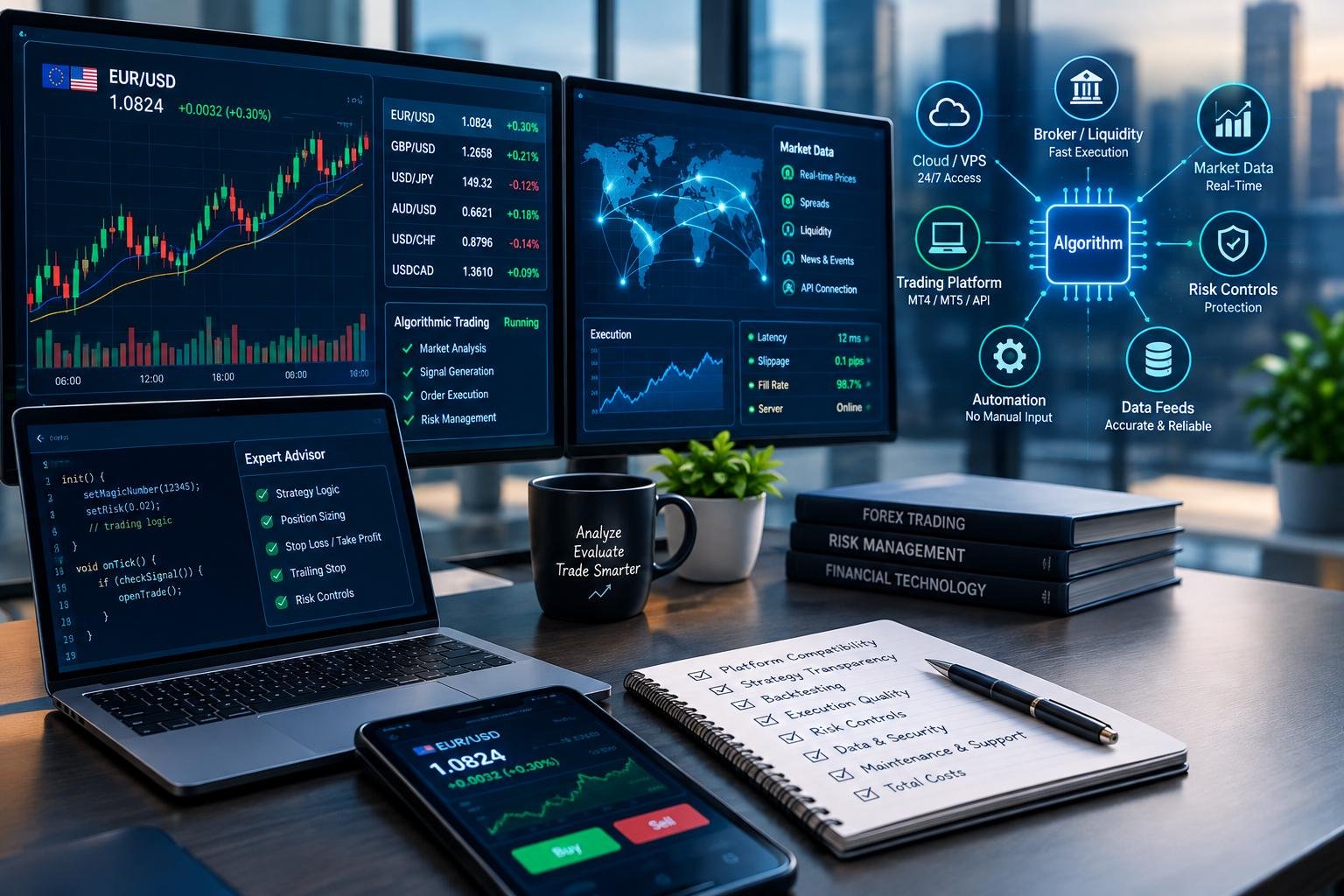
Automated Forex trading technology has revolutionized the way traders engage in foreign exchange trading, enabling traders to rely on software to analyze data and carry out pre-programmed instructions with minimal human interaction. With the increasing popularity of automated trading, traders are faced with expert advisors, algorithmic trading, signal engines, application programming interfaces, and cloud-based trading. These systems can’t be evaluated on the basis of pretty historical returns. A valuable evaluation should involve the workings of the web site, the assumptions the strategy is based on, the way orders are carried out, what dangers are managed, what information the software needs, and exactly the way it performs under altering market conditions. The goal is to get down to a concrete level to decide if a system is technically appropriate or not, prior to relying on it for live trading. An appropriate evaluation should then commence prior to installation and funding.
Ensure Platform Compatibility.
The first is if the automatic system can work in the trading environment that it will be used in. Compatibility is available for a variety of operating systems, broker requirements, programming languages, broker API access, account types, instruments, and permissions for automated-order entry. When it’s necessary to have software running around the clock, traders also need to make sure that the software can be accessed from a virtual private server or cloud environment. Execution might be affected by the server location, platform versions or broker settings. It is important that documentation make the versions supported and any limitations that may become apparent when using a broker clearly known, because a technically compatible system may be failing due to an outdated or limited integration. These issues can be identified by testing the connection in a non-live environment prior to real money. Verify the software is able to communicate with the target broker and account in a realistic manner in a reliable fashion.
Examine Strategy Transparency
Another criterion to evaluate a trading system by is to check on how well the decision-making process of the system can be understood. While it is unlikely that users will be able to discover the entire source code, they should at least be aware of the general logic behind the strategy, as well as when it will get in and out of positions and what the position sizing and risk management rules will be. It is essential for traders to understand the kind of algorithm’s trading method it employs, whether it is trend-following, range-trading, volatility trading, and/or applying technical indicators. They should also make sure that it does not leverage, averages losses, leverages up after losses, or locks in trades on big economic releases. The behaviors are significant because it is possible that certain market conditions are vital to a strategy. Transparency can assist the user to understand where performance is being weaker and if the strategy’s behavior would be able to fit within their own risk profile. Users should also inquire about market conditions that trigger the buy or sell order and if the rules of those conditions will automatically change over time. This allows the system to be easily evaluated prior to deployment.
Use Backtesting as Evidence, Not Proof
Back-testing can be helpful evidence of the performance of a strategy on the past but is not a guarantee of future performance. A viable test should include: Historical period, currency pairs, time frame, Spread assumptions, Commissions, Swap costs, Slippage assumptions, Data source. Traders must differentiate between in-sample period and out-of-sample period when creating a trading strategy and testing it out of the sample, respectively. One way that may help is to repeat testing a strategy on fresh data as it’s optimized and from “walk-forward” tests to get further proof. Another way to view the results is to look at the drawdowns, losing streaks, number of trades, exposure, recovery periods and performance in varying market scenarios. This helps to minimize the chances of focusing on a system’s “headline return.

Unrealistic Results and Overfitting
Overfitting is one of the shortcomings of algorithmic testing. You can tweak a strategy over and over again until it gets to perform really well on a specific time period, but it doesn’t necessarily perform well in other time periods or markets. If the indicators, stop distances, entry points, trading times or position sizes are optimized to the extent that the model fits the historical noise, then it doesn’t work. There’s another issue, unrealistic assumptions. The reverse side of the coin is that the backtest may underestimate the spreads and/or slippage, have infinite liquidity, or place orders at prices that are not available during fast markets. A more robust assessment, then, would require an investigation into the change in results when costs and execution conditions turn out to be less favorable. Evaluating performance at other time periods can identify if there is a narrow historical pattern to performance. Results should be taken with a pinch of salt.
Evaluate Execution Quality
It’s still important to have a profitable algorithm but it needs to be executed well. Automated systems feed into a broker or liquidity provider and the actual deal could be different from the price that is detected when a signal is created. Key factors are: latency, spreads, slippage, order is rejected, partial orders, order types, and the availability of the Broker Server. Traders need to find out where the software and broker servers are hosted, how orders are passed on and if the software keeps track of order execution times and prices. The information gained from comparing expected and actual fills when performing controlled tests, can be more useful than using a backtest alone. Spreads may also widen and liquidity can fluctuate rapidly during volatile times and this should be checked for execution as well. It is important that a useful evaluation takes into account the trading costs the system (or the trading margin) that it is expected to incur when the market becomes less favorable.
Prior to Returning, Review Risk Controls.
Risk management is not necessarily a business that must be done with the profit motive in mind. Useful controls can be: Maximum position size, Stop loss, Daily loss limits, Maximum account exposure, Drawdown limits and Emergency shut off. Traders should be aware of the consequences of a failure in the internet, the broker’s fail, the prices becoming abnormal or the software producing unexpected orders. Just as with leverage, it’s a factor that needs to be taken very seriously, as the amount of profit or loss that can be made with relatively small price swings could be substantial when it comes to large positions. Some strategies involve taking up more exposure following losses, and can result in significant drawdown in extended periods of losses. This should be detailed in a clear risk framework, which would include when the system should ease up or cease activity and trading. Limits are easier to keep in check than vague warnings, especially if the trader cannot keep an eye on all of his positions.
Check Data Requirements and Data Quality
Algorithms are only useful if the information they’re given is accurate. This can be a range of data such as historical prices, tick data, spreads, volume data, economic-calendar events and market-depth data depending on the strategy. It is important for traders to determine data sources, whether they are from the platform, a third-party, or the system developer. They should also see how often they are updated and if it is similar to the broker’s price live. Bad or incomplete data can lead to flawed research and implementation. For instance, bid and ask prices can cause significant price deviations that can impact strategies that require small price movements, and gaps in time can alter the apparent frequency of signals. Document storage and updating requirements, costs of data, and ways to determine missing or damaged data. This is especially true of short-term trading that relies on market data for accuracy.
Account Security and Access to Accounts.
It is imperative to have account security when software can interact with a trading account. The user must be aware of the specific permissions an app needs and if it needs to trade access, username and passwords, API keys, or other sensitive information. If a trading authority can be separated from withdrawal authority, this should be done, and software should not be able to move funds. Avoidable risks can be minimized by using strong passwords, multi-factor authentication, secure devices, encrypted connections and limited permissions to API. It’s also important for traders to understand how credentials are stored and if the provider has documentation that detail their security processes. When purchasing automated software, it is advisable to purchase from trusted sources as it can expose an account or computer to malicious software if downloaded from an unknown source. Check the conditions of permission when software or trading environment is changed. The trading capabilities of a system should not take away more account rights than are necessary.
Evaluate software reliability/Maintenance.
As the technical environment evolves, an automated trading system may get dated, incompatible and unreliable. APIs can be updated by brokers, new versions of APIs can be released, new operating systems can be released, and market structures can shift. Traders should find out if they will receive maintenance, documentation, bug fixes, version histories and support from the developer. Monitoring is also a part of reliability. Users should be able to generate Logs of the signals, orders, errors, failed connection and account activity. Periodic checks are required to ensure software; broker connection, data feeds and risk control are functioning as expected. Having clear support procedures can minimize uncertainty in case of a platform’s failure during a trading session. The financial performance, connection status, software errors, unexpected orders and technical interruptions should be monitored. The user should also have an understanding of what is expected of them in the event of a failure and the time frame he or she can expect for the problem to be resolved.
Understand Fees and Total Cost.
The quoted price of an automated system may not cover the total cost of the system. Subscription, license, platform fee, data feed, virtual private servers, brokerage fee, spread, swap and maintenance fee should be computed by traders. Some services might even have upgrades and performance costs. Trading frequency is important to take into account when considering costs, as a strategy that makes lots of trades can have a lot of spread costs and commission. Both a low cost algorithm and a subscription service can be a burden if not managed carefully, and come with significant technical demands and/or ongoing costs. This will help you get a real sense of the amount of money you are really committing. Don’t just consider the cost or return as advertised; consider the total operating cost. It’s crucial to grasp these costs because a strategy’s gross historical performance can appear to be very good without trading costs, and the net performance may vary significantly.
Similarities and Differences between Historical Testing and Live Performance.
How it performs in the real market is the key to assessing automated trading technology. A backtest is based on past data and market conditions, and assumes a specific way of trading in order to test performance. The trading environment is different when using a live account, as the conditions of the markets, spreads, liquidity, latency, gaps, delays, technical glitches and unforeseen events can all change. This can be done in a sensible way, starting with historical research, then trying in an out-of-sample environment, followed by a demo environment or a controlled live deployment to production, and finally to a wider deployment. During live observation, traders can check if the signals expected and orders, fills, costs, drawdown and technical behavior. Please note that the short-term live results are subject to conditions of the market and should be taken with a grain of salt. While a few successful trades may offer some context, a longer time period will offer more context, but no observation period can remove uncertainty from the equation. If there is any significant difference of tested vs. live behavior, it should be investigated but not just dismissed.
Create a Checklist of Items for Practical Evaluation.
Traders can record their evaluation in a real forex trading checklist prior to using an automatic forex trading system. The platform should be suitable to the broker and account and the logic and assumptions of the strategy should be understandable enough to see how it will work. Backtests should be performed with credible data and realistic costs and separate backtests should be performed to minimize overfitting concerns. Not only should execution be judged by the actual fills, but by the number of fills that are executed as well. Risk controls should set exposure limits, loss thresholds and risk control measures in the event of a technical failure. Also record the data sources, security permissions, maintenance arrangements and the fees for recurring data. In particular, live performance should be checked against the development assumptions. This makes trading less reliant on impressive claims, without considering the circumstances that could have led to such claims, and provides a more structured ground on which to assess automated trading tools.
Conclusion
While automated forex systems can streamline trading processes, making them more efficient, systematic, and less reliant on manual intervention, they cannot eliminate market risks or technical uncertainties. The platform compatibility, clear strategy, quality of testing, execution, risk management, data, security, maintenance and overall cost are key factors in a responsible evaluation. Historical performance should be a statement on past performance, not future performance, not a forecast. By challenging assumptions, testing systems in realistic scenarios, observing real-world performance, and ensuring account security and risk management, traders can make more informed decisions about their technology choices. Critically assess the technology as a whole and not just a bunch of pretty performance figures. A disciplined assessment can assist users in understanding the role the automated tool will play and when the results of the automated tool may not match up to what the users are expecting.
Get more well researched information about Automated forex trading systems here.


