Introduction
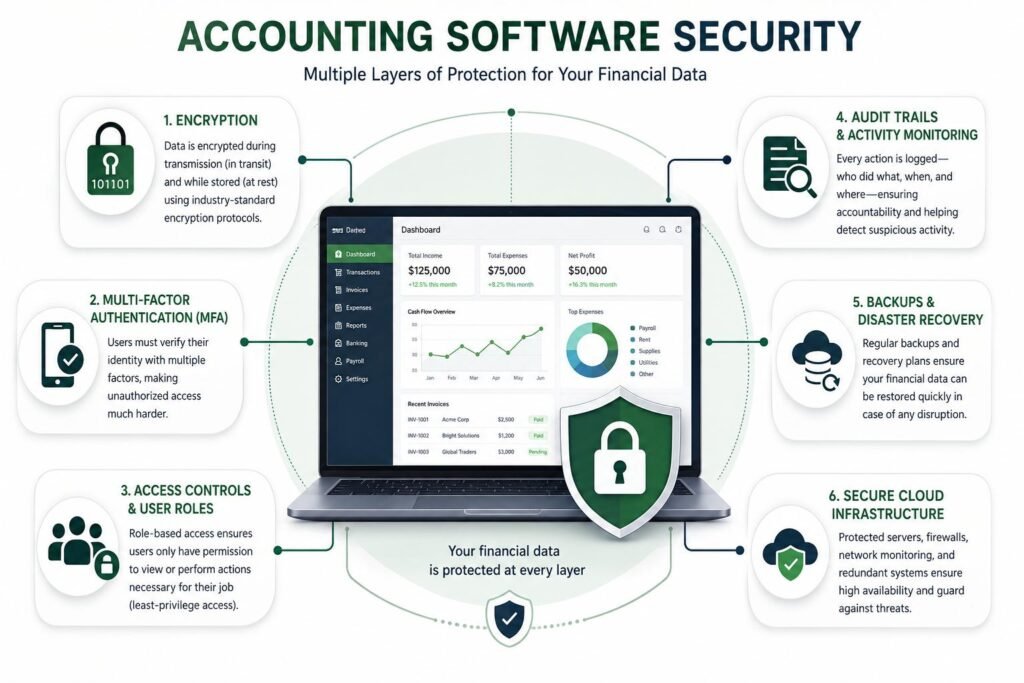
Financial data is one of the most sensitive data that a business will have. A company’s customer information, invoices, payroll information, bank information, tax document, expense information and financial reports can tell a lot about a company and its customers. With the shift of bookkeeping from paper and desktop software to cloud-based applications, it’s crucial for businesses to become familiar with the security measures of accounting software. With the move to cloud bookkeeping, it’s important that companies know about the security of accounting software. The modern accounting platforms have a number of different security features in place, not just one. But, even after reading all of this, businesses should still take some time to research how a provider safeguards data, manages user accessibility, reacts to threats and recovers information if something goes wrong with the platform before entrusting it with their monetary records.
Security is important with an accounting system because if it is a successful attack, then not only will it be an inconvenience in the short-term, but it can have other effects. Financial data stolen can be used in a fraud, identity theft, or for other types of financial crimes. A hacked account might also enable the individual to alter invoices, modify payment details, delete documents, or entry into private information regarding staff and consumers. Downtime and investigation, legal requirements and damage to reputation can be costly even if the attack does not cause permanent damage to data. So, businesses should not only consider the features of the software that will help those invoice, report and track expenses, but also consider a more important question: How well does the software safeguard the data residing within it?
Importance of Accounting Software Security
If it gets into the wrong hands, the information in accounting software can prove useful to cybercriminals and of great disadvantage to businesses. Records may contain names, addresses, bank information, tax identification numbers, business performance statistics, credit information, transaction histories, supplier information and salary information depending on the platform and organization. The system can also integrate with bank accounts, payment gateways, payroll software, CRM systems and more. That’s an interconnected world that means security is an important factor when it comes to software selection.
Security is also the maintenance of the three basic qualities of information – confidentiality, integrity and availability. Confidentiality is the ability of only those who are designated by authority to have access to sensitive records. Integrity – Financial information is maintained in an accurate and cannot be altered inappropriately. Availability – records are accessible to those with a right to them when needed. All three areas should be addressed by a robust accounting platform, using technical controls, secure infrastructure, monitoring, backup and appropriate user permissions. Companies need to evaluate the security of their system as a continuous process, and not as something that can be turned on at the time of the setup.
Using Encryption in Safeguarding Financial Data.
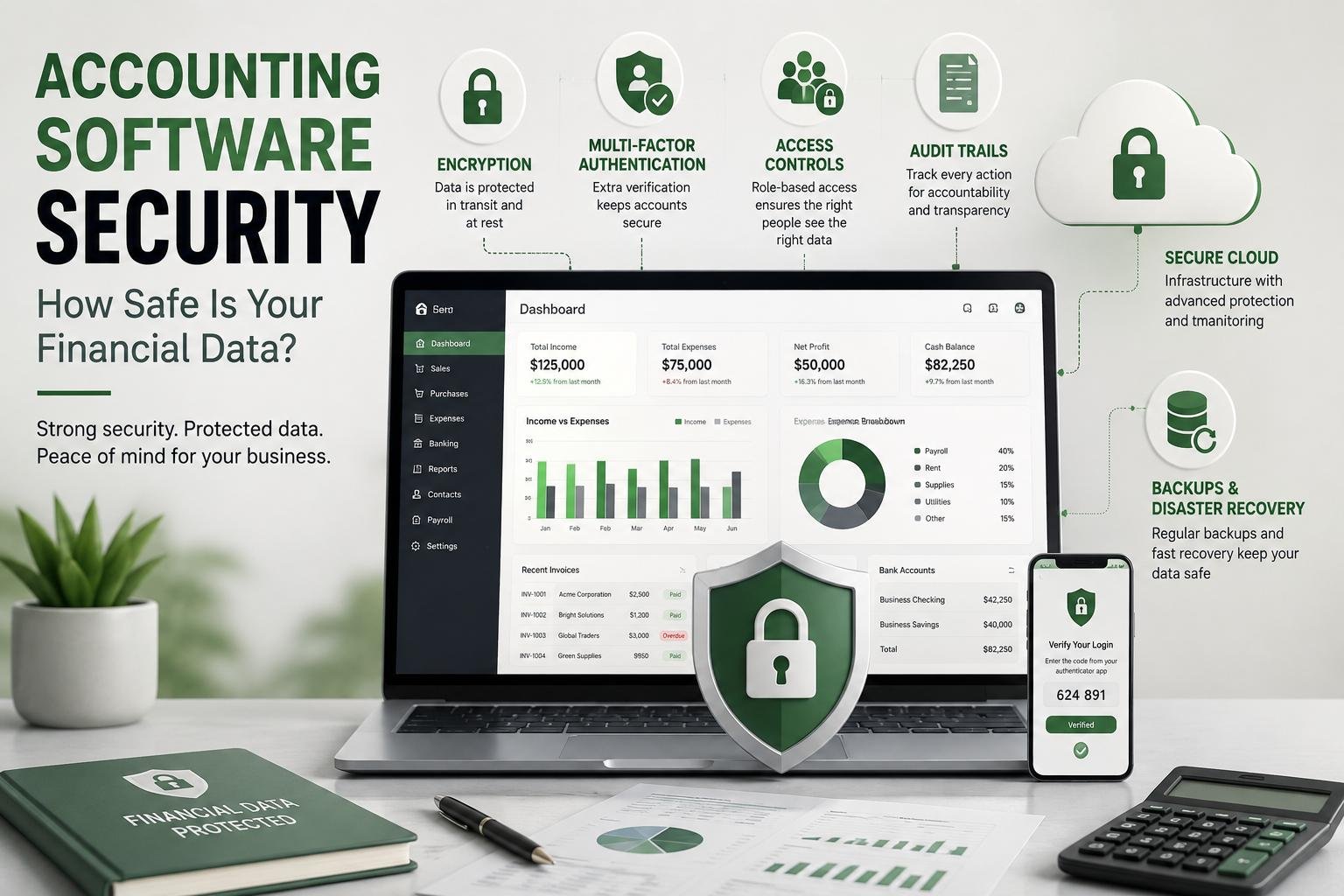
One of the most crucial technologies to safeguard information in modern-day accounting platforms is encryption. It converts data that can be read into a code that can only be read with the proper decoding device. If the information is encrypted, the unauthorized party who intercepts or gets hold of the protected information may not be able to read it.
Most accounting platforms have to safeguard data both during transmission and storage. When the information is traveling from a user’s device to the accounting platform’s servers, encryption in transit is used to help protect the information. This is especially vital if staff log on to financial documents via the internet. Encryption at rest is the protection of data stored in the database, on storage systems, servers etc. When businesses are considering accounting software, they should therefore inquire of the software company about the type of encryption that is used, where it is being used and how encryption keys are managed.
However, there are still a number of security risks that cannot be eliminated by encryption. If the employee’s account is compromised, for instance, an attacker might have access to information that is readily available to that account. This is why encryption needs to be used in conjunction with authentication, access controls, monitoring and more. However, robust encryption offers a valuable deterrent to anyone who would steal financial information that is stored or transmitted.
Multi-Factor Authentication (MFA) and Authentication
Authentication is used to establish the identity of a person trying to access an accounting system and whether he or she is an authorized user. The traditional way is the user ID and password, but passwords can be susceptible to the tricks of phishing, reusing passwords, guessing passwords, and stealing credentials. MFAs, also known as multi-factor authentication, can be enabled by modern accounting platforms to enhance authentication.
Multi factor authentication means that a user needs to provide multiple means of authentication to get access. User can type in a password; then confirm the identity by using an authentication application, security key or any other acceptable means of verification. The extra authentication factor can make it much harder for a criminal to access if he or she does get the password. For businesses, it is important to choose an accounting platform which offers the option of MFA, and to ensure that users are using it, particularly those with administrator access and those who have access to sensitive financial data.
Another aspect that organizations should look at is the treatment of the platform’s password policy, login sessions, account recovery and suspicious login attempts. Additional protection can be offered through features like automatic session expiration, login notifications, and device recognition and controls on failed login attempts. The authentication should be robust, but not so complex that staff will start to take shortcuts with security.
Access controls and User Roles
You don’t have to give all employees access to all of your finances. Access controls can be used to restrict the ability of various users to view, create, edit, approve, or delete. This is referred to as least-privilege access, where users are granted only the access rights they need to do their jobs.
For instance, an employee who enters supplier invoices might not need to be given access to company-wide accounting settings or to access payroll data. The manger may be able to approve the expenses but may not have access to make changes to system security settings. Admin users may need more access, but should be given extra security, as they can have a potentially significant impact on a lot of financial information.
An accounting software should allow you to have multiple user roles and set permissions accordingly, if needed. These permissions should be reviewed regularly by businesses, especially when employees are promoted or transferred or are leaving the company altogether. Old staff members should have their access revoked in a timely manner and nobody would want to have their account active for years, if ever. Well implemented access controls minimize the risk of damage arising from the loss of access control or from a simple error.
Ensuring that the Traceability of everything is Preserved and all Activity is monitored.
A set of records showing key events that happened in an accounting system is the audit trail. It can display information about who created, modified, approved or deleted a specific record, and the date of the action. This means that there is accountability and it can assist businesses to detect unusual or unauthorized behavior.
Financial systems may be the one that benefits the most from audit trails, as they can be the basis for internal review, external audits, investigations for taxes, or perhaps regulatory needs. An audit trail can be used to identify the reason and/or the account that caused an unexpected change in a transaction. It may also dissuade from engaging in inappropriate behavior as users are aware that some important activity could be captured.
Before implementing, companies need to take the time to see how comprehensive the software’s audit logging is. A beneficial system ought to offer valuable records, not just an indication that an account was accessed. Organizations should also decide on the duration of the audit records, who will be able to access them and whether the administrators can modify and delete these records. Alerts for suspicious activity are helpful when monitoring to investigate.
Backup/Disaster Recovery
Security doesn’t just have to mean preventing unauthorized access. Companies need to also be ready for data loss due to hardware failure, software issues, human error, hacking or other unforeseen issues. Backing up and disaster recovery measures ensure financial data can be recovered in case of disaster.
Cloud accounting providers often have backups to safeguard customer information and aid with service recovery. But it is not a business rule that just because the term “cloud” is used its data is completely protected. They should inquire about the frequency of backups, backup copies’ durations, if backup copies are secured from unauthorized access, and the speed of data restoration.
Recovering procedures are also crucial. Backups can be in place but it can take a long time for a provider to rebuild systems following a large incident. Therefore, companies need to look into the provider’s business continuity/disaster recovery policy. The ability of the service to resolve outages, data corruption and other disruptions can give a company the ability to determine if the service can meet its operational needs.
Secure Cloud Infrastructure
Cloud based accounting software can rely on infrastructure such as the servers, databases, networks, storage and more. This infrastructure is important in terms of security and can directly impact the security of customer information. Layered security is generally a hallmark of the providers that are reputable: network monitoring, firewalls, access restrictions, vulnerability management, system updates and controlled data-center environments are all key elements of layered security.
Businesses should look into the location of their provider’s data centres and whether their provider has a relationship with other cloud infrastructure providers. They should also try to find out about independent security testing, known security standards, compliance programs and ways of finding and fixing security weaknesses.
Redundancy is an important component of a secure cloud environment. In case of the failure of a server, the system must provide some facilities to ensure its availability or restore the service. It’s important for businesses to keep in mind that there’s a shared responsibility for cloud security. The provider uses their security infrastructure to protect the infrastructure, and the customer is responsible for protecting user credentials, setting access permissions properly and for safe security practices.
Regularly Updating Data to safeguard it
The risks associated with cybersecurity are always changing and accounting software should be regularly maintained in terms of cybersecurity. Patches can be released to fix newly discovered vulnerabilities, which can be an addition or enhancement of the existing protection, and to enhance the system’s reliability. Older versions of software may have been developed to mitigate risks faced by businesses that are still running the old versions.
Security patches may be a benefit for cloud-based platforms as the provider is responsible for updating them, as opposed to all of their customers. But, the organization should still have an idea of the process that the provider uses to update. They should have questions such as: Are security patches applied in real time, how are the vulnerabilities addressed and do customers get notified of major security incidents or changes?
Businesses need to also maintain connected apps secure. The integration with the third party can be insecure, adding to the risk of an accounting platform being well protected. Companies should carefully review the data being shared and the permissions granted to the integration prior to connecting banking, payroll, payment and/or business-management applications.
How to Determine the Security of Accounting Software.
Businesses should not overlook security when making the decision to choose an accounting platform; security should be considered as a part of the purchase process. The first step would be to check the provider security document and know what technology and security measures are implemented. Check for comprehensive details regarding the encryption, authentication, access management, backups, infrastructure protection, monitoring and incident response capabilities.
Then, check the platform’s administrative measures. Check if the software has multi-factor authentication (MFA), role-based permissions, monitoring user activity, and secure account recovery options. Think about setting up access logs and if they can be easily done to remove and change users’ permissions.
Another point of consideration is the security history of the provider, and their reputation. Independent certifications, security audits, compliance information and transparent documentation can be helpful in showing the security practices in place at a provider. Certifications should not be seen as a guarantee that all aspects of the service are risk free, however. A company should take into account the provider’s controls and how they align with their risk appetite and needs.
Lastly, examine what the company is responsible for when it comes to customers. There is always a risk of getting compromised even with the utmost secured accounting software if the security measures are not used properly, if there is a lack of proper securing of the software user credentials, users are issued with too much permissions, there is a risk of phishing, and the integrations are not properly configured. Both the software provider and organization using the system should therefore be included in security.
Best Practices for Companies with Accounting Software
After businesses have chosen accounting software, it is imperative that they put in place practical security procedures. All employees should use their own username or password and not share. Strong passwords should be used and, if available, multi-factor authentication should be used. Basic cyber security training should also be provided for employees, to identify suspicious emails, logins, attachments, and requests for financial information.
Review users’ permissions periodically. If the person moves into a new role, access should be modified to suit the new role. If an employee is terminated, his/her account should be disabled on the spot. Periodic checking of connected applications and unnecessary integrations should also be done to eliminate them.
By regularly reconciling and reviewing financial records, an additional security can be created. A sudden change in the bank details, invoice details, expenses or transactions should be investigated immediately. One of the benefits of using audit trails is that they can help determine the nature of the change and who had access to which account. They integrate technology with human control, offering enhanced security measures.
Conclusion
While convenient, accounting software needs to offer you strong tools for financial information management, without compromising security. Today, such platforms are layered with security measures such as encryption, multi-factor authentication, role-based access controls, audit trails, backups, monitoring, secure cloud infrastructure and more. Combined these technologies minimize the risk of unauthorized access, data loss, financial manipulation and extended service disruption.
Therefore, security should be assessed on an accounting platform prior to the problem, and not after it occurs. Providers should ask the questions below to see how they handle these things: what steps do they take to encrypt information, protect accounts, secure infrastructure, back up data, monitor activity, respond to incidents, and manage vulnerabilities. Meanwhile, businesses have to be aware of their own obligations by implementing robust authentication, restricting access, monitoring user activity, and securing integrations and educating staff.
No system of accountings can prevent all cyber threats. It is important to select a platform that has robust, clear security measures and to employ them appropriately. Integrating security into the software-selection process enables businesses to reap the rewards of digital accounting, while simultaneously taking matters into their own hands to ensure that their financial data stays both confidential and accurate while being readily available when necessary.
Get more well researched information about Accounting software security here.