Introduction
Real Estate Investment Trusts (REITs) are trusts that handle a variety of real estate portfolios that can include hospitals, industrial, warehouses, office buildings, shopping centres, residential apartments and other real estate types. Efficiently managing these resources involves having these in good financial order, knowing who they rent to, and monitoring maintenance and reporting on them from each location. Without systems or automation, these tasks can be time-consuming, costly and challenging to measure the performance of the portfolios. Hence, property-management technology has become a critical aspect of today’s property business. A suite of integrated software platforms allows REIT managers to consolidate key data, streamline repetitive tasks, streamline workflows and improve their ability to monitor performance. These digital tools will help organizations keep their assets secure, make better-informed investment decisions, and enhance their tenant experience while also being used day to day to help them run their business.
The Essence of Property Management Software in REITs
Property management software is any software used to plan the administrative, financial and operational tasks involved in managing or owning a property. For REITs, these systems can be especially useful as the same company can manage hundreds of properties, thousands of tenants and a plethora of service providers in multiple geographic regions. Managers can get the information they need from a single system, rather than having to keep multiple spreadsheets and databases, that are not connected. Users can check lease agreements, monitor rents, allocate maintenance chores, take care of costs, and generate performance reports on various platforms. Some options also incorporate accounting software, facility management systems, customer relationship management (CRM) and investment analysis software. These functions are combined in a property management platform, which helps eliminate information gaps, enhance coordination and create standard operating procedures for a large real estate portfolio.
Property Management Software for REITs and Key Features
1. Communicate Effectively with Tenants and Manage their Affairs
Tenant management software enables REITs to keep track of the tenants, their leases, contact information, payment records, complaints, and service requests in an organized fashion. With residential and commercial properties, these features can directly affect occupancy, rental income, and the overall performance of the properties in the long run, as they have a direct impact on the relationship with tenants. A central system allows authorized employees to view up-to-date tenant data without having to ask for it from various offices. Occupants can often use tenant portals to make maintenance requests and get announcements, access relevant documents, and communicate with the management teams. The automated reminders can remind tenants of upcoming rent payments, lease renewals, or scheduled inspections. These features contribute to effective communication and streamline administrative processes, empowering property managers to better address tenant needs in a timely and dependable manner. Combined data on complaints, resolution times, and tenant satisfaction can also help REITs pinpoint any repetitive issues and work out ways to increase tenant satisfaction.
2. Smart Home Security Systems
Collecting rents is essential for the performance of a REIT, as rents are the key drivers of a REIT’s operating expenses, debt obligations, distributions, and investments for the future. Property management software can send out reminder emails to pay rent, track payments and receipts, mark overdue accounts, and provide outstanding balance reports. These tools can be integrated with banking and accounting software, minimizing manual data entry and helping to better align expected rental income with the actual collections. They can see the status of arrears at the individual property level and look at trends over the portfolio at a glance by finance departments. Other platforms may even offer online payment features and automatic receipts to facilitate transaction process for tenants. But that doesn’t mean financial controls are superfluous when it comes to payment automation. It’s important that REITs have the right approval processes, safeguard payment data and make sure that software records align with bank statements. The measures are taken to ensure the financial reports are accurate and collection problems are identified prior to their becoming significant to cash flow.
3. Efficient Maintenance Scheduling and Work Order Management
With maintenance management software, REITs can manage repairs, inspections, preventive maintenance and service requests at various buildings. If a tenant detects a leaking pipe, malfunctioning electrical components or any damaged entrance, the system can generate a work order, assign the work to a tech that is appropriate, set a time frame, and monitor the work until it is done. Managers are able to identify priority problems, track contractor work, and keep track of labor, materials and repaired work. Preventive maintenance features are also crucial as they enable routine maintenance to take place prior to equipment failures, thereby avoiding interruptions to production. Lift and heating systems, fire safety and air conditioning units can, for instance, be tested regularly to minimize the risks of sudden breakdowns and costly emergency repairs. This will allow REITs to streamline the maintenance records and track any property that is having a high number of repairs, review recurring equipment issues and make better informed decisions on capital expenditure planning. This method helps achieve asset reliability, safety for the tenants, and more reliable operating budgets.
4. Administration of leases and Contract Management
The lease administration software will assist a REIT in the administration of their rentals and with their tenants’ agreements. The terms of commercial leases can be complex and include rent increases, lease renewal terms, rent-free periods, service charges, insurance obligations and maintenance obligations. Keeping track of these details manually in a large portfolio is risky as it can lead to missed deadlines, wrong billing, contract disputes, etc. A digital platform holds the lease paperwork, schedules significant dates and alerts on lease renewals, lease expirations, and rent adjustments. It can also be utilized to help managers compare lease terms, find out about upcoming vacancies and track contractual obligations. Lease data can aid finance teams with financial forecasting and reporting. However, it is important to note that software should be used in conjunction with professional review, rather than in place of it. Legal experts and accountants need to be able to validate intricately drafted contracts, approve adherence to the accounting principles and ensure that the data in the accounts are matched with the signed deals.
5. How to Account, Budget, and Manage Expenses
Integrated accounting features integrate property transactions with overall financial management. These systems can track income generated from renting out, operating costs, vendor bills, utility costs, property taxes, insurance costs and maintenance costs. Actually, the manager of REITs can see how much they’ve spent compared to their budgets and dig into odd expenditures, examine the financial gains of individual assets, etc. Consolidated reporting also enables corporate finance teams to integrate multiple properties data together and keep track of the financial status of each building. Other features might include accounts payable, accounts receivable, integration with general ledger and financial reporting requirements, depending on the software. These capabilities can be particularly valuable if properties are under various ownership and/or reporting structures. REITs need to develop uniformity in accounting processes, access authorization requirements and regular reconciliation exercises to get reliable results.
Centralized Systems offer Several Advantages to Portfolio Coordination.
1. Unified Information Across Multiple Locations
One of the biggest benefits of the property management software is that it can store all of the information regarding the properties in different cities, states or countries in one place. If there’s no platform in place, regional teams can have their own records, along with different reports, and find it hard to update corporate management. A centralized system provides a shared information landscape in which authorized users can access tenant data, lease data, financial data, maintenance data and operational data reports. The regional managers are able to oversee the activities in their specific region, and the senior managers are able to monitor activities on the entire portfolio level. Standardized workflows also help to guarantee that similar tasks are performed in the same way, no matter how the property is situated. Systems can support currency, tax and language variations and local regulations if needed. Centralization is not synonymous with giving everyone access to all records; it’s important to keep role-based access to records. If set up properly, a shared platform can enhance collaboration, boost accountability and enable REITs to manage their operations more efficiently without sacrificing asset visibility.
2. Compliance Level, Document, and Manage Risks.
REITs have to observe various building laws and safety standards, environmental laws, contractual leasing obligations, and financial reporting requirements. Compliance is facilitated with the help of property management software as it can store relevant documents, keep track of inspection dates, record maintenance actions, and remind of important dates. For instance, a portfolio manager could track fire safety checks, equipment checks, insurance renewals and contractor documentation for a number of properties on the system. Record keeping is centralized, which facilitates proving that necessary activities have been carried out, and helps identify pending activities. A few platforms also have activity logs that record who made a modification to a record or who approved a task, ensuring accountability and enabling internal audits. But there are differences in the compliance possibilities among the products, and software alone is no guarantee of compliance. REITs are required to verify local requirements, keep accurate records, review alerts automatically generated and make sure responsible employees perform in accordance with procedures. Effective documentation can mitigate risks during operations and enable organizations to better meet expectations when inspecting, contesting and being audited.
3. Reporting and Analytics in the Property Sector
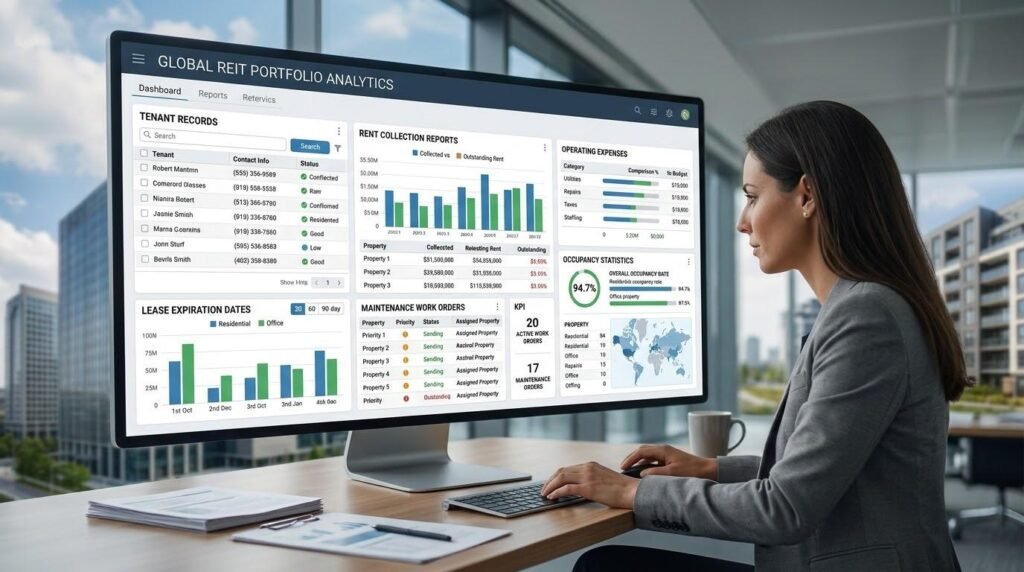
Reporting dashboards are tools that will transform operational and financial data into something that managers can use to assess portfolio performance. Some of the most common indicators are occupancy rates, rental income, collection rates, operating expenses, maintenance costs, tenant turnover and lease expiration. A Dashboard can indicate that a property has an increasing repair cost and another has a decreasing occupancy or an increasing collection lag. Managers can explore the discrepancies and decide if there is a need to take any action. Portfolio-wide reports also enable executives to compare assets, measure regional performance, track budgets and select assets that need more focus. Higher level platforms can include forecasting features which predict future cash flows, upcoming lease expiries or unusual spending patterns. The value of these insights is reliant on the accuracy of the source data and uniformity of the definitions of performance indicators. Standardized reporting means REIT decision makers leverage consistent data to make decisions rather than waiting for departmental reports or having to work with multiple spreadsheets with different data elements.
Selecting the Proper Property Management Software
REITs must consider their portfolio size and mix, complexity of operations, and long-term goals when making the decision on which software to use. For residential apartment management companies, tenant portals and automated rent collection, are important features along with high-volume maintenance requests. A commercial REIT will likely focus more on managing the lease terms, complex provisions, service charge calculations, expense recovery, and/or lease term end predictions. For organizations with a range of properties, a flexible enterprise platform that can manage different types of properties and is compatible with existing accounting or investment management software might be necessary. Some factors to consider include implementation, subscription fees, data transfer, employee training, customer support, cybersecurity, and scalability. REITs should find out what the critical issues are and determine if the platform could solve the issue before buying the platform. Usability and integration problems can be identified through pilot programmes, before the system is rolled out organization-wide. Not all software has to be the most extensive and rich in features, it just has to be the software that makes the most tangible improvement in accuracy, efficiency, visibility and cost control.
Challenges Associated with Putting Property Management Software into Practice
While digital platforms have many benefits, implementing them can be challenging if organizations do not appreciate the effort required. When moving data from spreadsheets, legacy databases, and paper records, it’s possible that missing documents, duplicate tenant profiles, or reports with inaccurate financial data will be discovered. Reporting accuracy can be compromised even if the software is functioning properly, because of poor-quality data. Staff can also be reluctant to implement new procedures, especially when old procedures are replaced by automation. These challenges can be mitigated by implementing structured plans, training employees, verifying data and communicating the need for a new system. Along with these aspects, cybersecurity is also important as property management platforms may have personal information, payment records, lease agreements, and sensitive business data. Reducing exposure is possible with appropriate access controls, multi-factor authentication, encryption, backups, and with vendor security assessments. Organizations should also have alternate plans for if their system goes down, and periodically check to see if the platform still fulfills the needs for them.
How the REIT will be Managed in the Future using Property Management Software.
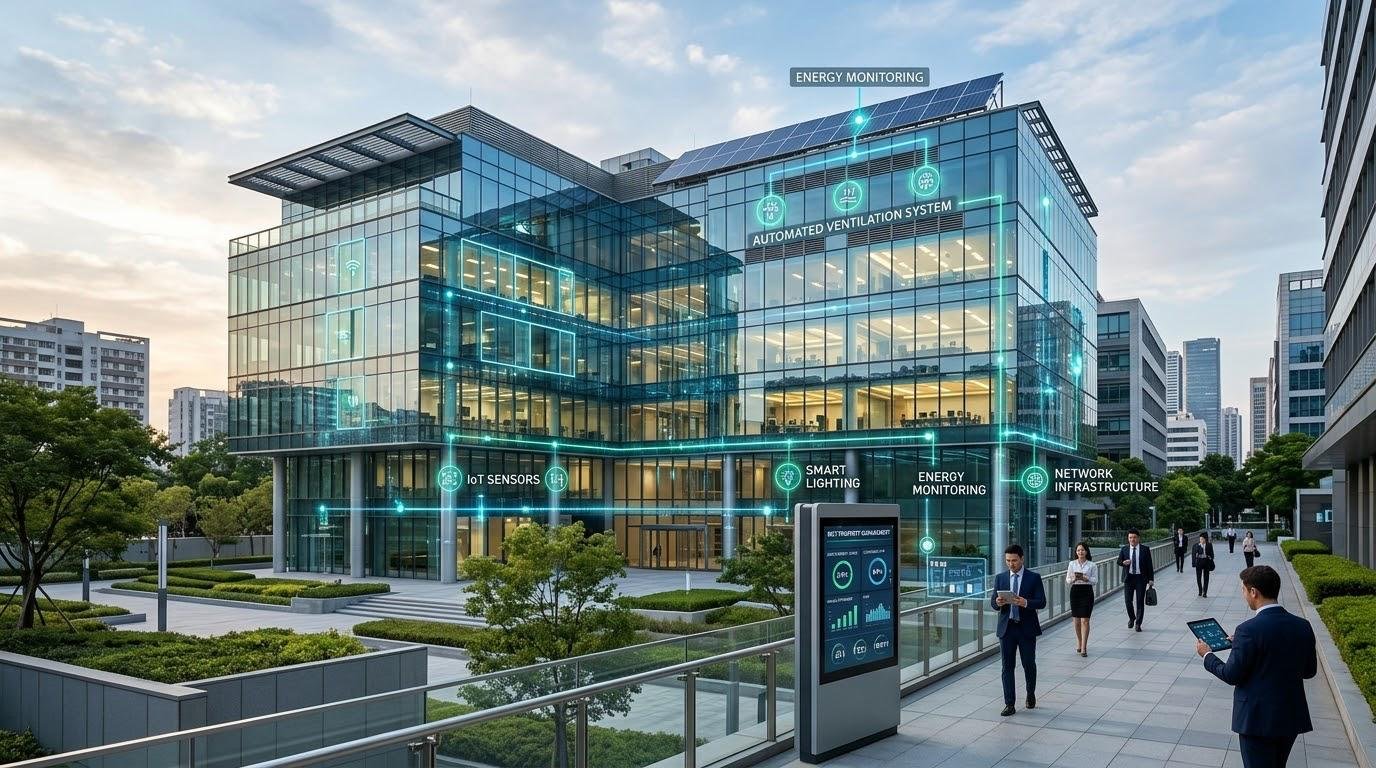
Property management software is being increasingly linked with AI, cloud computing, IoT devices and advanced analytics. These technologies can augment the traditional management systems with the scope of data to give more timely information on the performance of the building and its financial aspects. For instance, sensor information can be used to detect any anomalies related to energy consumption, while predictive maintenance can alert on equipment that needs attention. AI can help with document processing, tenant communication, expense analysis, forecasting, and other areas, but these recommendations need to be properly managed. Cloud-based solutions can also be used to provide access to information to authorized teams at any location, even without relying 100% on local office systems. As these capabilities grow, REITs will have larger opportunities to link how they operate a property with how they invest in it. Reliable data, secure integrations, clear governance and realistic expectations of what automation can achieve will be vital to the success of the adoption. The best technology does is to augment professional judgment not replace it.
Conclusion
In the modern world, property management software is emerging as a valuable tool for REITs in managing their complex real estate portfolios effectively. These systems offer features such as tenant management, rent collection, maintenance scheduling, lease administration, accounting, compliance, and performance reporting, all of which come together to coordinate activity on various properties and locations. A single information source eliminates administrative duplication, enhances communication, provides better financial oversight and makes it easy to detect operational issues. However, the best of software is always best when backed by accurate data, trained employees, effective security measures, and clearly defined procedures. REITs that can implement technology that support and advance their property portfolios and business goals will enhance their operation on a day-to-day basis and establish more favorable conditions for long-term asset performance. Even as technology evolves, integrated property management systems will continue to be useful in achieving operational efficiency, meeting tenant expectations, complying with regulations, and meeting investment objectives.
Get more well researched information about Property Management Software for REITs here.