Introduction
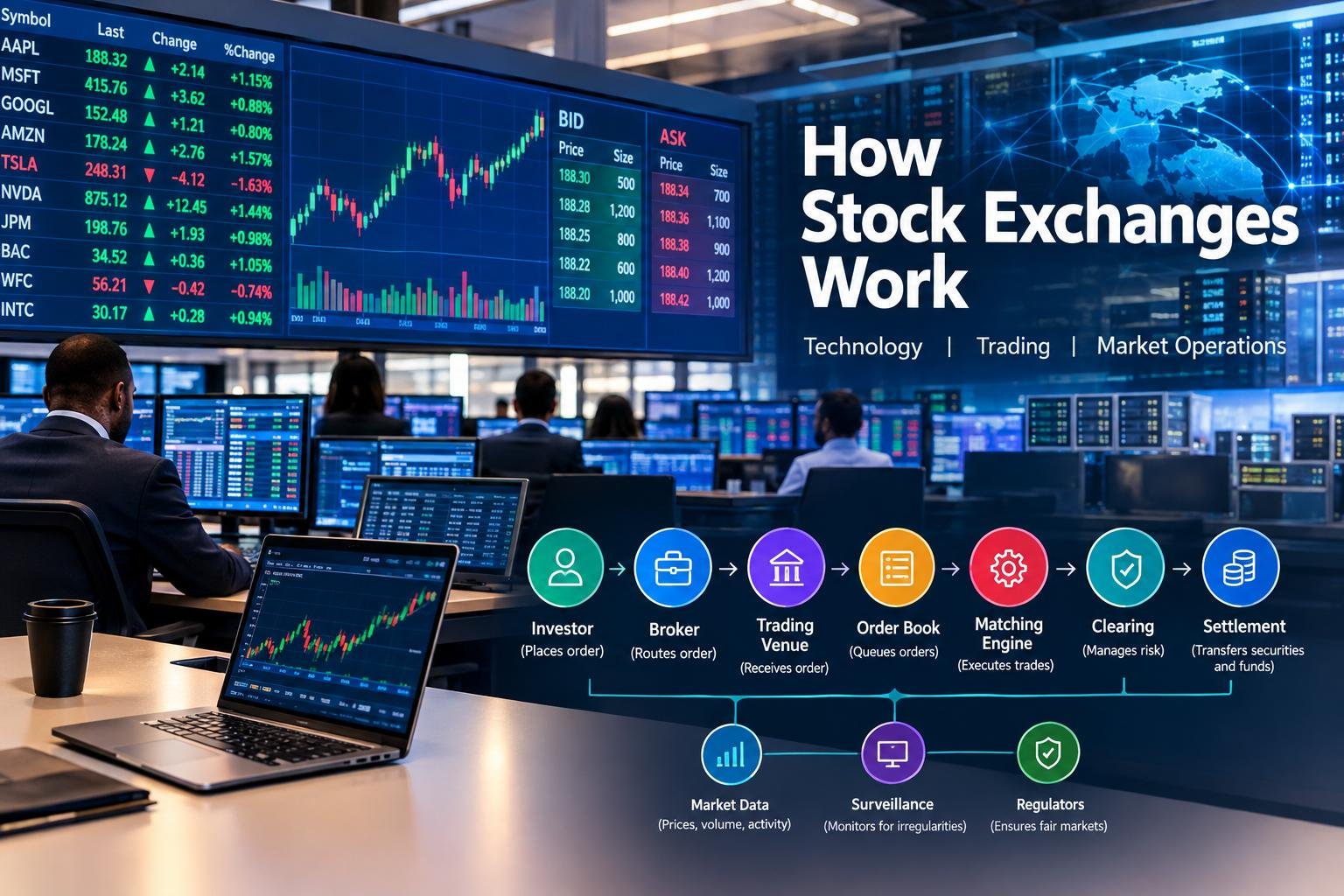
A modern stock exchange is more than a building in which traders used to meet to give out buy or sell orders. In major markets, orders are placed in nanoseconds, and important software, networks, databases, financial institutions and automated controls are all interwoven into each other. An investor starts this process when he or she chooses to purchase or sell and gives the instruction to a broker. The order then flows through an electronic trading market where it is held, prioritized, matched, confirmed, cleared and settled. Therefore, it is helpful to have a basic understanding of the electronic trading platforms before proceeding, as they are the platforms where orders are placed. While the purpose of all exchanges is similar, exchanges vary in design; the goal is to enable the assembly of buyers and sellers under rules and to keep the marketplace orderly.
How to Manage your Money with a High Level of Confidence
An investor doesn’t typically get on the stock exchange directly. The investor, however, submits an order through a broker, who can serve as an access point via a mobile app, website, terminal, telephone or other means. Order is to provide instructions like security, quantity, direction and type. In a market order, you expect to sell or buy right away at the price you’re offered, while a limit order will designate the highest price you are willing to pay or the lowest price you are willing to accept. The broker takes the instruction, verifies the account condition and sends it to a trading venue that is suitable. The broker can different marketplaces send it to an exchange or other liquidity provider. The brokerage layer is an entity that converts an investor’s request into a standard electronic message, which the market infrastructure can process.
The Electronic Trading Environment
The order, when it arrives at a trading venue, is picked up by some specialized electronic systems. The trading platform of an exchange enables its participants to exchange messages, keep records, share information and implement technical regulations. Such systems have to process very large volumes of messages without losing orders. They must also have backup power, backup servers, secure communications, and backup plans since their outages could impact participants. Today’s exchanges, for this reason, employ sophisticated computer networks and data centers instead of a single computer. In certain markets, a central exchange mechanism is utilized; others utilize a number of interconnected venues. The technology does its work in a predictable way: Messages are checked, orders are given identifiers, time stamps are captured and events are captured and saved for reconstruction. While speed is important, the ability to conduct the fair market in a reliable, consistent and controlled way is also crucial.
Understanding the Order Book
The order book is the primary features of electronic trading, keeping track of all the orders that stand waiting to be executed. Buy orders are “bids”, and sell orders are “asks” or “offers. The book is structured by the rules of the market, and sometimes the one with the best price is given the highest priority, or the one who got to the transaction with the best price. Normally, if multiple investors are placing an order at the same price, the first order placed will be fulfilled before the second order. Prices and quantities are visible on either side of the visible portion, but some markets and order types may hide information. The order book evolves as orders are placed, cancelled and revised and trades are made.

How the Matching Engine Trades.
Matching engine is particular software that is used to decide the timing of buy and sell orders that match. It will use the matching algorithm of the exchange to place orders in the exchange. With a typical price-time priority system, the lowest price gets the highest priority, and the earliest order at that price gets the next highest priority. If a buyer is willing to pay the same price that a seller will accept, then the matching engine can generate a trade, decrease the remaining quantities, and add this to the order book. There can be multiple executions of a single instruction, when there are large orders that match several smaller orders. The engine has to act in the same way for all participants in order to give them the proper treatment required by the markets. Execution data is communicated to relevant systems after match, such as brokers, market data infrastructure.
Market Data: Converting trades to information.
A stock exchange is not only a facilitator for order matching within the market; it is also the originator and disseminator of information in the market. Market-data systems gather data on orders, trades, prices, quantities, and other events, and pass approved data on to brokers, investors, financial websites, professional traders, regulators and others. Real-time feeds provide the current price at which trades are being executed, trading volume, bid and ask price levels and more. Historical databases provide a record of past transactions and events to analyze and report on. Many securities can trade at the same time, and data systems need to be able to handle large streams of data, with accurate data and consistent timestamps. Exchanges can offer a variety of feeds for public and professional purposes. Market data is important because they need it to make investment decisions, order management for the brokers, and market surveillance for the regulators.
Clearing: Identifying who owes what.
When an order is matched a trade is executed, but the transaction itself is not complete. The next step is “clearing” which establishes trade commitments and mitigates risk of failure of the participants. Where appropriate, eligible markets can have a clearing house or central counterparty position between buyers and sellers such that the clearing house or central counterparty acts as the buyer to every seller and the seller to every buyer. This can streamline obligations since participants’ obligations are settled in the clearing system instead of with the various counterparty exposures. Clearing processes may determine net positions, take in required collaterals or margins and also perform risk-management processes. There are different arrangements for different markets and securities. Clearing is not matching, matching is the determination of a trade, clearing is the process of organization and management of financial obligations that a trade has created.
Settlement: The Transaction Process
The Settlement is when the agreed exchange of assets and money is finished. When stock is bought, the buyer is given the stock and the seller is given the money, minus the market and settlement regulations. Securities are usually settled electronically in a central securities depository or other type of securities custody. There are differences in settling timings from jurisdiction to jurisdiction and market to market, and many equity markets were transitioning to shorter settlement cycles to minimize exposure to counterparty and operational risk. With the shorter settlement cycle, brokers, custodians, clearing organizations and investors need to be ready to provide accurate data in a timely manner. Indeed, a trade that may seem online in an investment application may have procedures in the back office before the transaction is completed in the books and records.
The Role of Brokers and Custodians
Brokers link investors to the financial markets but their role is not limited to executing orders on behalf of investors. They can confirm instructions, keep accounts, give confirmations, work out charges, and maintain records, and may deal with the clearing/settlement participants. Custodians and other intermediaries can be used by institutional investors to maintain securities and to process the transactions that are associated with them. These layers separate the responsibilities amongst institutions having different roles in the trading life cycle. The process for an individual investor can appear straightforward in that just one application might demonstrate a portfolio, take an order and demonstrate a confirmation. This interface could be used to communicate with multiple systems to validate, route, execute, report and prepare the transaction for settlement. This role separation can also help minimize operational errors, and define who’s responsible for what at every stage.
Security, Reliability and Risk Controls
Cybersecurity and cyber resilience are key components of the architecture of the stock exchanges, as they process a lot of information and a huge number of transactions. Authentication, encryption, network protection and access control, as well as system redundancy, backups, monitoring and systems for disaster recovery are implemented on exchanges and related institutions. Price bands, volatility interruptions, trading halts or circuit breakers are also possible to be implemented in trading systems under certain conditions. The mechanisms vary between the different exchanges and cannot prevent losses. Some operational risks can be mitigated with technology but not all market risks and technical failure can be avoided. So, a resilient exchange is a mix of automated control and human oversight, testing, incident procedures and regulations, to keep the infrastructure running during both normal and stressed operating conditions.
Conducting Market Surveillance and Regulating the Market.
Another crucial role is the market surveillance role. Exchanges and regulators monitor trading activity for any patterns that they consider they need to investigate, including unusual orders, suspicious trading patterns, manipulation attempts and activity that may be inconsistent with the market’s rules and regulations. Surveillance systems can be designed to recognize unusual relationships, price movements, order patterns or behavior, and automatically alert them to these events for review. An alert on the computer screen doesn’t automatically mean that something is wrong; investigators might have to review circumstances, communications, account relationships and rules before they can determine. Surveillance is the integrated use of automation and analysis by humans and/or regulators. Exchanges also keep logs which can be used to help recreate events. The audit trail aids in accountability if there are investigations when rules are broken and/or enforcement is applied.
Importance of Speed and Accuracy
Modern stock exchange infrastructure is fast, big, equitable and dependable. The billions of orders and data messages can flow through interwoven systems, but each event must have an accurate sequence, outcome and timestamp. Processing speed can be used to cut down delays but not for the sake of processing speed. An exchange should also filter data correctly, be self-reliant in case of failures and not cause any major disruptions. That’s why exchanges invest in high performance networks, specialized hardware, testing, redundancy and monitoring. To beginners, the basic concept is one of a chain of technology and institutions in which each link enables the next link to function. The technology needs to be complemented by well-defined processes and monitoring to ensure reliable market operations.
The Complete Trade Lifecycle
When all the pieces fall into place, the typical electronic stock trade performs a distinct sequence. While an investor decides to trade, he places an order via the broker. The broker authenticates and forwards the instruction to a trading venue, which receives the instruction in the platform. Order is added to the Order Book of the relevant order book and is waiting on the basis of the priority rules. The matching engine processes orders that are compatible by matching and fills the order with the relevant information being passed to the relevant systems. Market-data infrastructure is used to share information regarding the transaction and the clearing process is used to establish the resulting obligations and to handle the relevant risks. Then the settlement system will transfer securities and funds under the settlement cycle of the market. The brokers, custodians, exchanges, clearing entities and regulators keep records throughout the process. Market-surveillance systems are used to keep an eye on activity in case of violations. One click on an investment application starts a bigger sequence of well-coordinated operations.
Conclusion
The modern stock exchanges rely on the cooperation of technology and financial institutions, and the rules of the market. The environment for receiving and handling orders is offered by electronic trading platforms; order books are used to collect and keep track of interest in selling and buying; and matching engines determine when there are orders that can be executed that are compatible. Market-data systems transmit prices and trading activity, brokers link the investors to the market and facilitate transactions and account management. Once the obligations are made or securities are traded, clearing systems handle the obligations and risk, while settlement systems finalize the transfer of securities and funds. Information technology, operational security and market supervision provide additional protection for the infrastructure. The stock market is less like a one-and-done event and more like a series of related tech and institutional transactions that take an instruction from an investor to a completed trade with each step, for beginners.
Get more well researched information about How stock exchanges work here.