Introduction
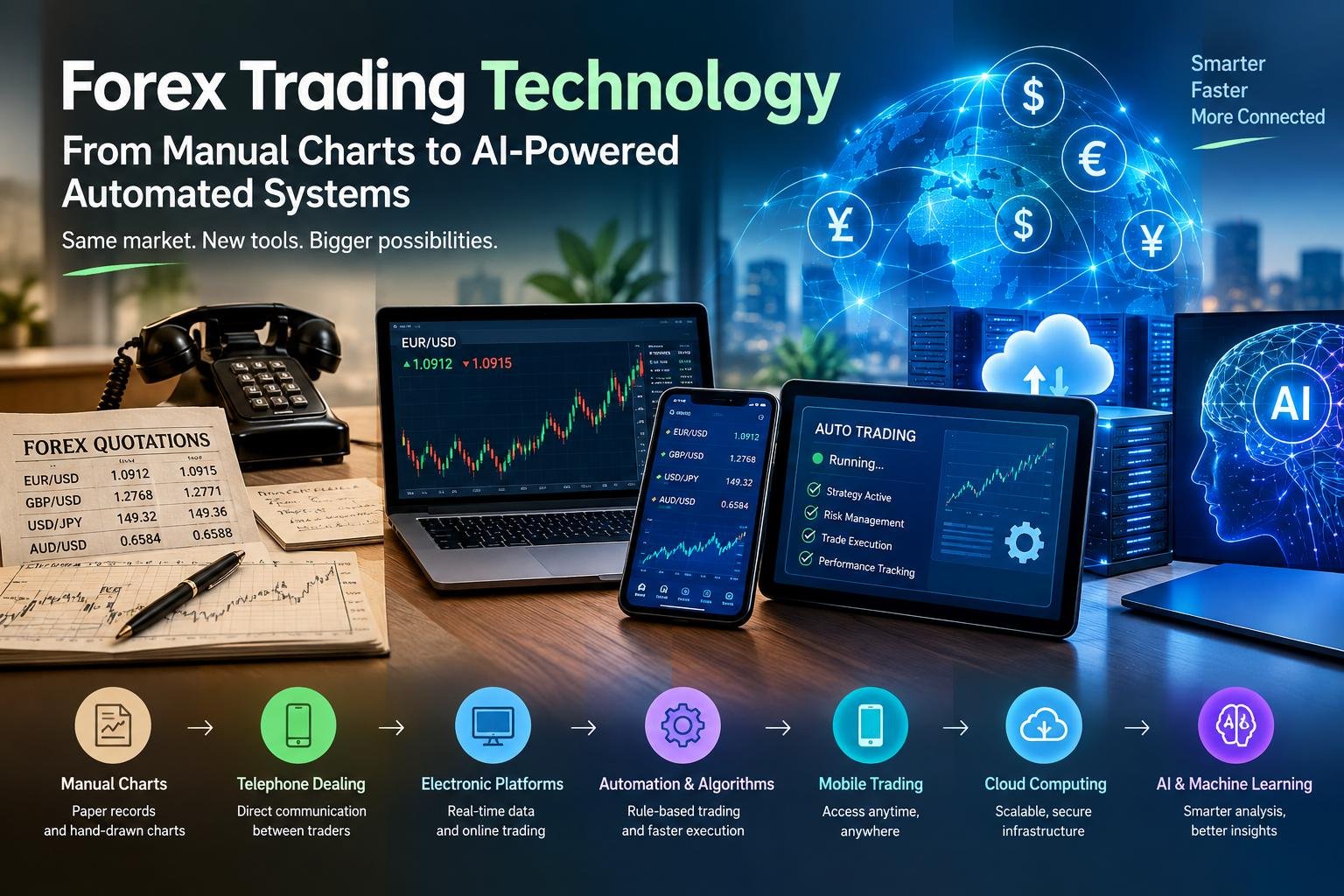
Algorithmic trading is gaining significance in today’s financial markets due to the capacity of computer programs to analyze market information and carry out pre-programmed trades more rapidly than a human could possibly make. In the Forex trading arena, algorithms can track price movements of currencies, perform calculations of indicators, recognize market conditions, and place orders based on predetermined rules. Simply put, traders give the instructions, and the software takes care of the mundane tasks of monitoring and execution. The general idea behind algorithmic trading is to use computer programs to make trades automatically and place orders automatically, according to set rules. Algorithms can help with the trading process, making it more systematic, but they are not guaranteed to result in profitable trades. Their performance relies on the quality of the strategy, market data, programming, execution environment, risk controls and assumptions that are used in designing the system.
Algorithmic Forex Trading Explained.
Algorithmic trading is a type of Forex trading where trading decisions are made automatically based on information from the currency market, using computer programs. A price chart can be watched, but a trader does not have to make trading decisions based on the chart; the program can be programmed to look for a specific set of conditions. For instance, if an algorithm is set to purchase a currency pair when its short term moving average is above a longer term moving average, and a subsequent condition is met to support the move, the algorithm will proceed with the trade. Depending on the conditions, the system can place an order without trading pressing a button. Algorithms may be as simple as a technical indicator program, or as complex as a system that can handle a great deal of market data. The major difference is that they make trading decisions based on certain rules, instead of doing them by hand for each specific trade.
Understand how Trading Algorithms Decide Trades.
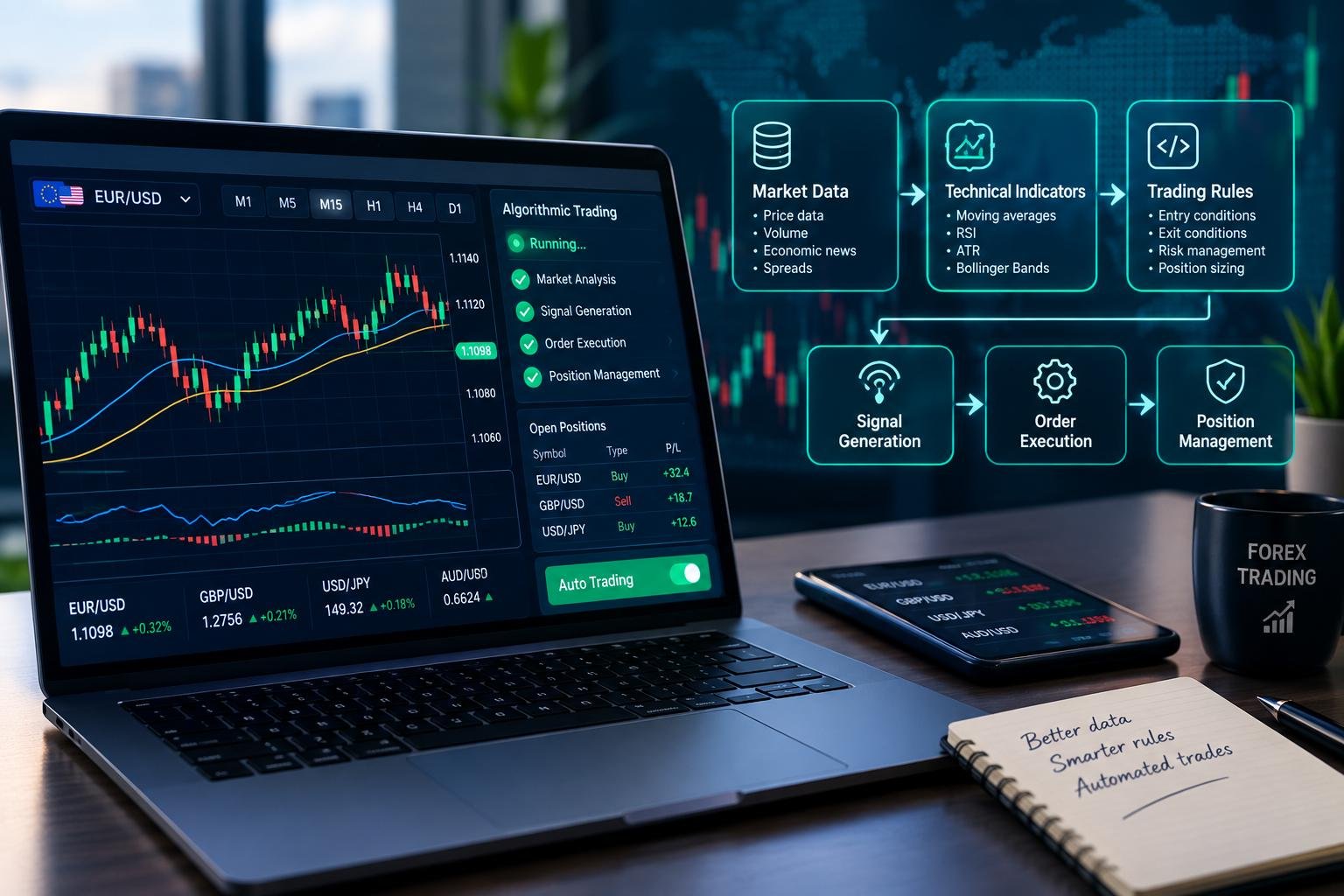
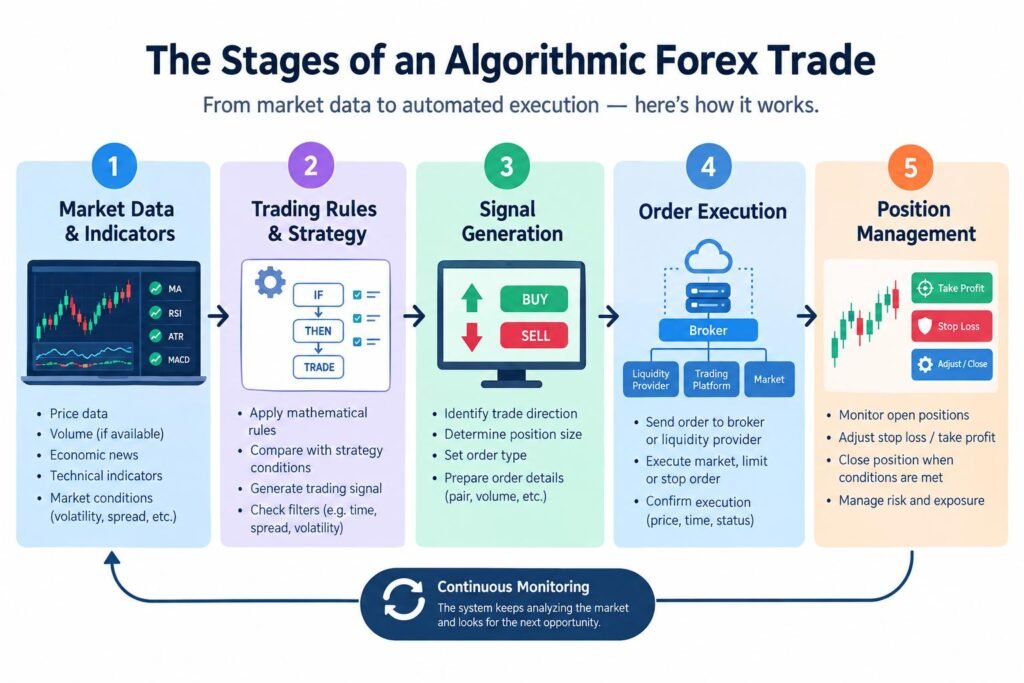
The first step in a trading algorithm is the input. These inputs can be currency prices, trading volume data (if available), economic data, volatility measures, spread data, time of day, and data about current positions. These inputs are passed through the program which contains mathematical rules developed by the program’s creator. Then it will compare the current conditions in the market with the conditions in the strategy. The program makes a trading signal if certain conditions are met. For example, a strategy could involve a currency pair crossing a specific price level while its momentum indicator is at a certain level. Rules to avoid trading during extremely large spread or during specific time periods can also be programmed into the algorithm. This is how a trading concept becomes a set of measurable instructions that can be continually evaluated by a computer.
Technical Indicators and Mathematical Rules
Algorithmic Forex Strategies often rely on technical indicators that serve as input for the strategies. Indicators are the tools used to change information about the past or present prices into a measurement that can be used by a program to help determine specific market attributes. For instance, moving averages can be used to determine directionality by taking the average price of the last five days, for example. The RSI can be used to gauge momentum, and the ATR can be used to gauge the volatility of the market. Other indicators can be Bollinger Bands, trend measurements, price breakouts, or the combination of several indicators. These indications are not processed as flexibly by an algorithm as by a human. Rather, the programmer needs to define “when”, “if”, or “when not” to execute an action. It’s precisely this accuracy that makes strategies easier to test, but it also means that badly designed rules can yield bad decisions over and over.
Combining Multiple Conditions
The more advanced algorithms tend to use more than one mathematical rule. A program could have to have a trend signal, momentum affirmation and also a tolerable spread prior to getting in a trade. It may also determine the right position size based on the account balance and the user can set the risk limit. One algorithm could be implemented to not accept a job if the volatility of the market is above a certain point. One can also have a rule that automatically closes a position when it moves a certain price or when the trading conditions by which it was opened are not met anymore. The combinations enable developers to create a complex decision structure. But if you make a strategy more complex by adding in more conditions, this is not necessarily an improvement. Too complex systems can be hard to test and could be performing well on historic data, and not as well as on changing market data.
Current Market Condition and the Trading Signals
Forex markets are not the same at all times, and this must be taken into consideration when creating algorithms. A trend, a sideways move, a sudden spike in volatility, an illiquid period and fast responses to economic announcements are all examples of periods during which currency prices have trended. Trends trading strategies can yield varying results underprice conditions of tight ranges. Some algorithms incorporate market-condition filters which decide whether commerce ought to be performed. These filters can be used to filter the volatility, price momentum, trading sessions, spreads, or other measurable properties. In some systems, trading may be carried out at specific times of the day, or trading may be less in times of high transaction costs. Programmers can customize the system by specifying market conditions. However, automated strategies have their drawbacks, since the market can move in a direction that wasn’t the one that was expected when they were created.
Algorithms are Designed to Execute orders in Forex.
Once a successful algorithm has identified a trading opportunity, it should be able to place an order with the trading system or the broker. Typically, the execution process includes the following steps: setting up an order (including the following details: currency pair, direction, volume, order type). A market order will be executed at the current market price, a limit order will set a price condition that must be met. A stop is a mechanism that can be used to start a position once the price hits a certain level. Algorithms may also be used to automate and adjust orders of the existing positions based on certain instructions. The programme thus can not only recognize potential opportunities but can also control the whole process from the generation of the signals to order placement and positioning management. This may be different from the actual execution price as prices may change between the time the signal is generated and the time the order is executed.
The Role of Execution Systems
The execution systems are of major significance as they can make or break a profitable theoretical signal when trading with real costs and market conditions are taken into account. When an algorithm places an order, then the order goes through technological infrastructure in order to be executed. Depending on the trading set-up, the system needs to be synchronized with the corresponding trading venue, the corresponding broker or the corresponding liquidity provider. The final result may be influenced by the speed of the network, processing time, the amount of liquidity, bid-ask price spreads, etc. In fast moving markets, the spread between the anticipated price and the market price at which it is executed can be more pronounced. Therefore, automated trading demands focus not just on the trading strategy, but additionally the infrastructure through which it is carried out. Market-related risks of execution can’t be avoided, but reliable connections, order handling suitable for the market and effective monitoring can help minimize operational issues.
Backtesting Algorithmic Forex Strategy
Backtesting is one of the most crucial steps in creating algorithmic trading system. It’s using a strategy’s rules to look at past market data to see how a strategy would have performed in the past. A backtest can offer information about potential returns and losses, drawdowns, trade frequency, and so on. This information can be used by developers to find out the obvious weaknesses and also if this strategy is operating in a manner that is designed. But, back testing does not guarantee that an algorithm will make the same trades in the future. Conditions in historical markets can be very different from those that will be experienced later on. The quality of the historical information and whether realistic spreads or transaction costs and execution assumptions were provided in the test can also impact results.
Avoiding Overfitting
One of the big problems in creating an algorithm is overfitting. When the strategy is focused too strongly on past data and includes trends that may not necessarily continue in the future. A developer could, for instance, tweak the indicators many times until they become extremely appealing in the past, etc. The resulting strategy might look great backtested, but be not so successful once a new set of data is fed into it. One way to minimize this risk is to test strategies on data which were not used during development. Forward testing can also be done (possibly in a simulated trading environment) to evaluate the performance of a system in the present market. It’s not just about making a great history, it is about finding out if the rules that are used to create the history are reasonably consistent when they are exposed to information for which they were not trained.
Key Components in Automated Forex Trading
The delay in trading from one stage to the next, for example from the time that the market information is received until the time that the trading signal is processed, until the trading order is sent, and until the execution response is received, is known as latency. In such a smartly driven market even a small lag can make a difference as the prices could fluctuate quickly. An algorithm identifies a signal at one price may place an order after the market has moved. Latency is a very differential property of strategies. A trend holding strategy that is time sensitive (holding for a few days) might be less affected by the smallest delay in executions than a time insensitive strategy trying to capture very short-term price changes. As such, algorithmic traders take into account such things as server location, network connections, the speed of data-feeds, and order-processing infrastructure. It can be beneficial to execute the trade more quickly but it is not a good trading strategy if they are executed quickly.
Advantages of Algorithmic Forex Trading
The automated systems have a number of practical benefits. The first is consistency as the program should be able to employ the same pre-established rules whenever the conditions are met. This can minimize the role of feelings like fear or excitement in individual trade making. This can minimize the impact of feelings like fear or excitement on individual trade making. Algorithms can also track the market on an on-going basis and analyze information at an instant level that much faster than human observation. One of the other benefits is repetitive tasks that can be automated. A system will identify signals, determine position sizes, place orders and execute predetermined exits without having to be manually monitored. Automation can also make systematic testing easier; if a rule is applied to a massive historical set of data, that rule can also be used to test it automatically. The traits of these features are the reason why computer-based execution has become more crucial in electronic financial markets. But, these benefits are only possible with proper programming, control, data and monitoring.
Limitations and Risks of Automated Systems.
There are also many drawbacks of algorithmic trading. The computer program executes its directions, such as directions that may not be applicable under the changing market conditions. An error in the program can lead to unintended trades, wrong order quantities or to repeated orders. However, this is often due to poor quality market information, which can trigger inaccurate signals. In addition, technical problems with the servers, the Internet, the trading platform or software may cause interruptions to the execution. Due to market activity, there might be significant discrepancies between the expected and actual prices at which the orders are executed. Other constraints include the fact that algorithms cannot be able to understand all the aspects affecting markets, unless they can be translated into usable inputs and rules. Systems based on past assumptions can be tested by economic changes, unanticipated announcements, variations in liquidity, and unusual market activities. So, even if the decision making and execution is automated, risk management is essential.
Conclusion
Algorithmic Forex trading involves the use of computer software that converts specific trading concepts into automatic procedures that interpret the market information and place trades. Various technical indicators, mathematical rules, market-condition filters and risk parameters can be used to decide when and how to trade. Back-testing is useful to determine how strategies would have performed in the past and forward testing can offer further details of performance when newer conditions were present. Latency and execution technology also are important as there could be changes in the market prices between signal generation and order completion. While automated systems can ensure consistency, speed, never stop monitoring and handle repetitive tasks effectively, they are still subject to the assumptions and instructions embedded within their systems. It is thus crucial to grasp their strengths and weaknesses when it comes to forex trading automation.
Get more well researched information about Algorithmic Forex Trading here.