Introduction
Financial technology has revolutionized the way the customer interacts with banks, insurance companies, investment companies, payment companies and other financial institutions. Before the advent of online banking, there were many inconveniences people had to deal with when handling their money: dealing with a physical branch, filling out paper forms, waiting for customer service, or limited hours for handling money. As technology advances, citizens today can conduct numerous financial transactions using their smartphones, computers and other connected devices. For instance, modern self-service systems enable customers to handle their accounts, make transactions, find out information, and manage their financial services without relying completely on workers. This has also established a more efficient and convenient financial landscape and increased customer expectations. Expectations have risen around financial services, which can be accessed on-demand, are efficient, deliverally relevant information and are tailored to each individual.
How Technology is Shifting Customers’ Expectations
Digital technology has altered customer expectations of good financial services. Customers no longer want to access just a bank account or insurance policy. They are becoming more of a consumer of services, and they are increasingly looking for services to be available at any time they need them, with little waiting and simple processes. A customer who can place an order online, keep track of actual deliveries, message with one another by using messaging applications and get instant notifications may anticipate the same from his financial institution. This has spurred financial institutions to reimagine their solutions with regards to speed, ease of access, customization, and convenience. Technology has thus turned customer experience from being primarily reliant on in-person encounters to being an ongoing digital relationship. Now, financial institutions must offer a safe and secure digital channel to their customers and the process of switching between the mobile application, website, automated systems, and human service must be seamless and free from any unnecessary hassles.
How Mobile Apps are making Financial Services more Convenient.
Financial technology has made mobile applications one of the most visible ways to enhance the customers’ experience. The banking and financial apps enable customers to carry out activities they would have to go to a bank branch or call in for. Users can view account balances, transfer funds, pay bills, control cards, view transactions and sometimes even apply for financial products through an application. Investment applications can also enable customers to keep an eye on their investment portfolios and be updated on their investments. Through insurance applications, policyholders can be able to see insurance policy information, submit documents or start claims. The primary benefit is that they’re very convenient, as customers can finish these activities from anywhere. Mobile apps can also help to cut down on the wait time for customers for regular services. In the case of applications developed with an obvious navigation flow and robust security measures, they will make financial management as simple as it can be for users who want to manage their finances on their own.
Elimination of Delayed Services by Self Service Platforms
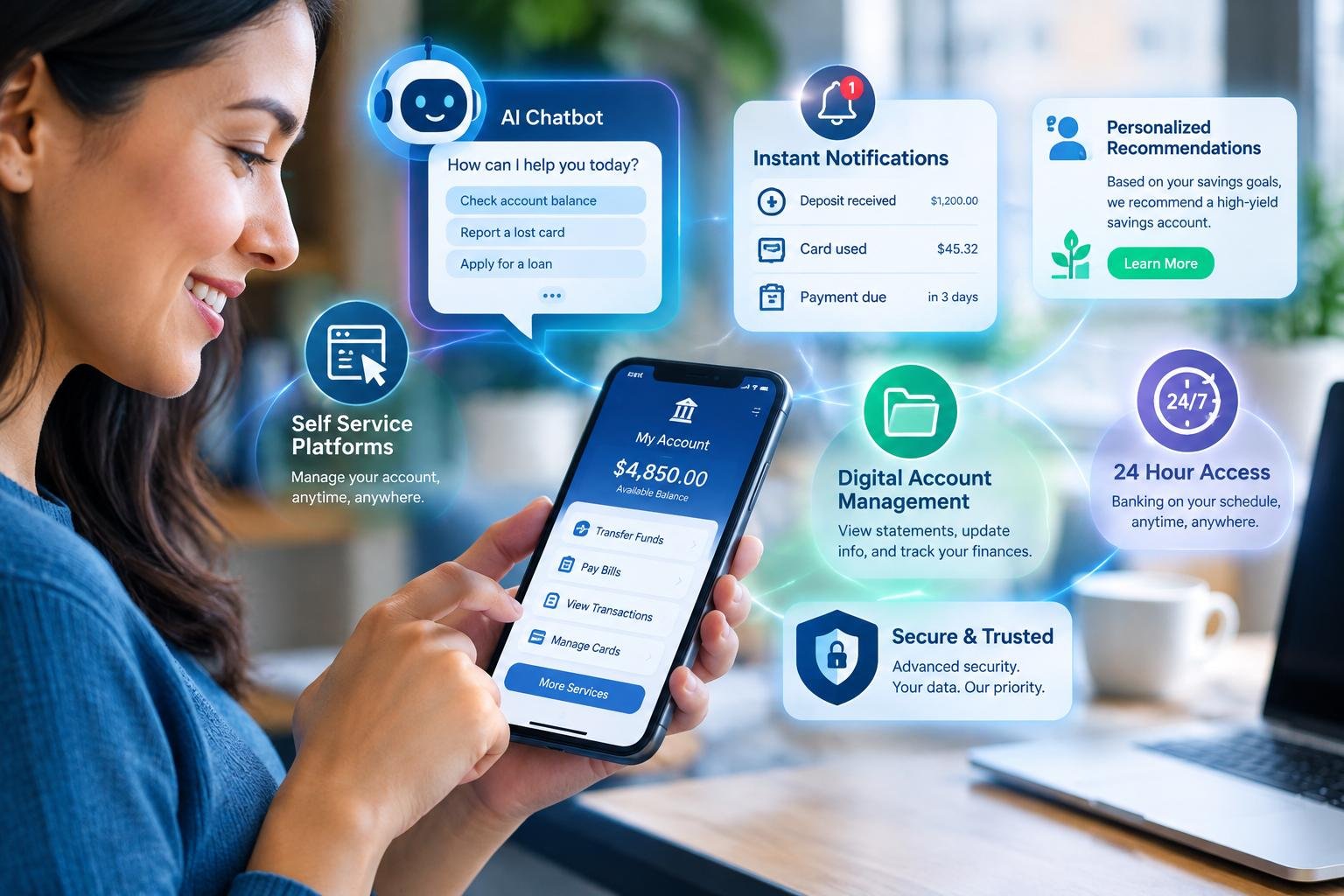
Customers have more control over repetitive financial transactions by using self-service technology. Customers can make transactions, such as updating information, view documents, make payments, transfer funds, check balances or get answers to frequently asked questions without having to contact an employee. It can be helpful in doing simple jobs that don’t need professional help. The self-service platforms also work in favor of financial institutions as they are able to streamline the pressure on their customer support teams, while also enabling them to dedicate time to more complex issues. But providing services online isn’t enough to provide good self-service. Platforms should be user friendly, responsive, accessible and secure. There should be no confusion with menus and no unnecessary instructions for the user so they are able to understand what they need to do. In the right context, self-service brings an enlightened relationship between financial institutions and their customers, which can be more efficient.
Quicker Customer Support through AI Chatbots
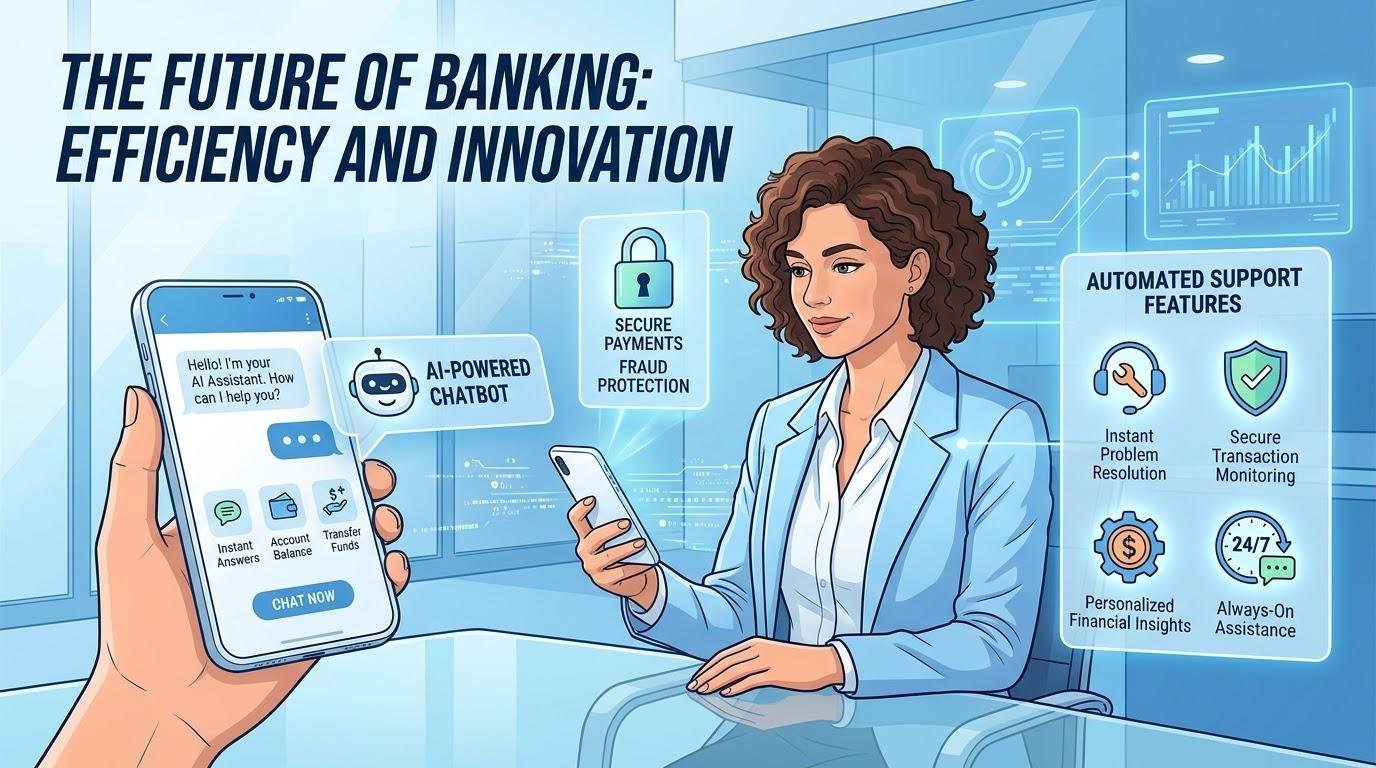
Another form of artificial intelligence that has been impacting customer service is the use of AI-powered chatbots. These systems can reach out to customers via web pages, mobile apps and messaging channels, and offer instant answers to frequently asked questions. A customer can interact with a chatbot and find out the procedure for opening an account, transaction details, card services, opening hours, and other common questions. A customer service representative isn’t required to be available; the customer can get help in seconds. Chatbots can also be used to guide customers to the appropriate services or to escalate more complex issues to human employees. In times of high demands on the customer, when human support teams can be overwhelmed, its value is particularly evident. However, financial institutions have to make sure that chatbots are correct and clear. When an issue is too complex, too sensitive, or too unusual to be handled by the automated system, customers should be able to contact a human representative.
Personalized Financial Recommendations
With the power of technology, financial institutions can leverage their customers’ data to offer more personalized experiences. With proper authorization, safeguards and privacy safeguards, institutions can review information like spending trends, account activity, financial objectives and past interactions to determine services or suggestions that could be applicable to individual customers. For instance, if a customer frequently makes a savings deposit, they might be offered a savings product that is appropriate for them; if an investor is interested in a particular type of investment, they may be offered educational materials about the type of interest. Personalization can also be of great value to financial services; the customer doesn’t have to wade through a lot of non-sensible information. But personalization should be responsible and not an intrusion. Financial institutions should inform customers about the uses of their information and safeguard them from unauthorized access. Recommendations should also help to ensure that the customer can make informed decisions, not press the customer into buying unsuitable financial products.

Instant Notifications keep Customers Informed.
Instant notifications are a key component of today’s financial customer service experience. Customers can be alerted on money deposits and withdrawals, card usage and unusual transactions. This notice is a highly timely notice, rather than the customer having to continually monitor their accounts. This can make things more convenient and enhance security also. For instance, a customer who receives an out of the ordinary transaction alert can easily look into that transaction and contact the bank if needed. Notifications may also prompt consumers of a financial service to inform customers of upcoming payments, requirements on an account, investment activity, or changes to a financial service. Customers feel more informed and connected to their financial accounts when they receive information when needed. Notification systems, however, should allow the user to set preferences on the number and type of notifications they receive in order to prevent the loss of important communications in the midst of irrelevant notifications.
Digital Account Management Enables Customers to have Greater Control.
Digital account management has simplified for customer the control of their financial information without having to go to the branch. Online banking services and mobile apps allow customers to check their transactions, download account statements, make some personal changes, organize payment methods, and track pending transactions. Financial records may also be easier to manage digitally, as customers are able to access any information that they require when they need it. For the enterprise, digital account administration can help streamline operations including customers examining transactions, employee payments, and business money management. The advantages of such systems are paramount for customers with hectic schedules or for those who reside off the beaten track. With the increasing number of services becoming digital, financial institutions must keep account management systems accessible to various digital skills and abilities. Positive experiences are essential and are built from clear instructions, easy to use interfaces, dependable performance and robust security.
Twenty Four Hour Access: Changing the Meaning of Convenience.
One of the main benefits of financial technology is the ability to access a number of services that are not available during business hours. The digital financial platforms are open around the clock, while physical branches have predetermined hours of operation. They might want to transfer money late in the day, glance at a balance in the early morning, make a payment over the weekend or take a look at a transaction while on the road. These activities can take place without customers having to wait for the branch to reopen, thanks to 24 hour access. This doesn’t mean that all financial problems can be solved without any intervention round the clock, but technology can certainly be of great assistance in providing certain automatic services. Customer expectation has therefore been raised with regards to 24-hour availability. Financial access is perceived to be an on demand service and not only a service provided during specific times.
Quicker and more Efficient Services through the Application of Technology
Financial technology has also added value in many other aspects of customer experience, such as speed. Many common tasks can be processed much quicker in a digital system than a manual system. Customers may not have to wait for manual processes like payments or verification, as electronic solutions can help streamline and automate them. There may be fewer delays for customers thanks to automated processes, real-time notifications, digital applications and electronic payments. It’s especially beneficial when the customer has to make timely payments or access essential financial information. Designing and monitoring systems appropriately can also help minimize error caused by manual data entry that can be repetitive. But, speed should not be at the cost of security or accuracy. The financial sector processes personal data and significant sums of money; therefore, the processes should have the appropriate verification and protection procedures. To achieve this, the best digital experiences are both fast and dependable, enabling customers to enjoy a speedy experience without sacrificing the confidence in security provided against fraud and unauthorized access.
Ensuring a Balance of Convenience and Security and Trust
While financial technology offers plenty of advantages, customer experience relies heavily on the trust of customers. Customers expect ease of services, but also they want to know that their cash and data are safe. To ensure the security of transactions, financial institutions require robust authentication, encryption, fraud monitoring capabilities, secure payment methods, and robust privacy measures. Additional security can be offered by multi factor authentication and biometric verification without compromising ease of access to the customers’ accounts. Institutions need to ensure that they also communicate clearly when implementing security measures, so that customers are aware that extra checks could be necessary. Security systems can be too complicated, or too weak: if the latter, the customer can be seriously exposed, if the former, the customer may become frustrated. The challenge is to develop secure and user friendly systems. Financial services should be made easier for the customers, but not at their own loss of privacy or financial security, through the use of technology.
The Future of Customer Experience in Finance
What’s to come for the financial customer experience will most likely be even more of a marriage of artificial intelligence, mobile technology, automation, data analysis and digital platforms. Financial advice can be more personal; customers can interact with smart bots and use a variety of financial services from unified digital spaces. Technology can also help financial institutions identify the needs of customers earlier and offer them help before they ask for it. Meanwhile, institutions will have to tackle issues of privacy, cyber security, transparency, access and responsible AI use. It’s not a tech solution that will magically make for a great customer experience. Financial institutions will have to be a blend of technological innovation and human understanding and reliable support for success. When dealing with automated services, customers should be able to use them at their convenience, and at the same time be able to speak to a knowledgeable member of staff when they require it.
Conclusion
Financial technology has revolutionized the customer experience in the finance industry, creating more convenient, accessible, personalized, and faster services. Mobile Apps enable customers to control finances from nearly anywhere and self-service platforms cut down on over the top waiting time and provide additional control. AI chatbots can answer common questions in real-time, financial information can be tailored to the user, and notifications can be delivered instantly, ensuring that customers are always aware of the important information regarding their accounts. Digital account management makes it easier to carry out every day financial transactions, and the 24 hours access enables customers to access a number of services outside of business hours. As a result of these developments, customers have new expectations and a new benchmark for the way financial services are provided. With the ongoing advancement of technology, financial institutions that are seamless, secure, private, easily accessible, and offer human interaction will be more likely to cultivate long-term customer trust and satisfaction.
Get more well researched information about Financial technology and customer experience here.