
Introduction
Banks, microfinance institutions and digital lenders are undergoing a transformation by employing artificial intelligence (AI) to evaluate borrowers and even lend money. Traditional methods of assessing borrower’s creditworthiness include credit scores, employment history, income statements, collateral and an individual’s borrowing history. They are still applicable but perhaps can be problematic in an assessment of individuals who do not have sufficient financial records to support their assessment or have an informal business. There are new tools for analyzing financial data, discovering repayment patterns and predicting the likelihood of paying back loans using AI. Lenders can leverage machine learning credit models to gain insight into complex relationships within the financial data, enabling them to make more informed credit risk decisions. These technologies, when used responsibly, can help to make lending more efficient, increase access to credit and make sound financial decisions. Good data and process are essential to their effectiveness, as is appropriate regulation and accountability by humans.
AI’s Applications in Credit Scoring Systems
Credit Scoring is the process of determining an individual’s or a company’s ability and willingness to pay back the borrowed money. The traditional credit scoring process takes place on the basis of pre-existing rules and statistical models which consider the following: debt owed, payment history, income and credit usage. Conventional methods can be augmented with AI by applying machine learning algorithms to identify patterns and relationships between many variables that might not be apparent from traditional analysis. For instance, a combination of inconsistent earnings, increasing debt loads and frequent delinquency may be associated with increased risk of default by an AI system. AI is not meant to replace all of the conventional credit assessment practices; it is meant to be used as a supplemental piece of the evidence used to make a lending decision. Financial institutions like banks can use these criteria to make consistent evaluations and apply them to your financial profile as it changes, to see which of the criteria are being achieved, and what needs to be adjusted, or if your finances aren’t good, review the application in more detail before deciding.
1. Borrower Evaluation.
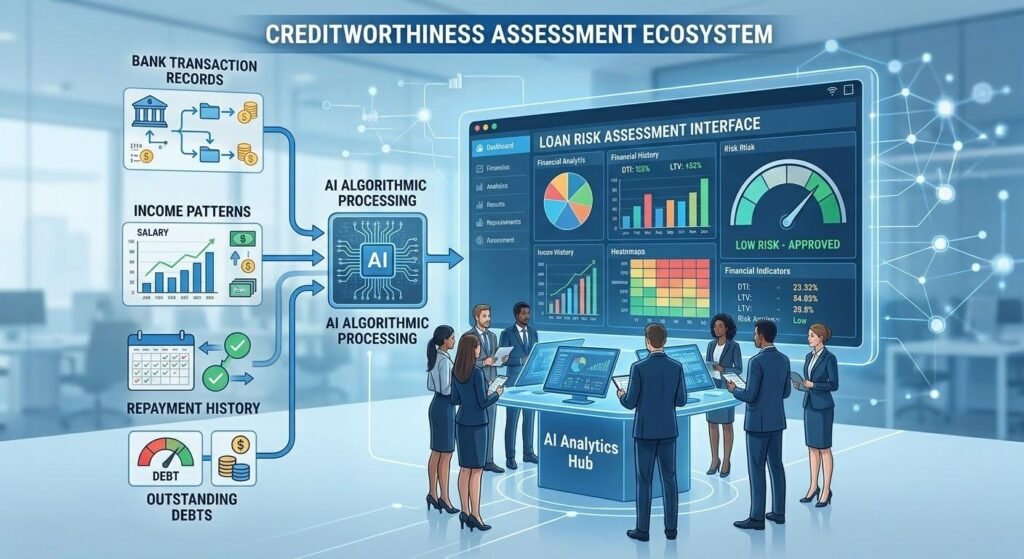
Financial data from the past is used to train machine learning models to determine borrowers’ ability to repay their loans. These models can be trained using historic loans applications and loan repayment data, outstanding loan balances, loan amounts, and known loan defaults. The models process the fail/success data of repayment to discover patterns of credit risk in relation to different levels of credit risk. For instance, a borrower with always paid their mortgage on time and low debt will be a better risk than a borrower with debt who has been late paying their mortgage many times. Some models can identify changes in behavior, such as an increase in borrowing or a decrease in the periodic deposits. Their forecasts are not promises, though, as what was once cannot be certain of what will occur in the future. There can be financial crises, sickness, company closure or unforeseen costs affecting the repayment ability. The lenders, however, must have to accept these predictions of the models, with the required financial checks and periodic monitoring.
2. Evaluating Financial Information and Income Trends
Another good thing about AI is that it can take into account other monetary details if the standard credit score is unavailable. Depending on the applicable law, customer consent, and the availability of the data, lenders can check the customer’s bank transaction history, periodic deposits, utility payment history, business cash flow and more to assess financial stability. If you are a small business owner that has not formally borrowed money from a bank, then you may demonstrate to the bank that you can pay it back by observing regular bank account transactions and repayments to your suppliers and regular sales. Similarly, the assessment may relate to income for several months rather than just one payslip, if the self-employed person has an irregular income. Such methods can provide a more comprehensive perspective of a financial situation, particularly in countries with a large informal sector. Other information must, however, be relevant, accurate and appropriate to the lending decision. Nonetheless, irregular does not equal irresponsible, and lenders shouldn’t request personal information that is irrelevant to evaluating the consumers’ worthiness.
3. Automate Underwriting and Loan Approval
An automated underwriter is a computer program that analyzes loan applications, checks data, assesses risk factors and determines if the loan application qualifies for the borrower. AI can sift through documents, verify reported income against financial statements, identify missing information, and verify the risk of default, helping lenders to approve loans more quickly. Simple applications can be dealt with fast, and more complex applications can be referred to a human underwriter for further consideration. This solution will help the administrators save time and manage more application instances without additional staff. The online lenders could automate their credit decision making process, outside of banking hours, which would provide a more convenient time for the consumer to receive credit services. However speed is no only a criterion of success. This can lead to wrong approvals or rejections if the data is entered incorrectly, there are technical problems or inadequate decision rules. If these underwriting elements are missing, then the process of underwriting is unlikely to be effective, as long as there are no validation processes, no safe system, easy loan requirements, and no tools to correct wrong information.
4. Accurately Forecasting Default Rate and Lending Decisions.
The risk that a borrower will not make the payments on a loan is referred to as default risk. Based on historical repayment data, the current level of debt, income stability, the characteristics of the loan itself, and the overall economy, AI models can make estimates of this risk. These estimates can help lenders decide if a loan request is approved, the loan amount, the length of time for the loan to be paid back and required additional evidence. For instance, a microfinance organization could discover a borrower whose income ebbs and flows seasonally and set up a repayment plan that is in line with the expected income. Predictive assessments can also enable institutions to track existing loans and act at an early stage by reaching out to customers when difficulties are starting to arise, preventing further problems. However, a model’s prediction is a best estimate that is provided from the evidence and assumptions. Financial institutions need to continuously evaluate the validity of their predictions under various economic scenarios and among different borrower cohorts, and not assume that algorithmic scores are predictions that are always accurate.
The Role of AI and Financial Inclusion in Emerging Markets
Many people and small business owners in emerging markets do not have formal credit histories, regular payslips or assets that are traditional collateral. This may make it difficult for the financially responsible borrowers to qualify for loans when their business has the ability to pay a loan back. AI can fill this gap by analyzing data that is allowed and determining if there are financially credible indicators. Market traders, farmers, artisans and small business owners can prove their financial strength by showing transaction history, sales on a regular basis or through business cash flows. These insights can be utilized by the digital lending platforms to target customers who do not have access to traditional banks. Improved access to appropriate credit could help businesses grow, students access education, farms to expand agriculture and to sustain the financial health of households. But financial inclusion should not be seen as approving loans without taking into account the affordability. The lender should provide information on the costs of borrowing, check the borrower’s ability to repay the loan and prevent the borrower from becoming too deeply indebted. Most of the value that AI can generate is when it expands access, without sacrificing good lending practices or consumer protections.
The Risks and Challenges of AI Credit Scoring
1. Algorithmic Bias and Unfair Lending
Algorithmic bias is a type of bias that results when an AI system systematically discriminates against certain individuals or groups. This can occur if training data includes over-representation of certain groups, is biased by historical discrimination, or if variables that are discriminatory are over-represented. For instance, residents of underserved communities might not have access to formal banking services, and thus have less documentation of their financial activity. By deciding to view minimal data as a sign of a high risk, it can keep on turning down applicants who are actually good loan candidates. Proxy variables can also lead to unearthing inequities in apparently neutral information. Lenders should create models for many groups of demographic and economic individuals and groups, review the rate of model rejection, and investigate differences that may not be explained by the model. Independent audits and well planned fairness assessments can be used to pinpoint issues, where legally allowed. An automated decision does not need to be the only factor taken into account, as review by a person and good complaint processes are also relevant, especially if the decision is likely to have a considerable impact on a person’s access to financial services.
2. Data Privacy, Security, and Explainability
AI credit assessment generally entails handling a significant amount of personal and financial data, which can cause concerns regarding privacy, cybersecurity, and unapproved data use. Financial institutions have a responsibility for safeguarding customer records to ensure this is done without being stolen, misused or accessed for inappropriate purposes and that the data protection requirements are being adhered to. They should gather only information they believe is needed for their legitimate lending purpose, have reasonable retention policies and inform borrowers of how information they gathered would impact the credit decision. Explainability is also crucial since there may be complex machine learning models that can be hard to understand. When the applicant’s application is unsuccessful, or other significant lending decisions are made, then the applicant should not be left without an explanation that has meaning. Lenders should keep documentation of the information and circumstances that influenced their decision and put in place easy procedures to correct inaccurate data and to review the decision. Good governance, safe data use and clear explanations can help build customer trust and facilitate institutions identifying errors before they can impact many.
Responsible AI Adoption in Lending
Financial institutions should see AI as a decision support tool that needs constant checking as opposed to replacing their duties. Lenders are advised to review the training data, perform predictive testing, determine if there is potential for discrimination and verify the appropriateness of the model for the purpose of lending before deployment. Once implemented, they should track performance for changes and explore unexpected results, and adjust their models when circumstances in finance evolve or borrower behavior changes. Designated staff must have clear accountability to be able to explain why, how, what and where something went wrong, investigate complaints and rectify any harmful errors. But human review should be more than just an oversight, and reviewers should be given the power and information to challenge automated recommendations, rather than simply accepting them. There are also a number of roles in the setting of appropriate standards to be filled by regulators, lenders, technology providers and consumer protection organizations. Technical solutions and responsible management can go hand-in-hand to allow institutions to reap the rewards of automation without sacrificing borrower’s rights, situations and wishes.
Conclusion
AI is revolutionizing credit scoring and loan approval by providing lenders with the ability to process financial data more thoroughly and accurately, forecast default risk, streamline the underwriting process, and evaluate borrowers who have less traditional credit history. They can assist banks, MFI’s and digital lenders effect faster, better decisions and deliver appropriate credit products to the unbanked and underserved small businesses. Meanwhile, AI presents significant privacy, security, and explainability issues as well as algorithmic biases and the risk of misinformation and bias. Historical data and predictive modeling do not account for all of the factors that impact a borrower, and supervised judgment is required to ensure they are suitably supervised. Financial institutions need to therefore ensure transparency in decision making process, frequent model review, data protection and issues regarding the complaints. The use of AI in lending cannot be solely evaluated based on efficiency in processing loans or profitability, but rather based on accuracy, fairness, accountability and inclusiveness of the decisions it helps enable.
Get more well researched information from AI credit scoring here.