Introduction
With the increase in size of a business, financial data is more complex than just entering sales, expenses, invoices and payments. Small businesses may be able to manage these functions with the help of accounting software, while growing businesses might require a more comprehensive software solution that integrates accounting with operations throughout the business. To make the right choice, business owners need to understand the difference between accounting software and enterprise resource planning systems, so that they can select the technology that best meets their needs without overpaying for options that they don’t need. The primary use of accounting software is to deal with financial transactions and to generate accounting reports, while an ERP system integrates financial management with other functions, including inventory, purchasing, sales, and human resources, supply chain management and customer management. The question of which is best is thus dependent on the business size, complexity, business structure and business plans.
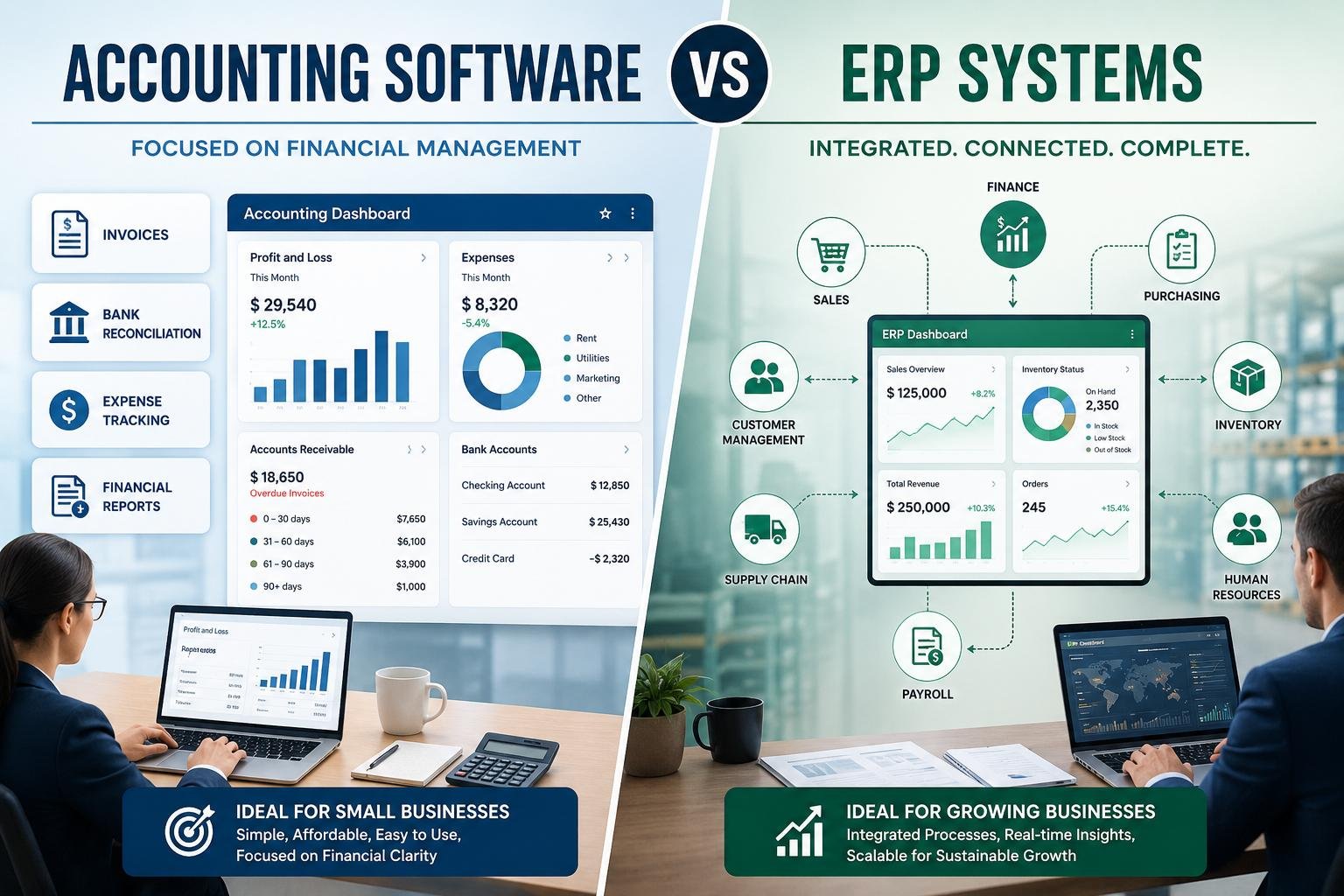
Businesses can also check out this ERP vs. accounting software comparison to get a detailed comparison of these technologies. Typically, accounting software deals with the monetary aspect of an organization, these are typical functionalities that include accounts payable, accounts receivable, bookkeeping and general ledger software, bank reconciliation, and bank reconciliation support, invoicing, expense tracking, tax support, and financial reporting. Such features can offer all the small or relatively simple business needs in order to keep a proper bookkeeping. ERP systems, however, are built to provide a single environment for multiple departments to facilitate the use of connected data. An ERP can merge processes such as finance, inventory, procurement, payroll, and more into a single entity, rather than having to work on multiple systems. This wider thinking is one of the primary motivations for companies to evolve from a standalone accounting application to another.
What is an Accounting Software?
Accountant software is a computer program designed mainly for recording, organizing, processing and reporting financial transactions on a computer. Its main goal is to replace or alleviate manual bookkeeping and provide business owners as well as their finance teams with a better understanding of the company’s financial health. With different products, bookkeeping software could take care of earnings and costs, create invoices, monitor consumer payments, process vendor bills, reconcile bank accounts, compute taxes, and create monetary statements. The majority of the modern applications are cloud-based, so that the authorized users can have access to financial information from various locations. Small business owners, freelancers, professional service firms and other companies with relatively simple operations find accounting software very useful. Since it’s focused on accounting and not the whole business, it is simpler to learn and implement than an enterprise platform.
The biggest benefit of accounting software is that its usability is extremely limited. An ERP system that includes all those powerful supply chain planning and warehouse management features, production scheduling, and HR systems might be overkill for a small company that doesn’t require them. If a small company does not need any of those advanced supply chain planning, warehouse management, production scheduling or HR systems then the acquisition of such a comprehensive ERP package might be an unnecessary cost and administrative overhead. Reports like profit and loss statements, balance sheets, cash flow reports, accounts receivable aging reports and expense summaries are examples of reports that accounting software can give you. These reports are useful for management to gain insights into revenue, cost, profitability, outstanding payments and financial performance in general. Many accounting programs also have connections with banks, payment processors, payroll software, expense software, as well as other business software. Business accounting software may be the most practical choice for small businesses with simple processes and a small workforce because it’s inexpensive, easy to use and provides financial clarity.
What is an ERP System?
An enterprise resource planning systems (ERP) business management system is a wider business management system that integrates all aspects of the company within a single business system. Financial management is generally a part of an ERP, but can also be integrated into inventory management, procurement, sales, customer management, production, project management, HR, payroll, supply chain management and more. The goal is to enable various departments to utilize the same information and not have isolated databases and spreadsheets. When a sales order is placed, for instance, an integrated ERP system can update inventory levels, generate financial records, initiate purchase orders and even share information with the management. This linked-up system can cut down on duplicate information and provide a more expansive overall business picture to decision makers.
ERP systems are particularly beneficial when business processes are interdependent and complex and can’t be effectively managed within individual applications. Take a company that is expanding and sells tangible products in several stores. The financial department might require accounting software, the warehouse could be running an inventory application, sales could be using a customer management application and purchasing could be handling its own supplier records. While each can be used independently, there can be a significant amount of time spent in transferring information between applications and working out inconsistencies. These processes can be consolidated into an ERP, and the information can flow between finance and operations. This doesn’t necessarily mean that an ERP is automatically better for any business but as the number of departments, transactions, locations, products, employees and business processes grow, the value of an ERP system becomes more significant.
Differences between Accounting Software and ERP System
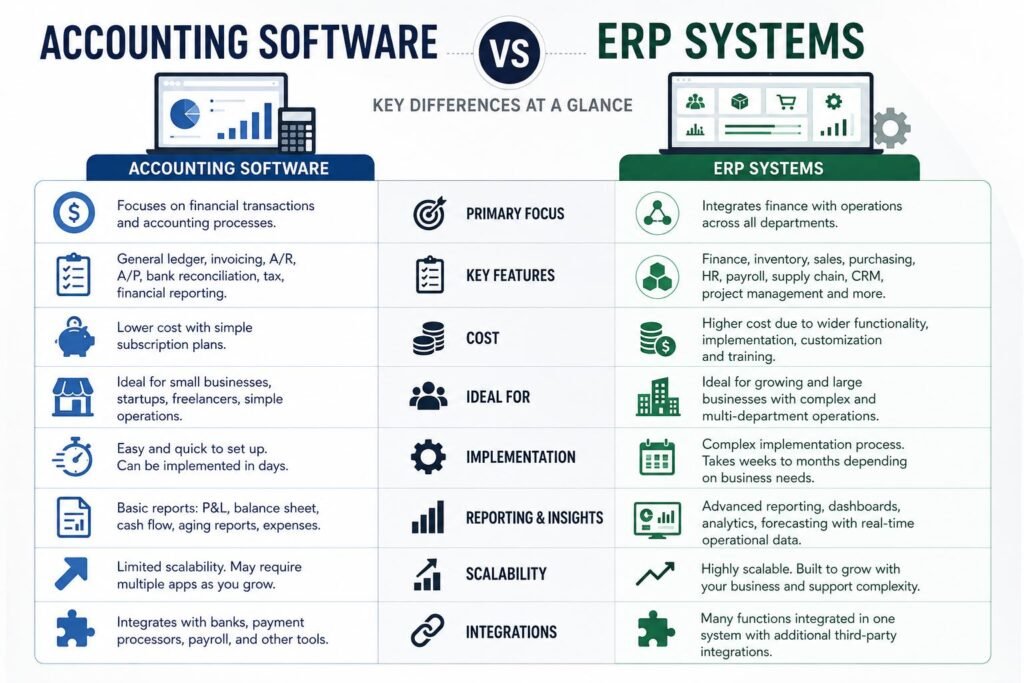
The most apparent difference between accounting software and an ERP system is that the accounting software has limited functionality compared to the ERP system. While accounting software focuses more on financial transactions and accounting processes, an ERP software system is more about the coordination of financial and operational activities within an organization. The software can combine simple inventory management and payroll integration, expense tracking, and customer records, but these capabilities are typically ancillary to the accounting aspects. Typically, ERP systems will offer more comprehensive functionality around inventory, procurement, order management, production, workforce management, supply chain management and business analysis. An ERP can also establish connections between these areas, such that information produced by one department can impact another. So, if your business only requires bookkeeping and financial reporting, accounting software might be enough, but if your business wants to run in synergy, an ERP solution would come in handy.
Cost Comparison
Another factor to consider when choosing between the two systems, is the price. Purchasing and implementing accounting software is typically cheaper than other enterprise software, since it typically has more limited functionality and easier implementation needs. Subscription fees are charged by businesses using this service monthly or yearly based on the number of users and features, per provider and plan. Other applications may also have separate fees for payroll, advanced reporting, payment processing, integrations and more. In general, ERP systems will cost more to invest, as they have more business functions to cover and could include implementation consulting, configuration, data migration, employee training, customization, integrations and support services. However, the first price shouldn’t be the only factor taken into account. Cost of ownership should be compared to the savings possible from eliminating duplicate work, streamlining processes, improving data quality and not having to pay for the expense of supporting a multitude of disconnected systems.
Growth and Scaling Capabilities
ERP systems can offer a significant benefit for fast-growing organizations in one aspect their scalability. Many accounting software systems can grow with a business, but will eventually become limiting if the business becomes complicated with its operations. A business could start from one store, couple of workers, handful of products to eventually develop to many stores, bigger warehouses, supporting multiple currencies and the involvement of more complex buying and selling systems. By then, a multitude of separate applications, to address each new problem, can result in a disjointed technology landscape. They can be managed through a single system of an ERP that can provide them with a basis. But businesses should not opt for ERP just because they believe that they are expecting growth. The system should solve the real life problems of the company and should anticipate the potential problems in the future, instead of being a costly solution that is required for problems that the company is not facing in the near future.
Difference between Financial Reporting and Business Intelligence
While both accounting software and ERP can help with financial reporting, there are differences in depth and scope. Manually produced financial statements and reports are normally some of the key features provided by accounting software that assist companies keep track of their revenue and expenses, profit or loss, receivables, payables and cash flow. Usually these reports will suffice for regular accounting and management needs. Financial reports can be linked with the operational data and used by the managers to analyze the financial performance as well as sales, inventory, purchasing, production, projects, or even other business activities. This wider context can assist management in comprehending the causal factors behind the changes in financial results, not merely on what changed. High-level ERP systems could also feature dashboards, analytics, forecasting, customizable reports and real-time information. This reporting feature, as opposed to data analyzed individually by department, can be more helpful to organizations that need to have detailed analysis from various departments.
Inventory Management
There’s also a major difference between basic accounting applications and ERP systems that can be seen in inventory management. Businesses can use some accounting software that has an inventory section that lets them record products, track the amounts and link purchases and sales with their finances. For small companies that do not have many products or a complex inventory system, these tools may be enough. For larger organization, it may be necessary to have more advanced inventory features: multi-warehouse, inventory transfers, reorder points, purchase planning, batch or serial tracking, demand forecasting, sales and procurement integration. Most ERP systems are geared towards these interdependent processes. For instance, when a product is sold, the system can be linked up with the inventory availability and financial records. An ERP comes with wider inventory management features which can be advantageous for companies with extensive product lines, multiple stores, production processes, or complex supply chains.
Human Resources and Payroll
The need for payroll software might also affect the selection of business management software. Many accounting applications either have built-in support for payroll, or can be integrated with a specific payroll application. This could be a great solution for a small business that employs just a few people and has a simple payroll system. An organization’s needs for employee management systems increase as the size grows, however, and can include employee records, employee benefits administration, attendance, workforce planning, recruitment, compensation management and integration with financial reports and payroll. ERP systems can offer more comprehensive HR capabilities or be integrated with other HR-specific systems while maintaining the flow of pertinent data into finance. An ERP is no longer a requirement just because a business has numerous employees as it is important to assess the real need for payroll and employees. Sometimes, using accounting software along with a specific payroll or HR software could be more cost-effective and efficient.
Integrations and Data Management.
Integrations come in handy as businesses don’t work with just one technology platform. There are various other tools that can integrate with accounting software, such as banks, payment processors, e-commerce platforms, payroll services, expense applications, customer relationship management software, and more. The integrations can augment a financial system without replacing all current apps, thus the business benefits from a financial system that it doesn’t have to buy a new one. ERP systems go a few steps further in being integrated and try to integrate many of these functions within a single integrated environment. This can also minimize the amount of data employees have to key into, and the number of systems they have to work with. There are still some integrations to outside applications that require special expertise in the ERP implementation process. Businesses need to think about if there’s a reliable way to exchange data, if there are integrations available native or by means of third-party tools, and if the data is uniform throughout departments while comparing systems. Even if the software is robust, poorly connected systems can cause errors to occur.
Implementation Requirements
It is easier to implement accounting software than ERP. An accounting application can be set up, the opening balances can be imported, linked with its bank accounts, users can be set up and the small business can begin operating in a relatively short amount of time. Implementation of ERP can be more of a process since multiple departments and business processes are involved. There are various reasons why organizations might have to document their existing workflows, clean up old data, set up approval workflows, configure modules, move data, test integrations, train staff, and handle changes to the existing processes. To be successful however, more than the software needs to be bought. Staff should be made aware of the new system and how their work will be affected/changed, and how information should flow within the organization. When deciding on an ERP, it is best to think of ERP implementation and training costs as well as the subscription/licensing fee rather than just the subscription/licensing fee.
Factors to Consider when Choosing a the best System for your Business
For businesses that focus mainly on handling financial transactions and generating accurate financial statements, accounting software often is enough. It is a great option for small organizations, startups, consultants, freelancers and other organizations with simple operations. An ERP becomes a better fit when business complexity requires integration with finance, inventory, purchasing, sales, manufacturing, human resources, projects, supply chain activities and/or multiple business locations. Some of the other warning signs are: Using excessive spreadsheets, duplicate data entry, inconsistent data between departments, challenges in creating consolidated reports, lack of visibility into inventory and increasing issues from disjointed applications. Businesses must also think about their future needs, but should not buy a system because of the reason that they may be able to expand in the future. The ideal choice is one that is likely to address the issues that are currently faced and one that has a realistic direction to the company’s expected growth.
Conclusion
Accounting software and ERP are different yet related functions. Financial management is one of the primary concerns of accounting software, and it can provide smaller businesses with the tools to track transactions, manage invoices, monitor expenses, reconcile accounts and prepare financial reports without the high expense and complexity of a large enterprise platform. By integrating financial management with operational processes and establishing a single source of information for all departments, ERP systems offer a much broader environment. The choice should then be made depending on business complexity, not on the premise that the more expensive the system, the better. Before using, companies should consider how many users they have, how many transactions they need to process, where they are going to be located, what inventory they will need, what reporting they will do, integrations they will use, payroll processes they will use, growth plans they will make, ability to implement, and budget. If accounting requirements are fairly basic, accounting software might be the more cost-effective choice – if siloed systems start to hinder visibility and efficiency, then an ERP could be the proper platform to invest in for an integrated base that supports sustainable growth.
Get more well researched information about Accounting software vs ERP systems here.