Introduction
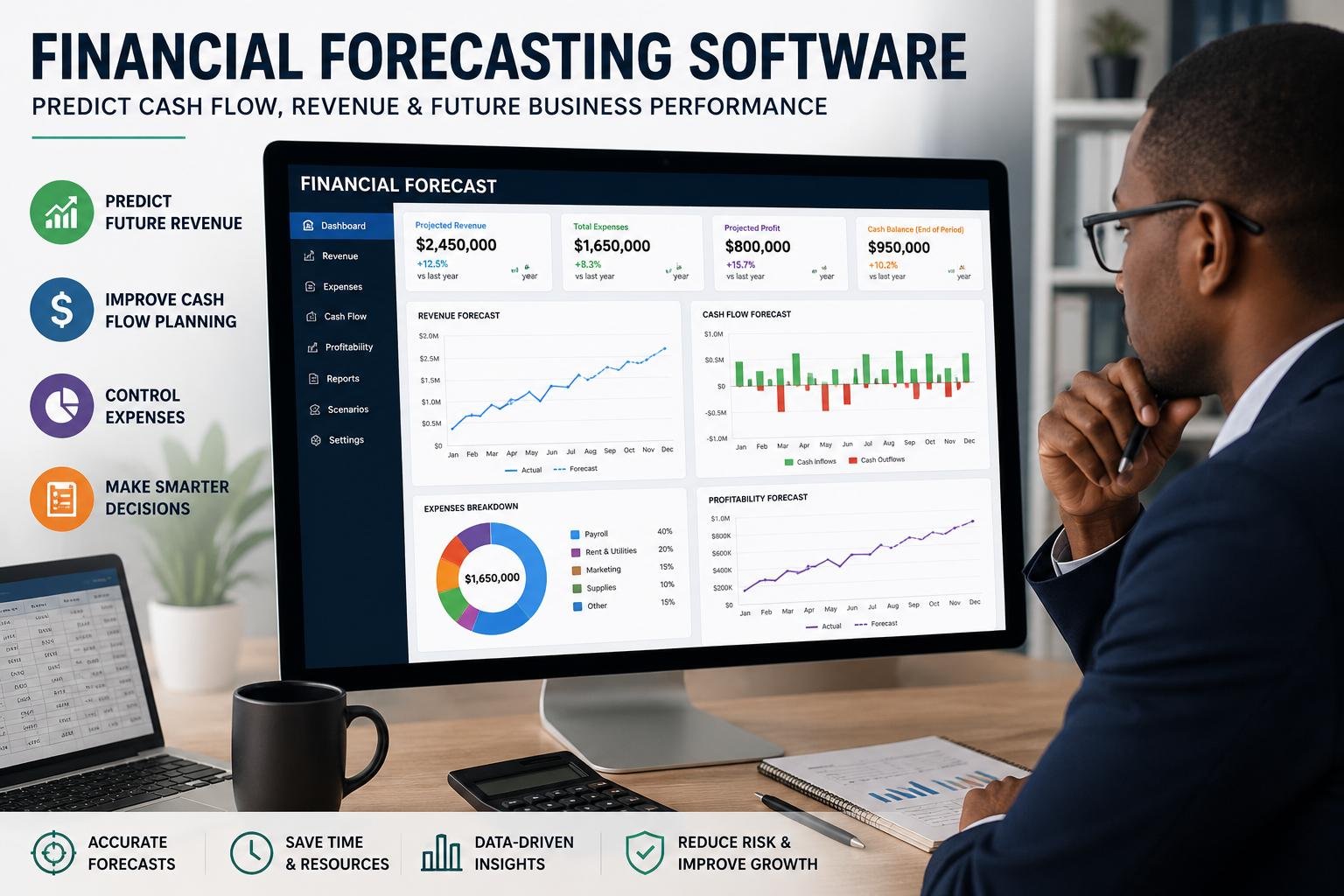
Traditionally financial forecasting has relied on spreadsheets, historical reports, and the knowledge and estimation of what may occur in the future. Yet these techniques are still applicable, and, more and more, technology is being used to improve forecasting processes to make them quicker, more regular and easier to update. Financial forecasting software can compile past financial data, present business information, assumptions, and analysis to predict future revenue, costs, cash flow and financial performance. By eliminating the need to do manual calculations, forecasting software enables finance teams to focus more on analyzing results and making decisions. This is especially useful in markets where the prices fluctuate rapidly, customer demand is volatile, operating expenses are subject to change or business operations are driven by priorities and need to change rapidly to meet the demands of the businesses.
Financial Forecasting Software: What is it all about?
Financial forecasting software is a technology product that can assist businesses to make their future financial projections based on the financial and operational information available. Companies would rather not have to make all forecasts manually in different spreadsheets; software can be used to order and apply forecasting models that can predict future income, expenses, cash balance, profitability and any other significant financial measure. Information can be pulled from accounting systems, enterprise resource planning systems, customer relationship management systems, payroll applications, banking applications, and other business applications, depending on the platform. This information is then combined in the software with assumptions for expected sales growth, pricing changes, hiring plans, and supplier costs, and planned investments. As a consequence, management can now see the financial picture ahead of them with a keen focus when it comes time to prepare budgets, review opportunities and anticipate potential financial issues before they arise.
How Technology Utilizes Historical Financial Data.
One of the most critical inputs to a financial forecast is the historical financial information since past business performance may be a good indicator of patterns and relationships. Forecasting software can take into account previous sales, operating costs, payroll amounts, accounts receivable and accounts payable, gross margins, and even cash movements, to develop a baseline that can be used for future projections. For instance, a business may find that there are months of the year when sales are always high and months when there are always high expenses when production is increased. Forecasting technology can process a tremendous amount of historical data and factor in recurring patterns to forecasting models, as opposed to simply relying on a person to identify these patterns. But past trends should not be assumed to be a forecast of future events. When evaluating the extent to which historical trends should be used to inform expectations, businesses need to take into account the changes in their market, customers’ expectations, pricing, staff, suppliers, and business strategies.
Converting Business Assumptions to Financial Projections
Historical data is a starting point; forecasting is an art that also involves assumptions regarding what the business expects to do next. With financial forecasting software, finance teams and managers can add in variables that can impact future results. They could be based on projected revenue growth, product pricing, salaries to staff, hiring, rent costs, marketing spending, loan repayments, taxes or planned capital purchases. After entering these assumptions the software can determine the impact they could have on the revenue, expenses, profitability and cash flow for a chosen period of time. This makes it easier to experiment with various scenarios without having to recreate the whole spreadsheet if there’s a change in an assumption. Should management be planning on achieving a 1% increase in sales in one scenario and a different percentage in another, the software can calculate the financial impacts of those two sales growth levels and assist management to understand what impact each growth level may have on the business.
Predicting Future Revenue
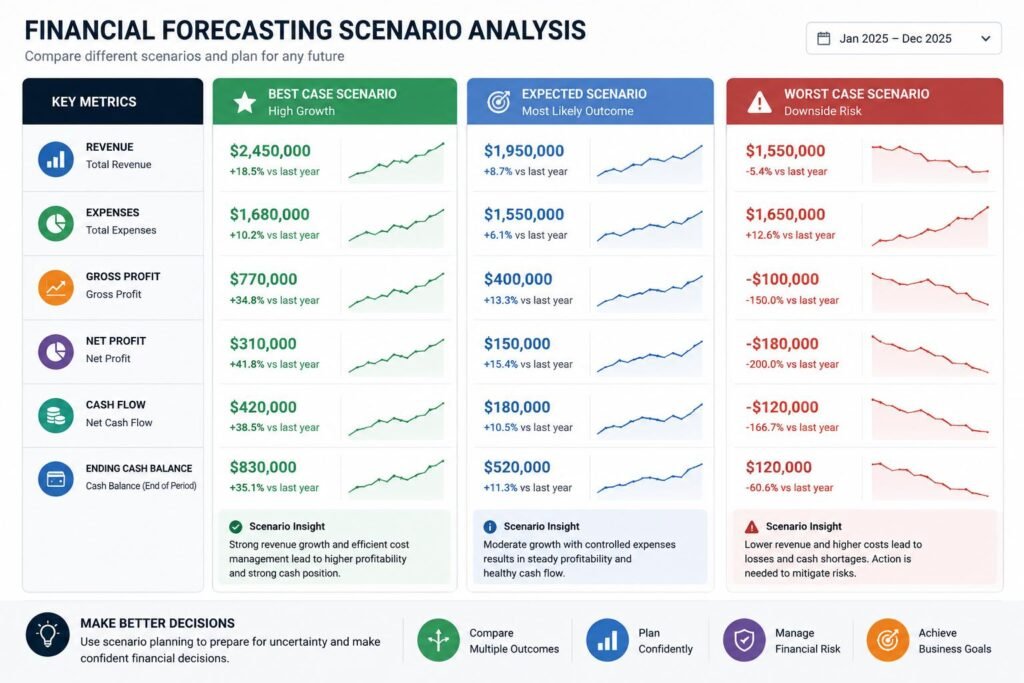
Financial forecasting technology plays an important role in revenue forecasting since businesses have to make many financial decisions with an estimate of the revenue that they will receive in the near future. By analyzing historic sales data, customer behavior, product demand, seasonal trends, pricing trends, sales pipelines and more, forecasting systems can come up with revenue forecasts. In addition, businesses can use historical trends and management expectations, for example, the projected contribution from the introduction of a new product, new customers, expansion into a new market or a planned marketing campaign. The more sophisticated platforms can also enable businesses to establish various revenue scenarios, instead of relying on a single projected income figure. A conservative estimate may suggest a downbeat customer growth rate, whereas a more optimistic estimate may suggest a high growth rate for customers. These scenarios can be compared to help businesses prepare for uncertainty and prevent making important decisions (about spending or investing) solely on an overly optimistic revenue expectation.
The Prediction of Expenses and Profitability
In addition to predicting revenue, it’s essential to also predict expenses; otherwise, good sales do not always result in good profits, or enough cash. Recurring and variable expenses, such as wages, rent, utilities, technology subscription, inventory purchase, marketing, transportation, financing cost and more operating expenses can be forecasted by forecasting software. The system can take into account the expected income as well as the projected costs, which can be used to estimate future gross profit, operating profit, and other performance measures. This enables management to gauge the consequences of spending variations on profitability before giving them a go. For example, a company that wants to hire more people may simulate the salaries and related expenses for the new employees while forecasting the income these staff members will generate, and see if the increase seems financially viable. Similarly, management can try and measure the impact of the supplier’s price rise or higher operating costs and decide if a change in prices, spending or resource allocation might be needed to ensure that margins are maintained.
Understand and Monitor Cash-Flow.
One of the best uses of financial forecasting software is cash-flow forecasting since profitability doesn’t necessarily mean cash is available. If a business’s customers pay late, if inventory uses up a lot of the business’s cash, or if there are big bills that fall due before they receive the money from customers, the business may be making a profit, and yet still be short of cash. Forecasting technology can be used to integrate information on when customers are likely to pay and when suppliers are due for payment, and on payroll and tax payments, cash flow from debt repayments, and other cash flows in and out, to predict cash balances in the future. This can help management determine when it might be difficult to obtain cash flow. Having early visibility will allow businesses to act before the debtors notice, to collect unpaid bills, or adjust payment timings, slow down any non-essential spending, organize financing or even delay purchases. Management can see from the forecast information when the cash-flow is on the verge of becoming a problem and take corrective measures before it is too late.
Importance of Artificial Intelligence in Financial Forecasting
AI is becoming a more prevalent factor in the processing of data and pattern recognition of financial forecasting systems. While traditional forecasting models typically rely on formulas and assumptions, AI-based models can analyze vast amounts of data and identify patterns that might not be easily recognized through manual analysis. AI can help to analyze historical patterns, provide recommendations for changes to financial models, or help identify trends and changes that are unusual. As more data gets added to machine learning models, they can become more useful as well, but only if the data that is fed into the model is high quality and relevant to the model. AI should thus be used as an aid to, not a substitute for, financial judgment. Even though a finance professional has completed the steps listed above, he or she must still look at assumptions, discuss odd findings, comprehend business issues, and decide if a forecast is reasonable in the context of the organization’s objectives and environment.
The Concept of Scenario Planning and what-if Analysis
There is one important benefit to forecasting technology: the ability to do scenario analysis without having to pick up the bricks and start over with a new financial model. Businesses don’t always have a clear idea of what the future will bring and when planning for various thoughts is more beneficial than a single prediction. Financial forecasting software can enable users to build scenarios of the best, expected, and worst cases by varying assumptions, including sales growth, customer payments, expenses, borrowing costs, or staffing costs. Management can then measure the impact of these changes on revenues, profits and cash flow. As an illustration, a firm that is considering a growth may simulate what takes place if sales increase at the forecasted rate, increase at a lower rate, or increase at a higher rate. By developing a scenario plan, decision makers can gain greater insight into risks and opportunities and help ensure they have contingency plans in place before the event becomes financially challenging.
Plan Budgets and Financial Plans.
Another benefit of financial forecasting software is that it can enhance budgeting by linking future performance with future spending and business goals. The traditional budget is usually made on a time-limited basis and may not be as useful if the circumstances of the business change greatly throughout the year. With the latest financial and operational data, forecasting technology can help make updating forecasts easier. This makes the planning process more dynamic and enables management to review the outcome of the process in relation to their expectations and adjust future projections accordingly. For instance, if the revenue is always less than expected, the business can revise the forecast and evaluate if there are any changes to the business expenses or investment plans. Likewise, if the company produces greater than anticipated results, it could present chances to make further hires, market its products, buy equipment, or expand its operations. Integrating budgets with continually revised forecasts allows businesses to plan more flexibly, rather than accepting the initial annual budget as a fixed plan.
To Improve Investment and Business Decisions
When business owners need to make decisions about whether they can afford to make large investments, expansions, acquisitions, hire new employees, upgrade technology, or any other large expenditure, they need to make the decision. Forecasting software can be a structured approach to analyze the impact of such decisions on future financial outcomes. Management can input expected costs and potential returns into a forecast and analyze them in relation to their effect on revenue, profitability and cash flow. It doesn’t mean that an investment will be profitable, but it does give a better financial justification for making a decision. Forecasting can also indicate whether or not the business will have enough cash to make an investment without outside financing, or if there is a need for external financing. Decision-makers are able to learn about the financial risk of an investment and what would make the investment more or less appealing based on different scenarios.
Early Detection of Financial Issues
One of the major advantages of financial forecasting technology is that it provides a much earlier warning of financial issues. A forecast can be useful in identifying warning signs like a fall in revenue, or in rising operating costs, a dwindling margin, slow customers, growing debt loads, or cash shortages. Earlier identification of these signs means management can take time to delve into the reasons and take appropriate action. For instance, if the finance team is forecasting a cash crunch that will occur in a few months, they might want to push the collection of receivables up to the next level of urgency or re-evaluate planned spending. In the case of a gradual decrease in expected profitability, management will consider price, supplier costs, productivity, or product performance. Early identification does not remove financial risk, but it can help take an unexpected crisis and make it one that can be planned by providing the time to think of other options.
Selecting the Correct Monetary Forecasting Software
There are different financial planning needs for different businesses and should be carefully considered when choosing a forecasting software. A small business might want simple cash-flow estimates and an easy integration with its accounting system, while a larger business would need more complex scenario planning, departmental budgets, forecasting models, reporting features, and integration with multiple business apps. Data integration, ease-of-use, reporting functionality, scenario analysis, automation, security, scalability, collaboration, and customizable assumptions are all important factors to consider. Businesses should also ask themselves if they need to use the software to forecast the period or financial metrics that is important to them. While AI can be beneficial, it’s important to not solely rely on it. A steady platform with clear calculations, beneficial reporting, and accurate data integration and practical controls may be more valuable than a platform that offers advanced features that can’t be utilized by the finance team.
Best Practices for using Forecasting Technology.
If the data and assumptions are poor, there is no reliable financial forecast that can be produced by technology. Businesses should have robust procedures in place for keeping accurate financial records and regularly examining the assumptions for forecasting. Past projections and actual results should be compared to find out where projections have fallen short of actual results, and why. Forecasts should also be updated when important business conditions change and not be kept the same for long periods. Finance teams should also engage the other relevant departments as the sales team, operations manager, procurement team, HR team may have relevant information that can impact on the financial expectations. Last but not least, businesses must not make forecasts as definite outcomes. A forecast is an educated guess that is made based on information available and assumptions made, rather than a sure thing. Then it’s viewed as a decision-support system and management stays flexible and ready for shifts in the marketplace.
Conclusion
Financial forecasting software provides companies an even more effective method of turning monetary and operational data into forward-looking insights. These systems can facilitate businesses to forecast their future revenue, expenses, profitability, and cash flow by utilizing historical data, business assumptions, analytical models, scenario planning, and more recently, AI-driven features. Because their value goes beyond the numbers – forecasts can help with budgeting, investment decisions, allocation of resources, cash management and the early detection of financial risks. Businesses should, however, keep in mind that technology is not a solution to uncertainty and cannot replace the human judgment. Good forecasting requires correct data, realistic assumptions, frequent updates and correct interpretation of the forecast results. Forecasting technology, if applied correctly, can provide more visibility for management on potential financial outcomes and allow the time and information to make decisions before future opportunities or issues turn into a financial reality.
Get more well researched information about Financial forecasting software here.