Introduction to Machine Learning in Everyday Life
The use of machine learning has revolutionised the way people use social, search, transportation, retail, financial, and electronic services. While it may seem like the coolest new technology and intricate AI systems, ML also powers many common applications people use every day. It allows the computer to detect patterns, make predictions, recognise pictures, understand words and do better in processing more information. For instance, a smartphone camera could automatically enhance a photo, a navigation app could predict when it’s likely that someone will reach a particular destination, and an online retail store could suggest items based on what someone has expressed interest in.
The features show some of the ways that machine learning can take in a ton of information and come up with something useful out of it. By studying these practical examples, one can gain insights into the real-life implications of AI and its significance in shaping today’s digital landscape, particularly the role of machine learning.
How Machine Learning Works
Machine learning is one type of artificial intelligence that enables a computer system to learn patterns from the data without being fully programmed. In traditional software, the rules are already defined, while machine learning models can learn from examples to predict relationships with new data. It usually starts with gathering the necessary data, then pre-processing it for analysis, and finally training a machine to identify patterns. A system that is trained with thousands of pictures could learn to identify both cats and dogs based on the shape, texture, or facial structure.
After the model has been trained it can analyze an unknown picture and approximate to which category it belongs. It can be tested with other data and, when new examples are received, it can be modified. There are various machine learning methods that can be employed for various tasks such as classification, prediction, recommendation, and anomaly detection. The machine learning capabilities are conducive in a range of industries as organisations can use them to solve problems which would normally require a lot of manual work.
Machine Learning In Smartphone Photography
One of the most obvious examples of machine learning in everyday use is the smartphone camera, as many of its functions rely on processing the image and automating camera functions. If someone takes a photo, the camera system can identify faces, scenes, objects, and can apply machine learning algorithms to select the appropriate exposures and sharpness to improve the image. The systems are trained from a large set of images showing various lighting conditions, subjects, colours and photographic situations. The patterns are used to identify a photograph as a portrait or landscape image or if it has food, buildings or people in it.
Other smartphones also stack multiple photos taken in a short time together to minimize noise, enhance brightness and retain details under difficult lighting conditions. Machine learning can be used to figure out which of these images to combine to yield a better image. These processes occur rapidly, so users can capture better photos without knowing the complicated camera settings. The evolution of the smartphone camera has seen the incorporation of increasingly sophisticated photographic techniques, with the help of machine learning, into the hands of the common consumer.

Machine Learning in Search Engines
Machine learning assists search engines with finding the relevant information in vast amounts of web pages, images, videos, and other digital content. If people type a word into the search box, the system has to understand their meaning, what they are likely to be looking for, and which of the available results will be most useful to them. Machine learning models are trained with data like search queries, web page content, language usage, relevance ratings, and user interaction with search results. This information enables the system to identify word relationships, question similarities and guess what pages might contain the answer to a user’s query.
A search for a nearest drug store, for instance, should ideally result in articles about pharmacology that are useful to the local searcher, and not general articles about pharmacology. Machine learning can also be used to decipher spelling errors, understand similar phrases and more, and even identify content even if the query doesn’t match the exact wording on the webpage. The resulting rankings will better enable users to find information faster. But search engines have to deal with problems of stale content, inaccurate information and sometimes the variation in how people ask the same question.
Machine Learning and Streaming Recommendations
Machine learning is able to suggest movies, TV shows, documentaries, and other media that fans might want to watch on streaming services. In a more intelligent approach, recommendation systems consider the browsing history of users to predict their preferences, rather than showing them the same list of titles. This data can contain programmes watched, viewing time, search usage, ratings, saved programmes and interactions with suggested programmes. Some models also take into account how similar users are, and relationships between the various titles, depending on the type of service. For instance, a person who frequently reads science fiction movies can be provided with suggestions for different stories on futurism, space exploration and so on.
The system learns what attributes and perspectives are correlated to specific selections after which takes this learning into account to rate recommendations that are possible. It simplifies the user’s task of finding entertainment that is relevant for him instead of searching a catalogue. If you want to look at some of the films and TV shows that are available, you can also check out the streaming recommendations of the shows that they recommend. But recommendation systems are not infallible: history of viewing does not always reflect present interests and excessive personalisation can restrict exposure to unfamiliar genres.

Machine Learning for Navigation and Traffic Management
Machine learning can be utilized in navigation apps to forecast travel times, identify traffic jams and suggest alternate routes that can aid individuals in reaching their destinations efficiently. The systems analyze data from various sources such as GPS signals, previous traffic behavior, road networks, accident reports, as well as location data if available. Machine learning models analyze past and existing traffic patterns and can establish correlations between traffic data like time of day, road conditions, and travel time. For instance, heavy traffic may occur on a road during the morning rush period and the system may be able to anticipate delays on that road before a driver arrives there.
The application can be updated once new traffic information is available, and other routes can be suggested. These predictions are particularly valuable in busy cities, where traffic conditions can change rapidly. Machine learning can also help navigation systems optimize estimated arrival times by analyzing and matching the reasons behind travel times. While they can’t solve traffic jams or ensure the quickest route for drivers, delivery firms and transport organisations in every scenario, it can certainly aid them in making better educated travel decisions.
Artificial Intelligence in the Retail Sector and AI in eCommerce
Machine learning is employed by online shopping platforms to gain insight into customer preferences, enhance product discovery, and aid business decision making. An online store might gather data on products searched, purchased, clicked, reviewed and added to shopping carts, as per the privacy policies of the store and relevant laws. These patterns are used to train machine learning models to predict products that individual customers or groups of customers with similar preferences might want to purchase. For example, if a user requests a laptop, related accessory suggestions might be provided, and if a customer requests a book of a specific type, they may also be offered other books of the same type.
Recommendation systems can also be used to categorize products and to forecast what products will be of interest. In addition to recommendations, machine learning can also help with inventory planning by analyzing past sales data, seasonal trends and other factors to predict future demand. These features enable companies to handle stock, boost client satisfaction, and make better use of resources. But the recommendations can be less helpful if customers have incomplete or out-of-date information. Companies should also manage personal data responsibly, and refrain from using machine learning in ways that infringe on the rights of customers and limit their options.

AI for Banking and Financial Services
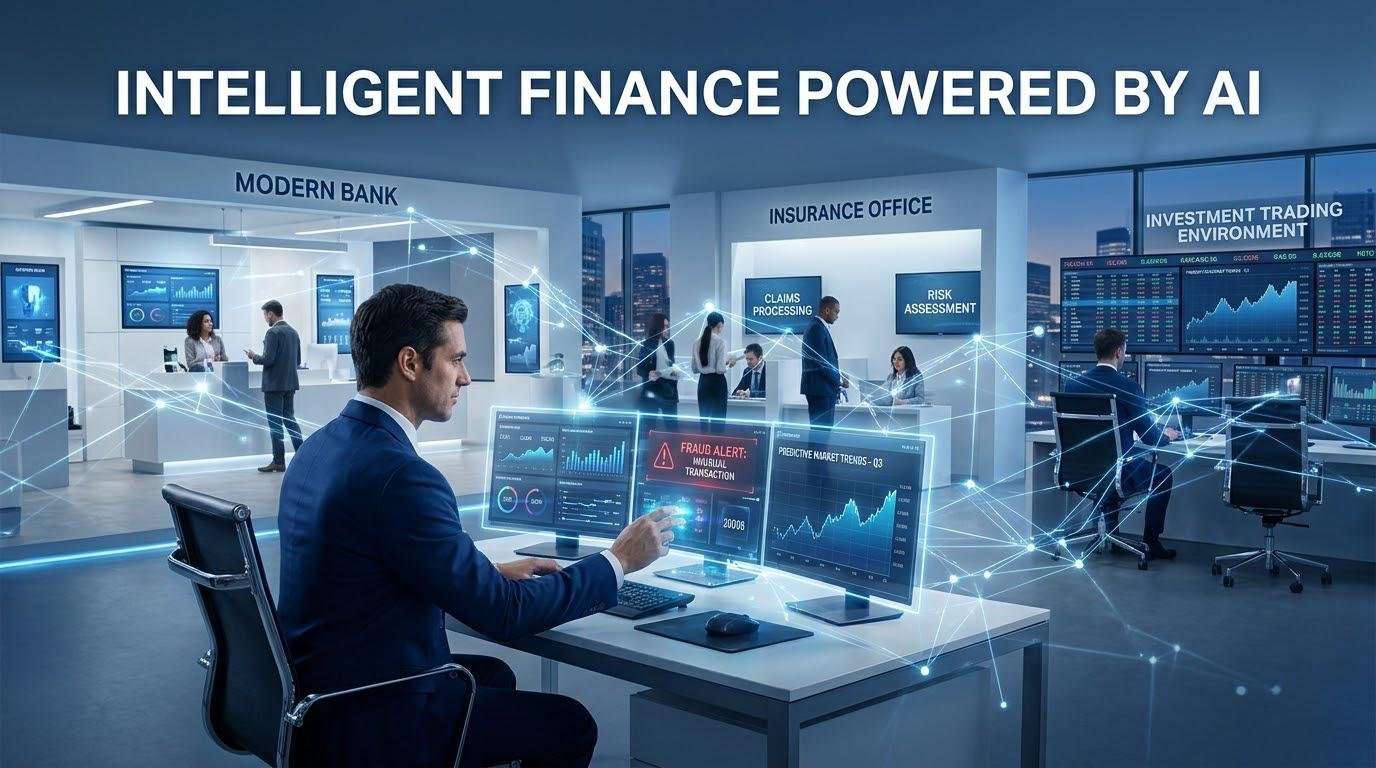
In banking and financial institutions, machine learning applications include fraud detection, transaction monitoring and customer service, as well as some aspects of credit risk assessment. Large volumes of information are produced during financial transactions, such as transaction values, time stamps, merchant information, account activity, and more. Patterns can be analysed by machine learning models to determine their deviation from the normal activities of a customer and find activities similar to that of previously detected fraud. For instance, if a transaction is significantly different from the typical activity of an account and includes other features of suspicious activity it may be subjected to further investigation.
The system can flag the transaction for additional review or, as per the policies of the institution and the risk level, initiate more checks on the transaction. Machine learning can also be used to analyse customer enquiries, automate certain administrative tasks, and predict some financial risks for banks. The applications enable institutions to provide efficient information processing and focus on possible severe issues. But not everything that looks like a transaction is actually fraud and sometimes legitimate customers are falsely warned of fraud. Financial institutions must therefore have the right protections in place, humans to monitor them, a clear procedure for settling disputes and routine checks to be sure that systems stay accurate and fair.
Administrative Application of Machine Learning for Healthcare
In healthcare administration, machine learning aids medical institutions to structure information, manage appointments, process documents, and optimise overall operations. Administrative information – such as appointment records, patient registration, billing, lab requests, and insurance claims – is stored in vast amounts of data in hospitals and clinics. These records can be used to track patterns and automate some mundane tasks using machine learning systems. A hospital could, for instance, use the historical appointment data to predict and then schedule staff or appointment time slots more effectively during times of high demand. Document-processing systems can also be used to identify information from documents and sort the documents for further processing.
In some places, machine learning can help identify incomplete insurance claims, or odd billing habits, allowing administrative staff to investigate anomalies before claims are paid. The applications can help to eliminate repetitive tasks while allowing healthcare professionals to spend more time with patients. But health information is especially vulnerable, and systems must ensure that they only have access to the information they need to access and have appropriate access restrictions, and meet relevant data protection requirements. Machine learning should complement, and not supplant, qualified professional judgement, particularly when administrative predictions have the potential to affect access to medical care or other critical choices.
Machine Learning in Cybersecurity
Machine learning helps cybersecurity teams to detect suspicious digital activity, flags potentially dangerous scenarios, and reacts to cyberattacks faster. Computer networks generate vast amounts of data such as access to digital resources, software usage, network traffic, and login attempts. It’s often hard to analyze all the events manually, especially for companies with extensive networks. Machine learning models learn patterns from normal activity, and then use these patterns to compare new events to detect potential anomalies. Login attempts, for instance, that fail repeatedly, anomalous access to the network or unusual behaviour may be a sign of a security issue that needs to be investigated.
Several systems can also scan examples of malicious software and suspicious messages to look for characteristics that are known as threats. These capabilities enable security teams to prioritize alerts, and get a faster response to incidents. However, machine learning is not flawless in recognising all attacks, and there may be false alarms when there are legitimate activities. Cybercriminals may also change their techniques to avoid detection. So, a good cybersecurity strategy integrates software updates, access controls, encryption, employee training, human effort in investigation and a defined incident response plan with machine learning. This gives a better level of protection than just automated detection.
Machine Learning for Email Filtering and Spam Detection
Another common example of machine learning in action is email filtering, which aids individuals in organizing their electronic correspondence. Valuable e-mail is mixed with advertising, offers that are not legitimate, phishing and junk e-mail. Machine learning models can examine the characteristics of a message, including the wording, sender details, links, formatting, and spam signal patterns, found in previously reported spam. In training, the models are taught which associations of properties are typical for undesirable and possibly harmful messages. New emails automatically are predicted when they come in and if they are predicted to fit into the inbox, the system categorizes them as such, if they are predicted to fit into the spam folder, then it categorizes them there, or if they are predicted to fit into a different category, the system categorizes them there, too.
There are systems that are able to detect suspicious links or messages disguised as trusted organisations as well. These capabilities can help to shield users from some online dangers and help them avoid having to read lots of unwanted information. The problem with spam detection, however, is that it is not guaranteed to be perfect. A genuine email can end up in the wrong place, and a well-crafted fraudulent email can go unnoticed. They should, therefore, check their spam folders when they are expecting an important message and be wary of any unsolicited requests for passwords, payment or confidential information. Email filtering is a perfect example of how machine learning can enhance our everyday digital interactions, without eroding the need for careful human reasoning.

Machine Learning for Voice Assistants and Speech Recognition
Machine learning is the technology that turns spoken words into information that computers can use, such as voice assistants and speech recognition. These technologies are found in mobile phone assistants, dictation software, smart speakers, accessibility software and voice-controlled apps. Speech recognition models are trained on audio recordings along with written transcriptions, allowing them to learn the relationship between sound patterns, words and sentence structures. Given a voice command, the system analyzes the speech and infers what the words are. Other machine learning models can then analyze the request and take an action or return a reply that is suitable for the request.
For instance, a user may request a forecast, reminders, or dictate without typing. The technology also can aid individuals who struggle with a traditional keyboard or reading on screens. But background noise, unfamiliar names, regional accents, and languages that aren’t well represented in training set data may cause problems with speech recognition. These restrictions highlight the need for a variety of training instances and ongoing assessment. Speech technologies are making digital services ever more convenient and accessible to more people, as they improve.
Advantages and Disadvantages of Machine Learning in Daily Life
There are several advantages of machine learning, such as better predictions, reduced repetitive work, and personalised services, and faster information processing. Machine learning systems can aid people identify patterns in massive data sets to locate information, uncover amusement, navigate new roads and defend digital accounts. These are the same capabilities that may be leveraged to enhance planning, identify unusual activity, control resources and ensure that processes are more efficient. In spite of these benefits, there are significant challenges to machine learning. Models are only as accurate as the information on which they are based are complete and relevant, and information that is incomplete or biased can lead to inaccurate or unfair results.
Another concern is privacy, as some applications are based on personal data, patterns of behaviour or location information. Automated systems can also make errors that aren’t easy for a user to comprehend or question. Also, recommendations can limit the information that people are seeing, and the fraud detection system might misclassify normal behavior. To implement responsibly, organisations must ensure the data is protected, test their systems regularly, constantly monitor their systems’ performance, and have appropriate human oversight. Users can gain insights into the pros and cons of machine learning and leverage its utility without expecting that automated decisions are invariably accurate.
The Future of Machine Learning in the Real World
Machine learning will increasingly be embedded in daily activities as more and more varieties of information are gathered by digital services and will be captured into more powerful models. Smartphone apps could also get better at image processing, access and language recognition, and navigation systems could get more advanced in predicting disruptions and estimating travel times. The recommendation could be more relevant in retailers and streaming services and the financial institution could improve their capacity to detect suspicious transactions. In healthcare organizations, machine learning could also be used to aid administrative planning and minimizing delays in routine tasks.
All of this, however, will need to be handled carefully with considerations of transparency, privacy, security and fairness. More complex systems don’t necessarily lead to better results, especially when predictions are used to make decisions with important consequences for people. Organisations will have to assess whether machine learning is actually addressing a challenge, whether the data it is using is suitable, and whether human contrary will be possible to the incorrect findings. Public understanding will also continue to be relevant as people who have an understanding of how these systems work will be better able to identify their limitations and be able to make informed choices about the services they use.
Conclusion
Machine learning is moving beyond the research lab and specialized technical setting and is now a part of daily digital life. It is used in various aspects of computer systems to identify patterns, make predictions, and automate specific tasks, ranging from generating recommendations in streaming services to navigating, searching, and performing online tasks, such as banking, healthcare management, and cybersecurity. All applications require data, which can be used to train a model on the relationships specific to a particular problem. The resulting forecasts and the resulting classification can aid people in finding information, carrying out activities efficiently, and making informed decisions.
But good machine learning still requires good data, good design, and continual assessment. It can be wrong, it can be biased, it can give rise to privacy issues. Understanding these restrictions is crucial to responsible technology use. Through understanding the practicality of machine learning behind commonly used applications, individuals can build a solid base of understanding in AI, appreciating the opportunities it affords, while also gaining understanding of the responsibilities of continued evolution.