Introduction
Technology has transformed the way we communicate, work, shop, learn and solve day to day issues. We see in today’s digital tools many of the tasks which once required human intelligence played out by machines which include recognizing speech, identifying items in pictures, product recommendations, and detection of unusual activities. Also at the forefront of this is machine learning. It enables computers to identify patterns in data which in turn are used to make predictions or decisions without us having to program in specific responses for each and every issue. For example email services which learn to filter out unwanted mail, and shopping sites that put forward product recommendations based on what a customer may be interested in. Also it is in these systems’ advantage that they are able to look at info in a different light and to see relationships which may not be so easy to notice by hand.
Machine learning is a field within artificial intelligence which focuses on the development of computer systems that improve performance based on data input. Rather than run on fixed instructions these systems use math to identify trends and apply what they have learned to new sets of info. What we see is that this area has grown in importance as today’s organizations produce large amounts of data which in turn can be used to better inform decisions, automate repeatable tasks, and create more personalized digital experiences. We see machine learning as a way for beginners to understand how many modern tech tools work and why computers are able to take on more complex tasks. This guide goes over the basic principles of machine learning, how it is different from traditional programming, the main steps in the creation of a machine learning system, and the practical applications which make it a valuable component in our daily lives.

What is Machine Learning?
Machine learning, which is a branch of artificial intelligence, allows computers to learn from data and examples instead of which we may exclusively use which program’s written rules. In a machine learning system it looks at information, identifies trends and uses these trends to present predictions, classifications, recommendations which in turn present useful output. For example a computer may analyze thousands of photos labeled as that of cats or dogs and determine what visual elements best tell the difference between the two species. After the training is completed the system looks at a new photo and puts out a prediction of which animal is in the picture. The computer does not have a programmer to go in and describe each and every animal photo that may come in, instead it creates a math based model of the trends present in the training material.
Machine learning is not to be defined by how computers learn as humans do. We learn from our emotions, experiences, reason, physical interaction, and social relationships, which are very different from what machines do. Machines on the other hand identify trends in data which they have been fed via mathematical algorithms. Also their performance is a result of data quality, choice of algorithms, and how they are trained and evaluated. May do very well with what they are familiar with but may fail when presented with information that varies greatly from what they were trained on. Thus it is best to think of machine learning as a tool which we use to get computers to recognize patterns and make predictions, not that the computer has the same understanding a human does.

Difference between Machine Learning and Traditional Programming
Traditional programming and machine learning are different in the ways in which they approach the computer problem at hand. In traditional programming a developer puts forth instructions which tell the computer precisely how to act out in given scenarios. For example a simple program that computes the total price of items in a shopping cart has a structure which the programmer gives it. If the values of the prices and the quantities are known, the program multiplies each price by the respective quantity and sums the results. The computer follows these instructions given to it and produces the expected output. This approach does very well when the issue at hand has definite rules and the steps that must be taken are precisely defined in advance.
In some cases what we do is we develop a set of very specific rules to address all the issues at hand but that’s not always the best approach, take for example an email spam filter. What it may put into that email box are words that you didn’t expect, different types of formats, links, and writing styles which makes it hard to create a full out list of rules that will catch everything. What a machine learning system will do is it will look at spam and non-spam emails, see what patterns are present in each group, and then use that info to sort out new emails. Also as against the traditional programming that is very rule based in nature we have machine learning that is example based in its approach. Both of these approaches are of value and in fact many present day solutions use a mix of both. In a banking environment for example they may use pre-determined rules for what the account limits are and also will have machine learning in play to notice out of the ordinary transaction trends.
Fundamental Ideas of Machine Learning.
Machine learning becomes easier to grasp when it is broken down into its core ideas. For instance we look at data, algorithms, models, training and prediction which are at the root of what we do in this field. Out of these components comes the whole system that is able to carry out certain tasks.
Training Set.
Training data is what we use to teach machine learning algorithms to recognize patterns. It may include numbers, text, photos, audio recordings, customer transaction info, or any other type of info. For instance a system which we design to spot spam email requires samples of messages which have been labeled as spam and which have been determined to be legitimate. The labels help the system out in determining what features are associated with each category. Also a system which puts forth home price predictions will use past info regarding property size, location, age and past sale prices. The examples form the base which the system uses to make its predictions.
The quality and diversity of training data is a key element of machine learning model performance. If the info is inaccurate, incomplete, out of date, or doesn’t represent real world situations the model will put out poor results. For instance a voice recognition system which is trained mostly on audio of a certain accent may do poorly with other accents. We collect proper data, we correct what we can, and we see to it that we have representation of all groups and situations which we are trying to model that will improve performance. But also it is not the case that the more data the better we must have data that is relevant to the task at hand and we must design the training process in a way that the system learns from what is truly there and not from what is not there.
Sets of rules.
A machine learning algorithm is a math based approach we use to identify patterns in data and develop a model. We have different algorithms for different types of issues which is an important element of building a successful system out. For example some algorithms do well with email classifying, others are better at predicting numerical values, grouping similar customers, or recognizing patterns in images. Decision trees, linear regression, logistic regression, and neural networks are examples of machine learning methods. Each algorithm has a different way of looking at info and which is the best will depend on the data you have, the problem you are trying to solve, the accuracy you require and the resources you have.
An algorithm doesn’t produce perfect results as a matter of course just because it is applied to a data set. Developers must put in the work to choose the right parameters, clean the data properly, and analyze the results which in turn improve the model. Some algorithms are very basic and easy to break down, while others present a great degree of complexity which in turn requires more computing power. For example a linear regression model will determine a numerical value by which variables are related, at the same time a neural network will learn from complex patterns in images, audio or text. Also it is important for developers to know what they are trying to achieve with an algorithm which in turn will guide which method to use instead of thinking that one machine learning technique will work for any issue.
Artificial Intelligence Models.
A machine learning model is the outcome of a learning algorithm’s application to training data. As the model trains, the algorithm changes the internal parameters which in turn help the model to identify the patterns that it will use for performing the task at hand. Once trained the model is put to work at which point it will produce an output based on what it has learned. For example, a model which is trained on past home sale prices may determine the likely price of a home based on the size of the home, the location, and other features. Also the model does not just memorize prices for each individual home rather it uses relationships it learned from the training data to come up with an estimate for a home it hasn’t seen before.
Models vary in terms of their complexity, accuracy, interpretability and computational requirements. For some easy prediction tasks a very simple model may do the job, but for recognizing subtle patterns in images or understanding speech a more complex model is required. That said, complex models don’t always outperform simple ones. A model which learns too closely to the training data may do well during that phase but perform poorly on new data which is an issue known as overfitting. We therefore use separate data for testing models and also adjust our approaches as required. The goal is to put forth a model which does well on what is unseen, not just what is seen in the training phase.
Prediction and Forecasting.
Prediction is out to use a trained machine learning model which in turn estimates an output or class of new data. What we also call as inference in machine learning is that process. Also it is a fact that the term prediction is not strictly for the future. Which is a system that determines if an email is spam at present is a prediction of the email’s category, although the mail is a present entity. Also a voice assistant which turns speech into text uses a model to predict what words best correlate to what it heard. These outputs are based on what was learned during the training phase and also may include a confidence score which indicates how strong the model stands behind a certain result.
The predictability of a model’s output depends on how well it mirrors the real world issue at hand. A spam filter may mislabel a non spam mail as spam at times, also a purchase recs system may put out a product which the user has no interest in. Developers identify these errors then work to improve the models. In certain applications the prediction is the go ahead for a machine to take a stand alone action, in other cases it is used to support a human decision. For example a machine learning model may bring to a bank’s attention a possibly out of the ordinary transaction for further look into instead of locking out all strange payments. By looking at how models perform in the field we are able to see how they play out in practice post the learning phase.
Meaning of Machine Learning
Although different we see that some machine learning systems use distinct approaches but many of them go through a very similar development stage. This stage which we may say is a template begins with identification of a problem, we then see data collection which is very key, preparation of that data, choosing an algorithm that best fit the problem, training a model based on that choice, evaluation of the model’s performance which is very critical at this point, and finally putting that model out there for practical use.
These stages are what transform a very broad general idea or issue into a tangible technical solution. For example a company which is looking to predict which clients may cancel their services will have to first define just what is meant by client drop off, get access to the past reports that may have such info, and also determine which elements may be associated with client leave. Then the team can train a model from that and check if what it is putting out is accurate enough to make a good decision for the business.
Outlining the Issue and Gathering Data.
The first step we do is to put out what the system is to achieve. A clear goal is which in turn defines what info is needed and how we will measure success. A company may wish to go after that which is unusual in financial transactions, a hospital may go after the analysis of medical images, or a retailer may want to put forward product recommendations to customers.
Each of these tasks will require different data and evaluation methods. After we define the goal we get relevant info from the right sources which may include historical info, customer interaction, labeled examples, or authorized data sets. The collected info has to be relevant to the end use and also handled in a responsible manner especially when it includes personal or private details.
Gathering the data.
Raw data has issues like missing values, duplicate records, out of range or incorrect data which in turn affect the machine learning results. In which case we do data preparation which is the process of identifying and fixing these issues prior to training a model. For example a set of customer age data may have blank fields or wrong values.
At this point a team has to clean up the errors, determine what to do with missing info, and transform data into a format that the algorithm will accept. In many projects we also see the practice of breaking the data into training, validation, and test sets. These groups of data are used to build out the model, to try out different approaches, and to see how the model does on data that did not go into the training phase at all.
Training and which models to use for Evaluation.
During which a model is put through its paces the algorithm looks at the training data and changes what it is doing in an attempt to do a better job at what it is trained to do. What method is used for the change is a function of the algorithm which we are working with. For instance a model which puts a price tag on homes may put out a price which it determines from available info and then look at actual sale prices to see how it did and change what it is doing to reduce the error.
After the training is done developers get out of the training data which was set aside at the start and they run the model through a series of tests. They may look at how accurate it is, what types of errors it is making the most of, or other metrics which are relevant to the task. If the model does not perform well the team may go back and clean up the data, try a different algorithm, play with the settings, or relook at the problem at hand before they try again.
Release and Ongoing Improvement.
When a model does well enough for what it is supposed to do it can be put into an application, website, business process, or any other computer system. For instance an online store may use a trained up recommendation model to put forward product suggestions to customers as they shop. Also when a model is deployed that doesn’t mean the job of the developer is done.
The world and what users want from a product or service is in constant flux and the data a system is fed may change from the original training data. Thus it is the role of the developer to track performance, look into errors, and retrain models as needed. This is an ongoing process which in turn keeps machine learning systems relevant over time but at the same time care must be taken in these improvements to not introduce new issues or reduce the system’s reliability.
Primary Types of Machine Learning.
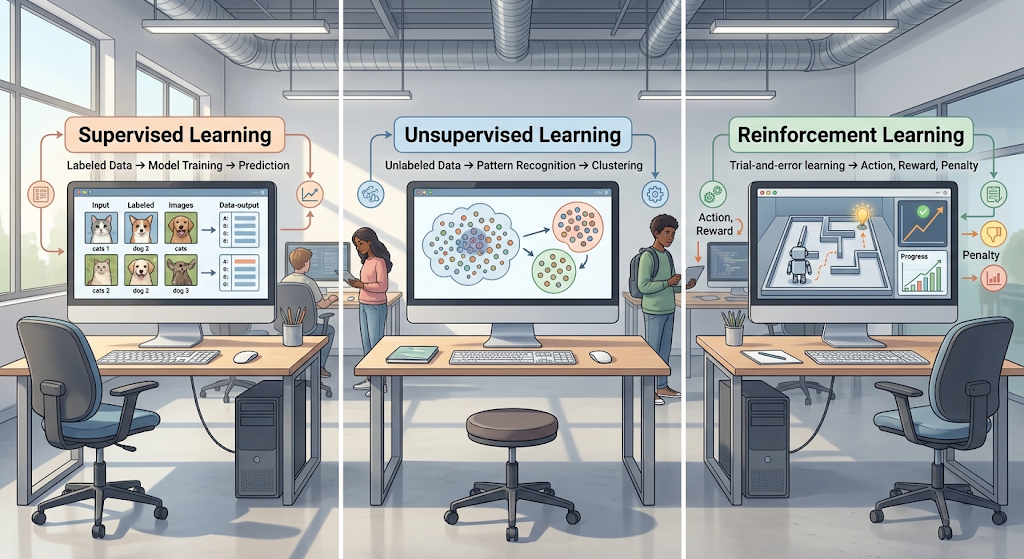
In the areas of supervised, unsupervised, and reinforcement learning we see which different sets of information are at play as the systems learn and grow to perform usefully.
Study of these areas forms the base which in turn allows us to see how machine learning may be put to use in many different tasks.
Trained Learning.
Supervised learning we see that it uses what we call training examples which also include what the answer is which is often referred to as a label. The algorithm in this case is learning from these inputs what the relationship is between the given info and the right answers so that it can in turn make predictions for which new examples it has not seen before. As an example a spam filter may learn from a set of emails that are marked as spam or not, also a model which determines home prices may learn from sets of home info that is paired with the homes’ sale prices.
Also which we see is that supervised learning is used for classification and regression. In classification we put info into categories, which may be as simple as determining if a transaction is fraudulent, in regression we are trying to predict numbers out, like what the sale price of a home will be. Also what determines how well these models do is the quality of that labeled data and also how well that which we are using to train the model represents what the model will see in the real world.
Clustering Algorithms.
Unsupervised learning uses data that does not come with preassigned outcomes. Instead of learning from given answers, the algorithm tries to identify structure or patterns within the data. For instance in customer segmentation we see a business which puts customers into groups based on similar purchase behavior. These groups may help the business to see what different customers prefer or to tailor better to those preferences.
Also we see the grouping of documents that are similar in content. Unsupervised learning is very useful when organizations have lots of info but do not have enough labeled examples to use for a supervised model. Also the results that it presents are not by itself meaningful so often the human element is still required to determine if the groups that are put forth are useful for the issue at hand.
Reinforcement Learning
Reinforcement learning is a field in which an agent is made to interact with an environment in order to improve its action decisions which it does by the means of getting rewarded or penalized. As time goes by the agent develops a strategy which is meant to maximize the total reward it gets out of the environment. This is a very useful approach in the fields of robotics, game playing systems, and some types of resource management.
For instance in a simulated robot setting the machine may learn what it takes to reach a target by which we give it a positive response for good actions and a negative one for errors. Also unlike supervised learning which requires a data set that has the right answers for each issue, in reinforcement learning the bulk of the learning happens via interaction and feedback. What determines the success here is the reward structure which we put in place and the environment in play. Also which paths the agent takes to get to solutions also plays a role.
Use of Machine Learning.
Machine learning has transformed what we see in modern computing which is in great part due to its ability to help systems work through large data sets, identify trends, and put out useful results. Also many of us use machine learning every day without even knowing it. In email we see it in the form of which messages are flagged as junk, in online shopping we see recommendations based on past purchases, in our media we have personalized content, in navigation we see improved routes, and in voice assistants we see almost instant responses.
What we are seeing is that what was once a research topic or specialized field has made its way into the everyday digital experience which also includes support for a wide range of tasks from weeding out that which we don’t want to seeing that which may be of interest to us.
Anti-Email Spammers.
Email spam filters present a common example of machine learning in practice. Email services see a large variety of messages which include personal communications, ads, newsletters, phishing attempts, and also a lot of unsolicited mass emails. A machine learning based filter looks at what it deems to be key elements of a message such as content, who the email is from, included links, and other related features to determine if a given email is in fact that of a spam.
In the training stage the system is given past emails that users have labeled as junk and it develops a model. Then it uses that model to sort out new messages. As the system goes through more data it’s also reworked or updated by developers to deal with new spam issues which in turn helps email companies to minimize what people get that they don’t want while at the same time not to put through what is important.
Online Store Recommendations.
Online shopping sites use machine learning to put forth product recommendations which are based on a customer’s past behavior, what they have bought in the past, what they rate products as, and what other items are similar to what the customer has looked at. For instance a person who frequently looks at tech books may be suggested other books in the tech domain or educational materials. Also a system may note what products are often bought together and put forth those as related or complementary items.
We see that recommendations are a guess at what a customer will like and what they will purchase it is not a sure thing. A user may get a recommendation that doesn’t play into their interest at all — the info we have may not fully represent what a customer likes. Also businesses have to think through issues of privacy, fairness, and transparency as they collect and use customer info for personalizing recommendations.
Voice Assistants.
Voice assistants use machine learning for better computer understanding of voice commands and response to users. As a person sets an alarm, searches for info, or plays a song via a voice assistant, the system has to capture the audio and out of that determine which words are said. In that process speech recognition models do the job of turning voice into text, and natural language processing does that which the user’s intent is to do.
Also other elements may choose what is the right reply or do what is asked. This is a tough job because people have different accents, speak at different paces, and use different pronunciations. Also background noise and unclear words play a role in recognition. Machine learning is used to get over many of these issues in speech but still at times voice assistants misinterpret the command or give out wrong responses.
Health and Transit.
Machine learning is a tool which health care professionals may use to analyze medical images, identify in clinical data what is normal and what is not, and to better organize info which requires more look at. For instance a model put together from quality medical images will put out what is typical and what is out of the ordinary for a given condition. Such models support health care professionals’ decision making but should not be seen to take the place of a health care providers’ analysis.
In transport we see that machine learning is used to determine traffic trends, to predict arrival times, and to recognize what patterns play a role in which route to choose. Navigation products may take in past traffic data along with present info to put forth which routes will most likely be the best. These examples put forth how machine learning plays a role in critical decisions, also at the same time they put into relief the issues of accuracy, proper supervision, and responsible design.
Advantages of Machine Learning.
One great advantage of machine learning is that it processes large sets of data at a rate which is beyond what people are able to do with their own two hands. Also it is able to identify trends, automate repeatable tasks, and to make predictions based on which it has collected info over time. In terms of business it is used to study customer behavior, to detect out of the ordinary transactions, and to improve recommendations, also researchers use it to find patterns in scientific data sets. Also it supports personalization by tailoring digital experience to individual preferences. For example a music streaming service may put forth song suggestions based on a user’s past action. When developed and monitored properly these systems may improve efficiency, reduce some types of human error, and help people to make better informed decisions.
Another key benefit of machine learning is that it is present in very complex relationships which are hard to put into rules by hand. In speech recognition, image analysis, and text interpretation many interacting variables are present. What we see in machine learning is that it is able to come up with solutions for these issues when it has proper data sets and computing power at its disposal. Also the fact that this tech can be updated as new info comes in which in turn allows systems to adapt to change. That said these benefits are dependent on which model is used and how well it is put together. Also machine learning does not in all cases improve speed, cost, or accuracy. In some cases a simple programming approach may be more practical, easier to maintain and less expensive than to go the machine learning route.
Issues in Machine Learning.
Despite its benefits , machine learning also has issues. Of which the most important is that it is very much a data dependent field. If we put out bad data in, we get bad data out also we may get incomplete data which also plays a role as well as unfair patterns in the data which the model will learn from. For example a system trained on past decisions which were made unfairly may end up reproducing those same unfair results. Also developers must look at the data they are using, study how the system performs across many different groups of people and then keep an eye on how it does once it is live. Also even with all that done we can’t say we have solved all issues. What is put in place must be an ongoing process of testing, have clear lines of responsibility and also think through the human impact of the algorithms which may be making decisions.
Another issue is that we see some machine learning models which are very hard to decode. A large scale model may produce very good results which at the same time do not present a simple explanation for what made that result. This issue plays out in fields like health care, finance, and hiring where we may need very clear reasons for key decisions. Also, machines may perform badly in new situations or when the real world changes from what was seen in the training data. Also, it takes large amounts of time, skill, and money to collect data, train models, and put up the needed computing infrastructure. Also privacy and security issues come into play when we are dealing with personal info in these data sets. These issues put into play the fact that we must choose which applications we put these models in very carefully, secure the data, do proper evaluation of performance, and that humans still have a large role to play in big picture decisions.
The Future of Machine Learning.
The coming years will see machine learning’s growth tied in with that of artificial intelligence, computing hardware, data processing, and automation. We see that researchers are working out new approaches which in turn help models to interpret many types of info at once: text, images, audio, and video. Also we are to report that which in turn is leading to systems which do better at tasks like writing, research, software development, translation and other complex work. Also we note that machine learning is put into the mix of tools used in education, agriculture, manufacturing and scientific research. For example in agriculture we see that which is supported by data from sensors and weather reports used to inform decisions around irrigation or crop care. As these technologies grow we will also see a focus not only on making models more powerful but also on improving their reliability, efficiency, interpretability and real world application.
To apply info and math to recognize patterns which in turn help solve problems and inform better decisions.
Conclusion
Machine learning is a key element of artificial intelligence that enables computers to identify patterns from data and use them to make predictions or to decide. We see that it is different from traditional programming which for the most part uses explicit instructions, in machine learning algorithms we give the computer examples and it develops models from them. At its base are training data, algorithms, models, training, and prediction which in turn play a role in the development of what we use to do useful work. We see mainly in supervised, unsupervised, and reinforcement learning which are the ways we get machines to learn from info and solve problems. These methods put in play in the development of from which we get out spam filters and shopping recs to voice assistants and health care research and transport.
For new learners, which is what we are dealing with here in this field of machine learning, it is not true that you require an in-depth background in math or that you have to be a programmer. We see value in first getting introduced to basic ideas and at the same time looking at real world examples as a foundation from which to do a more intensive study of the subject out there in the field. Also at the same time that we present these basic ideas it is important to note that machine learning tools are not infallible, they may present bias in their outputs based on biased input data and also have issues with which they perform in novel situations. Also we should note that which of these models work best is very much dependent on the quality of the input data, the skill in which the model is created, the proper evaluation of the model, and also the issue of who is in charge of the model and how it is used. As machine learning is brought into the mainstream of computer science, issues related to its inner workings will become more and which in turn will help people to be better consumers of the tech they are putting into play. In the end what we see as the value in machine learning is that it is a tool that computers use to identify trends in data sets and then apply that info to real world problems on a large scale and across many aspects of our daily lives.