Introduction
One of the most critical functions of an operating system is to manage memory; in order to run any program, it requires access to memory. Many users expect to have numerous applications running simultaneously on a computer, which has only a finite amount of physical memory, or RAM. It’s not just programs running on the computer that require memory; web browsers, text editors, media players, development tools, background services, and more also need memory at the same time. The operating system then needs to determine the allocation, monitoring, protection and reclamation of memory.
It also must allocate to each program the illusion of its own usable memory space, while several programs are accessed via the same physical device. The operating system must efficiently manage these competing demands using techniques including paging, segmentation, virtual memory, swapping, page faults, memory protection and address translation. Once you know these things, you can understand how computers work efficiently to run several programs and maintain separate and protected memory spaces.
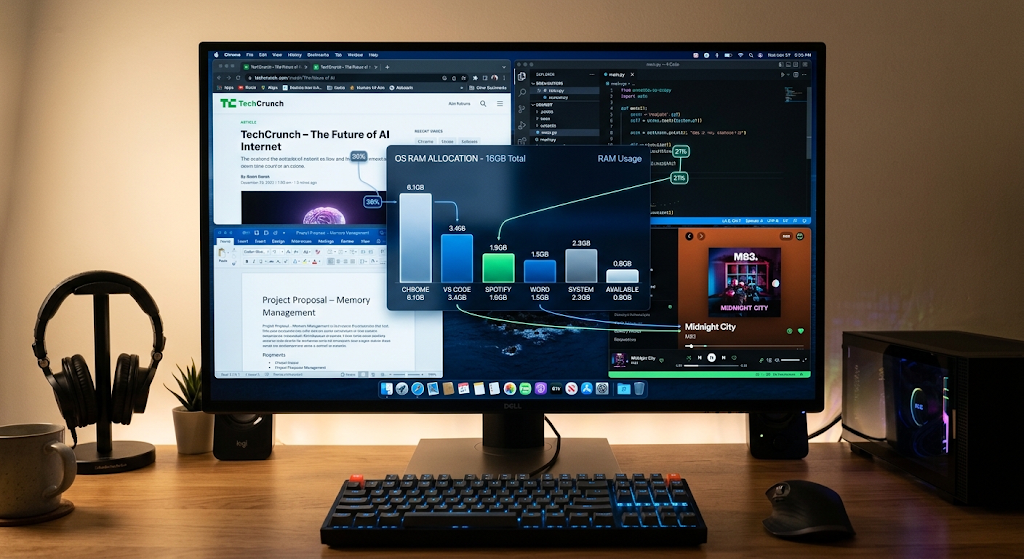
Memory Management in an Operating System
Memory management is the way in which an operating system can manage and organize the computer’s main memory. The RAM is the place where instructions and data are rapidly stored when a program is in use, but it has limited capacity. At the beginning of a program, the operating system will need to allocate memory to hold executable instructions, variables, data structures, libraries and other data that will be used while running the program. Any areas of memory that are not currently required by the program can be turned over at any time for other use.
This is not just assigning addresses to a program, it is memory management. It includes keeping track of memory areas being used, determining where to store memory data, establishing virtual to physical address mapping, and forbidding any program from accessing another program’s private information. The operating system is also capable of using the RAM efficiently with good memory management, and giving the programmes a stable environment in which to run.
Memory Allocation
Memory allocation is the action of allocating segments of memory to programs and the operating system when they require memory. A program run usually has multiple memory segments such as the segment for code to be executed, a global data segment, a dynamically allocated data segment, and a call stack. How these areas are represented and mapped depends on how the program uses its own memory-management mechanisms as well as the operating system’s memory requirements.
Allocation can happen at various levels. For instance, a program or runtime environment might manage smaller objects within a fixed-size unit of physical memory called a page. It is possible to unload memory if it is no longer needed and make it available to be used again. The efficient allocation is critical as the improper use of memory may result in wasted memory space, too much memory fragmentation, or the program may fail to acquire sufficient memory despite a still available capacity.
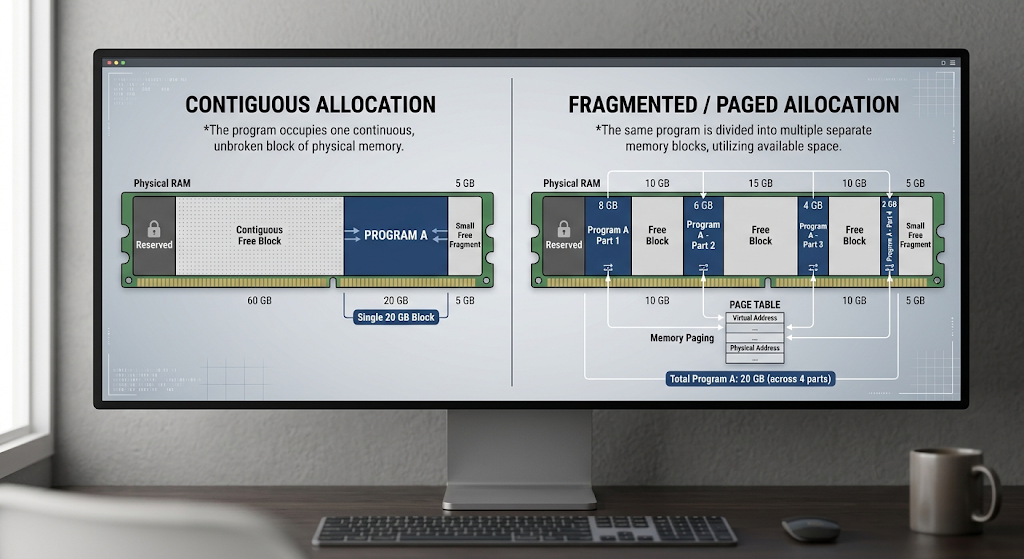
One of the first memory management techniques was to store a program in one contiguous area of physical memory. In contiguous allocation, the memory used by a process is contiguous, that is, it is stored in a single block. This can be relatively simple, as the operating system can determine the start and end point of the region that it allocated. It can cause issues when programs are initiated and terminated. External fragmentation can occur if free areas become separated by areas of active programs.
There could be enough FREE memory that it may not be in one single block. Addressing is the method used to store the program’s virtual address space in memory.Addressing is used to store the program’s virtual address space in memory; this is a technique that is commonly used in modern operating systems that does not require contiguous addressing. This flexibility is useful for allocating memory in a usable way if numerous programs with varying memory needs are operating concurrently.
Paging in Operating Systems
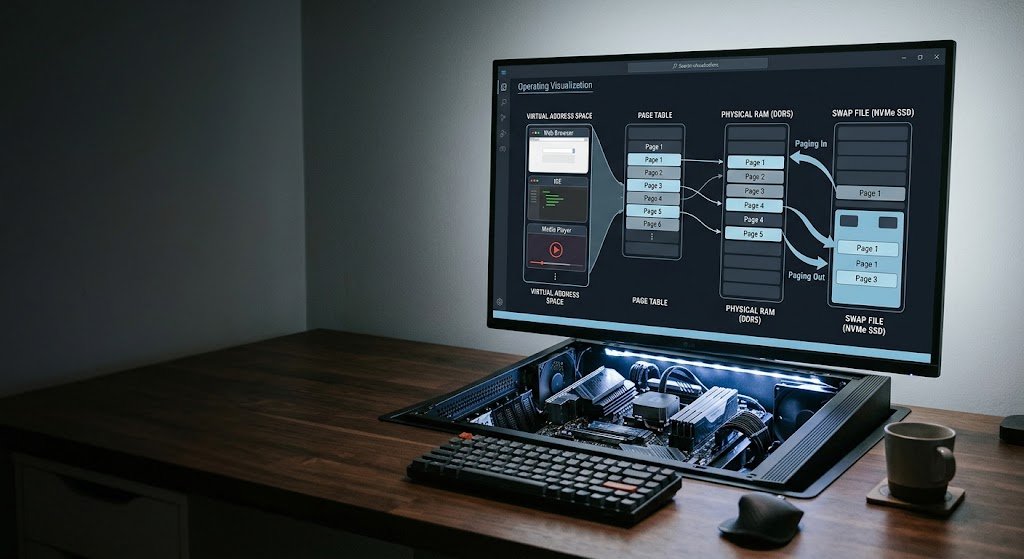
The memory management technique that partitions virtual memory and physical memory into fixed size segments is called paging. A virtual memory unit is referred to as a page and a physical memory unit as a frame. The pages of a program do not necessarily need to be stored in contiguous physical frames during the execution of a program. Rather, individual pages may be located anywhere in the frames that are present for the operating system.
A page table is a data structure that stores the association between virtual pages and physical frames. For instance, a program may be linked to a virtual page in which part of its code resides, and the page table will show which physical frame is holding this page. Paging is used to free up the need for a large continuous region of physical memory and is the basis of virtual memory. It also enables the operating system to swap the selected pages between primary memory and a secondary storage space when there is not enough physical memory available.
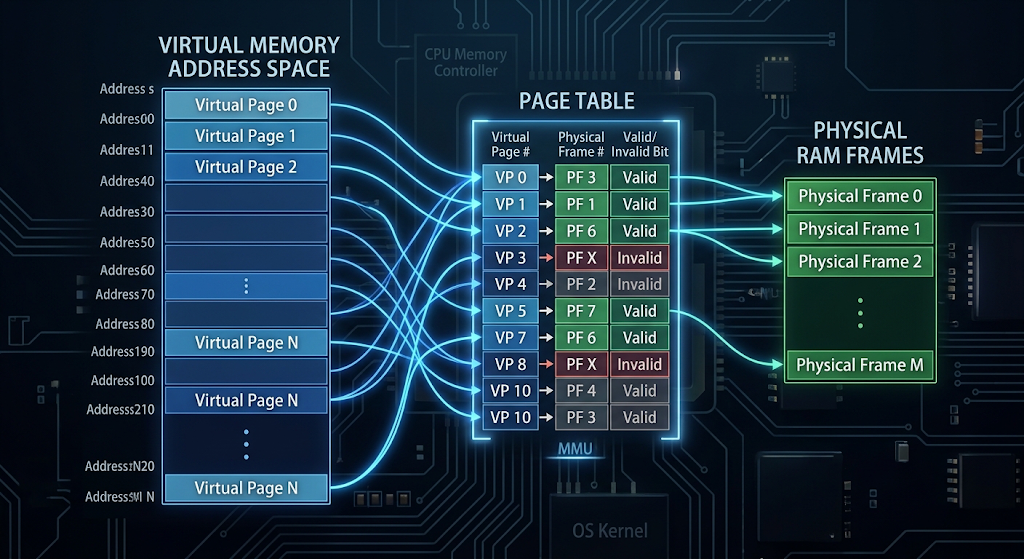
The Concept of Page Tables.
A page table provides information that the processor and operating system use to translate virtual addresses into physical addresses. Typically a virtual address consists of a page number and an offset within the page. The page number is used to find an entry in the appropriate page table. That entry references the physical frame for the virtual page, and may include protection information. The offset is not changed because it specifies the exact location within the page.
The physical address is the combination of the physical frame number and the offset. Programs access memory much more often than they access secondary memory, so mapping each address in the program to a page table in primary memory might cause an undesirable overhead. To cache recently-used address translations and to minimize the expense of repeated translations, processors are likely to include special hardware like a Translation Lookaside Buffer.
Segmentation
Another way of segmenting memory is. Segmentation is similar to paging but instead of dividing memory into equal sized pages, a program’s logical address space is subdivided into variable-sized segments of meaningful units. The program may consist of different parts of code, data or other logical parts. Each segment may have a base address and a length of the segment, enabling the system to determine the address of the segment and the length of memory required for the segment. Segmentation can be more like the logical structure of a program than fixed-size paging.
It can also enable protection through the addition of different permission sets to various segments. Variable sized allocation can, however, cause external fragmentation as the free memory can be broken up into pieces of various sizes. The concepts of segmentation and logical memory organization are still relevant for the understanding of how memory protection and address translation evolved, but modern systems tend to be heavily dependent on paging.
Virtual Memory
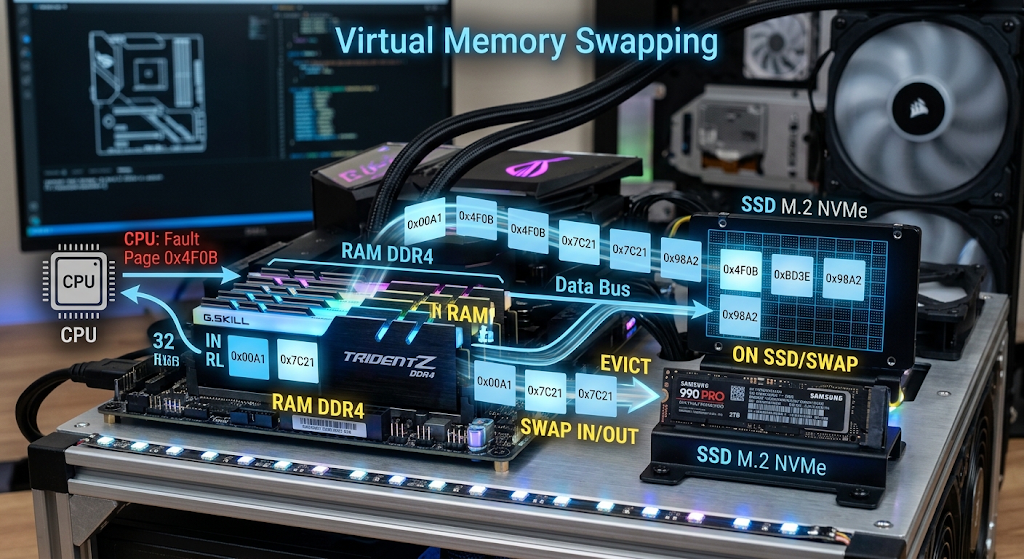
Virtual Memory: An Operating System’s ability to allocate processes an address space larger or more flexible than the physical RAM that they currently have available. A program uses virtual addresses, not the physical addresses of RAM, to access memory. The operating system and processor work together to create the mapping between these virtual addresses and the physical memory. Some parts of the address space of a process could be in RAM, and other parts could not be in RAM until they are used. This is because the total memory needed for the workloads can exceed the total physical RAM available in the computer, but the performance of the system may suffer if it uses too much of the secondary storage.
Virtual memory also facilitates isolation since each process could have its own virtual address space. Two processes could share the same virtual address, but have different physical frames allocated, which means that normal memory references of one process are not automatically mapped to the memory of another process.
Advantages of Virtual Memory
Virtual memory offers a number of significant advantages beyond just the ability to expand memory. First, it provides a consistent address-space model for processes, but doesn’t require a developer to be aware of the physical location of his data. Secondly, it provides greater flexibility in sharing physical memory space between processes. Thirdly, it can be used to help with memory protection, as page-table entries may include a bit that indicates whether a page can be read, written or executed.
Fourth, it allows the loading of only parts of some programs, as opposed to having to keep all of their address space in memory at all times. This can be helpful when programs include infrequently-used code or data. Virtual memory thus possesses the qualities of flexibility, isolation, and efficient use of real memory. It is only effective when the operating system, processor’s memory-management hardware, RAM and secondary storage are cooperative.
Page Faults
A page fault is an error which occurs when a program tries to access a virtual page which it does not have in its current physical memory location, the one requested by the memory-management system. Can read like a warning sign that there is something seriously wrong, but page faults are part of the operation of virtual memory. If the necessary page is not in RAM, the processor recognises this and switches to an operating system function to get it from the disk.
The operating system has to determine if the access is valid, and if the page is valid, has to ensure that the required page is available. The page may be loaded from secondary storage or retrieved by some other suitable means. When the page is ready, the information in the page-table can be changed and the interrupted instruction may be resumed.
Handling a Page Fault
There may be several steps to take when dealing with a page fault. First the processor discovers that it is not possible to find an available physical frame for the requested virtual address at this time with the proper permissions. So the operating system looks at the cause of the fault. If the address is correct, but the page is not in RAM, the OS needs to locate an appropriate physical frame. If there is no room available in the free frame, it might have to choose another page to have removed.
Then the required page is retrieved (from secondary storage if required) and stored in the selected frame. The page table is changed to make the virtual page point to the new physical frame. Finally, the processor can go back to execution, and try memory access again. Storage is significantly slower than RAM, so if the page fault is frequent then performance can suffer greatly.
Swapping
Generally, moving memory contents between physical memory and secondary storage is known as swapping. If there is too much use of physical memory, the operating system can swap out certain pages or other memory contents out of memory to free up more memory for data that is being used. These contents can then be retrieved as necessary later on. In contemporary virtual-memory systems, the transfer of memory contents between RAM and storage is most often done on a page-by-page basis, not the entire process at once, but the concept is similar.
When more memory is needed than a computer has physically, swapping can be used to help the computer run; however, the storage devices are much slower than RAM. When active programs demand more memory than the system has, a lot of time may be spent transferring pages between memory and storage, and not much time spent on useful program instructions.
Memory Protection
Memory protection: Protects memory regions from use by unauthorized processes. This is crucial for the security and stability of the system. If not properly protected, one application might accidentally overwrite data from another application or affect memory used by the operating system. New processors and operating systems rely on systems involving virtual memory and page tables to set permissions. In various systems and circumstances, a memory page may be readable, writable, or executable.
The operating system may be able to tell the difference between memory assigned to regular user programs and memory dedicated to privileged operations of the operating system. An exception is an error generated by the processor if a program tries to perform an operation that is not allowed by the permissions. These safeguards are intended to limit the effects of processes and minimize the risk of a mistake in one program corrupting other programs or vital operating system resources.
Address Translation
Address translation is a technique for “mapping” the virtual address a program uses to the physical address in RAM. With this translation, applications can work without knowing the actual physical locations of the data. Normally, a virtual address consists of a virtual page number and an offset. The memory-management hardware reads the virtual page number to find the corresponding entry in the page-table that specifies a physical frame.
The offset then references the exact byte or location in that frame. The result is a physical address which can be used to access RAM. These translations are done efficiently in present processors by using hardware support, and the translations of recently used entries can be stored in the Translation Lookaside Buffer. Thus, addressing translation is a very important issue in virtual memory, since it relates logical memory addresses used by the program to physical memory resources managed by the OS.
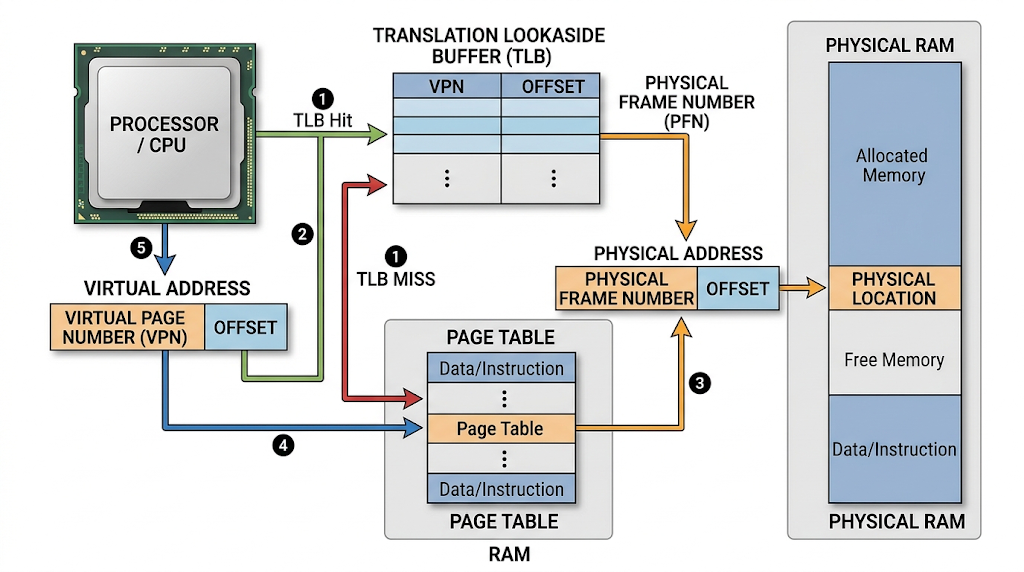
Many recent virtual-to-physical address lookups are stored in a small, fast cache called the Translation Lookaside Buffer (TLB). If there is no caching, then the processor may have to repeatedly retrieve page-table structures each time it accesses memory while running a program. Programs need to access memory locations that are close to each other or used again and again, so recently-used translations can be used again. If a translation exists in the TLB, the processor does not need to make the full page-table look-up to access it.
If it does not have the required translation, the system has to perform the required page-table walk; it can later store the translation in the TLB. This improvement of hardware is not only significant due to the fact that memory translation takes place concurrently with the normal running of programs, but also because the memory translation system is not yet implemented in the computer. Virtual memory can implement its organizing and protection services efficiently, without memory access costing too much.
How Multiple Programs are Managed by Operating Systems
There can be a lot of processes on a computer competing for the same amount of physical memory. It is managed by the operating system, which keeps track of each process’s address space, assigns physical memory frames, converts virtual addresses, ensures access rights, and frees up physical memory when needed. Paging enables that pages of different processes can be stored in different physical frames and virtual addressing provides an independent view of memory for each process.
If physical memory is limited, the OS can determine what pages stay in memory and what pages can be swapped out to other devices. When sharing is intentionally programmed, selected parts of the memory can be shared by multiple processes using shared memory. On these, the OS manages physical memory for a variety of programs rather than letting them manage their own.
Memory Management Systems and their Performance.
The reason that computer performance is affected by memory management is that accessing RAM is faster than accessing secondary storage. A well managed system will attempt to have all the pages in physical memory that are being used and will not move pages between RAM and storage unless absolutely necessary. These can all affect performance, such as allocation strategies, page replacement decisions, caching, address translation efficiency, and the amount of available RAM. While certain forms of fragmentation caused by contiguous allocation are minimized by paging, fragmentation can also impact the effectiveness of memory usage.
If a workload is producing a lot of page faults, the operating system can be spending a lot of time loading and removing pages, instead of running program instructions. By knowing how their programs allocate memory, access data and release resources, developers can help to use memory efficiently. In summary, the efficiency of a computer’s performance with challenging workloads is determined by the interactions between operating system memory management and application behavior.
Conclusion
A memory management mechanism helps the operating system to use the available physical memory efficiently, to run more than one process and to keep the processes protected from each other. Memory allocation allocates resources required by programs; paging segments memory into manageable blocks that can be mapped flexibly from virtual to physical address space. There are also other models for organization of logical memory regions, such as segmentation, and flexible address spaces for processes which need not be directly related to physical RAM through virtual memory.
Page faults help to bring missing pages into memory when needed, and swapping or paging to secondary storage can help the system function when there is not enough memory. Address translation relates virtual addresses to physical ones and memory protection defines boundaries between applications and privileged system resources. These mechanisms together are the basis for modern operating system memory management, enabling computers to have efficient use of physical memory, run complex workloads, and process isolation.