Introduction
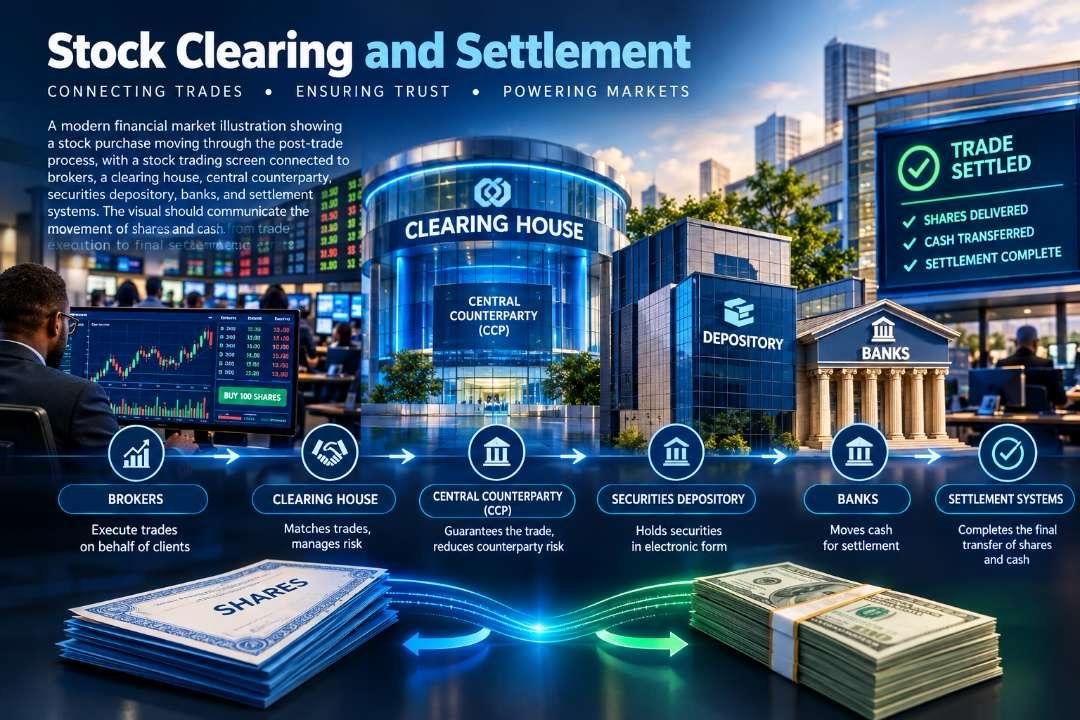
Once you hit the “Buy” button, it’s just the start of the process when you buy a stock. However the trade doesn’t take place at that moment because your broker takes the order to a trading venue where it can be matched with a seller. A series of coordinated parties’ behind-the-scenes brokers, clearing houses, central counterparties, settlement systems, custodians, banks and market infrastructure providers are involved in the trade confirmation. This behind-the-scenes affair sets out how the securities are to be delivered to the buyer and the funds to the seller. It makes it much easier to understand how a stock-market transaction works if you comprehend the infrastructure. If you understand that infrastructure, it’s easier to understand why a stock-market transaction isn’t just a simple exchange on a trading screen. It also provides an explanation of how markets can facilitate the processing of many large numbers of trades, while at the same time minimizing settlement risks and maintaining records of who owns what and who owes what.
From Order Execution to Trade Processing
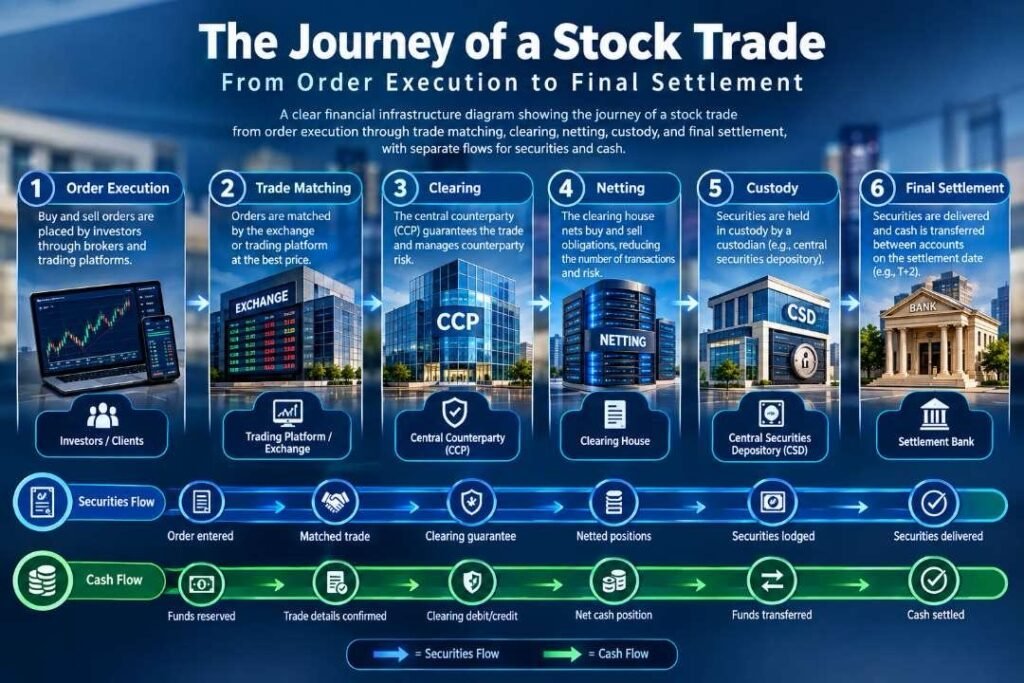
The first important event in a broker’s life after he fills a stock order is the creation of the trade record. The trading venue provides details regarding the security, quantity, price, and trader(s) involved, as well as the time of trade. Your broker is then able to get details of the order being filled, and will show you the result in your account, most of the time. This is also known as trade confirmation/execution confirmation. But, as with any other confirmation, it doesn’t necessarily imply that the securities are in your custody, and it doesn’t necessarily mean the seller has been paid. Rather, the executed trade is subject to a post trade process to ensure the accuracy of the trade, determine obligations, control risk and arrange for the delivery of securities and cash. There are basically a number of different markets with various infrastructures and time lines, but the all-important goal is the same: get an executed agreement to a completed asset, money transfer.
The Broker Executed
The broker is not only integral to the trading process, but will also be crucial to the operation post-trade. It stores and manages the customer’s account information, provides the customer with information regarding the transactions and manages the clearing and settlement processes, which are necessary to guarantee the broker’s obligations. The broker is responsible for ensuring that the buyer has enough cash or they have pre-arranged financing in place for the buyer to purchase the property. For the seller it should make sure that the securities it is selling are deliverable. The broker also offers statements and transaction records to assist the customers in knowing their positions. In some exchanges, the customers are not directly involved with clearing house or central counterparty. Rather, it is the broker who links the investor to the broader financial system. This way, individual investors can invest in markets without taking care of institutional level settlement procedures.
The function of a Central Counterparty and a Clearing House
Clearing after a trade has been made, is when each participant makes out what they are owed and what they owe. In a central counterparty (CCP) markets, the CCP can intervene between buyer and seller in the clearing phase once the trade has been accepted. It acts as a “buyer to all sellers and a “seller to all buyers” for the trades it clears. This is a framework to deal with the counterparty risk and to ease the organization of obligations. The CCP implements risk management systems like margin requirement, collateral regulation, and default-management process. The measures are important because if a market participant suffers financial hardship between execution and settlement, it would likely impact them. Clearing infrastructure facilitates the continuation of trading in the market in the event of problems with individual participants by centralizing the risk management processes and making the participants deposit financial means against their obligations.
The Process of how Trade Matching and Trade Verification work.
Before final settlement, the trade information will have to be checked to ensure that the parties and obligations match. Matching is the process of comparing information provided by the parties involved in the match such as the security identifier, quantity, price, settlement date and other details of the transaction. When records don’t match, it could require corrections to proceed with the trade normally. This information is used extensively in modern financial markets by electronic systems to exchange and validate this information and costs are minimized. The key area of particular concern is trade confirmation and matching; there is a significant risk for a larger operational issue later if there is a small data error. Clearing systems need to know how to calculate obligations (correctly) and settlement systems need to know what securities and cash to move. As such, post-trade technology provides a secure link between the trading and settlement services where the ownership and payment of the securities actually takes place.
Netting is another way to Minimize Payments.
Netting is an important aspect of the clearing process. A clearing system may calculate the clearing participant’s net obligation rather than having to make a separate payment on each purchase and receive a separate payment for each sale. For instance, if a given institution purchases shares for a specific amount in the day, and sells other shares for a different amount, the net amount of cash that must be paid or received in the clearing process may be determined. Securities obligations may also be arranged via netting arrangements, if such netting is allowed by the market infrastructures applicable to the obligation. Netting can significantly minimize the number of single steps, which have to be processed. This optimizes the operation and can minimize the cash and securities that the participants have to move. It does not cancel out the underlying trades – rather it brings them all together in a more manageable settlement process.
The Settlement System
When the commitments arising out of the trade are met, it is considered to be settlement. A typical delivery-versus-payment arrangement is a transaction in which the securities are delivered only in exchange for cash – or cash are delivered only in exchange for securities – in the same transaction or within specified conditions. Securities are normally not issued in paper form but in the form of an electronic record. A central securities depository (or other authorized settlement institution) provides records of securities ownership and keeps track of transfers of securities from one securities account to another. On the cash side, banks and payment systems offer the technology which makes money flow from the relevant parties. Each different market and security will have their own settlement cycle and investors should not expect all stock trades to settle in the same way across the globe. It is important to understand that settlement is the last in a series of infrastructure that enables the exchange of the securities, and the payment for those securities.
What is a Central Securities Depository?
Central Securities Depository (CSD) is a concept different from that of a central counterparty. The CCP’s activities are dedicated to clearing and settling eligible trades and the CSD offers securities custody and settlement services. A CSD can keep electronic records reflecting the position of any participating institution, and facilitate the transfer of securities between accounts. The investors do not have a direct account at the CSD, but are rather represented by an intermediary in certain markets. The intermediary can keep a record of the customers while the CSD keep a record at a higher level of market. The advantage of this multi-layered setup is that securities can be processed by the securities system without each investor being linked directly to the central system, thereby enabling millions of investor positions to be processed. It also establishes guidelines for corporate transactions dividends, stock splits, and other events relating to securities.
The Role of Custody in the Process
Custody relates to holding and managing financial assets once they have been purchased. In the market where the investor purchases securities through a broker, the securities are normally reported on an account held by the broker, custodian, depository participant or other intermediary. Custodians support institutional investors in the maintenance of the accurate records, settlement, collection of dividends and corporate actions. Much of this is behind the application or account statement of the broker for retail investors. Instead of being a piece of paper that sits in a vault, a stock balance on a computer screen is the outcome of several interdependent systems of record keeping. Reliable custody infrastructure is crucial since the information on who owns what should continue to be correct as securities are transferred and investors frequently trade in and out of securities and corporate events alter the securities rights and amounts.
Explain the Movement of Cash and Securities.
After a stock purchase, the movement of assets has two related aspects: movement of assets in the form of securities and movement of assets in the form of cash. Let’s say an investor buys shares from a other market player. When the transaction is executed and the settlement process is cleared, the number of shares to be delivered and the amount of money to be paid is determined. The securities travel in the relevant depository or settlement account, the cash travels in the banking and payment system. If the delivery/payment relationship is properly controlled, it is important that the two transfers are coordinated so that the delivery party does not deliver without getting paid. The investor might see a completed trade in their brokerage account, but there are electronic messages, account updates, settlement instructions, reconciliations and confirmations in between financial institutions. What this means is a syncing of change in ownership and finances.
What if Settlement Does Not Work Out?
For not all the trades are the ones that come down at the right time. Failure to settle will happen when the securities are not available, there is not enough cash, or an operational issue means that the securities cannot be delivered. Market infrastructures have mechanisms in place for such circumstances, which may involve determining the obliged party that has failed, fining or charging the party as appropriate, arranging for a subsequent settlement or by any other mechanism as allowed by the market rules. Clearing houses may also have default management arrangements to deal with the case of a participant’s inability to fulfill its obligations. The reason these safeguards are important is that, even if a trade is completed successfully, it does not mean there is no risk of settlement. The systems that are involved should have ongoing monitoring requirements until the transaction is done. The exact repercussions of a collapse in the settlement are dependent on market, security, relevant regulations, and contractual terms and conditions of the players involved.
Conclusion
One of the reasons that post-trade processing is “invisible” for an individual investor is that a brokerage application might record an executed order almost instantly. However, execution and settlement are two separate events. Execution is the acceptance of the agreed trade, clearance is the management of obligations and transfer of relevant risks and settlement is the completion of the securities and cash transfer. Each of the participants of the chain (including brokers, clearing houses, CCPs, CSDs, custodians, banks, or any other infrastructure provider) has an interconnected function that contributes to this chain. They need to exchange correct information, make the records match, safeguard the problems in the system, and handle a lot of transactions. The knowledge of these stages will help investors properly read the updates of their account and understand why an order placed can be “filled” while in the settlement process. It also reveals that stock markets are not only about the market platforms in which people can see the trading activities, but also a complex technology and financial infrastructure that lies behind the market platforms.
Get more well researched information about stock clearing and settlement here.