Introduction
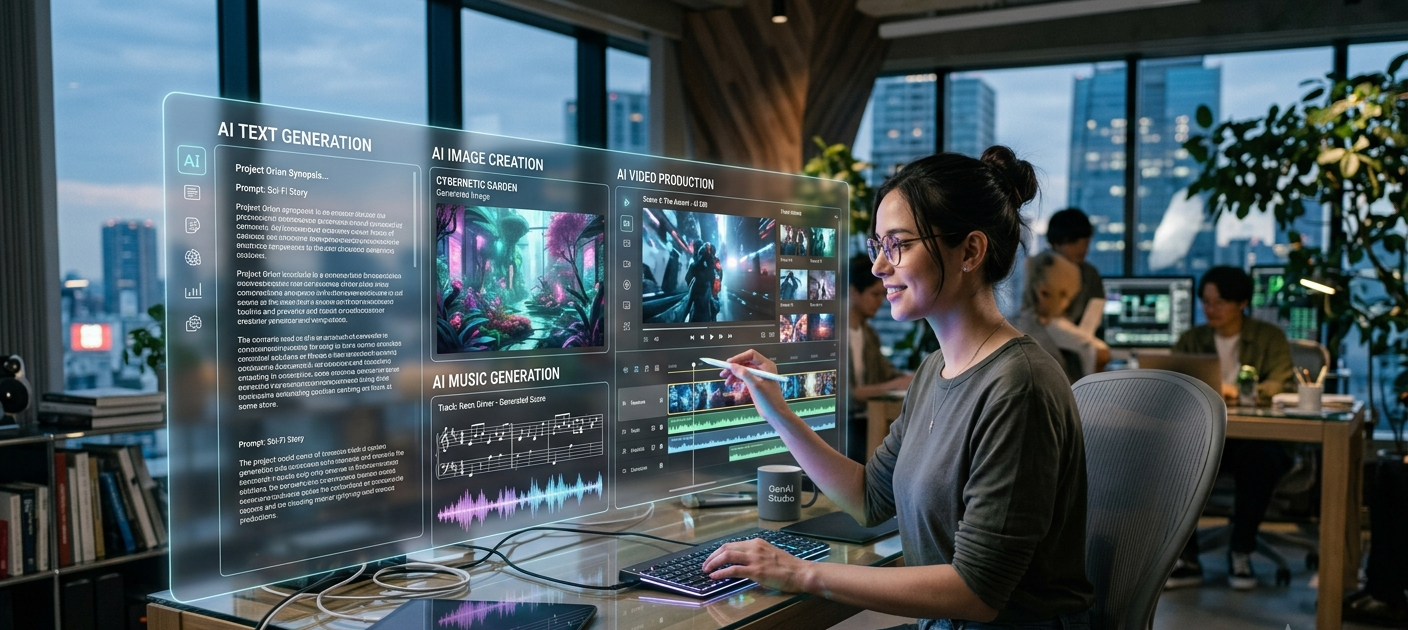
The AI world has undergone a tremendous transformation in recent years, moving from the static algorithms and analytical classifiers to the dynamic generative systems. Generative AI is fundamentally a new paradigm in computer science: It moves beyond extracting patterns from available data, to creating original, high fidelity content across various sensory modalities, without relying on external ‘models’. Breakthroughs such as ChatGPT, appearing earlier, have introduced the natural language interaction experience to hundreds of millions of users globally and shown that deep neural networks can hold complex conversations and provide assistance in complex creative writing and draft functional computer software code. Going beyond mere completion of text, this technology has been extended to the generation of high resolution images, musical composition with expression, and unrivaled, high resolution video synthesis. With its grasp of the statistical underpinnings of human knowledge and artistic expression, generative AI has emerged as a key force powering digital innovation in various industries around the world.
In the mathematics of generative AI, complex artifacts created by humans, such as a paragraph of persuasive copy, a digital painting, a musical symphony, or a film clip, can be described as high-dimensional data distributions. Generative models can approximate these distribution landscapes by parsing huge amounts of training data, creating new samples of previously unseen data points whose style and context follow rules of the original data. This empowering feature has democratized the creation of content, allowing individual creators, software developers, and enterprise organizations worldwide to seamlessly transform natural language prompts into high-quality, multimedia-rich assets within seconds. As a result, generative systems are changing the way modern businesses communicate their brand, produce digital media, prototype products, and interact with human computers and are becoming an integral part of the modern digital economy, and synthetic content creation is becoming a vital component of it.
How Generative Models Are Trained.
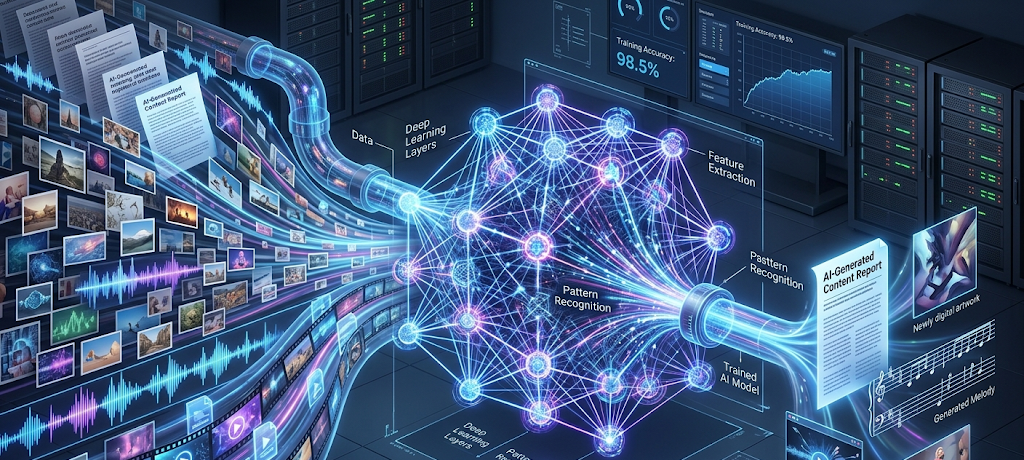
Every high-end generative model starts with a lot of data collection, curation and structural preprocessing, shaping the basis for digital learning of human expression with the help of artificial intelligence. Neural networks are fed trillions of representations of unstructured natural language text, hundreds of millions of captioned images, thousands of hours of multi-track audio recordings, and huge volumes of raw video content. In the initial pre-training stage, it learns on a self-supervised learning task, trying to complete incomplete parts of the input data without any explicit human labels.
A text model can, for example, predict the next word within a text, and a vision model can reconstruct the missing parts of an image or predict the movement between frames. The network optimizes billions or trillions of internal mathematical parameters in an iterative fashion, over millions of steps, to learn subtle semantic relationships, grammatical structures, visual textures, and acoustic nuances—all hidden within the training corpus.
The applications of transformer architectures and Attention mechanisms.
The Transformer architecture is the backbone of the technological engine that supports generation of high-level text, audio, and visual.The Transformer architecture is the technological engine for generating high level text, audio, and visual, with its novel self-attention mechanism revolutionizing sequence modeling. Transformers can handle lengthy context memories and analyze the data in parallel, as opposed to legacy recurrent neural networks that process data one time step at a time, with little relation between the strength of attention to the current token and its attention to the previous one.
This parallel processing capability enables the network to learn anything from a long-range dependency—a key fact in a story, for example, that is mentioned several chapters in the back of the book, or keeping the light consistent in a complex visual representation. Self-attention, combined with high-capacity positional encoding, allows for the synthesis of coherent, contextually rich outputs, which maintain the overall narrative flow, structural balance and nuanced style over lengthy generations.
How things started: Diffusion Models, VAEs, and Generative Adversarial Networks
Although transformer architectures have taken over the sequential treatment of NLP, visual and auditory data are critically dependent on generalized mechanisms that are distinct from the transformer, such as Diffusion Models, Variational Autoencoders (VAEs), and Generative Adversarial Networks (GANs). The basic idea behind diffusion models is to incrementally add Gaussian noise to an image or audio signal when training the model until the signal becomes entirely random, and then the model is used to progressively remove the noise from the signal back to the original image or audio step by step.
In VAE, the model is trained to map a high-dimensional space of raw data onto a low-dimensional, continuous latent space, and the model can then sample smooth latent vectors in the low-dimensional space and map them back to structured visual or audio outputs. Generative Adversarial Networks are based on a dual system of networks: a generator network generates synthetic samples to fool another network, the discriminator network, which is constantly improving the generator network. These techniques are often combined to produce very high level, photo-realistic results in modern multimodal systems.
Optimization, Alignment, and RLHF After Training
If not carefully optimized and aligned for helpfulness and safety after training, raw generative models can yield unhelpful, offensive, or chaotic results when used for statistical continuations. Researchers use instruction fine-tuning and Reinforcement Learning from Human Feedback (RLHF) in addition to direct preference optimization techniques to make a probabilistic model into a reliable, useful tool. Thousands of model responses are checked by human evaluators who score the responses on clarity, accuracy, safety, and helpfulness, generating a preference dataset for training a secondary reward model.
This reward model is used to steer reinforcement learning algorithms, such as Proximal Policy Optimization, to model the main generator’s outputs towards human desired standards and operational guardrails. The key alignment phase is one that guarantees that generative tools will respond in predictable ways to user intent, refuse undesirable requests, speak in a courteous manner and deliver well-structured information suited to specific commercial or creative tasks.
How to make a synthesis using text, images, audio, and video.
Text Generation and Large Language Models.
Large Language Models (LLMs) are the workhorses behind the synthetic text, turning abstract, natural language queries into coherent essays, technical code, creative poems, or business reports. A user enters a prompt, and the model breaks it down into sub-word components, encoding them as dense mathematical vectors that represent semantic meaning in multi-dimensional space. These embeddings are then fed into the underlying Transformer layers, which predict the probability distribution of the next token in the vocabulary that best fits the context, dynamically.
The use of advanced decoding strategies, such as temperature adjustment and nucleus sampling, enables creators to make sophisticated decisions about the output, ranging from the most factual to the most creative. Consequently, language models are incredibly adept at understanding context, and can perform multi-step reasoning, summarize large documents, translate between human and machine languages, and model different brand voices with great fidelity.
Image Synthesis and Latent Diffusion Landscapes
By combining text embeddings with visual latent spaces, Generative visual AI can convert natural language descriptions into hyper-detailed digital art, graphic design, and photorealistic imagery. They use a specialized text encoder, typically with a CLIP or T5 architecture, to encode text into a rich conceptual representation. These textual representations are used to guide a latent diffusion model that starts with a field of pure Gaussian noise in a compressed latent space and “iteratively” subtracts the noise over several steps to build up a visual representation that matches the text semantics.
The latent map is then expanded into high-resolution pixel space by a neural decoder, creating crisp textures, accurate lighting, depth-of-field effects and intricate stylistic elements. With the help of modern visual generators, creators can now enjoy unprecedented control of camera angles, artistic styles, lighting setups, and character consistency, all of which allow for the creation of agency-grade visual assets in just a few seconds.
Composing music and neural rendering of audio.
Synthetic audio and musical generation is a special technical focus, where models need to be able to ensure the fidelity of the generated audio or music in both short-term and long-term aspects. Generative music platforms try to solve this problem with two main paradigms: symbolic generation, which generates notated music (e.g. as a MIDI file for an instrument), and direct neural audio synthesis, which generates high fidelity, raw audio waveforms. Direct audio generators map a spectral representation, such as a mel-spectrogram, into a continuous audio signal, using either an autoregressive model or a continuous diffusion architecture to create captivating instrumental arrangements, vocal melodies, and ambiance.
Advanced music models handle instructions for tempo, genre, emotional mood, and instrumentation, and produce music that is coherent in time, rhythmic, and has a rich and complex melodic sequence. With these audio models, anyone can quickly and easily make a custom soundtrack for their video games, commercials, movie scores, or even make music independently, which has changed the way commercial sound is created.
Dynamic Video Generation and Spatiotemporal Modeling
Video generation is the most complex form of generative AI that demands a highly sophisticated system to capture spatial visual fidelity, temporal continuity, smooth camera movements and physical real-world realism all at the same time. The modern text-to-video and image-to-video models take into account that video content is a three-dimensional spatiotemporal data block, rather than simply a series of two-dimensional images. The video engines use the advanced Diffusion Transformers (DiTs) to denoise the video latents and ensure the temporal attention mechanisms between adjacent frames, eliminating visual flickering, abrupt shape changes, and unnatural character drift.
Recent advancements include native audio sync, which creates corresponding dialogue, sound effects and ambient acoustic textures for each visual frame in a single pass. With precise camera movements, lighting dynamics, and multi-shot storyboards, creators can now have generative models generate video clips that closely replicate the characteristics of physical lighting, gravity and fluid dynamics.
Real-world applications: Business integration and creative workflows.
Business Integration and Enterprise Automation
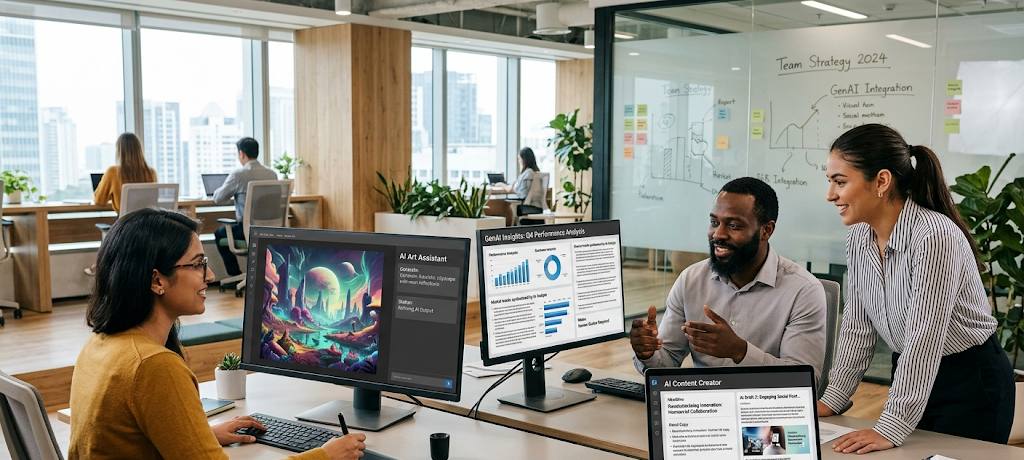
In the world of business, generative AI has moved beyond mere experimentation to become an integral part of how businesses operate, contributing significantly to the productivity and efficiency of organizations. Large language models are used in businesses to streamline intricate customer support operations and manage complex customer inquiries quickly and intelligently by using conversational chatbots. MARKETING AND SALES: Marketing staff use text and image generators to create personalized email campaigns, variations of those campaigns for different audiences, dynamic ad creative assets and optimized search engine content at scale, significantly faster than their campaign launch times.
The software development teams embed software-drafting assistants, code-refactoring assistants, bug-detectors, and unit-testing assistants into their integrated development environment, which allows them to rapidly draft software, refactor software, identify bugs, and test software units. Moreover, enterprise search solutions that integrate retrieval-augmented generation can enable workers to ask their internal knowledge bases using natural language, providing instant actionable insights from unstructured corporate repositories, which can also improve decision making for global teams.
Within the creative sectors, generative tools are acting as game-changers, enhancing creative expression and reshaping conventional creative workflows in the realm of filmmaking, graphic design, and gaming. Visual artists and creative directors use Midjourney to quickly generate character concepts, environmental storyboards, and mood boards, helping them avoid the high costs of physical production. Text-to-video and image-to-video systems are used by film producers and advertising agencies to create pre-visualization animatics, virtual production backgrounds and localized promotional clips in which the language is dubbed over moving images with realistic lip-syncing.
Independent game developers use generative AI to create dynamic soundtracks adapted to the context of the gameplay, to produce procedural textures for environments, and to craft long non-player character dialogues. Rather than replacing human artists, these synthetic creation tools provide unprecedented freedom of experimentation, iteration and rapid delivery of ambitious imaginative visions with accuracy.
Restrictions, risks, and ethical boundaries.
Although generative AI is incredibly powerful, it has a number of technical weaknesses and quality control issues that must be addressed and monitored. A primary pain point is that of model hallucination, in which large language models confidently assert facts that are factually incorrect, cite non-existent sources, or make logically unsound deductions, as a result of the probabilistic basis of next-token prediction. Models often produce spatiotemporal artifacts in visual and video synthesis, including anatomical deformities, incorrect spatial arrangements, arbitrary merging of objects, or incompleteness in physical interactions between objects across successive frames of a video.
Moreover, the computational resources and electrical power required for running state-of-the-art multimodal diffusion models as well as the billions-parameter language architectures entail significant costs and environmental impact. To overcome these technical challenges, organizations using these models need to have established evaluation metrics, human-in-the-loop validation systems, and effective retrieval-augmented systems that allow for continuous evaluation and monitoring.
Identifying ethical concerns, copyright issues, and intellectual property concerns.
With the prevalence of generative synthetic media, new legal, ethical, and societal issues arise, and regulatory bodies and creators are grappling with them. One of the biggest legal issues is the consent to use training data and the fact that some content on the internet, such as artwork, literature, dynamic photography and repositories of proprietary code, are under copyright. Content creators say that removing copyrighted material without clear permission or compensation is a violation of copyright, and that they have been targeted by continued landmark cases and requests for clear-cut systems of attribution.
In addition, the ability to create hyper-realistic deepfakes, synthetic voice duplicates and automated misinformation creates serious security threats with respect to digital identity theft, political manipulation and consumer fraud. In order to mitigate these societal risks, measures must be implemented such as mandatory digital watermarking, mechanisms for tracking the provenance of content, strong content moderation filters and clear regulations that safeguard individual privacy and intellectual property.
Conclusion
In the near future, generative AI will increasingly be able to act independently and autonomously, carrying out multi-step tasks with little to no human oversight. Future generative paradigms will go beyond the simple prompt and response paradigm and be used as networks of collaborating agents to plan, enact, assess, and adapt multi-modal projects independently. We will experience real-time interactive visual and video rendering, immersive dynamic environments that react in real time to the user’s gestures, voice commands and preferences in virtual/augmented reality spaces.
Moreover, open-source model architectures are leveling the playing field with proprietary enterprise systems, making high-quality AI capabilities accessible to all developers, no matter where they are around the globe. Generative Artificial Intelligence will persist in shaping and changing the human creative capability, ushering into a new era of digital innovation, economic transformation, and collective human-machine expression.