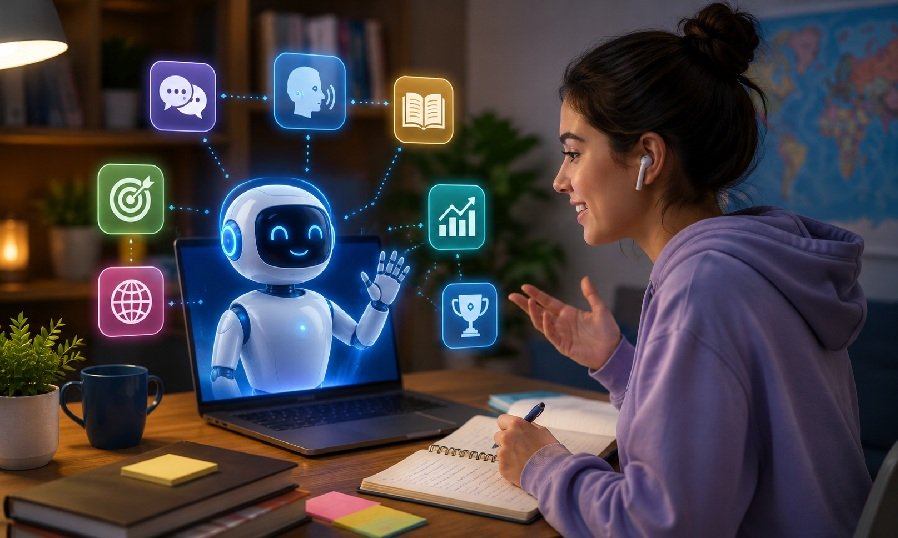
Every language learner eventually hits the same wall: you can memorize vocabulary and grammar alone, but fluency only comes from conversation — and conversation requires a partner who is patient, available, and non-judgmental about your mistakes. Human partners with all three qualities are rare and expensive. This is why conversational AI has become one of the most quietly transformative tools in language education, and why learners are adopting it faster than institutions can study it. Here are seven specific ways it is changing the practice.
1. Unlimited Speaking Practice Without the Embarrassment Tax
Research on language acquisition consistently identifies anxiety as a major barrier — learners avoid speaking for fear of sounding foolish, and avoidance stalls exactly the skill that needs repetitions. An AI partner removes the audience. Learners report attempting constructions with AI they would never risk with a tutor, and the willingness to fail freely is precisely what accelerates progress.
2. Conversation at Your Level, Adjusted in Real Time
A good human tutor calibrates difficulty instinctively; AI does it on request. Ask for simpler vocabulary, slower pacing, or gentle corrections, and the conversation reshapes itself instantly. This solves the classic mismatch problem of language exchanges, where partners are too advanced to be comprehensible or too basic to be challenging.
3. Roleplay for Situations That Matter
Textbook dialogues rehearse restaurant orders; real life demands job interviews, medical appointments, and apartment negotiations. AI partners roleplay any scenario on demand, in character, with unlimited retakes. Learners preparing for specific high-stakes situations — a visa interview, a first day at a foreign workplace — can rehearse the exact conversation until the vocabulary is automatic.
4. Ongoing Relationships Beat Isolated Sessions
One underrated finding from learner communities is that continuity itself aids acquisition. Talking regularly with a consistent AI character — one that remembers your interests, your progress, and last week’s conversation — turns practice from a drill into a correspondence. Companion platforms such as MyDreamCompanion were not built as education products, yet language learners have adopted them for exactly this reason: a character with persistent memory gives you something to talk about, and wanting to communicate is the engine of fluency. Motivation, it turns out, is a feature.
5. Writing Practice with Instant, Judgment-Free Feedback
Conversation includes text, and text-based chat is its own powerful modality: learners see correct forms modeled in every reply, can ask why a phrasing works, and build reading fluency alongside writing. The feedback loop that once required a teacher marking essays now happens inside the conversation, sentence by sentence.
6. Access for Learners the Market Ignores
Tutoring markets serve major languages and affluent learners. AI conversation costs a fraction of human tutoring and works for learner-language combinations no marketplace would sustain — a Mongolian speaker learning Portuguese has the same access as anyone else. For rural learners, shift workers, and anyone far from language schools, availability is not a convenience; it is the difference between practicing and not.
7. Voice Interaction Closes the Pronunciation Gap
Text chat builds vocabulary and structure, but speaking is a motor skill, and voice-enabled AI now provides the missing rehearsal space: real-time spoken exchanges where learners hear natural pronunciation and produce their own, without an audience. Combined with the roleplay and continuity above, the result approximates the immersion experience — conversation woven through daily life — that was once available only by moving abroad.
What AI Practice Does Not Replace
Honesty requires the caveat: AI partners are practice, not culture. They will not teach you the gesture that accompanies a phrase, the regional joke, or the thousand contextual cues of real social immersion, and learners who never graduate to human conversation are optimizing the rehearsal while skipping the performance. The best framing treats AI as the flight simulator of language learning — the place where hours are cheap, mistakes are free, and confidence is built for the conversations that count.