Introduction
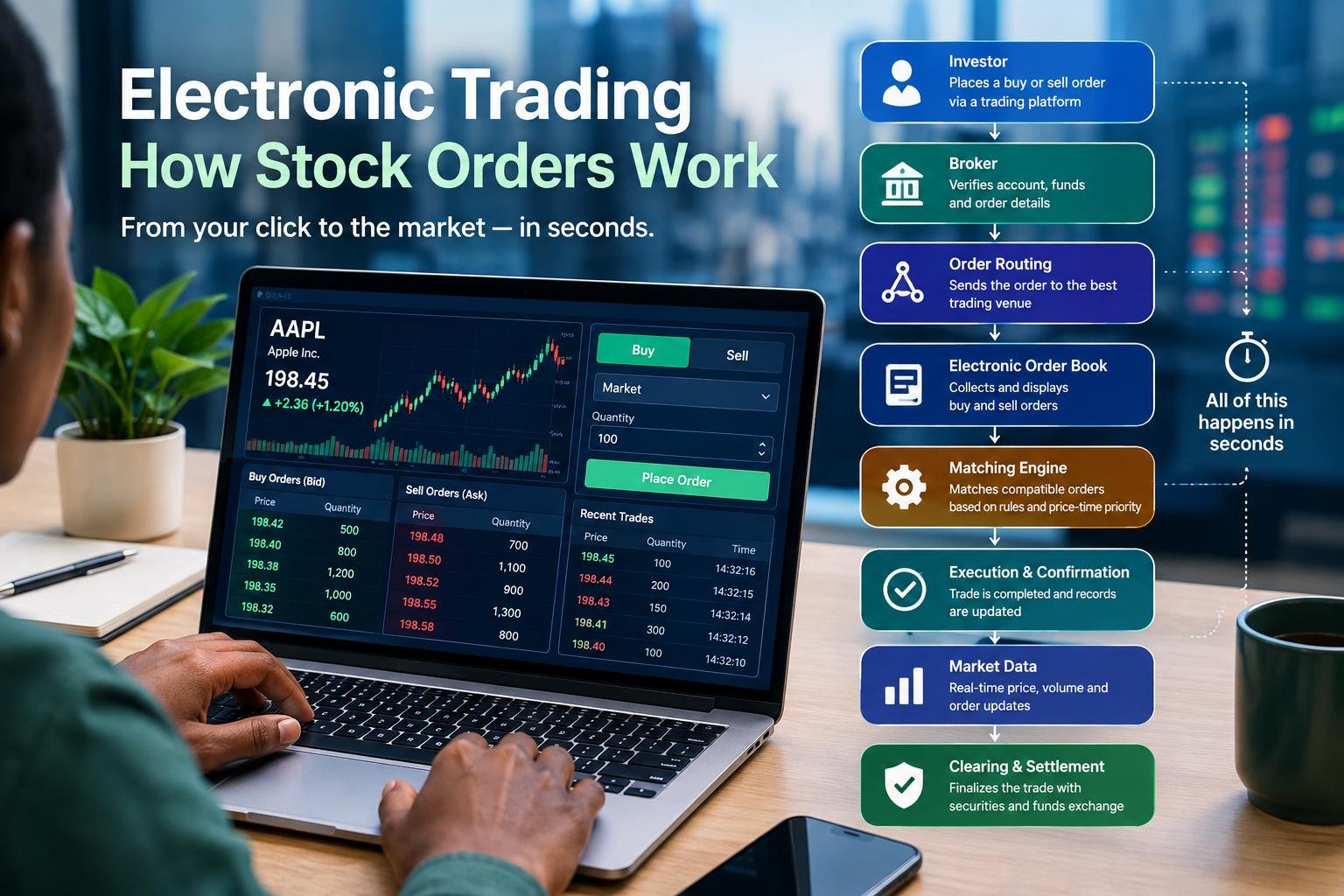
Stock exchanges have evolved from the traditional trading floors, populated by which traders spoke orders to highly automated and digital networks. For the investor today, it may be just a single buy or sell button; yet when that investor clicks, a series of systems will also be triggered that includes a broker, an electronic trading venue, an order book, a matching engine, a record of trades, a market-data feed, and post-trade infrastructure. The order is to be received, verified, passed to the electronic order book, matched with other orders and fulfilled within the conditions of the order or left in the order book until the conditions are met. It is a very fast process and the investor may expect to receive his results almost immediately. Knowing what is going on behind the scenes will allow a beginner to realize electronic trading isn’t all about logging on to the internet and putting in an order, but a technology system that facilitates the connection between the buyer and the seller and keeps all the records up-to-date and timely.
From the Buy or Sell Button to the Market
The first phase starts with a security selection, trading decision, order size and order type input by the investor via a brokerage application or platform. The broker is given the request and carries out checks prior to putting the order out to the market. The checks can pertain to permissions on the account, available funds or securities, order details, and applicable trading rules. The broker then passes the order to an appropriate place. This could mean an exchange or other trading venue based on the market structure. Routing technology takes into account the trading opportunities and conditions with the order. The key is the investor engages in one interface, but multiple interwoven systems can operate behind the scenes. The click doesn’t complete the transaction, it initiates it.
Order routing is crucial because an order can be routed to various trading destinations, all of which have varying liquidity, pricing, fees and operating rules. The routing technology of a broker can assess where an order might be filled in accordance with the arrangement and requirements at play. For instance, the order must be submitted to a place where selling interest at a specific limit price might be available for an investor wishing to buy shares at that price. The routing systems in use today can do these decisions electronically rather than having to be done by a person sending each order. This ability is an integral part of the efficiency of modern markets, especially if thousands of orders are being submitted at the same time. So, routing is one of the initial big technological advances in the process of an investor’s order and a potential trade.
Understanding Electronic Order Books
Once an order arrives at a trading venue it can be placed in an electronic order book, a place where all orders destined for a trading venue are collected, sorted, and displayed based on the current buying and selling interest in a security. The specific order entered to purchase a security is called a buy order and the order entered to sell a security is called a sell order or an ask. The highest bid is the highest price that a buyer has offered and the lowest ask is the lowest price that a seller has asked. They differ with respect to difference they obtain in the form of bid-ask spread. An order book may have numerous price levels and volumes, and the picture of the liquidity available is a constantly evolving one. An order in the book does not necessarily mean that a trade has been completed. It is an instruction that could be matched later if another eligible instruction matches it. The book may be updated continuously as participants place, cancel or change orders.
By using electronic order books, trading venues can structure large orders of interest in buying and selling in a digital format. Suppose a stock has a best bid of $49.95 for 500 shares and a best ask of $50.00 for 300 shares. With the sell side now having 300 shares, a new buy order that can pay $50.00 might be able to engage with the existing sell order. If you placed a buy order at $49.90, however, you would not likely get that order filled at the $50.00 ask. Rather, it might sit in the order book until the appropriate vendor is found. This structure provides uniform approach to organizing instructions to compete in trading systems. It will also give market participants information regarding the availability of prices or quantities, but the quantity of information visible to the participants can differ from market to market and feed to feed.

Matching Engine
The matching engine is the computer program used to decide if orders that come in can match with orders in the market. Should apply rules of the trading venue uniformly, and perform many instructions with a small delay. There is a price-time priority approach in many markets as well, which means that it will be the first order to be filled that has the better price. The same applies to orders with the same price, but the rules of many markets vary. For instance, when a sell order is seen in a stock at $50.00 and a new buy order comes in at the same price, the matching engine can find matching buys and sell order size and execute them when there is enough buy order size. If all of the items requested are not found, then the order may remain in the order book—depending on the instructions of the order.
The matching process is automated since electronic markets can get a tremendous amount of orders in a very short time. Suppose that an investor places an order to buy 1000 shares and the number of shares available at the best compatible price is 300. The matching engine can perform the quantity available, and then proceed to match for the next price level, if it exists. Any additional shares ordered may be sold at different prices as influenced by the type of order placed and market conditions. This results in multiple fill orders, rather than just one. The matching engine maintains the amounts, prices and order status, ensuring that the trades made are in line with instructions that went into the market.
Bid, Ask and the Price of Execution.
Bid and ask prices help to understand how an investor’s price can vary from the price that is displayed on a screen. Suppose a stock shows a $99.90 bid and a $100.00 ask. Typically, the ask level will be the point where a market buy order will intersect with sell interest in the market, and the bid level will be the point where a market sell order will meet with buy interest in the market. The limit order sets a price constraint: A buyer states what the maximum price is that he/she will pay, and a seller states what minimum price is that he/she will accept. The actual execution will rely on the venue liquidity, order size, market movements and the rules of the venue. Many fills are possible for a large order. A 1,000 share marketable order may actually be filled at both prices rather than receiving one single price.
The type of order can also affect the technology’s interpretation of an order. A market order will put focus on the execution, whereas a limit order will put focus on the price condition and may not be filled if the price condition cannot be met. Other instructions may specify other conditions such as timing, quantity or handling of an order. The rules are programmed into the trading systems to tell them whether an order is considered to be good for execution, should be added to the order book, or should be denied. Therefore the type of order submitted has an impact on the order in which the instructions are executed after the order is placed. It’s helpful to know these differences since two investors might place orders for the same stock at essentially the same time, and get different results if they have different conditions.
The Execution Order and the Confirmation of the Trade
Once a compatible match is located, the trading system will then mark the execution and notify the appropriate parties of the trading. The broker’s systems update the investor’s order status and the trading platform can present information, e.g. on the executed quantity, the execution price, the execution time and if the order was executed in full or in part. These records are valuable as they indicate what transaction took place, and include information that will be required for subsequent processing. Not all orders are filled immediately. A limit order may stay pending if there isn’t counterparty, and the other order may be rejected due to account limitations, incorrect instructions, and inadequate buying power or market guidelines. A cancellation may not be in effect if an execution has been made, but an investor can cancel or change an open order. The confirmation is therefore a result of several automated checks and records and not a mere on screen message.
Electronic execution systems are required to keep records in a reliable way, too, since trade consequences span beyond the time that the order is matched. The broker should have an exact record of the number of shares traded, the price and the order instructions. This data can then be fed into the accounting, reporting, risk management and post-trade processing systems. If the order is only partially filled, the system should be able to know the difference between the order that was fulfilled and the quantity of the order that has not been fulfilled. If the order is cancelled the remaining order amount should be removed from the trading active amount. In the face of huge volumes of transactions, these small details have a huge impact. These records can be kept up to date and consistent quickly and with automation without having to enter each and every trade by hand.
Market-Data Feeds
Market-data systems are used to transmit data which makes it possible for the participants to keep track of the evolving trading environment. Market data feeds can be used to distribute order and cancel order, modified order and executed order information when orders are entered, canceled, modified and executed. This data can be any information available on the order book, such as the best bid/ask, available supplies, completed transactions, etc. depending on the feed and market. Typically, retail investors will access market data via their broker’s app, while professional firms will access them using specific feeds and infrastructure. Trading and market data are tightly coupled, such that each trade that is made can impact the available liquidity, and that can in turn become new information for other traders. That is why there are times of variation in prices from when someone sees a quote through to when an order is placed and matched within the matching engine. The price displayed in fast markets does not necessarily mean that it will be executed, as prices may vary from time to time.
An additional characteristic of electronic markets is speed. The trading venues are constructed using specially created software, network connections, data systems and hardware to handle orders and deliver information in minimal time. But that is not enough when it comes to speed. For electronic trading systems, these controls should include those that prevent invalid orders, keep accurate records, ensure the orderly operation of the market and protect against interruptions. The exchanges and other exchange facilities impose technical and regulatory protections and controls to deal with unusual activity and system risks; the brokers implement their account and order controls. These protections are not designed to supplant the matching process, but to protect the matching process. The objective is to enable fast trading and ensure a safe trading atmosphere where trading orders can be executed following well defined rules.
The Three Phases of Clearing, Settlement and Final Stage
There are also differences between execution and clearing and settlement. A matching engine generates a trade whenever the buyer and the seller agree to a trade, but the financial and securities commitments must be fulfilled in the post trade systems. The clearing processes are used to establish the commitments of the parties, and can assist in managing counterparty risk, while the settlement is the stage at which securities and money are exchanged according to the applicable market system. The following activities may be conducted by brokers, clearing organizations, banks, custodians and other financial institutions. Its exact structure is different from one market to another, and different from one jurisdiction to another, but it’s crucial to recognize the difference between execution and clearing and settlement. This means that the infrastructure will enable investors to execute trades without having to make an individual delivery of shares and payment with every individual counterparty.
Once settled, the investor’s brokerage account will show the settlement and cash flow of the position as per the appropriate market process. When investors receive an execution notification, they may assume that a trade has been executed; however, the underlying financial system may keep executing the financial transaction until settlement. This separation enables the stock markets to conduct large numbers of transactions on the machine using dedicated systems, each of which carries out a specific function. The trading venue concentrates its efforts on order matching, and the clearing and settlement infrastructure deal with the match obligations. Such separation of these functions, however, does help to establish an organized process for the transfer of securities and funds between market participants.
Conclusion
Electronic trading has transformed the place of technology in stock exchanges, replacing numerous manual transactions with software capable of receiving, organizing, matching, recording and communicating orders at a high speed. People talking to one another, giving directions and making deals in the markets were much more important in traditional markets with floors. Large amounts of activities are possible with modern systems, which can be consistent in applying programmed rules. The role of the human participant is not taken over by the machine: investors make investment decisions, brokers take care of the customers’ orders, exchange operators maintain trading venues, technology teams keep the machines running, and regulators devise and enforce rules in the market. Automation has thus not eliminated man from financial markets, but has shifted a large portion of mundane order processing tasks to interwoven computer-driven systems that can work round the clock and at a very high speed.
The trader/investor can see electronic trading as if it were happening in real time since much of the infrastructure is hidden from the user. In fact, an order can go through multiple states: the investor enters an order, the broker validates and routes it, it reaches a trading venue, the trading venue’s order book sorts it, and the matching engine decides if it’s allowable to interact with another order. If the trade takes place, execution records and confirmations are generated, market data systems provide the information of the event and clearing and settlement systems provide the services for the obligations that arise. There are unique functions of each component and they must be able to communicate well. When these steps are understood, it becomes easier to appreciate how simple the investor action of pressing a buy or sell button is: it’s complicated on the backend with an advanced digital infrastructure, but easy on the front.
Get well researched information about Electronic Trading here.