Introduction
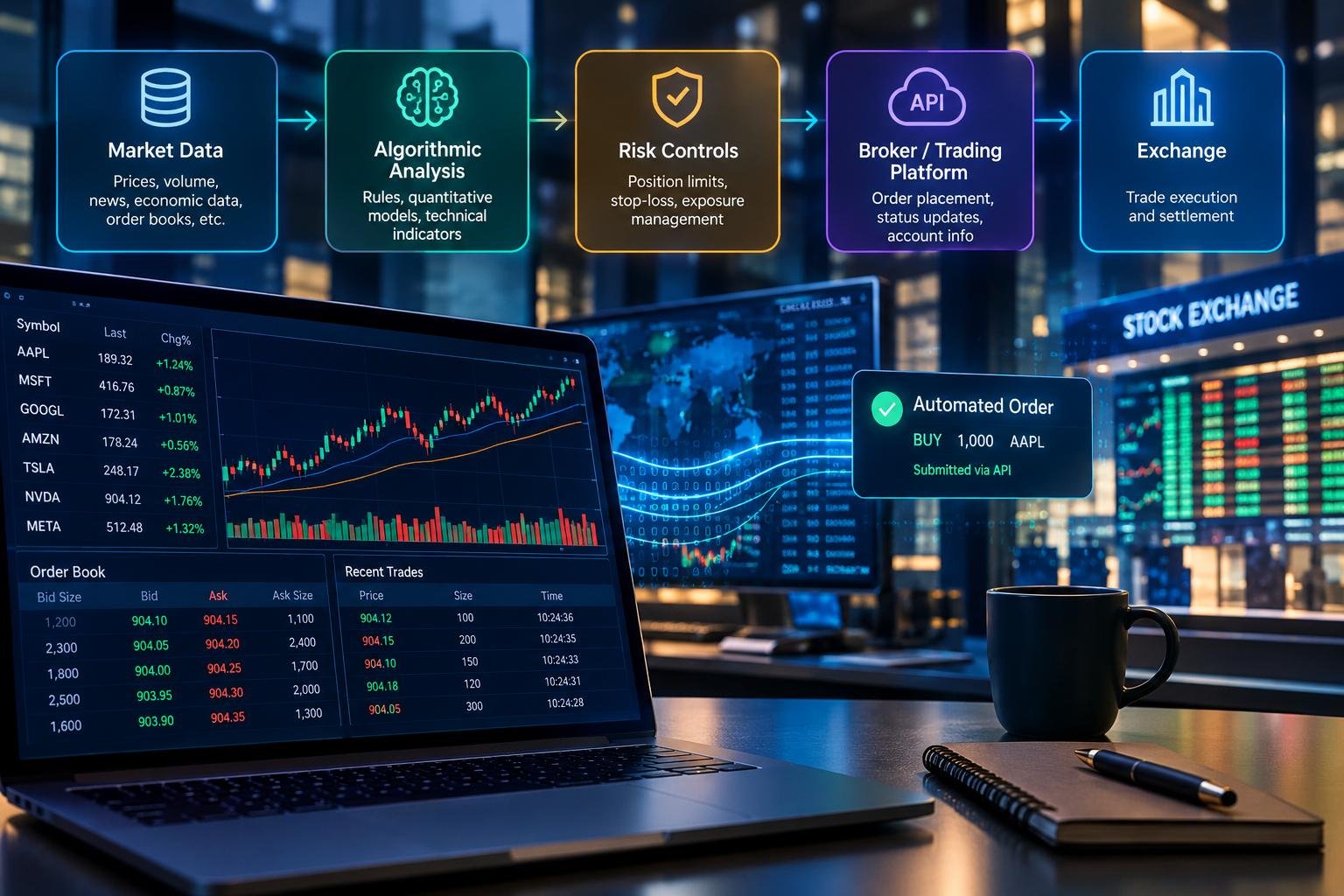
Financial markets produce a vast quantity of information in the world second-by-second, such as price, volume, economic releases, company statistics, and order book fluctuations, as well as signals from other markets. Some of this information can be learned by a human trader but it can be processed automatically by a computer program and acted upon following directions as a data stream flits by. This capability is used in algorithmic trading to convert trading ideas into a systematic rule, which can analyze the market situation, make trade decisions and even execute trading orders automatically. This is not to say that the computer is able to “understand” a market the same way that a person does. Rather, they adhere to models, conditions and risk parameters that are set by the developer, quantitative analysts, traders and/or an investment firm. Therefore, the quality of an automated strategy is dependent on the data, assumptions, programming, testing and controls used.
What is Algorithmic Trading
Algorithmic trading is a process that utilizes computer programs to execute one or more of the trading process automatically. An algorithm can be given market data, derive indicators, compare prices to set conditions, find risk and place an order if they meet their rules. It can also adjust or cancel an existing order in case of changes in the market. There is a wide variation in the extent of automation. Some systems just look for potential opportunities and alert a human trader and others take the entire workflow from analyzing the market and placing a trade. Instead, algorithmic trading is more of a trading technology and approach to making trading decisions than a single strategy. Algorithms can be utilized by various firms in a variety of ways such as trend following, statistical analysis, portfolio rebalancing, execution management, hedging, or liquidity provision.
How to use Rule Based Strategies
Some simple rules similar to a decision tree can be used in a simple algorithm. An example of a strategy might be to watch a stock and trigger a buy signal when the shorter moving average crosses over the longer moving average, but only if the stock’s trading volume exceeds a certain amount. This rule could be made a separate one, and it would ban trades when the stock is in the portfolio already. More sophisticated systems can potentially utilize dozens or hundreds of conditions such as price changes, volatility, volume, spreads, correlations, and market session data. What matters is the rule is clearly defined so that a computer can apply it uniformly. A human might alter a decision if he or she is frightened, excited, or reads differently the news, but a rule-based program will usually follow the rules it’s programmed with without being frightened, excited, or changing how it interprets the news.
Quantitative Models to Analyze Financial Data
When quantitative models are added to algorithmic trading, it can be quite a bit more sophisticated. Quantitative systems are mathematical and statistical systems used to convert financial information to estimates, signals or portfolio decisions. A model could look at how securities relate to each other, how much return they are likely to generate, how volatile the market is, how volatile the securities are, how unusual the price action is, or what the probability of the various market outcomes might be. It can take into account the historical price, fundamental data, various indicators, or other data sets. But that doesn’t mean that any model that employs complex mathematics is reliable. Past connections may not exist, information may be inaccurate, and assumptions that are valid for one market may not be for another. Therefore, quantitative trading must be validated, assumptions must be realistic and continuous monitoring must be done, rather than expecting a sophisticated formula to make decisions at all times that will produce profitable results.
The Peculiar Role of Technical Indicators
Another popular trading component of automated strategies is the use of technical indicators. Indicators transform market data into metrics which can be systematically analyzed. The moving averages may be used to detect price trend changes, while the Relative Strength Index (RSI) may be used to determine the price momentum in the recent past. Bollinger bands can be used to analyze price relative to a moving average and volume-based indicators can be used to determine trading volume. One indicator may be used alone or multiple indicators can be used in conjunction to other conditions in an algorithm. For instance, a momentum signal, minimum trade and a volatility range ranging between a set amount may be needed, before taking into consideration an order. Indicators can help to simplify trading rules in software and can help to ensure the correct predictions, but they cannot ensure them. Their value is dependent on their method of construction, testing, assembly and usage in a specific market.
A Complete Trading Signal to Automated Order.
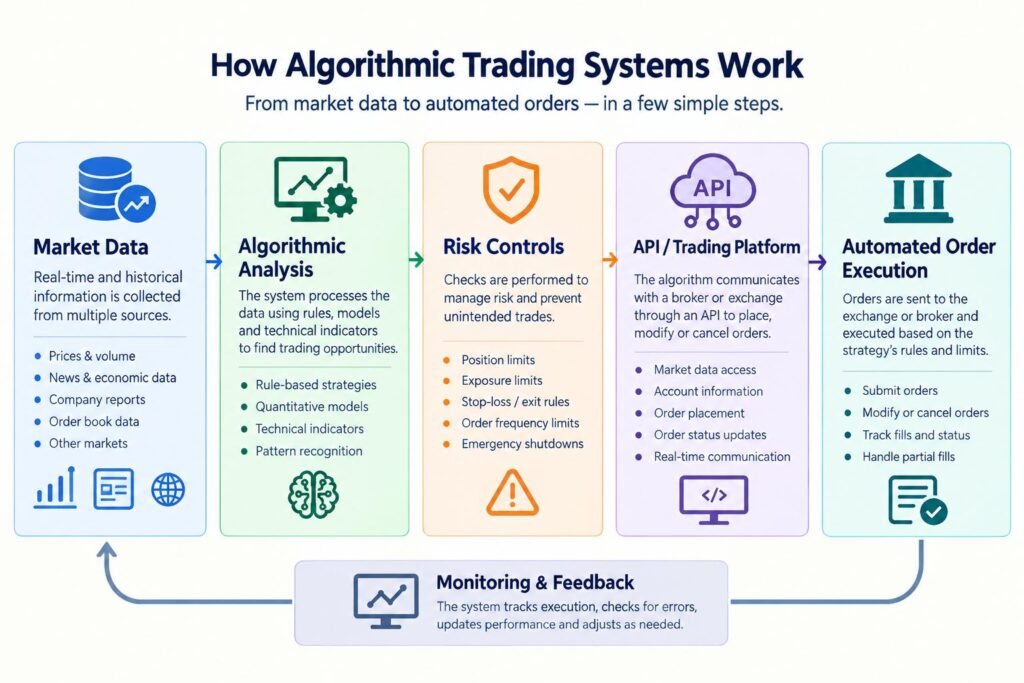
After a trading algorithm signals a potential trade, the next step is getting the algorithm’s signals converted into a tradable order. This can take several steps before reaching an exchange/broker. The program may first see if the security is eligible for trading, ensure that the desired position adheres to the portfolio limits, calculate the appropriate size of the order and choose the order type. It can then interact with a broker or trading platform using an application programming interface (API). APIs enable software systems to communicate with each other without having to manually enter each order. An automated system can submit, cancel or alter orders depending on the platform and permissions and it is able to retrieve information regarding the status of the orders. This linkage between analytical software and execution infrastructure is what can make a trading rule a process.
APIs and Automated Execution
The significance of APIs lies in providing a standardized means to communicate between an algorithm and a financial service, especially in these cases. An API for trading can have a variety of features, such as access to market data, account information, order placement, order status updates and more. These can be implemented in the algorithm, which can take action on specific conditions without having to constantly rely on a graphical trading interface. For instance, if the strategy decides to decrease the portfolio exposure, it can compute the amount to be reduced and place an order via the API that is allowed. But execution of the algorithm is not always as it expects. In part, orders may be filled, rejected, delayed, cancelled and/or executed at prices different from the signal price. For these outcomes, it is important to have monitoring of the execution. Thus, an order acknowledgement and/or order fills must be tracked in a reliable way, and not assumed that the order will have been executed when it is sent.
The Cornerstone of Algorithmic Trading is Risk Control.
While automation may help the trading process be faster and more consistent, it may also lead to errors to happen in a blink. Risk controls are thus key elements of algorithmic trading technology. A system can have limits on position size, daily loss, exposure, price range, frequency of orders and more. It can also help determine if an order would result in an unintended concentration or if the order would go over buying power. Some strategies may include stop-loss or exit rules, but these are not guaranteed to eliminate market risk and don’t always mean that you will exit the market at the price you want. More sophisticated systems can also have emergency shutdown features to halt trading if abnormal behavior is detected. The human element is still important, as the software can malfunction if data feeds fail to work, assumptions are incorrect, network connections are lost or a surprise market event happens. However, the best automation will be fast and ensure that the ramifications of mistakes are minimized.
Testing before Deployment
Generally, before an algorithm is put to use with real money, its developers will try to check its performance. Backtesting is a strategy that is applied to historical data to see what its rules were like during prior markets. A further stage can then be created using simulation or paper trading in which the system works without the requirement to place live orders. These processes can bring to light coding mistakes, over-trading, faulty assumptions and unrealistic expectations. However, past performance is not indicative of future performance. The strategy can look good when in fact it was accidentally built on the same data history on which it was assessed, often the case of overfitting. Other factors also have to be taken into account transaction costs, spreads, market impact, latency, taxes and liquidity as a theoretical backtest could involve conditions that don’t exist on the live markets. Testing is not of course a proof that a strategy may be successful; it is a process of recognizing weaknesses.
Algorithmic Trading vs. HFT
Algorithmic trading and high-frequency trading are two similar but distinct ideas. Algorithmic trading refers to the general term that encompasses a range of computer programs used to make trading decisions or execute trades, and can be used on any time frame. A portfolio-rebalancing algorithm may only execute trades on a monthly basis, and an execution algorithm may trade all the time during a trading session. By contrast, high-frequency trading is typically linked with very quick automated trading, significant technological infrastructure, higher order and message volume and strategies that might look for trading possibilities over extremely brief time periods. While high-frequency firms may employ their very sophisticated algorithms, not all algorithmic trading systems are suitable for high-frequency trading. If a fund rebalances a portfolio using software or if the fund slowly fills a large institutional order, the fund is using algorithmic technology, even if it makes the decision on the re-balance or the slowly filled order less than often compared to a high frequency trader.
Capabilities and Limitations
The major capability of algorithmic trading is systematic processing. Computers can look at all the data, follow the same rules, track hundreds of stocks at once and react without the time delays of manually entering order data. Automation also helps to mitigate some of the manual errors, consistency of execution and the management of complex workflows. Algorithms, however, have their drawbacks as well. They rely on data quality and availability, and they may make bad decisions when their suppositions are no longer true. A strategy may also have unanticipated correlations, variable liquidity, technology failures or programming mistakes. Automated systems can’t take away uncertainty from financial markets. They just outline a way of dealing with the uncertainty. However, human judgment is still crucial in the design of objectives, the selection of data, review of model behavior, management of exceptional situations and the decision of when an automated strategy should be adjusted or terminated.
Conclusion
The algorithmic trading technology enables to link the field of financial analysis, software engineering, data processing, risk management and electronic execution. A computer program can gain market data, use a rule-based or quantitative model to make a calculation, perform technical indicators and tell a broker through an API. The same system can automatically create, update and control the orders, and can track the order status and outcomes with proper controls. Automation isn’t automatic gain or profit, though. Algorithms execute based on the data and according to instructions that are often changed when markets change, and may not be the instructions they expected. It is important to grasp this difference when learning how to do automate market participation. The effectiveness of algorithmic trading relies on strategy design, realistic testing, robust infrastructure, proper risk management and a constant check, and at the end of the day, it is a tool to implement a strategy quickly and accurately.
Get more well researched information about Algorithmic trading technology here.