Profiting from the poultry business is one of the most lucrative business ventures in the world of agriculture but this will be achieved by much more than the quality of birds and feed. Among the most important of these that are vital to success in poultry design and construction is the poultry house design. An efficiently designed poultry house is a safe, comfortable and productive home for the chickens to grow, providing good feed conversion ratios, creating minimal opportunities for disease to break out and in the end, profitability is boosted. Contrary to this, substandard housing can result in stress, substandard performance, higher mortality rate, and more operating expenses.
Many poultry farmers suppose that a valuable financial investment is essential to construct a loan-effective poultry house. However, when properly planned and strategically managed in decision making processes, it is indeed feasible to build affordable housing that is of use to the birds and has minimal construction and maintenance costs. Farmers can optimize production and cost control by being careful what types of housing they use, operating adequate ventilation and space, and applying biosecurity strategies.
In this article, five practical suggestions are provided that can guide poultry producers as they work to reduce the cost, improve capacity utilization, maximize profits and provide high levels of bird comfort and productivity in their poultry housing.
The importance of having a well designed poultry housing
Farmers need to know the importance of poultry housing before embarking on any poultry housing project. With poultry birds spending most of their lives with them inside the housing, a significant amount of their health and performance is dependent on the housing environment. Good Housing provides protection from extreme weather conditions, predators, disease causing organisms and unnecessary stress for birds. It also provides the optimal environment for feeding, drinking, resting and egg-laying.
Egg production, feed efficiency and mortality are all directly linked to the quality of housing, as are growth rates. When kept in comfortable surroundings, birds are less stressed and are more able to use the feeds they are provided, thus their growth rate and productivity are improved. Moreover, adequate housing allows a range of housekeeping routines, like cleaning, vaccinations, feeding and supervision of disease, to be reduced. Standards of poultry house construction can offer farmers some useful advice for correct building and closing practices, which can help both improve the welfare of their birds and boost the profitability of their operations. The planning process from the outset is time-consuming but always worthwhile for farmers to avoid unwelcome investment failures and to get long-term investment value.
1. Build an appropriate and economical housing system.
One of the most critical choices that a farmer has to make is the type of poultry house or building to use. Maximum costs of construction, manpower need, productivity, and management complexity are different for various housing systems. The most commonly used systems are free range, deep litter systems, semi intensive systems (and cage systems).
The deep litter system is a good choice for small-scale poultry producers and medium-scale producers because of its cost-effectiveness and effectiveness. This system uses absorbent bedding materials, like wood shavings, rice husks or sawdust to raise the birds. Deep litter housing is comparatively cheap to build as it does not need a necessity of special materials and equipment like cage system housing. Further, birds are able to move around more, possibly improving welfare and reducing behaviour problems.
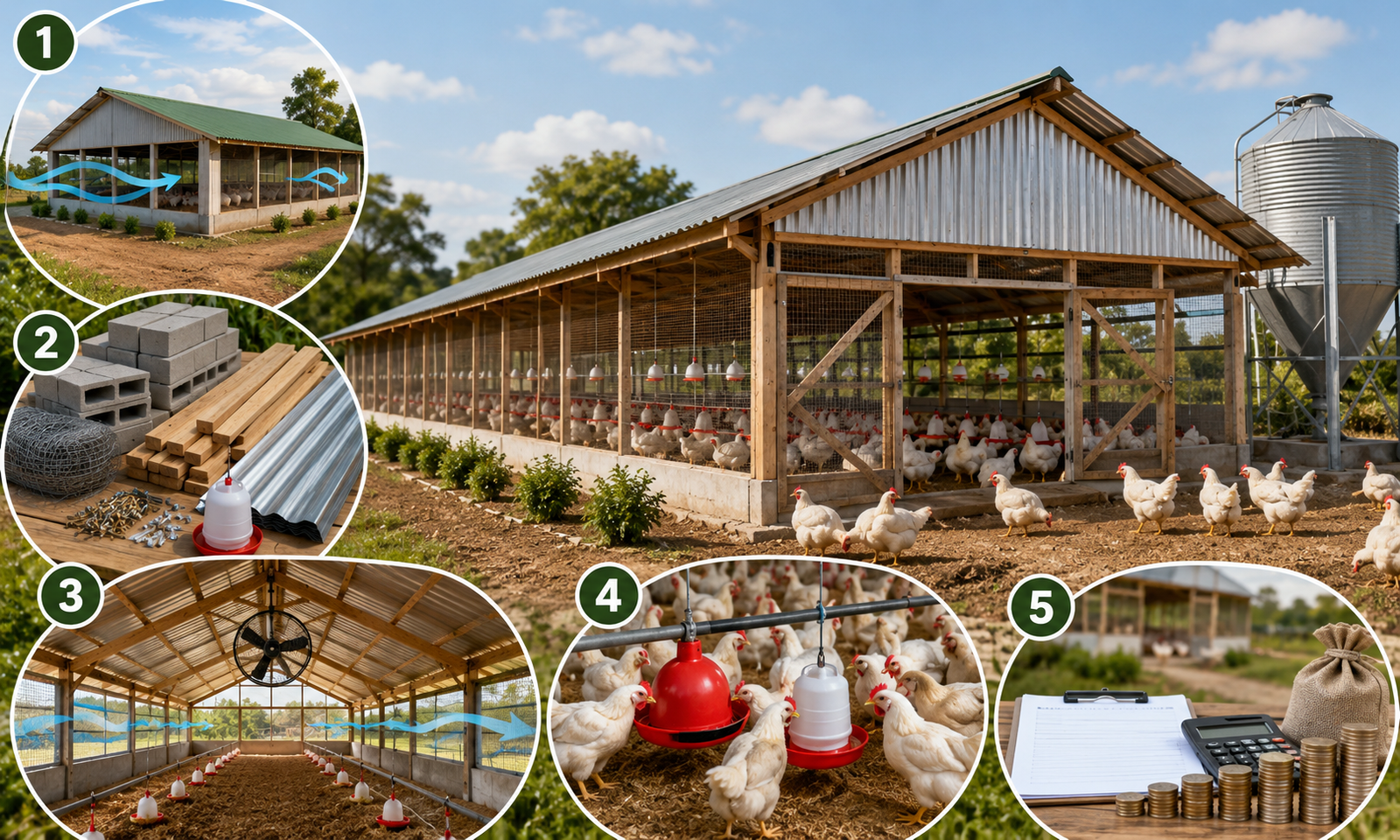
The climatic conditions, availability of resources and labour resources, as well as the production objectives of farmers, should also be taken into account when making the choice of a housing system. Recycling materials from local resources like bamboo, timber, concrete blocks or metal sheets can help lower building costs without sacrificing quality. There are examples of practical housing systems that can be erected to suit a farmer’s particular requirements and available resources, and the need is there to know how to build a house that can most effectively contribute to production and is not wasteful.
2. Appropriate siting/house orientation.
The first step toward an efficient poultry house is to determine its location. The wrong site location can cause recurring problems with drainage, ventilation, disease management, and managing the environment. The poultry houses must be constructed on raised ground and have good drainage to avoid water-logging during the rainy season especially. Moistures invite the growth of harmful microorganisms and make the breakout of a disease more likely.
House orientation is also one of the significant factors which can contribute to keeping the house indoor temperatures comfortable. For tropical and subtropical areas, the poultry houses are generally built east/west to minimize direct sunlight to sidewalls. This is beneficial in hot weather to reduce their heat stress, which can improve their comfort and output. If the spacing between poultry houses is adequate, more air circulates around the house and between houses, limiting any likelihood of spread between flocks.
Site selection should also take into account accessibility. Poultry houses should be close to roads to facilitate feed, equipment and product handling and sufficiently away from areas that are used by residential occupants and other livestock operations. The use of reasonable distance from potential sources of contamination also enhances the biosecurity practice and helps minimize disease risks. Choosing a site will ensure the best level of production efficiency as well as lower the operational cost of the production system in the future due to having a poor environmental management and disease control system.
3. Install effective ventilation systems
One of the most important features of a poultry house is ventilation which has close connection to bird health, the regulation of temperature and the quality of the air. Sub-optimal ventilation conditions cause the build-up of dampness, bacteria powder, ammonia and toxic gases which can affect performance, especially of the birds. Poor ventilation systems can be linked to respiratory diseases, poor growth rates and higher rates of mortality.
However, there are cases where the right ventilation can be accomplished without expensive equipment. Natural vents can yield great results in many areas, especially by being integrated into the housing design. Open-sided poultry houses have wire mesh that allow fresh air to flow but keep predators at bay. Extreme weather can be tackled by installing adjustable curtains to control the airflow at that time. Raised roof design elements like ridge vents or areas for natural ventilation are also beneficial in increasing air flow.
In the hot environments, natural (passive) ventilation might be complemented by inexpensive circulation fans or exhaust fans as needed. The improvements in ventilation become significant, however, even with simple improvements to birds’ comfort and productivity. Proper air flow will provide the correct hydration, humidity control, disease risk control and feed conversion efficiency. In healthy birds growth rates are increased and performance is increased as well – so it may be seen that an investment in good air exchange can often reap significant dividends in terms of improved performance and reduced veterinary costs.
4. Ensure birds comfort
One of the most frequent errors made by poultry farmers in designing poultry houses is that of keeping too many birds in a house. It is tempting to increase the density of birds to generate greater profit but as with all pallet production, the more crowded the birds are, the less money they will make. A higher stress level, aggression, less feed utilization and susceptibility to diseases among birds kept in a cramped environment. Such issues can have a tremendous impact on productivity and profitability.
Space requirements should be based on the type of bird, age, and production. There are specific space requirements for broilers, for layers and for breeders. Farmers really need to work out their flock size and stocking density carefully before construction so that they know what size flock can fit in the poultry house. Also adequate feeder and drinking space should be provided to make it possible for every bird to have ready access to feed and water.
Spacing helps to improve ventilation and bird-to-bird contact, which decreases competition and spread of infectious diseases. It also facilitates easier cleaning and management activities. Creating slightly larger houses could help with the cost of the building but in the long run can provide the property with added value. There are additional benefits to improved bird welfare, better production performance, reduced mortality rates and reduced disease treatment expenses which adds up to higher overall profitability. Thus proper utilization of space becomes an important investment for successful poultry production.
5. Implement strong biosecurity measures.
Poultry systems should never forget about biosecurity while housing. Disease outbreaks can rapidly cause devastating economic losses within poultry enterprises including by death, lost productivity, treatment costs and market limitations. Buying in at the initial design phase where the opportunity for good biosecurity is available will help keep birds safe and limit harm to the farm economy.
Controlled access to poultry houses is one effective bio security measure. Fencing the outside of the farm and limiting visitors to the farm decreases the opportunities for disease introduction. Disinfectant footbaths should be used at entry areas and workers wearing dedicated clothing and footwear to enter the poultry areas. Buildings should easily be clean and disinfected from one production shift to another.
Rodent and wild bird control is equally important as rodents and birds can carry disease causing organisms. Adequate storage of feed, building construction and regular clean-up can reduce pest issues. Also protection of water sources from contamination should be maintained to avoid disease transmission. Biosecurity measures should be incorporated into housing design and on-farm biosecurity management practices and can contribute greatly to minimising disease risk and production loss. Good biosecurity not only helps maintain a healthy flock, but it also promotes consumer confidence and market access.
Additional cost saving measures in the construction of a poultry
The following are some more ideas to help farmers save money on construction without compromising on their housing quality: Locally available building materials can reduce transportation and procurement expenses. Recycled materials can also be used as much as possible, as long as they can be used for structural and sanitation purposes. Farmers should not consider luxury, but more about durability of the products and the features that directly affect the welfare and productivity of the birds.
Expansion needs to be taken into account as well as in the planning process. Providing accommodation in a manner that offers flexibility for population growth will save on extra, future, modifications to the accommodation. Designs that maximize and utilize natural light and ventilation minimize on-going utility costs. Additional savings can be realized through the use of rain water in a rain water harvesting system to supplement water supplies for cleaning and maintenance activities. All cost reduction options must be considered in relation to their long term production efficiency and bird welfare.
Conclusion
Maximizing profitability in poultry farming is one of the best ways to maximize through building affordable and efficient poultry houses. A properly designed poultry house provides a healthy environment that supports bird welfare, increases productivity and feed efficiency and minimises disease risks. With careful selection of housing systems, choosing appropriately, adequate ventilation, space and good biosecurity management, farmers can get good production without the burdensome cost of construction.
The ideal housing for poultry should combine reasonable costs with practicality. Although it is important to keep costs to a minimum, features that contribute to the bird’s health and performance should never be a compromise. With thoughtful planning and knowledge of how to make decisions, farmers can build long lasting, efficient facilities that bring a good return on investment. Overall, good housing is essential in an effective poultry production system and will help farmers to achieve sustainable growth and maximize profit in a very competitive agriculture industry.