Crop rotation has proven to be one of the most effective and traditional farming practices to preserve soil health, boost production and decrease reliance on chemical inputs. It is a planned and systematic rotation of two or more crops, or groups of crops, in the same cultivated area over a season or a number of seasons or years. Farmers practice rotation of different plants or crops that have different nutrient requirements, root systems and pest problems to ensure they are not growing the same plant/crop in the same location continuously. This approach allows for breaking pest and disease cycles, nutrient balance and general farm resilience. Crop rotation is an important example of practice to implement for obtaining sustainable yields and maintaining soil fertility in the long term. With a proper system of crop rotation, synthetic fertilizers and pesticides are largely eliminated, production costs cut down and ecological balance improved in the farming system. In contemporary farming, soil degradation and the emergence of pests’ resistance are significant issues that are of great concern to productivity and profitability.
Understanding the Principles of Crop Rotation
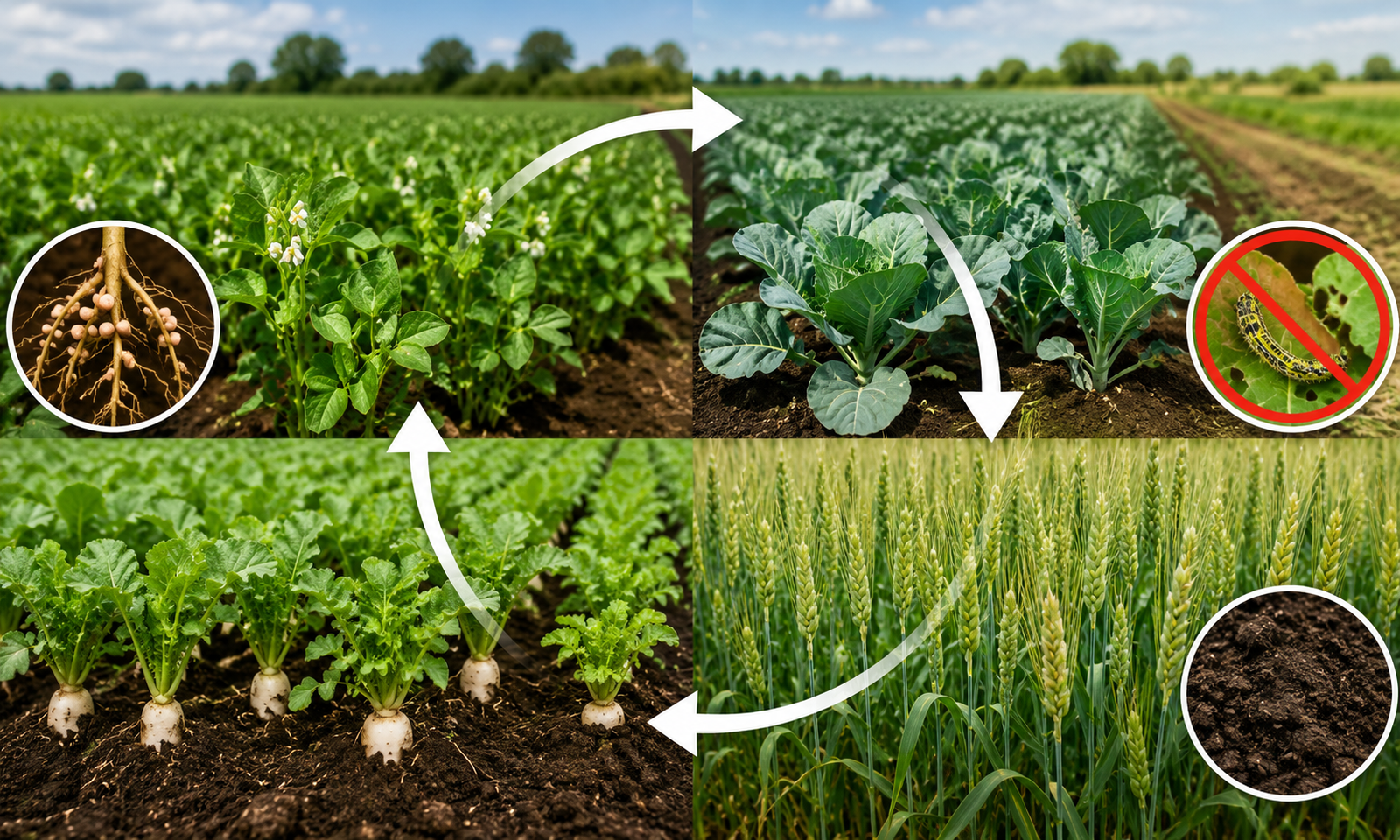
Crop rotation principles are related to maintenance of ecological balance, nutrient cycle and biological diversity in the soil. Crop rotation is nothing more than an awareness that different crops utilize soil nutrients and soil organisms in varying ways. Legumes, for instance, like beans and peas, can naturally fix nitrogen in the soil, adding to it for the subsequent crops, such as maize or wheat, which need higher levels of nitrogen. Likewise, a deep-rooting crop will use nutrients which are found at a depth lower in the soil; a shallow rooted crop will utilize nutrients that are closer to the soil surface. Farmers use this cropping rotation with a definite sequence, which will help to avoid soil exhaustion and to ensure desirable soil structure over the years. Crop rotation also disrupts the life cycle of pests and diseases that rely on particular crop species. This minimises the accumulation of pests and diseases in the soil, and the chances of a general crop failure. Together, these principles build a better farming environment that instills stability, prosperity, and sustainability to agriculture.
Soil Fertility Improvement Through Crop Rotation
Crop rotation is regarded as one of the more notable benefits of the rotation is that it returns a certain natural fertility to the soil ‘for free’, rather than relying upon chemical fertiliser inputs. Nutrients can be leached away over time using continuous monocrop, reducing the soil’s productivity. Crop rotation works because it alternates crops that require a lot of nutrients with crops that replenish nutrients. Leguminous crops, especially, are important for fixing nitrogenous gas in the soil because of their association with nitrogen-fixing bacteria, which are present in their root nodules. Against cereals or with root crops such rotation will benefit subsequent crops by providing nitrogen. Further, crop rotation is an aid to increasing the amount of organic matter because various crops leave different amounts of plant residues after they have been harvested. These residues break down, building humus in the soil, while enhancing water holding, aeration and microbial action. This, over time, results in improved soil structure, minimized erosion and greater ability to withstand drought. Soil fertility is nurtured in a more natural and efficient manner, helping farmers lower input costs and enhance yields.
Understanding rotation for pest and disease reduction.
Crop rotation is another effective way to control pests, diseases and weeds in agricultural production systems. Many pests and pathogens will only survive when the same crop is grown time after time in the same field. This makes it easy for infection to grow over time. However, the cycles can be broken by rotating crops, which will lower the levels of harmful organisms in the soil. Such rotation with non-host crops can greatly help limit soil-borne diseases like root rot and blight, for instance. Likewise, changing crop hybrid shapes and types will reduce weed growth due to the changing light patterns and soil coverage as well. This means less dependence on herbicides and pesticides; lower production costs and lesser contamination found in the environment. Rotation also promotes beneficial organisms in the soil ecosystem like predaceous insects, earthworms, and others that can naturally manage the pests. This helps make the farm more resilient, stable and helps to reduce the chances of such a sudden outbreak that could affect yield significantly.
Agronomic recommendations to improve crop rotation for Sustainable Agriculture.
Several crop rotation models are available which could be used as a foundation for sustainable crop rotation systems; however, the design of an effective crop rotation plan depends on the size of the farm, climate, soil type and the preference of farmers. Typically crops are grown in a 3 year rotation – cereals for 1 year, legumes for 2 years and root or tuber crops for the third year. This will help to ensure balanced nutrient requirements as well as recovery and soil enrichment of the soil. Continuing with the same rotation as four years above, farmers may choose to add a cover crop or green manure phase that would emphasize supply of soil organic matter and soil structure. Spring and fall are generally considered off-season planting periods for crops; either can be cultivated as a cover crop to help to prevent nutrient loss and erosion. Later these plants will be added into the soil to boost microbial activity and organic matter. Incorporating cash crops into rotation with forage crops is also good to do as it increases soil fertility and/or generates an extra stream of income or feed for livestock. The trick to being successful is to not use the same plant family again, as it decreases the likelihood of common pests and diseases and healthy soils.
Crop Rotation Best Practices (Brieta & Barrera)
Crop rotation is a clear-cut system that must be planned, observed and “recorded” carefully to be a positive help to each crop in the system. Soil analysis (regular soil testing) should be the first step that farmers take to inform crop rotation planning by showing nutrient levels and deficiencies. It is also crucial to have a record of the preceding crops, yield, pest incursions and fertilizer usage. Nutrient requirements and plant families should be taken into account when grouping crops and it is important that heavy feeders are succeeded by light feeders or nitrogen fixers. Use of cover crops during fallow periods can help prevent soil erosion and increase the organic matter content. The need for sustainable practices that are economically viable should be taken into consideration while implementing a rotation system based on market demand and profitability. Also, working the animals into crop rotation can further improve the nutrient cycle by utilising manure, which can be called as a closed circulatory farming system. When these practices are done well, the results are better soil health, lower input expenses and a better long-term productivity.
Conclusion
Crop rotation is still one of the best and eco-friendly methods of keeping soil fertile and pest free while in cultivation. Farmers’ knowledge and utilization of structured rotation systems can greatly diminish their need for synthetic fertilizers and chemical pesticides, and enhance soil condition and productivity. Benefits include improved soil structure, increased biodiversity and environmental resilience to drought and disease conditions, among other reasons. Crop rotations can be more sustainable and effective as climate change puts pressure on crop yields and soil health globally, ultimately balancing productivity with eco-friendly practices. Implementing well-designed rotations can also yield long-term benefits to the farm’s land value, while providing immediate benefits to the grower in the form of harvest benefits. Of course, the concept of crop rotation isn’t merely a farming practice, but a key principle in sustainable agriculture that promises healthier soils, stronger crops, and more robust food systems going forward.