Introduction
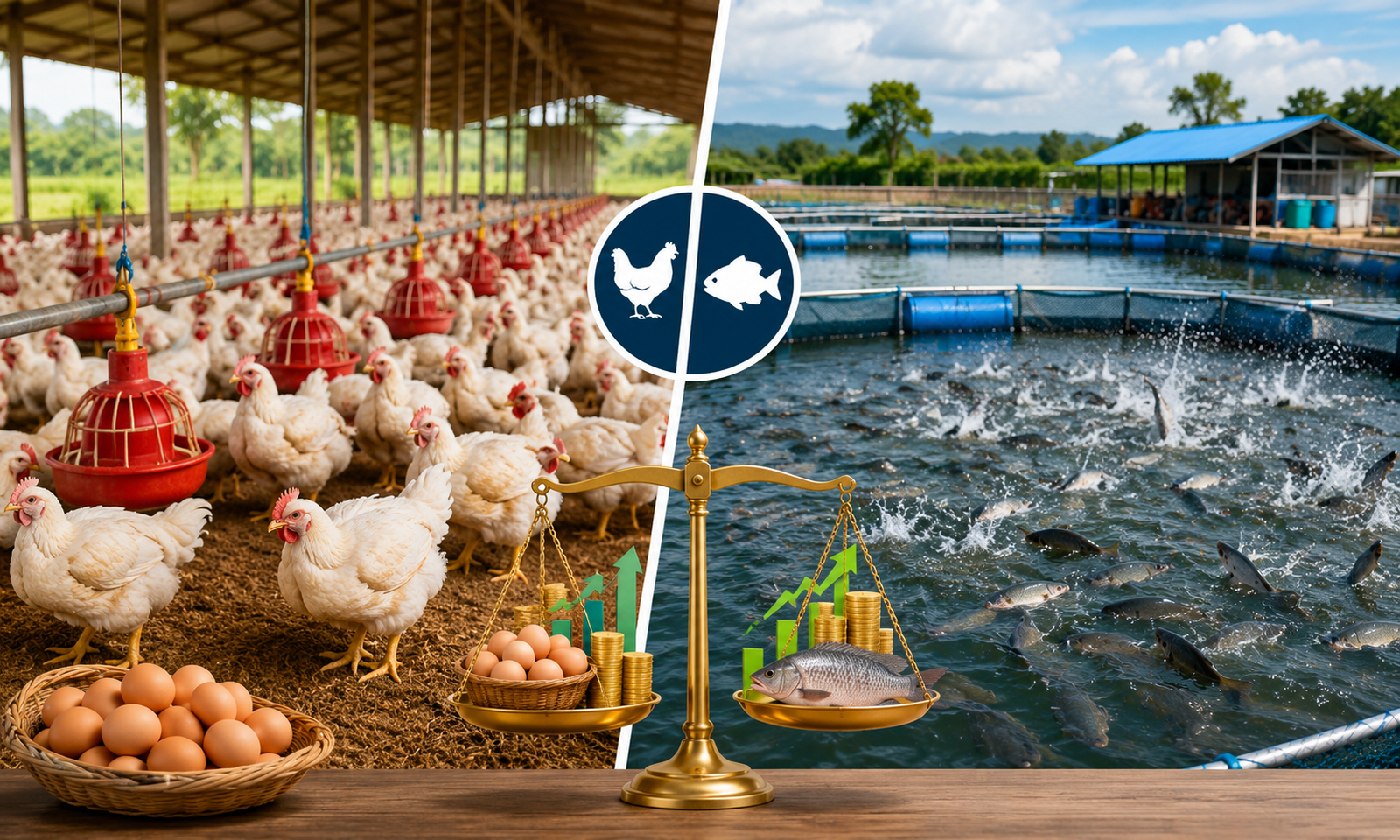
Despite the current dramatic shift in agricultural technology and expanding technological possibilities, agriculture remains as one of the most secure industries to invest in particularly in less developed nations in which the demand of food prevails over supply. Poultry farming and fish farming (aquaculture) are two of the most prosperous and sought-after agribusinesses to pursue. Although both industry sectors appear to present good opportunities for income generation, job creation, and growth potential, there are significant differences in terms of start-up requirements, level of management required, the level of risk faced and overall profitability. When individuals are considering investing in real estate, they need to know the differences before they put their money into it. Even though egg and meat production are always in demand and rapid production cycles make poultry farming attractive, fish farming is seen as still having high market value, and able to be scaled up. Both ventures share certain similarities, each has its own merits, this article compares both businesses in great length and helps the investors to understand which is better for them from their business perspective.
Startup Costs Comparison
One important factor that should be considered in determining between the poultry farming and fish farming are the startup costs. The general rule is that moderate investments are needed for poultry enterprises, depending on the scale of production. These costs generally include housing (deep litter or battery cages), day old chicks, feed, vaccines, water systems, and labour. An attractive quality of poultry is that it permits the slow incremental escalation of activity – it is easy to begin with 50–100 birds and add to the numbers over time. But feed is a major ongoing cost, however, which can be as much as 70% of operation costs. However, the following costs are involved in fish farming and cannot be eliminated: the initial expense of establishing ponds, which involves excavations and structuring, the cost of water supply systems, including purifiers and pumps, and aeration products, fingerling purchase, and the effort required to purchase special feeds. There is a cost difference between backyard or tarpaulin ponds and commercial aquaculture projects, as the latter requires more technical infrastructure and planning work. Moreover, the presence of consistent water supplies and in some cases the water treatment is required for fish production, this can make fish farm setup complicated. Overall, it can be concluded that small farmers with small amounts of capital are able to raise chickens, while beginning pisciculture investors are the ones able to make higher investments in the initial stage to enjoy higher returns later.
Management Requirements
Another key factor that sets a lot apart between poultry farming and aquaculture is the intensity of management. The farm is home to poultry and will need to be managed on a day-to-day basis, especially for feeding, cleaning, vaccination, and watching over the well being of the birds. Environmental changes make birds very susceptible and can cause outbreaks of Newcastle disease or coccidiosis in a matter of days, if hygiene is poor or ventilation is not adequate. Beginning poultry operators, however, can be easily schooled in the basics of poultry management, since much of the basics can be readily found in standard practice. By contrast, aquaculture requires a more technical application for monitoring water quality, feeding habits, oxygen level in water and stocking density. It is more difficult to detect stress or disease early, as fish are less visible in their surroundings. It is important for farmers to regularly test pH, dissolved oxygen and ammonia levels, as these will affect the health of the aquatic environment. Although on a day-to-day basis, the process of fish farming may seem less labour-intensive, it demands more technical knowledge and monitoring of the environment, to prevent massive die-offs. Thus, small-scale farmers have more success in raising poultry than raising fish, while those who can afford to learn technical skills and use environmental control systems can have more success raising fish.
Enterprise and market returns
Maximizing profits are often important determinants for the most agribusiness investors, and this is what makes both the poultry business and the aquaculture business attractive. Poultry farming allows for recovery of investment in less time because the production periods are short – the investing time for a broiler is 6-8 weeks and for a layer that of laying eggs starts within a few months. This enables farmers to have a steady income flow every year. But feed prices, disease blips and changing market prices can impact profit margins. Fish farming generally, however, yields better profit on the final product, particularly where fish species such as catfish and tilapia are in demand in a community. Fish raised in aquaculture systems can take several months (typically 4-8, depending on species and system) until they are market size, but if survival is good this can be a substantial return on investment. When assessing the profitability of poultry farming and aquaculture, investors need to understand the investment returns associated with both to understand the pros and cons of both, as well as their long-term viability and scaling up potential. In the end, it is clear that although the recurrent profit potential of poultry farming and aquaculture are similar, the profits in fish farming, although slow, can be high in lump-sum.
Risks and Challenges
Every farming business has the potential for risk and understanding these risks is a key factor to sustainable success. Diseases are a consistent threat to raising poultry, and birds can quickly die off if good biosecurity practices are not BIO SECURITY PRACTICES are STRICTLY followed. Common problems that farmers have to deal with include diseases, fluctuations of feed prices and heat stress. Moreover, there should be a constant supply of energy to the poultry for light, heat (in certain systems) and ventilation. Farming of fish, on the other hand, has its own hazards like failure in quality of water in the farm, flood, lack of oxygen and predation. Over a short period of time, large numbers of fish can die as a consequence of suddenly depleting oxygen, causing financial losses. Furthermore, environmental pollution and necessary water stability affect fish farming, and this may not be easily found in every place. Availability of fish markets can also be an issue for fish farmers who are in the interior of the country with no cold chain facilities. However, while both businesses are considered high risk, risks associated with poultry will be more situational as interventions can be more consistent and controlled; fish will have more environmental-based risks that can be more catastrophic and abrupt if not properly controlled.
Scalability
The long-term profitability and expansion of a business can greatly influence market demand. Eggs and chicken meat, which are all year-round products of poultry, continuously have high and consistent demands because they are both affordable and nutritional and are well accepted by the majority of culture. This also allows poultry farmers to scale their operations up easily, further adding to the number of local and institutional buyers like restaurants, hotels and supermarkets. Distribution channels are also well developed, its business growth, so it supports. There is also good demand in the fish farming industry, particularly in the production of catfish and tilapia, which are popular in many areas. But in some markets the demand for fish may be more seasonal and is likely to involve more effort in market and distribution owing to the perishable nature of fish. For larger operations, cool down and transportation systems are important. From the point of view of scalability, poultry can be expanded quickly with the addition of new poultry, and the income can be reinvested in the operation, whereas scaling-up of fish cultivation is achievable, but takes longer term and requires hardware upgrade. Despite this, in these two sectors there is good long-term market opportunity if properly situated at proper points in the value chain.
Which is Better for Investors?
Investors will ultimately make their decision on whether to opt for the poultry or fish farming product based on their resources, experience, and business goals. Poultry farming is more easily undertaken for the less financially advantageous due to its relative ease of entry, its usually quicker turnaround, and its relatively simplified management techniques. Best suited to those who wish to generate regular cash flow in an incremental way. Fish farming, however, might be more interesting to investors who have more capital to invest, more technical knowledge, and more patience in waiting for longer production periods. It can help create higher profit per production cycle, particularly in well managed businesses with minimal mortality. The location is also important to consider; there are places with secured water availability and high fish market interest that are more favorable for fish culture, and other areas where the poultry supply chain is developed, may turn out to be better for poultry farming. In the end, both are not necessarily better or worse, but solely successful depending on planning, risk management, and market timing.
Conclusion
While poultry farming and fish farming present good agribusiness opportunities, there is a tremendous difference between the structure of the two businesses, as well as differences in risk and profitability patterns. However, it is easy, quick and manageable, and thus favored by small to medium scale investors, as is poultry farming. Fish farming, in contrast, provides higher potential income per cycle, but has a higher technological requirement, infrastructure and environmental stability. Investors should do their due diligence on financial capacity, market demand in their area, and their readiness to handle the management of the complexities involved before a choice is made. Moreover, in a lot of cases, a different strategy that incorporates both ventures can also assist in reducing risk and profit the most from the income streams. If the activity is managed in a disciplined manner and planned in the right way into the market and with proper management both poultry and fish farming can be a sustainable and profitable agricultural enterprise.