
Introduction
Launching a small business with a small amount of capital is one of the most sensible methods to attain monetary independence and develop lasting wealth. Lots of prosperous business owners started with very little resources and increased over time by persevering, being creative and making savvy choices. But there are other challenges for businesses with low capital. Resources are scarce and even a little error can mean big loss in profit and business survival.
It’s not that many startups are a bad idea, it’s simply that most of them make mistakes in the planning and spending, marketing, and management of the business that could have been avoided. By knowing these common challenges, entrepreneurs can better safeguard their investment and build a successful and sustainable business. New business owners can gain valuable insights from others and minimize potential risks, enhance efficiency and boost their likelihood of success.
The best way to steer clear of the many pitfalls that new business owners may fall into is to identify issues and problem solve as early as possible in the process so that they will not become major hindrances. This article discusses 10 common pitfalls that people fall into when they start a small business with minimal capital and offers some tips on how to avoid them.
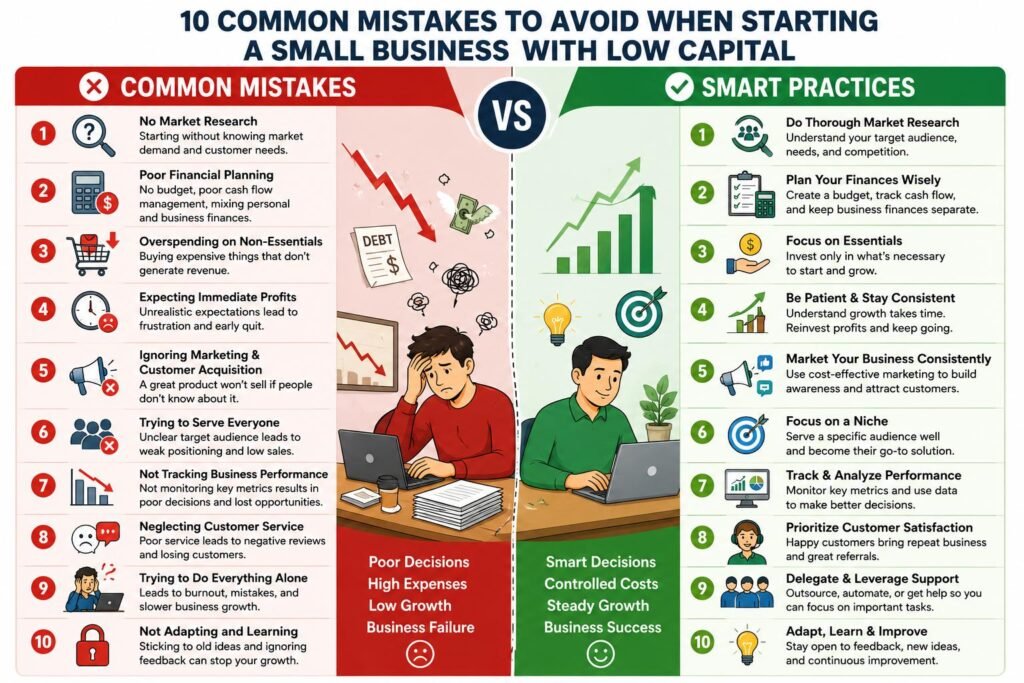
1. Making the assumption that there is no market.
The worst thing that new entrepreneurs can do is start a business without knowing much about the market. People get an idea and without knowing whether the customers are interested in the product/service they put their little money. This frequently results in sub-optimal sales, unsold stock and lost resources. Market research provides business owners with opportunities to determine what their customers are looking for, how they’re planning to purchase their product or service, the competition, and pricing information before they spend any money.
Low capital entrepreneurs can’t afford to make assumptions. Simple surveys, talking to prospective customers, watching what competitors do, and analyzing market trends can give a lot of insight. Knowing the target market and its problems, enables the entrepreneur to develop a product or service which people will be willing to pay for. The market research is the right approach to minimize uncertainty and to ensure that business owners can make informed decisions that can lead to better business sustainability and profitability.
2. Poor Financial Planning
Poor Financial Management is one of the main reasons for business failure. When starting a business, many entrepreneurs overestimate the start-up expenses, don’t keep a record of expenses or simply don’t bother developing a realistic budget. When you are on a budget, every dollar counts! If you don’t have a financial plan, it’s easy for businesses to run out of money before they’re able to cover their costs.
Good financial planning means forecasting how much it is going to cost to start up, predicting income, keeping track of expenses and having an emergency fund. To avoid any confusion and to ensure that the business is running smoothly, it is necessary to distinguish between the business’s and the owner’s finances. Simple bookkeeping tools and spreadsheets can assist you to monitor cash flow and recognize any potential cash concerns early. By carefully planning the budgets, the money invested is used in an efficient manner and the extra expenses are avoided that may harm the business.
3. Excessive spending on non-essential purchases.
It is a common mistake of many new business owners to over-invest in non-revenue generating activities. They can end up buying expensive office furniture, renting large spaces, buying high quality equipment and much more before developing a loyal customer base. These purchases might seem business-like, but they can all too easily eat into limited business start-up capital.
Entrepreneurs should concentrate on core expenses which are required for the business and to acquire customers. Do not necessarily go for perfection from the start, rather, go small and then upgrade as profits go up. Through lean business practices, the business owner is able to keep money in his pocket and experiment with the business model. By focusing on generating revenue instead of unnecessary costs, businesses can ensure their continued financial stability during their early stages.
4. Expecting Immediate Profits
If you have the expectations that you’ll make a lot of money, you’re setting yourself up for failure. A lot of business owners think that they’ll make a lot of money in their business in a few weeks or months of its launch. If results are not as they had hoped, they might give up too early from the business or resort to desperate measures that negatively affect long-term growth.
It takes time to build a successful business. For customers to come to know, trust, and purchase from a business repeatedly, consistent revenue must be developed. Entrepreneurs should make realistic financial forecasts, and know that it pays to invest profits in growth. Patience and persistence are the key ingredients for success in the business. This will help owners make more informed decisions and stay committed during tough times because they are concentrating on sustainable growth, not quick gains for short-term profit.
5. Ignorance of Marketing and Customers Acquisition.
There is a misconception by some businessmen that because they have a good product, they will sell. Sadly, even the best products and services cannot succeed when potential customers don’t know they existed. One of the biggest challenges for many low-capital businesses is that they don’t invest in marketing, which is to their detriment.
Successful marketing doesn’t have to be expensive. There are a number of different ways you can get great exposure, such as social media sites, word of mouth, content marketing, local networking and customer testimonials, and they don’t cost much of anything. It is important for entrepreneurs to always promote their business and establish a relationship with their target market. Marketing is not an expense, it’s an investment. Companies that continually seek out customers will be more likely to generate ongoing revenues and growth.
6. To Serve All
Another common pitfall is trying to appeal to all without a specific target audience. The temptation for entrepreneurs is to market products or services to as many people as possible in order to boost sales. On paper, this strategy typically leaves marketing strategies stunted and makes it challenging to out-compete.
Successful businesses know their target customers, and make their products their target customers. It can identify different market niches for entrepreneurs to develop their marketing strategies, product offerings, and customer relations. When customers understand what you’re looking for, they’ll be more inclined to interact with your business. By concentrating on a specific market niche, they can expect to achieve greater satisfaction, brand loyalty and profitability.
7. Failure to monitor business performance.
Far too many small business owners don’t track important metrics. They might not even be aware of the profits they are earning, the best-selling products and the best marketing strategies to use. Without the right information, it is hard to make the right business decisions.
Monitoring performance aids entrepreneurs to recognize their strengths, weaknesses and opportunities for growth. Sales revenue, profit margins, customer acquisition costs, inventory turnover, and customer retention rates are some of the crucial indicators. By continually analyzing the data of the business, owners can make the necessary changes to strategies and increase efficiency. It is better to rely on data and information for decision making than to act on a guess and make an assumption. Performance checking also enables entrepreneurs to identify issues in advance of them becoming serious issues.
8. Neglecting Customer Service
Customer service is a crucial element of any business, particularly for businesses with small marketing budgets like start-ups. However, there’s great focus on attracting new customers and neglect of existing ones. Negative reviews, lower referral rates and lost sales opportunities are potential consequences of poor customer experiences.
Good customer service helps to generate repeat business and fosters customer loyalty. Customer service is a major part of a business’s reputation and having a fast response to queries, a good approach to complaints and the ability to go above and beyond what the customer was expecting can mean the difference between a good and bad reputation. Happy clients may turn into brand advocates that vouch for the business with others. Customer service is a key to profitability and sustainable growth as it has a direct impact on retaining customers, which is generally less costly than customer acquisition.
9. Trying to Do All Things alone
However, small business owners with small capital often attempt to manage all aspects of their business themselves. Although cost cutting is essential, a lack of resourcefulness with accounting, marketing, customer service, inventory, operations and administration can cause burnout and loss of productivity. They might find their business owners to be overwhelmed and be unable to focus on the important activities.
Not all delegations have to be made through the recruitment of full-time staff. Outsourcing particular tasks, hiring freelancers, or utilizing software and hardware automation or relying on trusted partners are all options that entrepreneurs can use. Incorporating the most valuable activities will help optimize business performance and speed up its growth. It is important to know one’s own capacities and to ask for help when needed this is strength not a weakness in leadership.
10. Not adapting and learning
Business scenarios, customer preferences and markets are always subject to change. A lack of flexibility among entrepreneurs can become a real challenge to staying competitive. Others, however, are so fixated with their initial idea that they don’t take the time to consider the very useful impressions they’re receiving from clients or the evolving market. This reluctance to change may hinder growth and/or failure.
Entrepreneurs who are successful see education as something that is ongoing. They look for feedback, check out industry trends, and are receptive to new opportunities. Flexibility means that organizations are able to effectively meet challenges and take advantage of new trends. It is essential to be flexible whether it’s changing prices, creating new products, or enhancing your customer experience for long term success. Organizations that are dedicated to continuous improvement stand a better chance of surviving and prospering in today’s competitive environment.
Practical Tips for Prevent these Errors
The ability to avoid common pitfalls of entrepreneurship depends on discipline, planning and learning. The first step in the process for entrepreneurs is to develop a comprehensive business plan, including objectives, target markets, financial projections, and marketing strategies. It is important to periodically review the performance of the business to get early warning signs of problems and to make informed decisions. With a lean operating model, companies can keep cash in hand to try and refine their strategy.
Connect with successful entrepreneurs can also be a great source of information and advice. Knowing what has worked and not worked for others decreases the chances of a costly mistake being repeated. Entrepreneurs need to be constantly updated and stay competitive by attending industry events, taking courses and reading books and webinars. Above all, business owners should be patient and dedicated to growth in the long term, not for short-term gains.
Conclusion
The advantages of a small business with low capital start-up are many as well as the challenges. Although it is difficult to obtain enough resources, it can be done if entrepreneurs avoid common mistakes and make smart decisions. Some of the biggest challenges businesses face when they are starting out is poor market research, financial mismanagement, overspending, unrealistic expectations, inadequate marketing and neglect of customer service.
Entrepreneurs can navigate these challenges and ensure their investments yield positive results by being aware of these dangers and applying some practical steps to avoid them. While it often takes time to achieve success, there are a number of ways that you can increase your chances of success: working hard, careful planning, adapting, being customer driven etc. It is one of the best investments that an aspiring business owner can do before starting his business journey by learning from the following common mistakes.
Get more well researched information about Common Mistakes to Avoid When Starting a Small Business with Low Capital here.