One of the most crucial parts of the job search process is creating a solid resume. Your Curriculum Vitae (CV) is an introduction to your professional life and can be the deciding factor in whether you make it to the next step in the hiring process. Recruiters typically spend only a couple of seconds skim-reading each application before deciding whether to continue reading it or not. This is why it is important to get every detail right, even if it is a small one, as it can make all the difference in getting an interview.
Many job seekers have the necessary qualifications, experience and skills, but cannot convey them in a well organized manner on paper. Understanding the most frequent errors candidates make when preparing their CVs,can help you avoid some pitfalls and improve your chance of standing out in a highly competitive job market. These errors can have a negative impact on your credibility and the impression you make on potential employers, so it’s important to avoid them.
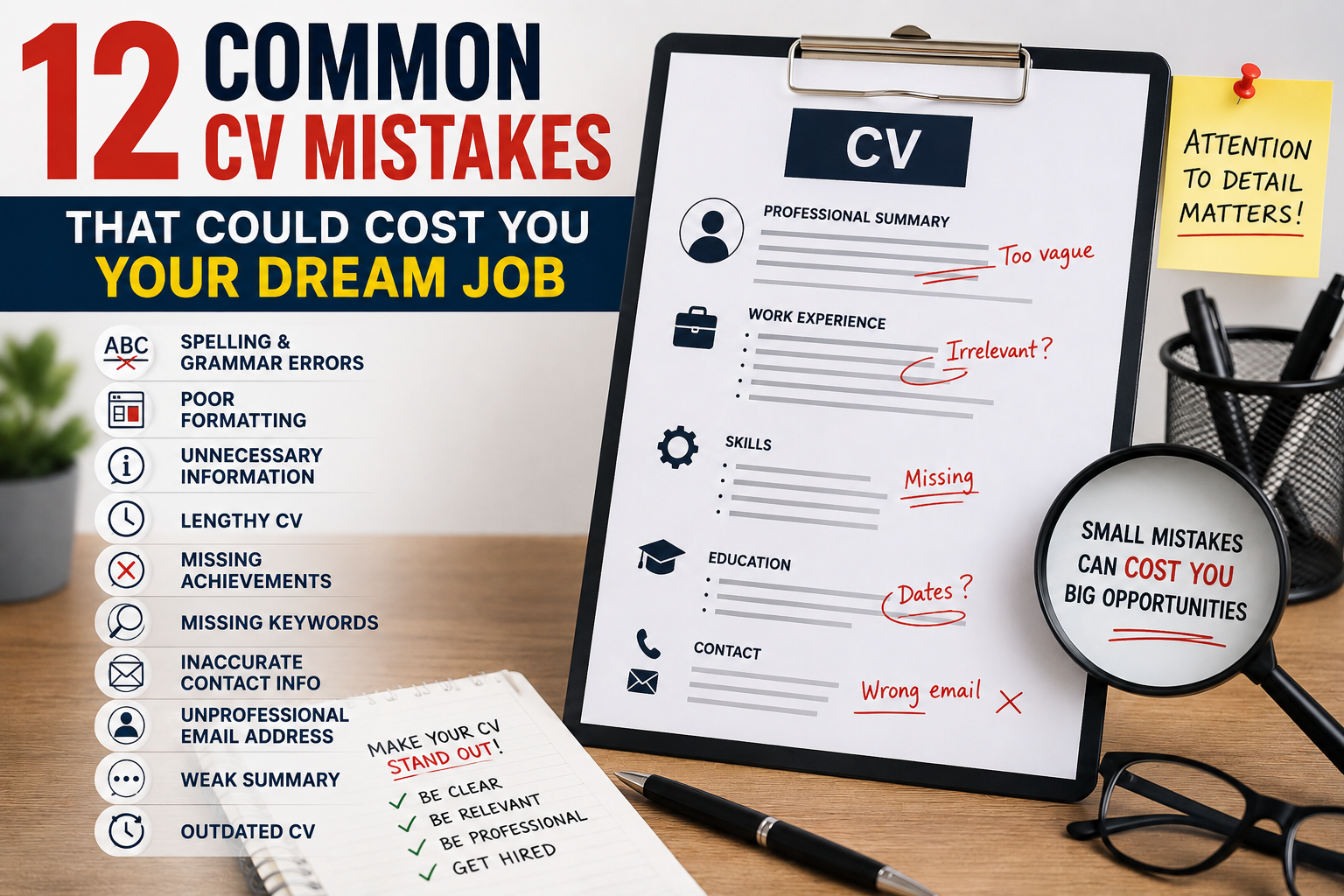
In this article, we will take a look at 12 common CV mistakes that might make you miss out on your ideal career and offer some tips to help you make your CV more impressive.
Why It Is Important to Avoid CV Mistakes
A CV is more than a list of your work experience. It is a marketing tool that is intended to inform an employing party that you’re the right person for the position. It is not unusual for recruiters to get hundreds of applications for a single position. With a high volume of submissions, they have a tendency to quickly rule out some candidates for various reasons.
This implies that if there are any errors, such as spelling or formatting mistakes, or if the information is irrelevant or not organized, there will be an immediate bad impression. These problems can be perceived as carelessness, lack of professionalism, or poor communication skills by the employer. Even if the CV is of a high standard, it is possible that the candidate will not be selected if the document is not up to standard.
By knowing about the most common CV preparation mistakes to avoid, job seekers can make their CVs more compelling and boost their recruitment prospects.
1. Spelling and Grammar Errors
A major CV error is submitting a CV that contains spelling, grammar, or punctuation errors. Such errors are often considered indicators of a lack of attention to detail by recruiters. In the majority of professions, accuracy and effective communication are highly regarded, and language errors can be a real problem.
A single error can make a recruiter think that you’re not professional. Typical mistakes are misspelled company names, job title misspellings, inconsistent verb tenses, and missing punctuation marks.
How to Avoid It
- Apply spell-checking tools prior to sending out your CV
- Read the text several times
- Have it read by a trusted friend, colleague, or loved one
- Read the CV aloud to detect awkward expressions and mistakes
2. Using Poor Formatting
If your CV is poorly organized or takes on a disjointed approach, it may be hard for the reader to follow. Recruiters like documents that are neat, tidy, and easy to read. When you don’t format your resume correctly, it can be difficult to see your qualifications and may distract from them.
These issues can include poor font sizes, too many colors, densely packed pages, and poor spacing between sections.
How to Avoid It
- Be sure to use a professional font like Arial, Calibri, or Times New Roman
- Keep the formatting consistent throughout the document
- Make use of headings and bullet points to make it easy to read
- Make sure that there is enough space between sections
3. Including Unnecessary Information
It is easy to see that many candidates add too much information that doesn’t really relate to their suitability for the position. Recruiters are looking for information that will show them that you will be able to do the job well.
This might include out-of-date work experience, unrelated hobbies, too much personal information, or information that doesn’t relate to your application.
How to Avoid It
- Customize your CV for each job
- Only include information that relates to the job
- Concentrate on accomplishments and skills based on employers’ job requirements
- Delete old or unrelated information
4. Writing a Lengthy CV
Recruiters don’t always have a lot of time to review applications. A CV that is too long and filled with irrelevant information may diminish the impact of your best qualifications.
For most people, a CV should be brief and to the point, but an experienced professional may need to include more details about their experience.
How to Avoid It
- Avoid going into too much detail; focus on the most relevant experience
- Use concise language
- Eliminate repetitive information
- Concentrate on quality, not quantity
5. Failing to Highlight Achievements
Numerous candidates simply write out job tasks rather than tangible results. While responsibilities tell what you were expected to do, achievements tell what you did that was valuable.
Often, recruiters are more impressed by actual results than by a list of regular tasks.
How to Avoid It
Instead of writing:
- Accountable for sales management
Write:
- Increased sales by 25% in one year by implementing a strategy that involved client engagement initiatives
Wherever possible, use measurable outcomes, numbers, and percentages.
6. Using a Generic CV for Every Job Application
A very common error is submitting the same CV to several employers. While there are some common elements in all CVs, they are likely to vary depending on the organization and role for which they are submitted, and a generic CV may not meet the needs of a specific position.
Employers will want to know that you understand the job and have the skills needed to be successful.
How to Avoid It
- Carefully read and understand each job description
- Write a professional summary specific to the job
- Emphasize pertinent abilities and experience
- Use keywords from the job posting when appropriate
7. Omitting Important Keywords
Large numbers of companies today use Applicant Tracking Systems (ATS) to filter out applications before HR receives them. When you don’t include relevant keywords in your CV, it may never be seen by a human reviewer.
ATS software scans for keyword phrases associated with qualifications, skills, and experience.
How to Avoid It
- Carefully read through the job description
- Identify important skills and requirements
- Naturally integrate pertinent keywords into your CV
- Avoid keyword stuffing
8. Providing Inaccurate Information
In some instances, candidates embellish their CVs to make them look more impressive or provide false information to stand out. However, most employers verify credentials during the hiring process.
Discovering that information is incorrect can damage your credibility and may even cost you a job opportunity.
How to Avoid It
- Honestly present your qualifications and skills
- Accurately represent your experience
- Provide accurate dates of employment
- Avoid exaggerating achievements
9. Neglecting Contact Information
Many candidates include obsolete phone numbers or email addresses in their CVs. No matter how good your application is, if recruiters can’t contact you, it becomes ineffective.
How to Avoid It
Include:
- Full name
- Professional email address
- Current phone number
- LinkedIn profile (if relevant)
- Location (city and country)
Please make sure you are using correct contact details before submitting.
10. Using an Unprofessional Email Address
Your email address contributes to your professional image. Nicknames, jokes, or inappropriate language in email addresses can negatively affect how employers perceive you.
Employers expect professional communication from the initial application through the recruitment process.
How to Avoid It
Utilize a simple format such as:
- firstname.lastname@email.com
- firstinitiallastname@email.com
Avoid humorous or informal addresses.
11. Neglecting the Importance of a Professional Summary
Recruiters tend to review the first section of a CV, which is the professional summary. If your summary is weak, vague, or generic, it will not grab the reader’s attention or encourage them to continue reading.
A well-crafted summary should include a brief overview of your skills, experience, strengths, and abilities.
How to Avoid It
Include:
- Years of relevant experience
- Professional skills and core areas of expertise
- Key achievements
- Career goals that are related to the job
Be concise and relevant with the summary for the particular job opening.
12. Not Updating Your CV Regularly
The majority of professionals update their CV only when they begin looking for a new job. This can result in forgotten achievements, missed certifications, and inaccurate employment histories.
A CV that is not up to date may not accurately reflect your current qualifications and skills.
How to Avoid It
- Revise your CV following significant accomplishments
- Add new certificates in a timely fashion
- Capture important project successes and achievements
- Review the document periodically every few months
Extra Tips for Writing a Strong CV
In addition to avoiding common errors, you can take a few steps to enhance your application and boost your chances of success.
Focus on Readability
Important information should be easily accessible to recruiters. Your CV is easier to review when it is clear, well-structured, and concise.
Quantify Results Whenever Possible
Use numbers to tell the story of your results. Achievements in areas like revenue growth, cost savings, project completion, and customer satisfaction improvements are more convincing.
Maintain Professional Design
Keep a modern and professional design that improves readability and does not distract from the content. Unless applying for a creative position, don’t over-emphasize graphics or decorative elements.
Tailor Every Application
Tailored CVs have proven to be more effective than generic CVs. Match your experience and skills to the needs of each position.
Conclusion
Employers are likely to form their initial impression of you from your CV, and first impressions count. What may seem like a tiny mistake can make a major difference in a recruiter’s opinion and your chances of progressing through the hiring process. Knowing the most common CV errors and how to avoid them will show that you are a professional, qualified, and detail-oriented candidate.
The main thing is to be clear, relevant, accurate, and professional. Avoid spelling errors, format the document properly, highlight successes, adapt the document for the target audience, and keep information current. By steering clear of the most common CV pitfalls, you will make your CV a more effective tool to help you secure the opportunities you are looking for and showcase your strengths.
Frequently Asked Questions (FAQs)
How much information is the ideal length of a CV?
The length of a CV is typically one to two pages for most professionals. Additional space may be needed for experienced candidates, but each section should remain relevant.
Do I need to tailor my CV to each job application?
Yes. Customizing your CV for every job you apply for can help it get past ATS filters and attract recruiters’ attention.
What are the most frequent CV mistakes?
Spelling and grammar errors are among the most frequent mistakes because they immediately create a negative impression and demonstrate a lack of attention to detail.
How often should you update your CV?
Your CV should be updated whenever you achieve a major accomplishment, complete a major project, earn a certification, or move to a new role.
Should hobbies be included in a CV?
Include only hobbies that are relevant or demonstrate valuable skills and qualities.