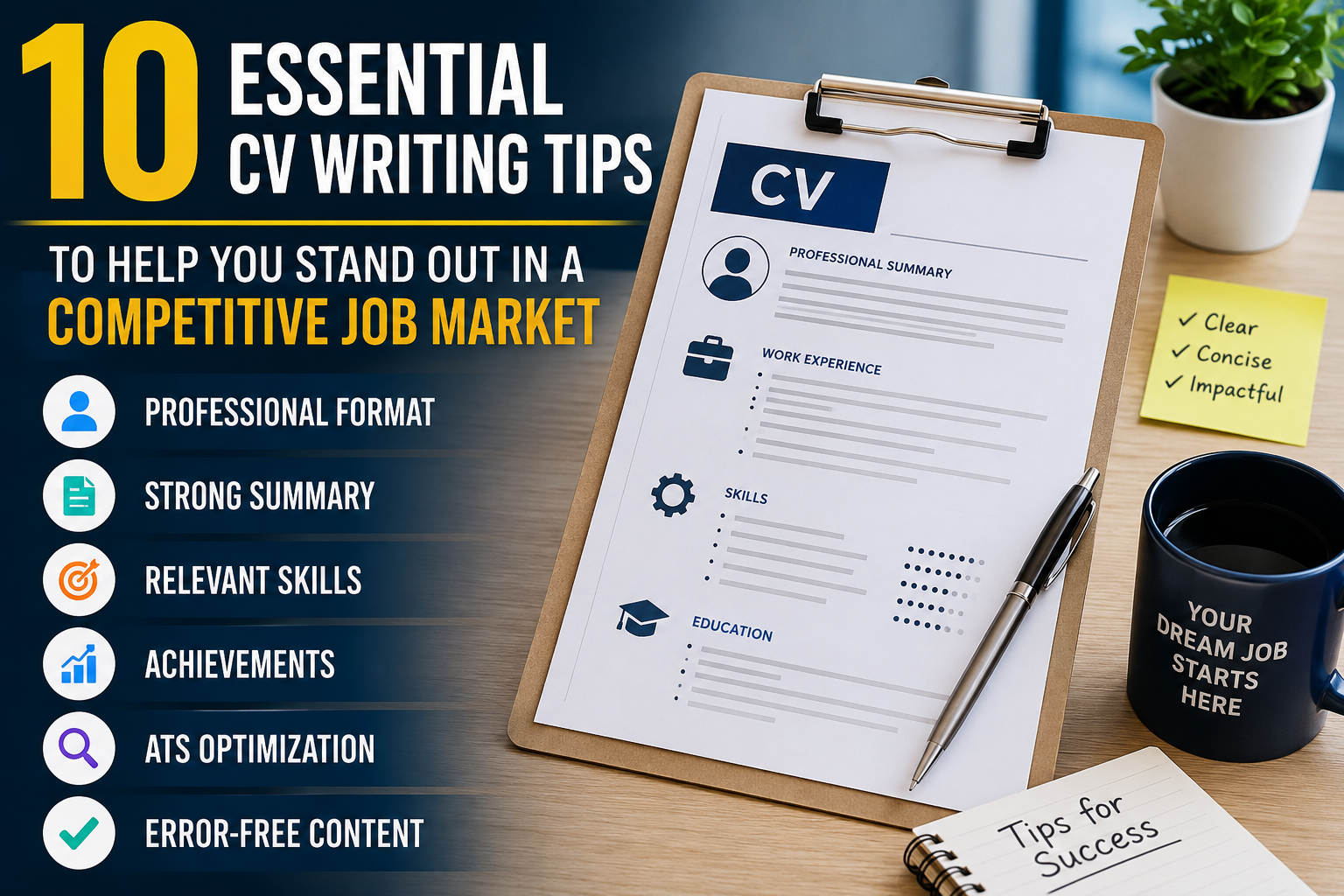
With the job market being so competitive nowadays, it is imperative that you have a well-structured CV that will help you land an interview. Applicants have just a few seconds to make a good impression on the recruiter, as they may be reading dozens, if not hundreds, of applications for a single position. A professional CV is a marketing document that showcases your qualifications, experience, skills, and accomplishments, which will help convince an employer that you are the right candidate for the position.
If you’re looking for CV writing tips or practical guidance on creating a professional CV, you need to make sure that you’re showcasing your abilities in a manner that will resonate with employers. Each part of your CV should help to make the case for your suitability to the job.
In this guide, you will find some tips and tricks that can help you write a CV that stands out and can give you a better chance in today’s competitive job market.
The Importance of Your CV in Today’s Job Market
Your CV is likely to be the first time that an employer will come into contact with you. Your CV is the first indicator to a recruiter that you will be suitable for a role before he/she reads your cover letter or even sees you in an interview. The CV is a very effective communication medium that conveys professionalism, attention to detail, and quality of relevant qualifications.
A high-quality CV can assist you to:
- Make a first impression that attracts a recruiter’s attention
- Show how well you are qualified to work in a job
- Show your achievements and abilities
- Improve your chances of being called for an interview
- Stand out from others applying for jobs
With so many industries facing a swell in demand for jobs, it is crucial to make an effective CV that is significant and matters to the employer.
Understanding the Purpose of a Professional CV
It is important to know what your CV is being used for prior to writing your CV. A CV isn’t just a list of your work experience. It is not a document to be used to demonstrate your professional value; rather, it is a strategic document designed to showcase your professional value.
A lot of people who are looking for a job don’t do a good job of marketing information effectively. It is no longer a case of “just putting down” old work and educational experiences. Employers look for proof of added value, achievements, and skills applicable to the job. The structure of your CV plays a crucial role in how it is perceived by potential employers and can help you make the best impression.
1. Begin with Clear and Professional Personal Information
What to Include
Your vital contact information should be included at the top of your CV. Your CV should grab the attention of the recruiter and allow them to reach you as soon as possible, rather than having to scroll through the document.
Include:
- Full name
- Professional email address
- Phone number
- Location of residence: city/country
- Cover letter (if applicable)
- LinkedIn profile (if relevant)
What to Avoid
Do not include any unnecessary personal information, including:
- Marital status
- Religion
- National identification numbers
- Age/date of birth (unless otherwise specified)
- Passport photographs (unless requested)
This section should be kept short and to the point to make a good impression and make it easy for employers to get in touch.
2. Write a Strong Professional Summary
The Importance of a Professional Summary
A professional summary gives a brief overview of the skills and objectives you have for your career. It appears towards the top of the CV and is a good introduction to the document to get the reader interested in reading further.
Your summary should:
- Emphasize past experience
- Mention key skills
- Include relevant achievements
- Reflect career objectives
- Match the desired position
For instance, a marketing expert could highlight their knowledge of digital marketing, brand development, and customer engagement, and highlight their ability to deliver measurable results.
3. Customize Your CV for Each Job Application
Do Not Use a Generic CV
The worst thing job seekers can do is use the same CV for all of their job applications. Employers are looking for candidates who have experience similar to what they need.
If you are creating a CV that is specific to a position:
- Thoroughly read the job description
- Identify important keywords
- Emphasize relevant achievements
- Highlight matching skills
- Make changes to the professional summary
Employers like to see applications that demonstrate an understanding of the position and what it entails.
Advantages of Customizing Your CV
Personalizing your CV can:
- Improve relevance
- Make it more applicant tracking system compatible
- Demonstrate genuine interest
- Improve interview opportunities
4. Emphasize Relevant Skills Strategically
Technical Skills
Technical skills are different for various occupations and industries. Examples include:
- Data analysis
- Graphic design
- Software development
- Project management
- Accounting software proficiency
Transferable Skills
Transferable skills continue to be relevant for a variety of jobs and industries.
Examples include:
- Communication
- Leadership
- Problem-solving
- Teamwork
- Time management
- Adaptability
Don’t just say that you have a skill; show how you have used it to achieve success in a role.
5. Demonstrate Accomplishments Rather Than Duties
Why Achievements Matter
Recruiters are interested in results. Job responsibilities tell what you were supposed to do; achievements tell how well you did it.
Compare the following:
Responsibility:
- Provided customer service to customers.
Achievement:
- Improved customer satisfaction ratings by 25% using a new support process.
Achievements are concrete evidence of your value and will showcase you in the best light when it comes to differentiating you from other candidates.
Examples of Achievement Statements
- Raised sales volume by 30% in one year
- Cut down operational expenses by 15%
- Oversaw teams to achieve projects on time
- Improved staff retention through staff development programs
6. Organize Work Experience Effectively
Write in Reverse-Chronological Order
The majority of employers like to see work experience in reverse-chronological order. This way, recruiters will have a quick glimpse of the level of experience you currently have.
For each role, include:
- Job title
- Company name
- Employment dates
- Key responsibilities
- Major achievements
Focus on Relevance
If you have a lot of experience, provide detailed information that focuses on information directly relevant to the application. If a position is older or not directly related to the career, it may not need to be as detailed.
7. Clearly Present Your Education and Certifications
For the majority of CVs, education is a crucial section. Educational qualifications are used by job recruiters to check suitability for a particular job.
Include:
- Degrees
- Diplomas
- Professional certifications
- Industry training
- Relevant workshops
Additional Professional Development
Ongoing education proves initiative and commitment to development and career growth. Recent certifications can also enhance the application and demonstrate current knowledge.
8. Use Clean and Professional Formatting
Importance of Readability
A CV that is not easy to read can result in the rejection of even the best applications. Good formatting is helpful in making the document easy to read and helping recruiters notice key details.
Formatting Best Practices
- Write in a professional font
- Maintain consistent spacing
- Employ clear section headings
- Use bullet points as needed
- Make sure to leave plenty of white space
- Use the same format throughout
A clean layout demonstrates professionalism and attention to detail.
9. Make Use of Relevant Keywords in Your CV
Knowing How to Deal With Applicant Tracking Systems (ATS)
Many companies employ Applicant Tracking Systems (ATS) to filter candidates before they are seen by hiring managers.
To improve visibility:
- Carefully read the job description
- Identify recurring keywords
- Use appropriate terms naturally
- Include industry-specific language
Avoid Keyword Stuffing
If your use of keywords is carried to an extreme, it can make your CV look unnatural. Always incorporate them naturally without disrupting the flow of the content, while maintaining readability and professionalism.
10. Make Sure to Proofread Carefully Before Submission
Common Mistakes to Avoid
When it comes to small errors, they can cause an employer to assume that you are not professional.
Common errors include:
- Spelling mistakes
- Grammar errors
- Inconsistent formatting
- Incorrect dates
- Missing contact information
Proofreading Checklist
Prior to sending your CV:
- Read it multiple times
- Use spelling and grammar tools
- Double-check all dates and information
- Check formatting consistency
- Have a trusted colleague review it
All of this will help make your application much stronger.
Other Tips to Distinguish Yourself
In addition to the above, here are some other strategies to consider:
Keep Your CV Brief
Recruiters like documents that are brief and concise so they can focus on the relevant information. Don’t add unnecessary details that are not related to the application.
Use Action Verbs
Impressive action verbs create more impact.
Examples include:
- Led
- Developed
- Improved
- Implemented
- Coordinated
- Achieved
Keep Updating Your CV Regularly
Have a current CV available to take advantage of any new opportunities. Include new successes, certificates, and skills as they are earned.
Conclusion
It is not enough to just list your work experience on a CV to make it stand out; it needs to be done correctly. This includes strategically showcasing your qualifications, highlighting your accomplishments, and adapting your content to the preferences of hiring managers. Effective CV organization, skills highlighting, optimization for Applicant Tracking Systems, and a professional format are all steps that can be taken to make your CV stand out and enhance your job applications.
In a competitive job market, one of the most important ways to stand out is by having a well-written CV. By following these ten CV writing tips, you’ll be able to better demonstrate your contributions, share your knowledge, and make it easier for you to get interviews and land a job.
Frequently Asked Questions (FAQs)
What is the ideal length for a CV?
Most candidates’ CVs will be one to two pages long. For those with large amounts of experience or academic qualifications, more than a couple of pages might be necessary.
Should I customize my CV for each application?
Yes. It is important to customize your CV to match the job requirements and help it pass Applicant Tracking Systems.
What skills should I include on my CV?
List skills that apply to the job, including communication, leadership, problem-solving, collaborative teamwork, technical skills, and industry-specific skills.
How frequently should I update my CV?
Your CV should be updated whenever you acquire new experience, skills, certifications, and/or achievements. It is a good idea to review it periodically, every few months.
What is the most significant part of a CV?
Although all sections are important, employers are likely to pay particular attention to your professional summary, work experience, accomplishments, and relevant skills.
Will a good CV help me get a job?
A CV plays a crucial role in catching the attention of recruiters and getting them to call you for an interview. Your CV is a key part of your job application process that can help you stand out and encourage recruiters to consider you for an interview.