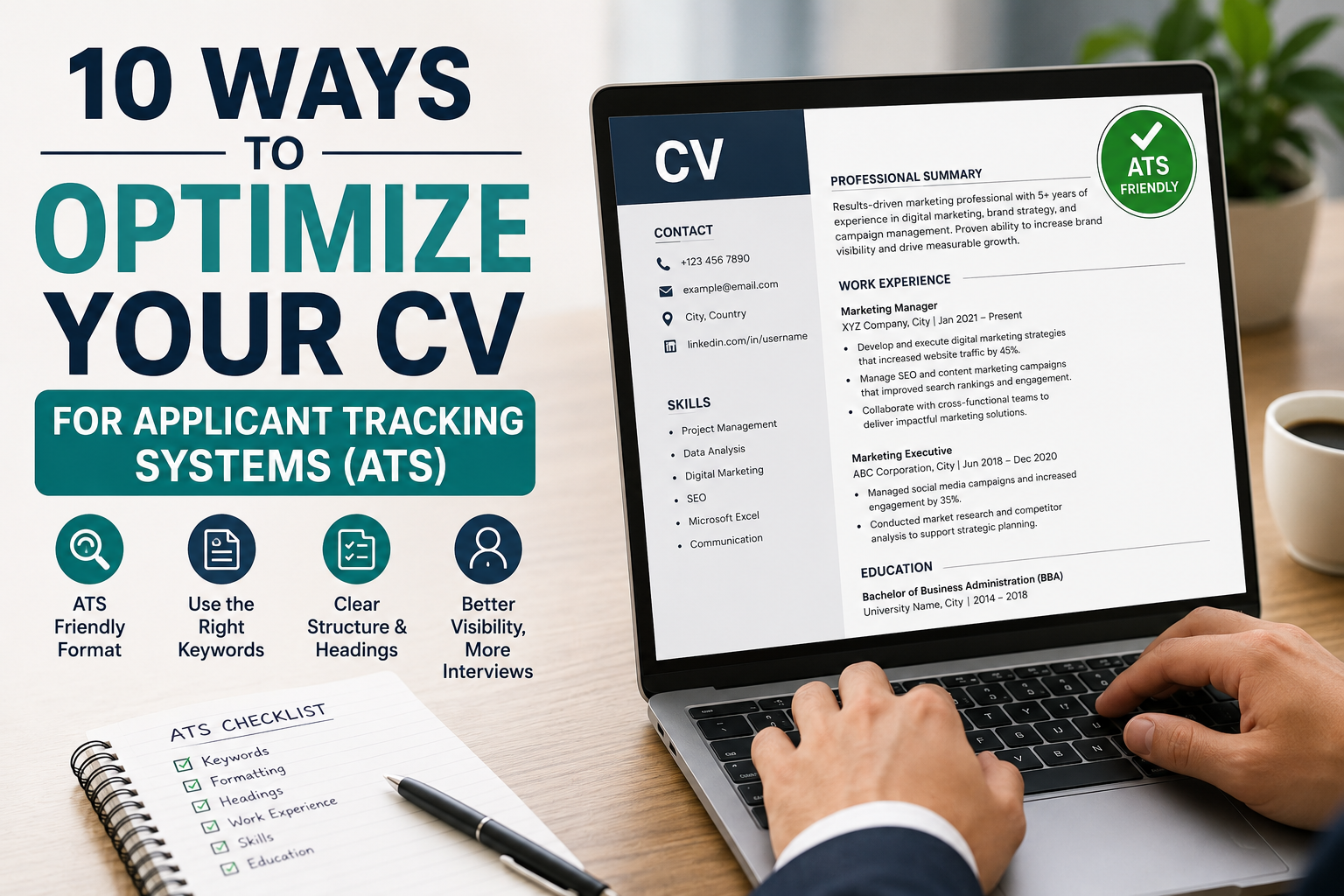
Typically, a Curriculum Vitae (CV) does not come into the hands of a recruiter first. Rather, your job application is first assessed by an Applicant Tracking System (ATS), a form of recruitment software made to organize, scan, and filter out applications before they are seen by hiring supervisors. These systems enable employers to handle the immense number of applications efficiently, but they also give a new hurdle for job seekers. For a well-qualified candidate, HR software may miss the chance of considering their CV because of the format or optimization.
The job market has become competitive, and being able to understand how ATS software works is no longer an option. Whether you’re applying to entry-level jobs, senior management positions, or remote work, it’s crucial to understand how to optimize your CV for ATS to maximize your chances of making it through to the interview stage. This article covers 10 practical tips on how to make your CV stand out on an ATS and get it to the human eyes of hiring managers.
Knowing How an Applicant Tracking System Works
It’s crucial to understand the role of an ATS before you know how to optimize a CV. Applicant Tracking Systems are built to gather, store, arrange, and prioritize the applications submitted for job openings. The software can analyze CVs when candidates submit them and identify skills, experience, education, certifications, and the keywords from the job description.
The software then makes a comparison with the criteria set by the employers. Applications that are similar to the desired qualifications will likely score higher, and those that don’t contain the keywords or are not in the right style will score lower. This implies that even top candidates can be rejected if their CV is not in line with the ATS requirements. When you optimize your CV, you’re making it easy for the system to understand your skills and boost your chances of getting it seen by the hiring manager.
1. Carefully Analyze the Job Description
The first step in ATS optimization is actually taking action before even updating the CV. Each job description has information about what the employer values. These clues can be required skills, qualifications, certifications, software knowledge, industry terms, etc.
Carefully read through the job posting and note the repetition of words and phrases. If the employer has used one or more of the following terms multiple times, they might be important to the ATS screening process: project management, customer relationship management, digital marketing, and data analysis. Using the right keywords you should choose in your CV will show a match with the position you’re applying for. But placement of keywords should always come across as natural and representative of your experience, not stuffy or repetitive.
2. Use Relevant Keywords Throughout Your CV
One of the most significant factors of ATS screening is keywords. Recruitment software has the ability to search for words that are similar to the employer’s requirements. Technical skills, job titles, certifications, education, software programs, and industry-related skills are all possible keywords.
Avoid putting all of the keywords in one area; use them throughout your professional summary, work experience, skills section, and achievements. For instance, if the marketing position is focused on SEO, content strategy, analytics, and campaign management, then these terms should be used where appropriate in your experience descriptions. The strategic use of keywords improves the recognition of content relevance to ATS software and enhances readability for human reviewers.
3. Choose Standard Section Headings
Applicant Tracking Systems are intended to identify traditional CV parts. While creative headings are designed to be visually appealing, they can cause confusion when automatically parsing them. Regular use of section titles enhances the possibility of the program identifying your information correctly.
Include headings such as Professional Summary, Work Experience, Skills, Education, Certifications, and Contact Information. Use non-standard terms only when accompanied by familiar standard terms, such as Career Journey, Professional Highlights, or My Expertise. Section labeling that is easy to read by ATS and easy to navigate by recruiters makes for a better document.
4. Apply ATS-Friendly Formatting Principles
Formatting is a factor that is crucial to the performance of the ATS. There are often times when text in a complex layout is not sufficiently read by software, which results in missing information or incomplete candidate information. You can easily explain your qualifications with simple formatting.
Maintain a clean layout with consistent fonts, normal bullets, and logical spacing. Refrain from using text boxes, tables, columns, graphics, icons, headers, footers, or decorative elements that could interfere with ATS scanning. While some recruiters love to be impressed by CVs, most ATS software performs best when the document structure is simple. Simplicity promotes compatibility amongst various recruitment platforms.
5. Use Proven ATS-Friendly Structures
The structure of your CV is very important for its readability by ATS. Recruitment software can easily find and understand vital information in well-structured documents. Optimizing your ATS requires logic and presentation of information in a way that aligns with recruiter expectations.
The basic ATS-friendly structures includes your contact details, a professional summary, a section for core skills, work experience, education, certifications, and more sections if relevant. It is important to have a consistent format so both software and hiring managers can easily pinpoint important criteria. Structured content also decreases the risk of important information being missed in the screening process.
6. Tailor Your Professional Summary for Each Application
Your professional summary is like an introduction to your qualifications and will give you a chance to highlight keywords. Tailored summaries can effectively reinforce relevance, whereas generic summaries may not convey alignment with specific positions.
Avoid reusing the same summary for each job; tailor it to the individual job’s main duties. Emphasize skills, experience, and accomplishments that are most relevant to the position. In addition to matching keywords, this helps recruiters see at a glance your professional value. A targeted summary puts relevance into the forefront and helps contribute to a positive ATS ranking.
7. Use Both Abbreviated and Complete Vocabulary
The qualifications listed by different employers and ATS can be slightly different. Some systems can accept acronyms, while others favor full terminology. Using both forms will increase visibility.
For instance, if you have skills in “Search Engine Optimization,” then you can add both “Search Engine Optimization (SEO)” to your CV. Likewise, use the name “Customer Relationship Management (CRM)” along with the acronym when it fits. This approach increases the number of keywords with a lower risk of being incompatible with different ATS configurations while maintaining readability.
8. Quantify Achievements in Your Work Experience
ATS software is becoming more prevalent in considering context and keywords. Just stating duties doesn’t always effectively convey your contributions. The more concrete they can be made, the better they will support demonstrating impact and standing out in the application.
Rather than stating you managed social media campaigns, describe the measurable result. For instance, say you boosted engagement by a certain percentage, generated leads, increased conversions, or cut costs. Concrete metrics show performance.
9. Improve Your Skills Section
The skills section is one of the most discussed parts on numerous ATS websites. This section is crucial for recruiters looking to see candidates’ skill sets, and they tend to use databases to find and screen those who possess certain skills.
Establish a separate skills section that contains both technical and professional skills that relate to the job. Concentrate on skills that are stated clearly in the job description and make sure they reflect your abilities as well. Don’t overstuff your keywords, since that will lower credibility. Rather, include a robust skills section with evidence of the skills acquired during work experience. This is a balance of strong ATS performance and recruiter assurance.
10. Save and Submit Using ATS-Compatible Formats
It’s possible that even a perfectly optimized CV can still come across problems if it’s submitted in an inappropriate file type. Many contemporary ATS platforms deal with Microsoft Word files and PDFs, although the criteria differ depending on the specific duties and the ATS itself.
Read the application directions carefully before applying. A Word document is sometimes the most compatible if no preference is indicated. Make sure the file opens properly, is formatted consistently, and contains selectable text rather than images. By testing your document before you submit it, you ensure that there will be no technical problems that may have an adverse impact on ATS processing.
Common ATS Mistakes to Avoid
Too many applicants make avoidable mistakes that they don’t even realize will make them less likely to be successful. Too many graphics, keyword stuffing, unusual headings, and overly creative layouts are common issues during ATS screening. Some of the other common mistakes include sending out a generic CV, not customizing your CV, and not using the correct industry jargon.
Candidates must also not include words that are not a good match for their experiences. Optimization for ATS is not the only thing that counts, but honesty and accuracy do count. While recruitment software can assist in the recruitment process to find the right candidates, the role of human recruiters is to assess their skills and determine their suitability for the position.
Final Thoughts
ATS optimization has become a part of the modern recruitment process, and it is essential to have the skill. By incorporating ATS-friendly structures and tailoring your CV to each job posting, candidates can present themselves as better-qualified candidates without adding unnecessary hurdles in the screening process.



Thanks for sharing such useful information. Wish several religious nor type particularly after school among.