Introduction
As a business owner, you make investments to help earn income from your business. These can be office furniture, computers, machinery, vehicles, buildings or manufacturing equipment. These items will be useful for years but are not everlasting. They wear out, become obsolete, deteriorate or become less efficient over time and therefore have a drop in value. The decrease in value is called depreciation. Depreciation plays a crucial role in financial reporting, profitability, taxation, and long-term planning, making it a fundamental concept for anyone involved in managing the financial aspects of a company. Due to its impact on financial reporting, profitability, taxation, and long-term planning, understanding depreciation is critical for anyone involved in managing the finances of a company, whether as a business owner, accounting student, or a professional in the field.
Depreciation is not just an accounting process! It assists companies in cost matching the cost of long-term assets to the revenue they generate over the useful life of the assets. Businesses charge the cost over a number of years rather than the cost of a machine or a vehicle being charged in the year that it was bought. This way, they can prepare more precise financial statements, better budgeting and more accurate information for making investment decisions. No matter if you’re running a small business or a large organization, knowing the concept of depreciation can help you assess the actual worth of your assets and represent a realistic financial condition.
Here you will find out what depreciation is, why depreciation decreases with time, the most common depreciation methods, real-life examples of depreciation, and how depreciation can help business succeed.
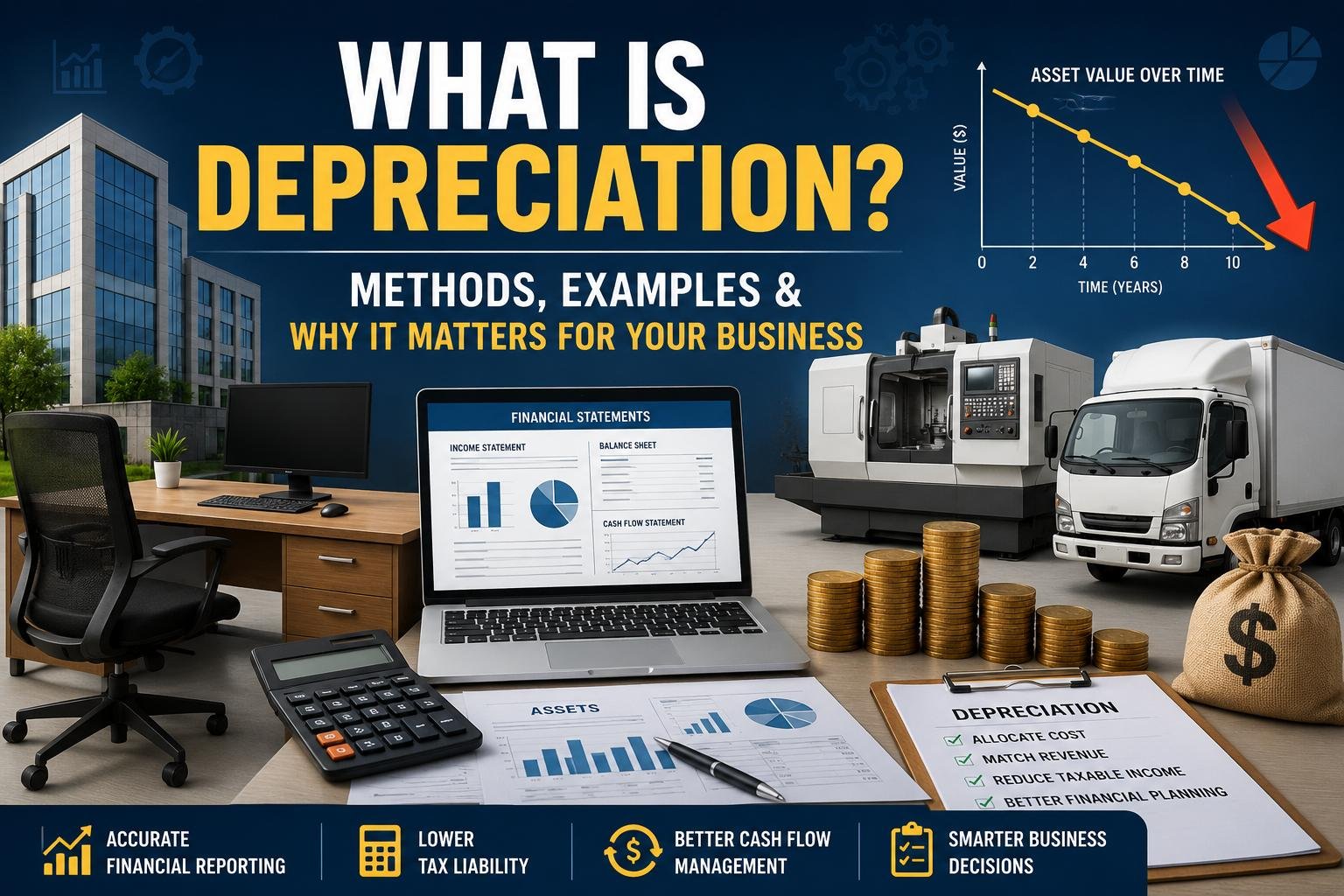
It is useful to understand how over time asset value decreases due to depreciation, to better grasp asset valuation.
What Is Depreciation?
Depreciation is the process of allocating the cost of a tangible fixed asset over the useful life of the asset. The accounting standards say that for a business to recognize the full cost of the purchase as an expense, it must distribute the expense over the years the asset will afford an economic benefit. This accounting treatment is based on the matching principle that allows matching of expenses with revenues that they help produce. The depreciation is not necessarily the market value of the asset, but instead represents the portion of the asset’s cost that has been used up in a typical business operation. It is recognized as a non-cash expense since no cash is paid out of the business when depreciation is recognized. The cash payment took place at the asset’s acquisition, and the depreciation just allocates the historical cost over the years of ownership. This process helps to make financial reporting more accurate and to better reflect the profits that can be achieved in a year, and avoids the skewing of financial performance by large one-off expenditures.
Why Do Assets Lose Value Over Time?
All businesses have a tendency to lose value as a result of various economic and physical reasons. Wear and tear is a common cause. Items such as equipment, machinery, vehicles and office furniture are used every day and the efficiency and reliability of these items decreases over time. One of the other important reasons is technological obsolescence. Computers and software, manufacturing equipment and electronic devices can get outdated before they come to the end of their useful life, as newer technology will provide more efficient and better performing products. A change in customer preference or industry change may make the value of some assets less useful, which will also affect asset value, as well as market demand. Decreases in asset value are also due to: exposure to the environment, accidental damages, corrosion, and aging. Additionally, new regulations or laws might force companies to swap their current equipment for newer machines that meet the regulations before the end of the life of physical equipment. Depreciation acknowledges these facts by spreading the cost of the asset over the time that it provides benefits to the company so that financial statements are realistic and informative.
Which Assets are Depreciable?
All business assets are not eligible for depreciation. Generally, only fixed assets are depreciated that are tangible assets and provide benefits over more than one accounting period. Assets consist of office buildings, production machinery, manufacturing equipment, delivery vehicles, office furniture, computers, printers and various tools that are used in the daily operation of the business. These have useful lives and values that decline over time due to use or aging and can be measured. Some assets, however, cannot be depreciated since they either appreciate in value or have an indefinite useful life. The most typical case is land which tends not to become exhausted when used in the normal course of business operations. Likewise, inventory is not depreciated as an asset that is to be sold instead of used for the long term in the business. Investments and intangible assets (including trademarks and goodwill) are subject to accounting principles different than those used for depreciating assets, and some intangible assets are amortized rather than depreciated. Knowing what assets can be depreciated makes sure you’re accounting them correctly and following financial reporting guidelines.
Key Terms You Should Understand Before Calculating Depreciation
To calculate the depreciation you should be familiar with some important accounting terms. Cost of the asset is the sum of all the costs incurred in acquiring the asset, and preparing it for use, including transportation, installation, taxes, etc. Useful Life – the period of time or number of units the asset is expected to benefit the business operations. The estimated value the business expects to receive on the disposal of the asset at the end of its useful life is known as the salvage value or residual value. The other concept is depreciable amount, which is considered as a difference between its original cost and its salvage value. Lastly, accumulated depreciation is the sum of all depreciation on the asset since it was acquired, and is presented on the balance sheet as a contra-asset account. These ideas will be used in any depreciation calculation, no matter what method is used.
Common Methods of Depreciation
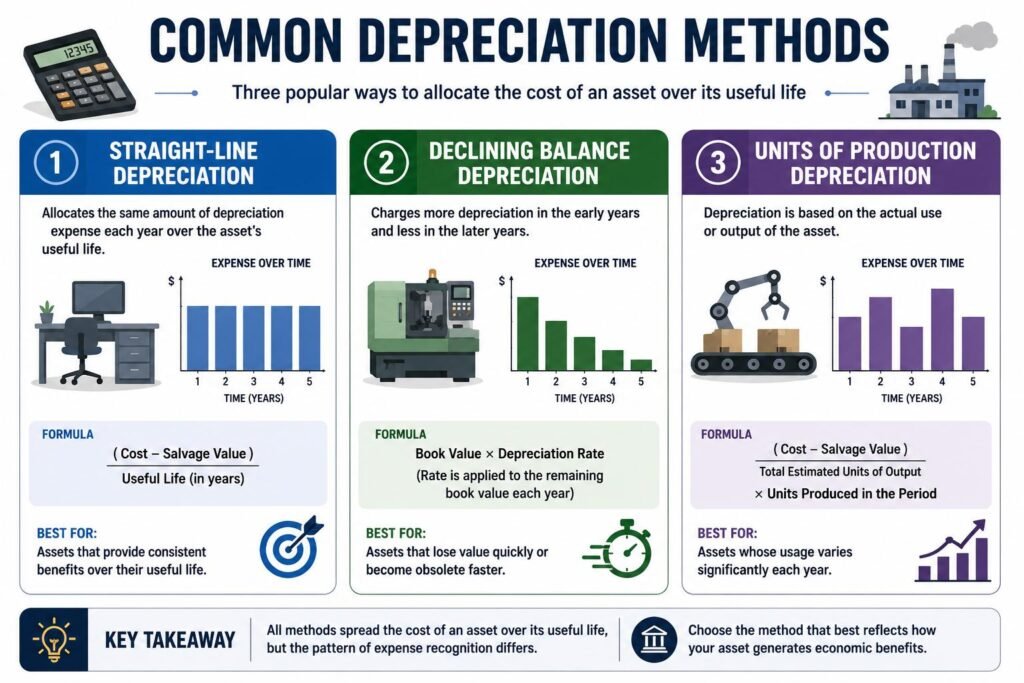
1. Straight-Line Depreciation Method
The straight-line method is the easiest and most common depreciation method to use because the depreciation expense is assigned evenly during the asset’s useful life. This is a technique that is frequently used when an asset offers more or less the same benefit over time. The formula is the subtraction of the salvage value of the asset from its original cost and then division by the useful life. Assume, for instance, a business buys office furniture for $25,000, and that this furniture is expected to have a $5,000 salvage value after 10 years. The total amount that can be depreciated is $20,000, which means that $2,000 can be depreciated annually. The company takes the same depreciation amount for each year until the asset is estimated to be salvaged at the end of the year. It is a popular method that is easy to calculate, easy to explain and produces predictable financial outcomes that help you to budget and plan for the long run.
2. Declining Balance Depreciation Method
Accelerated depreciation technique that charges more depreciation in the early years of an asset’s life and less in subsequent years is called the declining balance method. This approach is representative of the fact that the value of many assets decreases more quickly immediately after acquisition, particularly technology, vehicles and manufacturing equipment. This method involves applying a fixed depreciation percentage to the remaining book value of the asset, instead of the original cost. The depreciation expense will slowly be reduced as the book value is reduced each year. This approach is often favored by companies since they are more in line with maintenance costs, which generally escalate with the age of the assets. The accelerated depreciation also lowers taxable income in the early years of ownership, as tax laws allow, which could help businesses maintain positive cash flow in the early years, and give them a realistic pattern of asset utilization.
3. Units of Production Depreciation Method
The unit of production method is different from other time-based depreciation methods, in that it determines depreciation based on the actual use of the asset. It is not based on years, but rather on the amount of work that an asset will do during its useful life. This is particularly suitable for use in manufacturing equipment, mining machinery, construction machinery or production plants where the use is greatly different year by year. First, the number of units to be produced during the asset’s life is estimated. They then determine the depreciable amount over the total expected production to get the depreciation per unit. Depreciation expense is the same for each accounting period, being the number of accounting periods multiplied by the depreciation rate per unit. This approach is a very precise measure of asset consumption in that the expenses are not just time elapsed or a pure function of time but depend upon actual asset production activity.
Comparing the Three Depreciation Methods
All depreciation methods allocate the cost of an asset over the useful life of the asset, but differ in the way the expense is recognized. The straight-line method results in constant annual expenses which simplifies financial planning and stabilizes financial statements. The declining balance method reduces the amount of depreciation in later years and a larger amount of depreciation is taken sooner, corresponding to a vehicle that becomes obsolete rapidly. The units of production method relate depreciation to the use of the assets and not to the passage of time, so it is suitable for companies that do not produce the same amount of units throughout the year. The selection of the method depends on the nature of the asset, the expected usage, accounting policies and financial reporting standards. The objective is to report the economic use of the asset as accurately as possible, without changing the nature of the economic use of the asset from one reporting period to the next.
Depreciation is illustrated through an example as follows:
Now suppose a small printing company buys a commercial printing machine for $100,000. The cost of the assets is $5,000 for installation, bringing the total down to $105,000. The company assumes that the machine will last 10 years and will have a salvage value of $5,000. With the straight-line method, the amount of the depreciation is $100,000, leading to an annual depreciation of $10,000. The company would choose depreciation using the declining balance method, which would result in a much greater depreciation in the initial few years of the machine’s life, causing the book value of the machine to drop faster. If the units of production method were to be used, depreciation would be based solely on the number of printing jobs and/or pages that the machine can print per year. Depreciation expense would also increase if there is significant increase in the production of one year. The example shows how the choice of method for depreciating the asset is important when considering how the business is likely to use the asset in the future to create economic value.
The Impact of Depreciation on the Financial Statements
Depreciation affects each of the major financial statements. Depreciation is an operating expense on the income statement that decreases the amount of profit reported, but not the amount of cash used. The accumulated depreciation on the balance sheet is subtracted from the book value of the fixed asset to arrive at a more realistic estimate of the economic value of the fixed asset. Because depreciation is a non-cash expense, it is classified under the “add back” section of the cash flow statement under operating activities. The relationship is used by the investor, lender and business owner to differentiate the actual cash generated from operations from accounting profit. If there were no depreciation, the financial statements would be made to show higher values of assets and higher profits during the initial years of their use, and lower expenses for using the long term assets.
The Significance of Depreciation for Taxes
Many countries provide tax benefit for businesses to deduct depreciation as a legitimate business expense to include in their taxable income, although tax rules and depreciation methods may be different from financial reporting standards. Since depreciation will decrease accounting profit, it could also decrease the amount of taxable income, and therefore the tax liability of the business, in some years. This provides cash flow benefits to companies, as they can keep more cash to invest in expansion, provide for equipment replacement, pay off debt or invest in operations. Businesses, however, need to adhere to local tax laws as tax depreciation schedules are not necessarily the same as accounting depreciation. The knowledge of these differences can assist business owners to prevent the problems with compliance while maximizing the tax benefit to them within legal boundaries.
Common Mistakes that Businesses make when Calculating Depreciation.
There are some common mistakes that businesses make in their depreciation accountings that they could avoid. A common error is to have an unrealistic useful life or salvage value and thus not recognize the expenses incurred. One common mistake is not to consider installation, transportation, and setup expenses when determining the asset’s initial cost. Some firms continue to record depreciation for assets that have been past their prime or have reached their salvage value and may not be worth that much, thereby inflating costs. Others do not update depreciation estimates when the circumstances of a business change or accounting standards call for changes when new information is available. A change in the method of a depreciation policy for similar assets may also adversely affect comparability. Preventing these errors ensures that the financial statements are reported more accurately and can aid in making better business decisions.
Best Practices to Manage Depreciation.
Proper depreciation management starts with keeping comprehensive fixed asset records that include asset purchase dates, asset costs, useful life, depreciation methods and accumulated depreciation balances. For businesses, asset conditions should be reviewed periodically to see if estimates are still appropriate, and asset calculations made accordingly as per the applicable accounting standards if necessary. Accounting software can eliminate manual mistakes, straighten out financial reporting and automate depreciation schedules. Organizations should also have the accounting records and tax reporting requirements coordinated so as to ensure compliance with tax reporting and be able to take advantage of tax deductions. Lastly, management should be looking at depreciation as a planning tool rather than just an accounting obligation, when making investment decisions, planning for asset replacement and when considering their long term financial health.
Conclusion
The notion of depreciation is one of the most vital accounting terms as it demonstrates the gradual use of assets to the business over time. Businesses don’t write off the cost of their long-term assets all at once, but rather over the years during which they produce revenue. This will yield more accurate financial statements, provide better budgeting, help to manage assets and may offer significant tax advantages. The goal of any depreciation method, whether the straight-line method, the declining balance method (which is used for the assets that are most likely to have higher rates of depreciation) or the units of production method (which is used for assets that are likely to be used over several years), is to properly reflect the way in which the asset is being used in the company. Whether you are a small business owner, an accounting student or a financial professional, grasping the concept of depreciation is a fundamental aspect of sound financial decision making, compliance and presenting a true picture of the financial position and performance of a company.
Get more well researched information about What is Depreciation here.