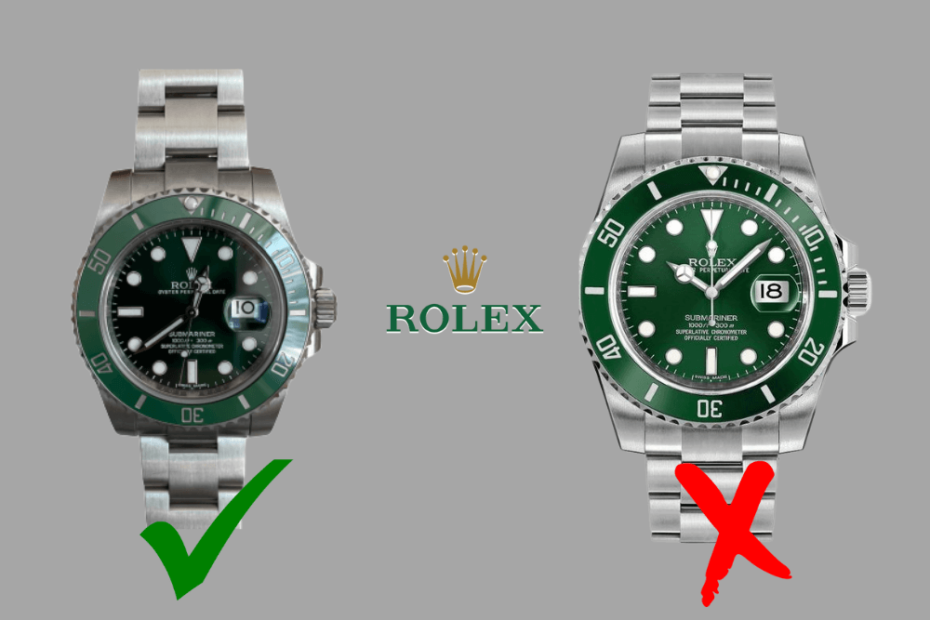
Telling an authentic Rolex apart from a modern super clone has become increasingly difficult for everyday buyers. As grey-market factories adopt medical-grade steel and advanced CNC machining, the obvious warning signs of counterfeit watches have mostly disappeared.
However, horological authentication still relies on tiny physical details. By examining structural metallics under a jeweler’s loupe, collectors can uncover microscopic clues hidden deep within the watch steel.
1. The Rehaut Engraving and Micro-Alignment
The inner steel ring surrounding the dial—known as the rehaut—contains subtle details that challenge counterfeiters. Rolex uses high-precision fiber lasers to etch its name repeatedly around the perimeter alongside the unique serial number at 6 o’clock.
Here is a clean, beautifully formatted version of your table designed for rich-text zone copy-pasting (optimized to paste seamlessly into WordPress, Google Docs, Notion, or email editors):
| Inspection Feature | Genuine Rolex | Typical Replica |
| Rehaut Alignment (Right) | “X” Aligns with Hour Markers | Slightly Off-Center |
| Rehaut Alignment (Left) | “R” Aligns with Hour Markers | Inconsistent Spacing |
| Laser Crown at 6 o’clock | Micro-dots, Soft Blue Glow | Solid/Dark Etched Lines |
On a genuine piece, the letter “X” in ROLEX aligns precisely with the minute tracks on the right side. The letter “R” aligns perfectly on the left side. Replicas often fail to maintain this exact geometric alignment across the entire circumference.
When evaluating a submariner replica, checking the rehaut alignment remains one of the fastest authentication steps.
2. Steel Finish Density and Bevel Edging
Rolex uses 904L Oystersteel, an alloy containing higher levels of nickel and chromium than standard 316L steel. This composition produces a distinct, warm luster and improves corrosion resistance.
- Satin Brushing: Authentic brushed steel shows razor-thin, perfectly parallel lines with uniform light diffusion.
- Chamfered Bevels: Case edges feature polished bevels cut at sharp angles without burrs or rounding.
- Weight Distribution: The density of genuine steel gives the watch a substantial, solid wrist presence.
While a modern submariner replica may use 904L steel, replicating Rolex’s proprietary hand-finishing and polishing standards remains difficult.
3. Laser-Etched Coronet Structure at 6 o’clock
Introduced in the early 2000s, the laser-etched coronet (LEC) on the sapphire crystal is an iconic security feature. Located at the 6 o’clock marker, this tiny Rolex logo is virtually invisible to the naked eye.
Genuine coronets are composed of microscopic dots etched at varying depths inside the glass rather than on its surface. Cheap fakes often acid-etch or print the logo on top, creating an oversized mark that stands out under plain light.
Even high-end clones struggle to replicate the depth and dot density of the original crystal etching. Buyers comparing a authentic piece with a rolex daytona copy should inspect the crystal under directional lighting to confirm the structure of the coronet.
Understanding these metallic details helps watch enthusiasts identify authentic luxury timepieces and appreciate modern horological manufacturing.