
Introduction
Money laundering is one of the most serious financial crimes that can occur within banking and financial institutions globally. With criminals becoming increasingly sophisticated at hiding the source of the money they have obtained illegally, it can be difficult for banks to identify any suspicious activity. Money launderers may move their money through various accounts, set up shell companies, work with intermediaries or use electronic payments to try and hide their illegal activities. Banks require more advanced technologies to identify any potential threats in order to prevent serious financial loss. AI and big data analytics are helping banks improve their anti-money laundering procedures by helping them identify any unusual patterns within large volumes of transaction data.
Understanding the Role of Artificial Intelligence in Anti-Money Laundering
Artificial intelligence in anti-money laundering procedures is very beneficial in banking. Traditionally anti-money laundering will follow rules that will identify any suspicious activity once a certain amount has been reached. This can be very useful; however criminals can easily avoid being caught by breaking up large amounts and moving money through several accounts. AI can help overcome this by looking at transaction history, customer behavior, location and other financial factors. Machine learning can also be used to identify any patterns that may not be so obvious. Financial institutions can use artificial intelligence to improve their ability to identify any suspicious activity and improve the efficiency of their procedures.
1.Automated Transaction Monitoring
One of the most important uses of artificial intelligence is automated transaction monitoring. Banks will process many thousands or millions of transactions each day. This could include bank transfers, card payments, cash deposits, withdrawals and international money transfers. This can take a lot of time to look through manually. With AI monitoring systems, banks can monitor transactions continuously and identify any suspicious activity. If a customer regularly receives small domestic payments but suddenly starts receiving several large international payments from unrelated people, this can be flagged up. This helps banks identify any suspicious activity quicker and will help prioritize any potential risks.
Machine learning also helps identify any suspicious activity. The monitoring systems will look at past transactions to identify any patterns. This means that they will look at previous cases of financial crime to identify any characteristics of money laundering. It can identify any unusual frequency, unexpected changes in spending habits, unusual payments made to and any transactions that don’t fit with the customer’s usual pattern. If a customer makes several deposits just below the threshold, it can indicate that they’re structuring money. Using machine learning, these patterns can be identified. If the system is properly trained it can be updated with new information to identify new types of financial crime. This helps banks improve their monitoring.
2. Customer Risk Profiling
Customer risk profiling helps banks understand any potential risks of money laundering. During onboarding and existing accounts, banks will collect lots of information about the customer. This can include occupation, business, location, transaction history and how they expect to use the account. AI systems will look at this information to create risk profiles. This will identify any activity that may need extra attention. If a business works within a high risk industry and makes lots of international payments, they may need to be monitored more closely compared to someone who regularly receives a salary. The risk profiles can also change if customers show any unusual financial activity or connect with potentially suspicious people/entities. Artificial intelligence can help banks move away from one-off risk assessments by continuously looking at the relevant information.
3. Know Your Customer Verification
Know Your Customer Verification can also be improved with the use of artificial intelligence. This will help banks identify who their customers are and understand what they’re doing with their money. AI verification tools can check ID documents, match faces to photos provided, identify tampered documents and identify any inconsistencies. OCR can extract information from ID documents to save time for employees. Biometric verification can also help confirm that the person holding the ID document is the rightful owner. The system can also compare customer information with relevant databases to identify any politically exposed individuals, those involved in financial crime and other high risk customers. This can speed up the onboarding process and help identify any identity fraud.
4. Sanctions Screening
It is important to carry out sanctions screening to ensure that banks aren’t providing financial services to individuals, organizations and entities that are restricted by sanctions regulations. Traditionally this will look at the name and transaction details of customers against the sanctions list. However, there may be issues with matching due to incorrect spelling, incomplete information and similar names. Artificial intelligence can help overcome this by identifying any name variations, alternative spellings and extra identifying information. This will reduce the chances of suspicious individuals, organizations being missed due to different names. AI can also help with ongoing screening by looking at customer information and relevant transactions against updated watchlists. However, any potential matches will need to be appropriately verified.
5. Identifying Unusual Fund Transfers
It is important to identify any unusual fund transfers as money laundering often involves moving money through several accounts, banks and locations. AI systems will look at the amount, time, destination, frequency and relationship between accounts to identify any unusual activity. If a new account is receiving money from multiple unrelated sources and then sending the full amount to an overseas account, this could be a potential concern. If several accounts receive similar deposits and then consolidate them into one destination this could also be a concern. Big data analytics will help banks identify any unusual patterns within large volumes of transaction data. This can identify any potential layering activity and help investigate any suspicious transfers.
How Machine Learning and Network Analytics Can Identify Relationships
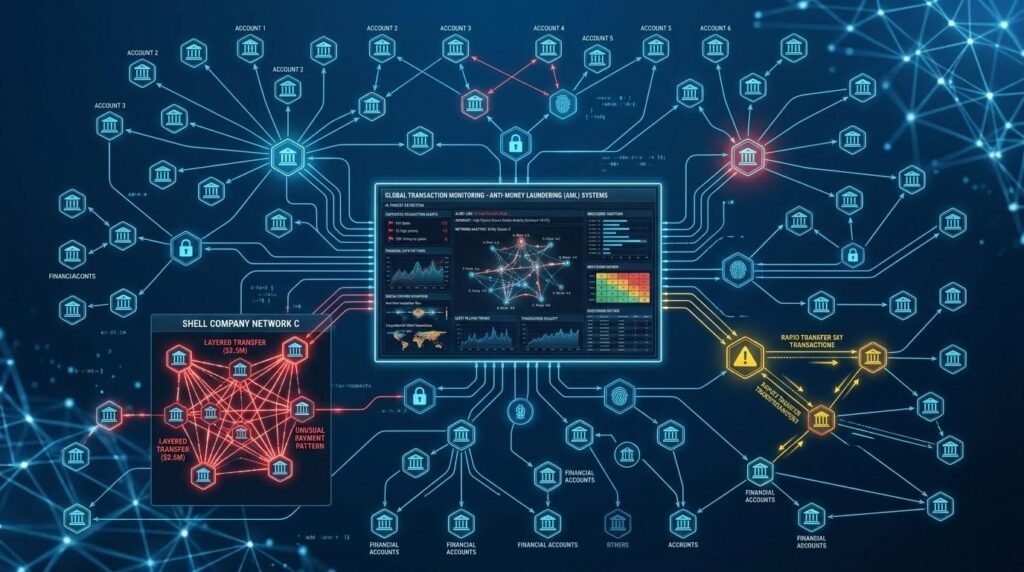
Money laundering rarely occurs with just one account. Criminals will often work with several individuals, businesses and financial intermediaries. Machine learning and network analytics can help identify these relationships. The network analytics will show the relationships between the financial information. This helps identify how money has moved between different entities. Several accounts may not appear to be related however they may have common beneficiaries, contact information, addresses or transaction patterns. Looking at this information together can help identify that they are all connected to the same suspicious organization individual. This will help banks identify complex financial relationships that wouldn’t be picked up by traditional transaction monitoring.
Network analytics can be very useful when trying to identify shell companies and money mules. Shell companies may be set up to hide the true owners, obscure business activity and receive money from criminal activity. Money mules are individuals who receive and send money on behalf of criminals. This can be done knowingly or through deception. AI systems can look at any common account information, recurring payment destinations, common directors, time of transactions and unusual patterns. This can help identify any potential relationships. If there are multiple new businesses receiving money from unrelated accounts and then sending it to the same beneficiary, this could indicate that they’re working together. This can help investigators understand the structure of suspicious networks, identify key intermediaries and understand which accounts need to be looked at.
1. Reducing False Positives
One of the biggest issues with traditional anti-money laundering is the large amount of false positives. A false positive is a transaction that isn’t related to financial crime but has been flagged up as a potential suspicious activity. This can create extra work for the compliance team and slow down investigations. Artificial intelligence can help reduce this issue by looking at multiple risk factors before creating or prioritizing an alert. Advanced models will look at the customer history, transaction patterns, account relationships and other relevant information. This will help banks identify any unusual but legitimate activity. Whilst AI cannot completely remove false positives, it can greatly improve the efficiency of monitoring by improving the risk assessment and prioritizing alerts.
AI can also help speed up investigations. Compliance officers can easily sort through information to identify relevant evidence. If a suspicious transaction has been identified, the investigator may need to look at the customer information, previous payments, account relationships, ID documents and supporting financial information. Using an automated system can help gather this information together, identify any unusual patterns and give a clearer picture. Some systems can use natural language processing to look through relevant documents and summarize the information. This will reduce the time employees spend researching information that isn’t connected and can focus on higher risk cases. AI can also help prioritize the alerts so that they can be investigated more efficiently. This will help financial institutions improve the timescales of investigations.
2. Supporting Compliance
Banks must follow strict anti-money laundering regulations to ensure that financial institutions aren’t being used for criminal financial activity. Generally this will involve carrying out customer due diligence, transaction monitoring, sanction screening, keeping records and reporting any suspicious activity. AI Powered Anti-money laundering systems will help banks comply with regulations by automatically carrying out processes and keeping information neatly organized. If a transaction meets the criteria for suspicious activity, automated tools can help compliance officers gather the relevant information and create supporting documentation. Some systems can also help identify any missing customer information and monitor changes in the risk factors. As regulations will vary depending on the jurisdiction, banks must ensure they set up their systems to follow local laws. Whilst automation can help with compliance, financial institutions will still need to make sure they meet the regulations.
Challenges of Implementing AI in Anti-Money Laundering
There are several challenges to implementing AI within anti-money laundering. Often financial institutions will have customer information and transaction data across multiple banking, payment systems and databases. If these systems are unable to communicate with each other it can cause issues with the AI models receiving incomplete or inconsistent information. This can cause issues with identifying any suspicious activity. For example, if customer information is stored across separate accounts with inconsistent identification information, the bank may not be able to identify any relationships. To overcome this, banks will need reliable data management systems, consistent formatting and appropriate security measures. They must also ensure that sensitive customer information isn’t accessed by unauthorized individuals and protect themselves against cyber threats. If the data isn’t accurate, complete or well organized even the most advanced machine learning models may not give accurate results.
A key challenge is explainability. Some advanced machine learning models can be quite complex to understand. This can be an issue for compliance officers as they will need to explain why an account has been flagged. Regulators will also expect financial institutions to have the correct documentation to prove that their monitoring systems are working correctly. Banks should implement explainable AI techniques to give clear reasoning behind why risk scores have been given, alerts have been raised and recommendations have been made. It is also important to have human oversight as AI can make mistakes. AI can sometimes misunderstand legitimate activity and may also have bias from historical data. Qualified investigators should review any significant alerts to assess the supporting evidence.
Future of AI Powered Anti-Money Laundering
The future of anti-money laundering will rely heavily on using artificial intelligence, big data analytics and human expertise. With increasing digital banking, international payments and financial technology services, criminals will have more opportunities to abuse complex financial systems. Banks will need monitoring systems that can look at transactions across multiple channels and identify any suspicious relationships. Improvements to machine learning, natural language processing and network analytics will help improve the ability of financial institutions to identify new money laundering techniques. Increased collaboration and secure information sharing between financial institutions may also help identify suspicious accounts and relationships with criminals. This can help banks become more proactive with their anti-money laundering procedures to identify potential threats quicker.
Conclusion
Artificial intelligence and big data analytics are transforming the way banks identify money laundering and investigate any suspicious transactions. Using automated transaction monitoring, customer risk profiling, KYC verification, sanction screening and network analytics financial institutions can identify any unusual financial activity. They can also identify any relationships between suspicious accounts, shell companies and money mules. Using machine learning can also help reduce any unnecessary alerts, speed up investigations and improve the distribution of compliance resources. However, it is important to ensure that the data is well integrated, explainable, security is strong and there is meaningful human oversight. AI should only be used to support experienced compliance professionals. As financial crime becomes increasingly sophisticated banks who utilize advanced technology, effective anti-money laundering policies and qualified investigators will be best placed to protect their financial systems, meet regulations and stop criminals from using legitimate banking services to hide their illegal funds.
Get more well researched information about AI in Anti-Money Laundering here.