Introduction to Trees in Data Structures
Trees are a very important class of non linear data structures in computer science and programming which we use because they present a practical solution for a hierarchical organization of info. As opposed to arrays and linked lists that typically present elements in a linear fashion, trees allow for an element to connect to many other elements via a branch which goes out from it. This structure is very useful when you have info that is in a natural hierarchy, in categories, has relationships, or has a parent child connection.
For example a computer’s file system which has folders that may in turn have subfolders and files, or an organizational chart that shows report structures. Also, learning about trees gives a great base for how computers handle and retrieve complex info very well. Also trees are present in databases, search engines, compilers, artificial intelligence, networking and many other software development fields. Although each tree type may have different rules, they all use what we call nodes which are elements that are connected to each other to present the info relationships.
Knowledge of a Tree’s Components.
In the university we have a root, faculties which are children of the root, departments which are children of the faculties, and we go down to individual courses. This parent child structure which is a tree puts info out into meaningful levels. At each level a node which is not the root has one parent in a typical tree, although a parent may have many children which depends on what type of tree it is.
By understanding these relationships you also better understand more complex ideas like traversal, search, insert, delete, and balance.
Root, Parent, Child, and Leaf Nodes
The base node is which the whole tree is built from and does not have a parent. A parent node is one which has one or more nodes right below it, and a child node is one which is right below a parent. A node may be a parent and a child at the same time. For example if node A is connected to node B and node B is in turn connected to nodes C and D, A is the parent of B, also B is the parent of C and D.
At the same time B is a child of A. A leaf node is at the end of a branch and does not have any of its own. These basic relationships are important as many tree algorithms go from parents to children or from children to parents. When programmers grasp these relationships tree diagrams become much easier to interpret and ideas like search, traversal and hierarchical data organization become more intuitive.
Depth and Height of a Tree
In trees two key measures are depth and height. Depth of a node is the distance of that node from the root which we determine by the number of edges on the path from the root to that node. Thus the root which is at the top has a depth of zero, its immediate children have a depth of 1 and so on. The height of a node is the length of the longest path from that node to a leaf, and the height of the whole tree is the height of its root.
We use these measures to analyze tree structure and performance. A tree which has great height may cause an algorithm to travel through many levels to find what it is looking for. On the other hand a more compact and well organized tree may see better performance in search and other operations. This is a reason very much into why balanced tree structures are important in many applications.
Binary Trees
A binary tree is a type of tree in which each node has at most two children. These children are also referred to as the left child and the right child. While it is not required for all nodes in the tree to have two children a node may have none, one, or two this is a key feature of the binary tree. This simple yet powerful characteristic which forms the basis of the binary tree structure is what makes it a popular study subject in the computer science field.
Binary trees are used to present hierarchical information and also are the which which many other specialized structures are based, for instance binary search trees and various balanced tree implementations. Also because of their structure binary trees are very useful in teaching the concept of tree traversal which in turn is very important in the processing of data. Thus binary trees are not only important as a data structure in their own right but also as a fundamental element in the study of more complex algorithms that depend on a hierarchy.

Binary Tree Example
Their value is in the representation of data relationships which in turn is made available for efficient processing by algorithms.
Binary Search Trees
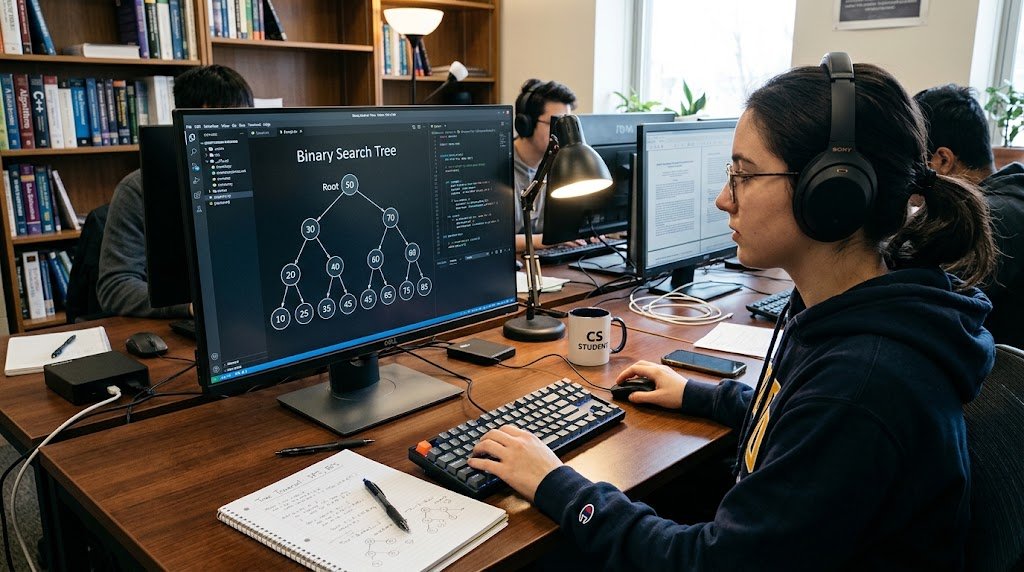
A binary search tree , usually abbreviated as BST, is a type of binary tree that has been structured to improve search and data maintenance efficiency. In a typical binary search tree we put values which are less than a node in its left sub tree and which are greater in its right sub tree. As for the issue of what to do with duplicate values that is left to the implementation. This order structure which is a feature of the tree allows a search to eliminate large parts of the tree as it makes its way from the root towards the value it is looking for.
For readers which are in need of an in depth definition and properties of this structure binary search trees do provide a useful resource. When the tree is well organized, performance of search, insert and delete operations is very good as each comparison determines which branch to go to. But also it is very much the case that the performance of a binary search tree is very much tied to the shape of the tree which is why balanced tree structures are so important in practice.

Binary Search Tree Operations of Search and Insertion.
Binary search tree search begins from the root which then is compared to the target value. If the target is found to be equal to the current value the search ends. If the target is less than the present value we go the left branch, if greater we go right. Also at the time of insertion the same basic compare process is used. We start at the root and go down till we find the proper place for the new value.
This approach is very efficient as opposed to checking each and every item in an unordered set when the tree is fairly balanced. But a binary search tree may turn out very skewed if values are put in in a poor order. In a worst case scenario the structure may as well be a linked list which in turn causes what should be fast operations to in fact be slow. That is what brought about the search for balanced search trees.
Balanced Trees
Prevent trees from growing out of proportion. In the case of programs which do many searches and updates, balanced trees are particularly valuable as they do a great job of keeping the work for these operations to a minimum and in a predictable amount.
Also they put forth a key concept in computer science which is that a data structure’s design may greatly impact the performance of an algorithm.
Heaps
A heap is also a very important type of tree based data structure which we use for different purposes from that of a binary search tree. A heap is usually implemented as a full binary tree and also puts on a special order which we call the heap property. In a min-heap the value at each parent node is less than or equal to that of its children which presents the smallest value at the root. In a max-heap the parent node value is greater than or equal to its children which puts the largest value at the root.
Heaps are very useful for implementing priority queues in which elements are processed based on priority, not the order in which they arrive. Also heaps play a key role in algorithms like heap sort and are used in scheduling and resource management tasks. Unlike a binary search tree which maintains order between every node a heap does not because its main function is to efficiently access the highest or lowest priority element.
Min-Heaps and Max-Heaps
In terms of priority rules that is what differentiates min-heaps from max-heaps. In a min-heap the root is the node which contains the minimum value thus enabling a program to easily pull the minimal value out. In a max-heap the greatest element is at the top, which in turn makes it easy for the program to see the maximum value which needs to be accessed first. As a new element is added to a heap it is put in a spot that will allow the heap structure to be maintained, which may also include moving that element up to the proper place.
Also when the root is deleted another element steps up to take its place which in turn may require adjustment. These processes are what we also call heapify. Out of the structuring that heaps do to hold data they do not have the full order which some search trees have but in trade off they provide very good priority management.
Other Important Types of Trees
Binary trees, binary search trees, balanced trees, and heaps are a few of the types of tree based data structures out there. Also we see B-trees which may have multiple children per node and which in general are used in storage systems and databases for they do a great job at reducing the number of expensive accesses which in turn is when you are working with large data sets. B+ trees which are a related type of tree are in particular very useful for database indices and file systems. Also we have Trie trees also known as prefix trees which are for storing sequences like words or character strings and which in turn are useful for auto complete, dictionary lookups and prefix based searches.
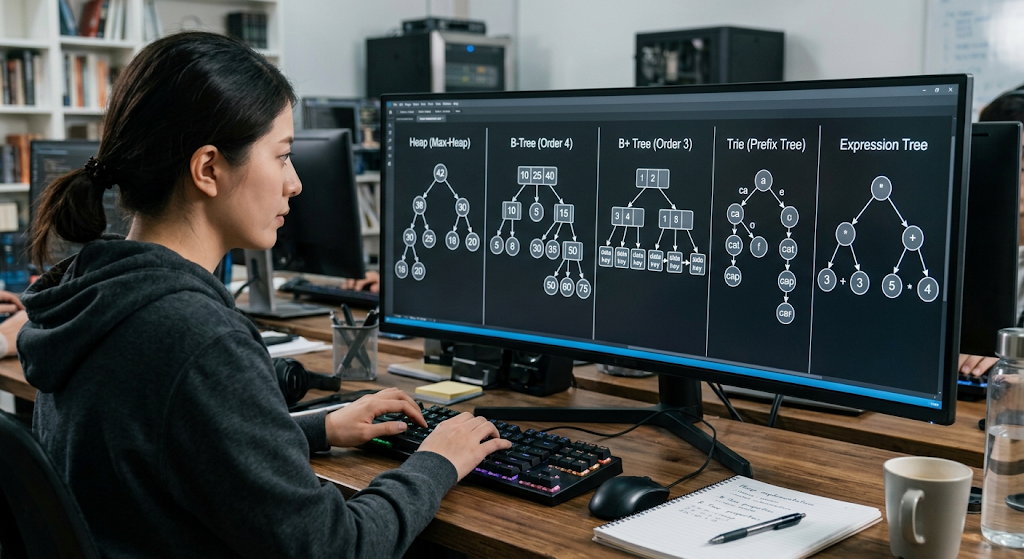
Also we have expression trees which present math or logic expressions and decision trees which present a series of decisions. That said there isn’t a single tree structure that will work for every problem. Rather what we do is we pick a tree which best fits the relationships in the data and also the operations that we want to perform in an efficient manner.
Tree Traversal Techniques
Tree navigation is a term we use for the action of visiting nodes in a tree based on a certain strategy. As trees do not present in a single straight line, we have defined traversal methods which allow programmers to go through the elements of a tree in a systematic way. We see two main depth first traversal methods in use today which are pre order, in order and post order traversal. In pre-order the present node is looked at before its children.
In order we go through the left sub tree, then the present node, and at last the right sub tree which is very useful in binary search trees as it puts out values in a sorted order. Post order looks at the children first and then the present node which is a good fit when you need to take care of the parent after its children. Also we have level order traversal which goes through the tree level by level and which is usually done using a queue. What method of traversal to use is based on what the program is trying to do with that data.
Applications of Trees in Databases
Trees are a key component in database systems which often have to search, sort out and present large sets of info very quickly. We see in database indexes the use of tree based structures like B-trees and B+ trees that put keys in order so we can go right to what we’re looking for instead of going through every single record. This is really useful when there are millions or even billions of records. As opposed to looking at each record one by one, index structures guide the database to the relevant part of the stored info.
Also these types of indexes are useful because they are able to be made to work well with storage that has very different performance characteristics — which means that getting at data stored on a secondary system which is much slower then main memory is made more efficient. Also by putting keys into levels, database systems can reduce the number of storage requests for large scale searches, insertions, and updates. In this way tree structures became a foundational element of today’s database technology.

Applications in File Systems
File systems also present a tiered structure which is very much like a tree. In a typical computer we see files put inside directories and subdirectories which in turn form a hierarchy that starts at the root directory and runs out into many levels. This structure is what allows us to find info via a predictable path. For instance a root directory will have several folders, in which we then have more folders and files, these in turn can go on to even more levels of sub directories.
Tree concepts also help us to see why file paths are so natural to a hierarchy and why actions like going between directories play out as if we are walking a tree. Also some file systems do in fact use specialized tree structures internally to manage directories, metadata, storage blocks, or indexes. What we see in trees is a great way to present contained units which is how a lot of our info is naturally organized.
Applications in Search Systems
Search engines may present info in a tree format which in turn reduces what is put forth as a result. For instance we see in the case of prefix based search using tries. A trie will put out characters along a path which in turn allows a system to tell which of the stored words have a given sequence of chars at the start. This also supports features like auto complete and dictionary look up. Also to that which is related, search systems also use other hierarchical indexes for very large sets of info.
The main benefit is that the structure which is in play will reduce what data is looked at during a search. As opposed to looking at each item as a stand alone element a tree will put related info in branches and levels. That hierarchical structuring also helps in algorithms which in turn will rule out irrelevant parts of the search. What tree structure to use is a function of the data type, search needs, info volume, and if the system is to do lots of updates.
Applications in Programming Languages and Compilers
Trees play a very large role in language design and development as the source material we provide for programs has a very natural hierarchy. As a compiler goes through a piece of a code, it works out the structure of the various elements and their connections. In the case of an Abstract Syntax Tree, more often known as AST, the source code is put forward in a way that is easy for the machine to interpret. For example a math expression is broken down with the operator at the top over terms and variables. Also the compiler will apply changes in the course of functions like semantic analysis, optimization, and translation to executable form.
Also these trees include features of nested blocks, function invocations, variables, declarations, and other program elements. This means which code you write which may seem complex on its face is really just a set of ordered elements that can be parsed by the computer. Out of that comes a much better appreciation for what happens in that process of translation between our human language code to that which machines run out.
Advantages and Disadvantages of Tree Data Structures.
Trees present a number of key benefits. They do a great job of naturally representing hierarchies, supporting efficient search in certain data structures, and in organizing large sets of info into more workable groups. Also we see that special trees do very efficient priority management, indexing, prefix search, and expression evaluation. But also it is not true that any tree is efficient by default just because it is a tree. What makes a tree perform well is the type of that particular tree and the way its nodes are set up.
For instance an unbalanced search tree may become very slow as it grows tall. Also trees may require more complex algorithms and memory management than linear structures do which is a result of nodes that point to many other nodes. This all means that which tree to use has to be based on the most common operations the application does. Also a tree works best when its structure fits the problem at hand rather than just because it is a familiar data structure.
Conclusion
Trees are a type of non linear data structure which put forth an excellent way to present info in a hierarchy. Their elements which include roots, parents, children, leaves, depth, and height which in turn present the base for study of more complex tree structures. Binary trees which is a type of tree that has a two child structure and binary search trees which in addition to structure also have order which in turn support efficient search. Balanced trees which are put forth to solve issues of high height and heaps which are for efficient priority management are also types of trees.
Also we have B trees, B+ trees, tries, expression trees, and abstract syntax trees which show how tree concepts are applied to various computing issues. Trees are used in databases, file systems, search engines, programming languages, compilers and many other tech fields. For students and beginners in programming, learning trees is very important as a step towards the study of algorithms, efficient data organization, and the in-depth structural aspects which support today’s software systems.