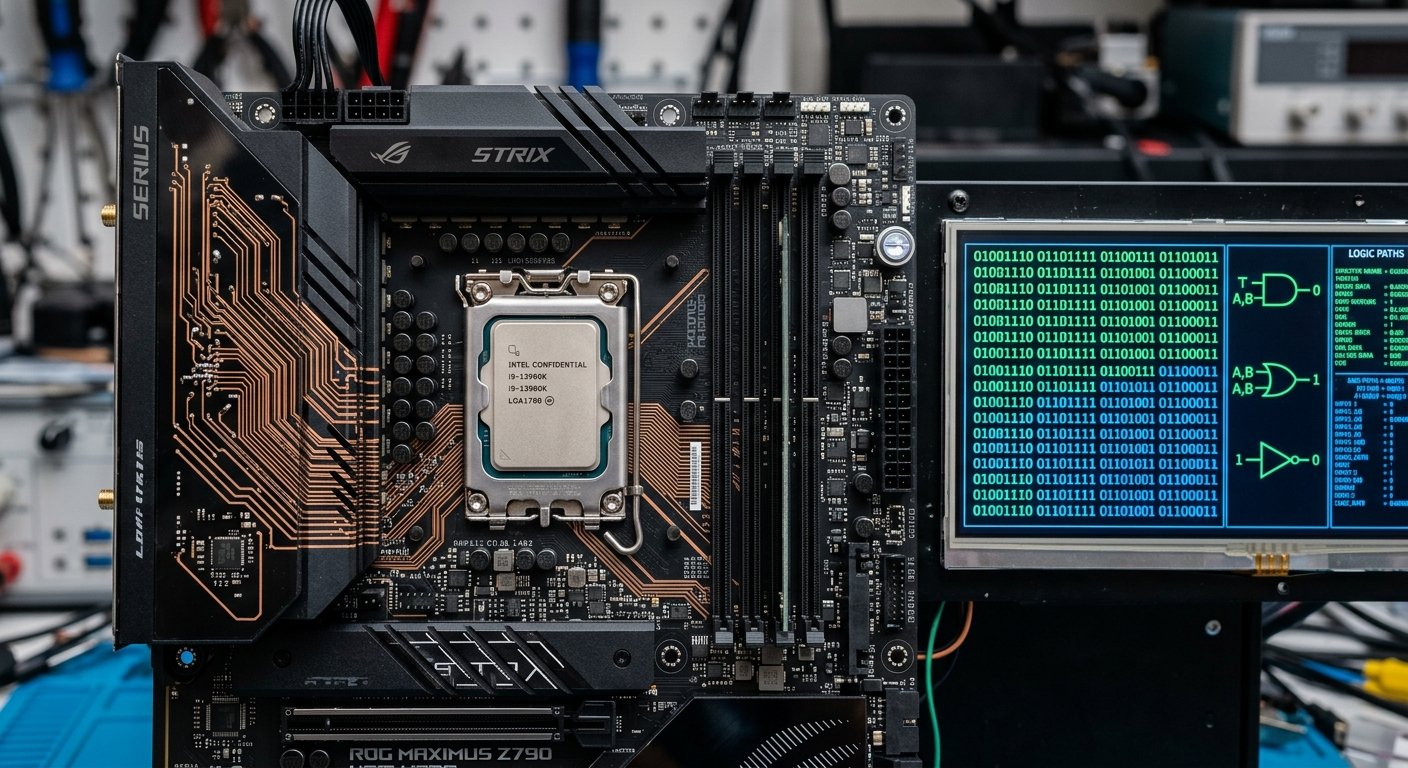
Boolean algebra is among the most significant foundations in modern computation since it is a formalism for representing and manipulating logical information. Boolean algebra differs from normal algebra, which is usually used for numbers and arithmetic, and with two possible values being true and false, typically 1 and 0. Boolean algebra uses only two values, so it is well suited for use in digital computers which use two distinct states for their electronic components, high voltage and low voltage.
Boolean algebra is related to the study of discrete mathematics as it involves finite and distinct values as well as logical relationships, which are not continuous. The ability to use concepts like boolean variables, logical operators, truth tables, boolean expressions and logical equivalence enables computer scientists and computer engineers to model how information should be processed. The mathematical concepts then turn into real parts of digital circuits, processors, memory, programming languages and computer architecture.
Boolean Algebra and Discrete Structures
Boolean algebra may be considered as a mathematical system to express relationships between values that are logical. Boolean is a variable that can only be true or false (typically 0 or 1). For example, a variable A could represent whether a particular condition is false or true, respectively. Boolean algebra is not like standard algebra, in that variables have a much more extensive range of numerical values. In the field of discrete mathematics, the structures are usually considered in terms of objects that can be counted or that can be differentiated quite clearly from each other, and Boolean values can be naturally fit into this. Logical reasoning is then able to be formulated in terms of exact mathematical rules. Several of the Boolean variables, when connected together, can represent more complex conditions such as whether a computer should or should not grant access, whether a circuit should or should not be activated or whether a specific instruction should be executed or not. Boolean algebra is valuable because it can be used to model logical relationships that can be expressed mathematically.
The basics of boolean algebra are boolean variables and boolean operators. The three basic operators are AND, OR and NOT. The AND operation will only output 1 if all of its inputs are 1. The OR operation returns 1 if either of its arguments is 1. Using NOT operation will invert the value of a boolean (0 to 1 and 1 to 0). These operations can be expressed mathematically, with words, or with symbols, depending upon the context. As an example, A AND B can be represented as A · B, while A OR B can be represented as A + B in Boolean notation. A̅ or ¬A is a common way to denote NOT A. These operations can be simple, but they can combine to represent complex logical conditions. These relationships can be used in a computer system to decide if a number of requirements have been met, if one of a number of alternatives exists, or if a specific condition should be refused.
Boolean Variables, Operators and Truth Tables
A way to demonstrate all possible inputs to a Boolean operation and the resulting output is to use a truth table. They play a significant role in Discrete mathematics, where they enable logical statements to be evaluated completely, not just by intuition. There are four cases of two Boolean variables: both variables are 0, the first variable is 0 and the second variable is 1, the first variable is 1 and the second variable is 0, and both variables are 1. An AND operation will output 1 only in the last row while an OR operation will output 1 in any row that does not contain both 0s. A NOT operation does only take one input and negates its value. Truth tables are, therefore, a simple means of checking if two logical expressions act alike and are also useful in the design and testing of digital circuits.
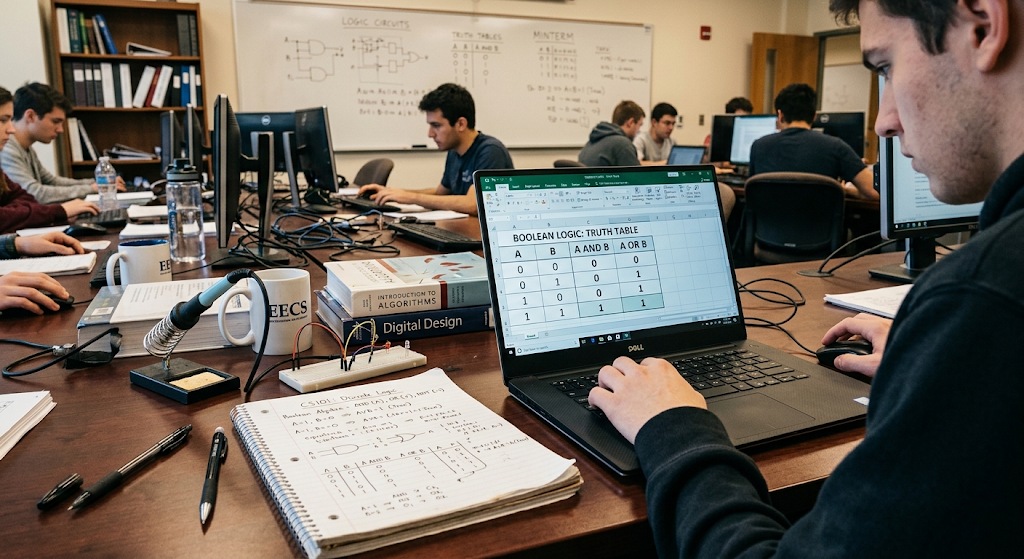
The following is a simple truth table for the main boolean operators:
| A | B | A AND B | A OR B |
| 0 | 0 | 0 | 0 |
| 0 | 1 | 0 | 1 |
| 1 | 0 | 0 | 1 |
| 1 | 1 | 1 | 1 |
The truth table for the NOT operator is even easier:
| A | NOT A |
| 0 | 1 |
| 1 | 0 |
As Boolean expressions get more complex, truth tables get more useful. Let’s think about an expression like (A AND B) OR C. The output is dependent on the output of A AND B and then, if C is 1. This type of expression shows how easy it is to combine logical operations to build up a larger structure for making decisions. Computing: Like combinations are used when a computer needs to test several conditions to create a result. One programmer could put a number of conditions inside the if statement, and a processor can check a number of control signals to decide which operation to perform. A truth table is a tabular method that allows you to test the output for each set of inputs. This gives a mathematical basis for reliable system design and testing.
Boolean Expressions and Logical Simplification.
A Boolean expression is a logical combination of Boolean variables and logical operators which return a Boolean result. The expressions can be simple (A AND B) or very complex with many variables, operators and parentheses. Boolean Expressions are significant because they offer a brief description of logical processes in a mathematical way. For instance, a security system may need two things to be true for the system to open: A AND B, which can be two types of conditions. Another security system may need either one or the other of two approved conditions to open: A OR B. More complex systems can include AND, OR and NOT conditions to represent more complicated decision rules. The expressions can then be translated into physical logic gates or as conditions in software. Boolean expressions are thus a tool that connects abstract mathematical thinking with the functioning of computing systems.
Logical simplification is the process of converting a Boolean expression into an equivalent expression which is simpler to understand, implement or evaluate. Simplification does not alter the logical outcome, but simply eliminates operations or groups together related terms. There are a few Boolean identities that can be used for this. For instance, A AND 1 is equivalent to A, so the value of the variable A does not alter when it is combined with 1 using the AND operator. Likewise, A OR 0 = A, i.e. OR with 0 doesn’t change the value of A. Other identities are A OR A = A and A AND A = A; and A NOT A = 1 and A AND NOT A = 0. Such identities can be used to simplify the operations in a logical system. This leads to the reduction of the number of gates, simplicity of circuits, lower complexity, and potentially increased performance in hardware design.
De Morgan’s Laws and Logical Equivalence
De Morgan’s laws are an extra important aspect of Boolean simplification that relates the logic of NOT with the AND and OR operators. The negation of an AND expression is the same as the OR of the negated variables, and the negation of an OR expression is the same as the AND of the negated variables. NOT (A AND B) is equal to (NOT A) OR (NOT B) and NOT (A OR B) is equal to (NOT A) AND (NOT B) in symbolic form. The reason that these relationships are useful is that they enable one form of a logical expression to be converted into another without altering the meaning of the expression. De Morgan’s laws can be very useful in digital circuit design, as an engineer can use the laws to rewrite an expression to fit the available gates, or to minimize the number of gates in a circuit.
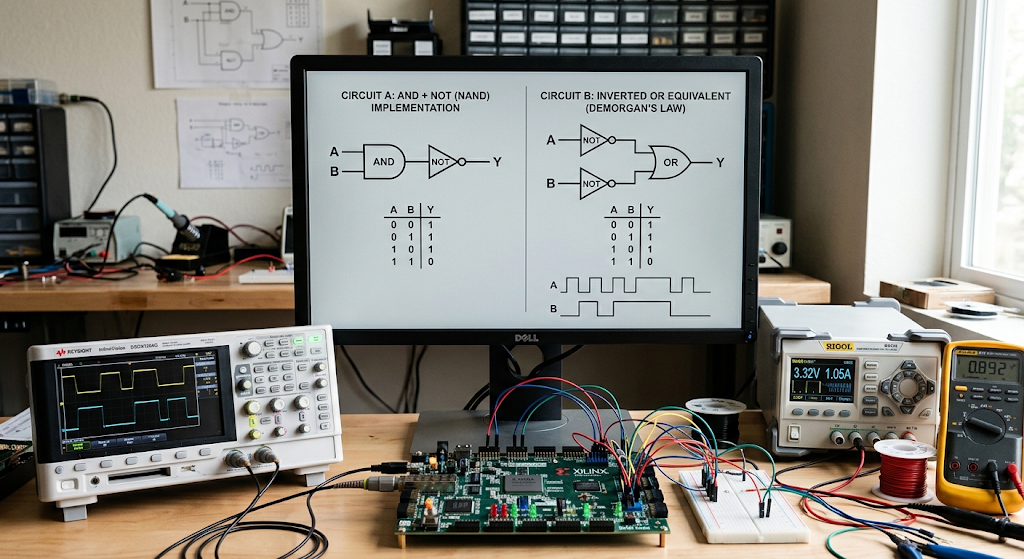
It is also possible to consider two De Morgan laws intuitively as the negation of a condition. Suppose that the statement is that both A and B are true. If the first statement is false then the second is false (or vice versa). This is why, in the negation of an AND relationship, the negation of the relationship becomes an OR relationship of the negated inputs. Similarly, when a statement is made that is “A or B”, then when that statement is negated, it should read “not A and not B”, which is the AND relationship between negations of A and negations of B. These transformations are not mathematical tricksters. They come with a variety of practical applications such as: converting circuits, simplifying expressions, verifying logical equivalence, and understanding how other representations of the same condition can be built. De Morgan’s laws are thus a theoretical and practical computing principle that students of discrete mathematics meet.
Logic Gates and Digital Circuits
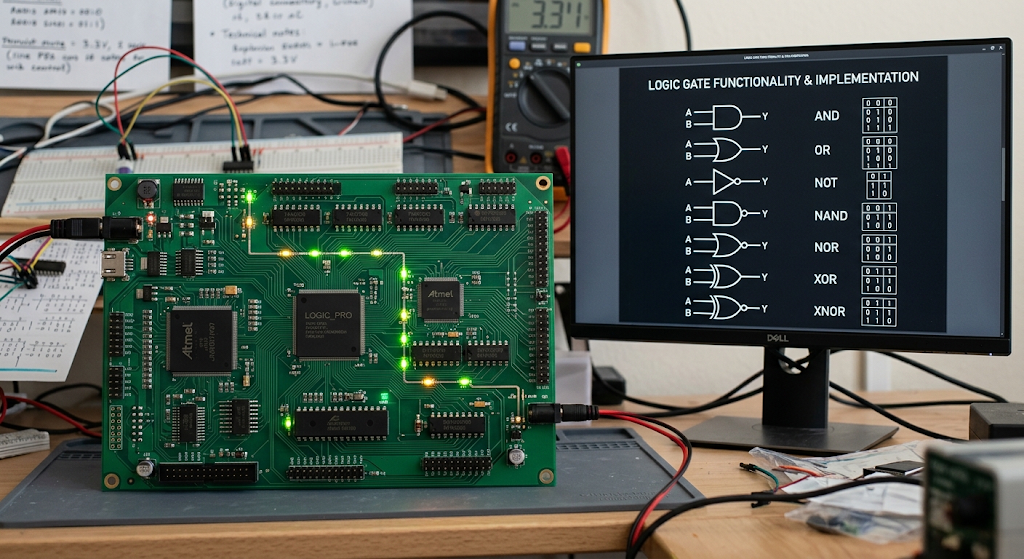
Logic Gates: Physical or Electronic Implementation of Boolean Operations. A digital circuit may be realized by cascading gates (or by feeding the output of one gate to the input of another gate). Basic gates are AND, OR and NOT gates, and other more frequently used gates are NAND, NOR, XOR and XNOR gates. AND gate will be the AND operation, OR gate will be the OR operation, and NOT gate will give the complement of the input value. NAND is the complement of AND and NOR is the complement of OR. The XOR is also known as an exclusive-OR gate, meaning that it outputs 1 when the two inputs are different; it can be used in binary addition. XNOR returns 1 if the inputs are different; it can be used in comparison operations. These gates can be used to make mathematical expressions real electronic structures, which can process the binary information.
Generally, digital circuits can be divided into two categories: combinational circuits and sequential circuits. In a combinational circuit the output will change according to the present input values. These include adders, multiplexers, decoders, encoders and comparators. For instance, a binary adder can be implemented with logic gates to add binary numbers. Sequential circuits are also distinct in the sense that their output may be influenced by both their present inputs and the past states of the circuit. They are frequently used with memory devices like flip-flops and are essential for registers, counters, and other systems that require memory. This difference illustrates the power of Boolean logic to be applied beyond a single gate to a complex digital system. Engineers can use thousands, millions or even billions of these logical components to build circuits that can do arithmetic, store information, control operations, and organize the activities of a modern computer.
Boolean Algebra in Processors and Computer Architecture
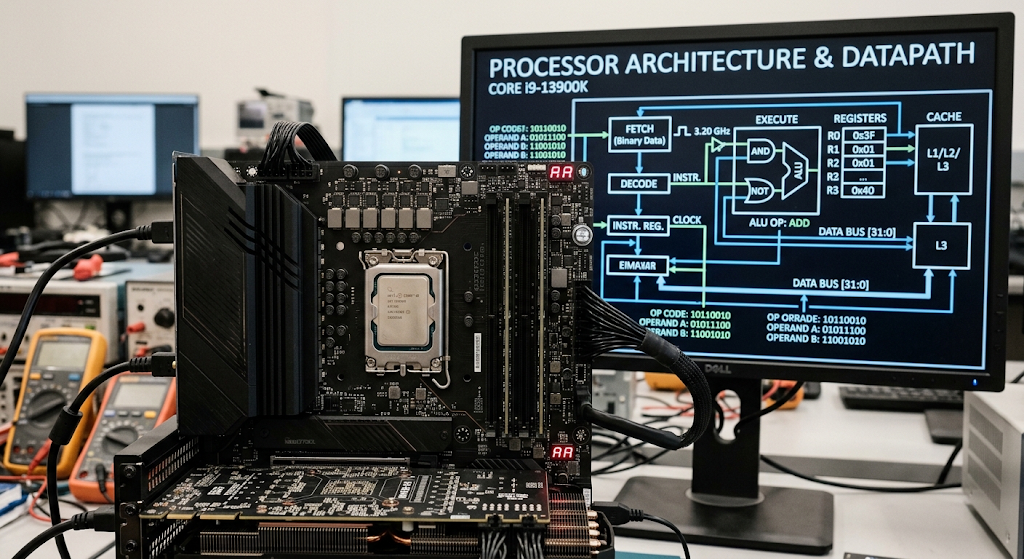
Boolean logic is at the base of how instructions and data are processed at the processor level. The parts of a central processing unit that carry out arithmetic and logical operations, direct the transfer of information, and direct the execution of instructions. ALUs, or arithmetic logic units, are digital circuits that perform arithmetic operations like addition and subtraction, comparisons, and bitwise logical operations. All of these functions are based on a set of boolean logic. For instance, circuits to implement binary addition must take into account both input bits and carry information from the previous bit positions. In addition, control logic uses a Boolean condition for each of the signals that must be activated at specific times in the execution of instructions. While processors are very complex today, their basic operations are still based on the same logical principles, expressed through Boolean algebra.
The use of Boolean reasoning is also used in computer architecture to coordinate registers, memory access, instruction decoding and control signals. A processor has to decide what instruction to run, which registers to store data in, which operation(s) to do and when to pass information from one component to another. These decisions are encoded by a set of digital signals. For example, instruction decoders decode binary instruction patterns and output control signals that control the relevant components of the processor. A multiplexer can be used to choose one of a number of input sources and registers can be used to hold binary values until they are needed. These can all be represented by Boolean expressions and logic gates. It is important that Boolean algebra is not just an introductory mathematical subject but is the basis of the logical structure out of which much of the computer hardware is built.
Boolean Logic in Programming
Boolean algebra and computing are not confined to the physical components of computing, but can also be seen in the language of programming. Most programming languages include boolean data types and operators with which to make decisions when a program is operating, based on conditions. Most of the programming operators are very similar to the concepts of AND, OR and NOT in Booleans. It may be necessary to determine if a user has entered an acceptable value, or if a certain value is in an acceptable range, or whether a number of requirements are met. Boolean expressions can be used to represent these decisions. Conditional statements like if, else if, else need to use logical evaluation heavily, and loops will keep going or terminate based on Boolean conditions. The ideas similar to Boolean algebra are used by programmers when developing decision-making logic.
Boolean reasoning is also important when designing efficient and understandable programs. A complicated expression can sometimes be simplified without altering its meaning, similar to a Boolean expression can be simplified mathematically. This can make the code easier to read, prevent the evaluation of unnecessary code, and can facilitate the detection of logical errors by the programmer. The same syntax is used by Boolean expressions in database queries, search systems, cyber security rules, configuration systems and artificial intelligence applications. For instance, if you want someone to have one word and another word, but not exclude either of two possible alternatives, those words can be connected by AND and OR operators, respectively. Programming Languages have their own syntax, but the underlying concept is very similar to Boolean logic. It is, therefore, helpful for students to have some understanding of how Boolean algebra is used to evaluate conditions and make decisions in a computer.Thus, it is beneficial for students to have a deeper understanding of the use of Boolean algebra to evaluate conditions and make decisions in a computer.
Importance of Boolean Algebra in Discrete Mathematics and Computing
Boolean algebra illustrates how an abstract mathematical system can be a useful basis of modern technology. Its two-valued variables constitute a natural mathematical model for binary information, and its operators represent logical relationships that must be used to work with the information. The purpose of a truth table is to systematically consider all possible input combinations that can occur, the purpose of a Boolean expression is to describe a logical process using a compact expression and the purpose of simplification is to eliminate unnecessary complications. De Morgan’s laws give useful conversions between equivalent logical formulations and logic gates are the equivalent of electronic circuits to these mathematical relationships. Engineers can construct adders, registers, control circuits from individual gates, memory components from which a memory can be constructed, and processors from which a processor can be constructed. Conditional statements, loops, database queries, and other instances of computational decision making can be seen at the software level.
The relationship of Boolean algebra, discrete structures and computing is a clear example of what is a fundamental principle of computer science: complex systems are frequently composed of simple, well-defined systems. Although a Boolean data element can hold only two values and a simple logic gate can carry out only one operation, billions of these logical decisions can be executed in tandem within the contemporary computing devices. Discrete mathematics offers the language and reasoning tools to precisely describe these structures and computer engineering, the machinery to build these structures in hardware. Knowledge of Boolean algebra is, therefore, more than that of a mathematical topic since it gives the learner a deeper understanding. It helps to understand how computers represent information, assess conditions, carry out instructions, manage electronic circuits, and carry out operations that enable digital technology to function.