Introduction
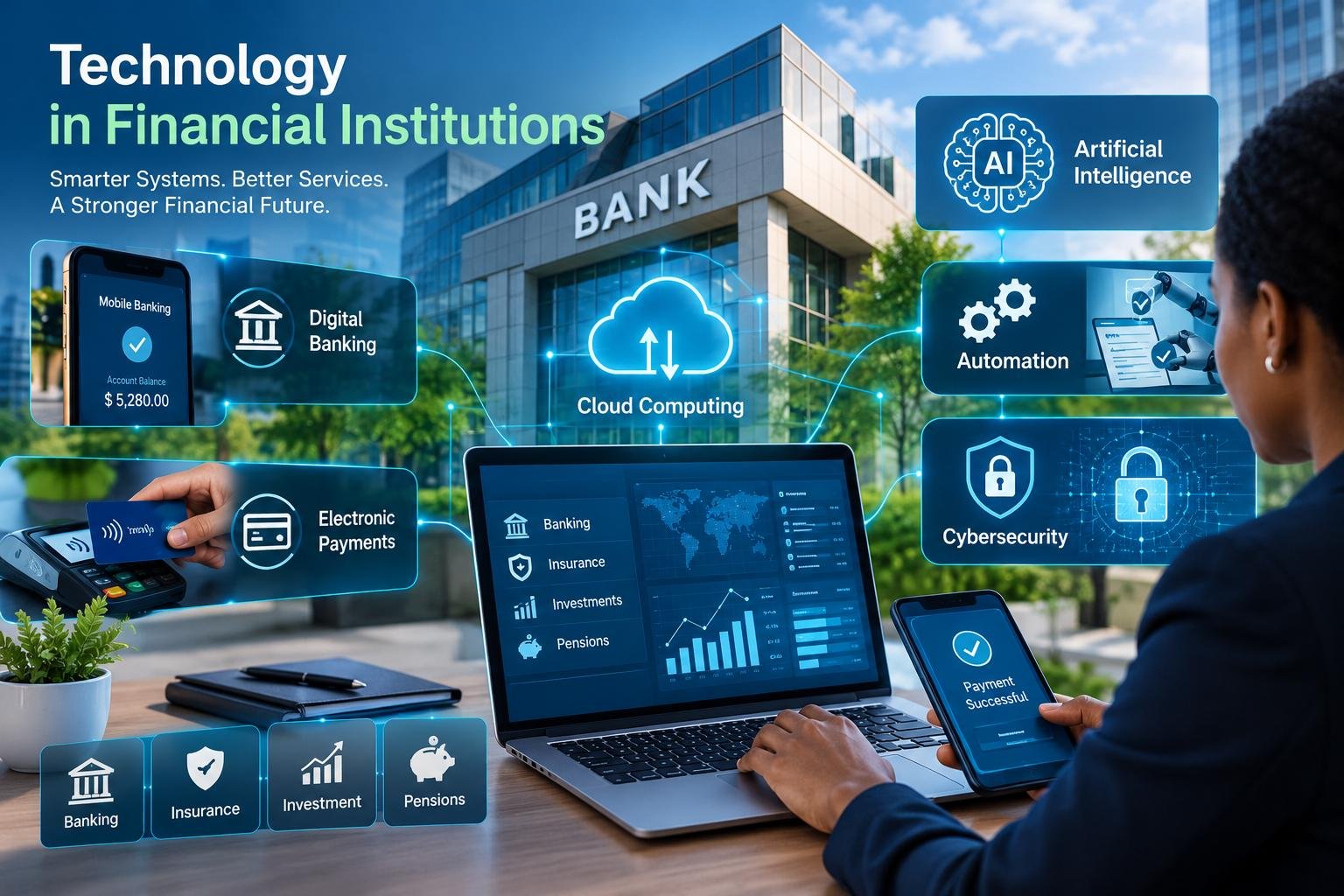
Technology is playing an important role in transforming the financial industry, impacting financial institutions’ services, information management, transactions and customer interactions. Financial institutions, such as banks, insurance companies, investment firms, pension managers and others used to rely on paper records, physical branches, manual calculations, and in-person interactions. Most of that work is now done today with interrelated digital systems that run across geographies and all the time. Financial services are now quicker and more easily accessible thanks to the rise of digital banking, mobile banking, automation, artificial intelligence, cloud computing and electronic payment systems. The convenience, security, personalization and responsiveness have also been modified by technology. So it’s no surprise that institutions are more and more considering technology as an integral part of their business rather than a support role.
A look at Finance from Paper Based Operations to Digital Finance
The traditional financial institutions were created with respect to the physical processes. You may need to sign some papers, make photocopies of your ID, sign the papers and visit a branch to open an account. Information was entered on to records by hand, documents were filed in cabinets and documents were sent to customers by letter or telephone. A loan, an insurance claim, an investment instruction or a pension request, therefore, may take days or weeks to process, if the same information was reviewed by several departments. Computerization started to alter this model; using electronic databases to replace paper records, and accounting software to help with customer management, processing transactions, and reporting. Digital records enabled information to be more easily retrieved, updated, shared and analyzed. Institutions linked branches and departments via centralized network as networks grew. Centralized system connected the branches and departments of institutions as networks grew. This resulted in the world of today: a digital world in which authorized information can flow rapidly between systems and a multitude of services can be performed without the use of any physical documents.
Digital Banking and Mobile Applications
One of the most apparent impacts of technology has been on banks, where customers are increasingly demanding a branch-free experience for managing their money. Online banking offers the ability to access your bank account, view your balance, transfer money, pay bills, download statements and more on a website. Mobile banking has taken these services to the mobile device, providing access to financial services anytime, anywhere with an internet connection. Mobile apps can offer a way to alert customers to their transactions, verify their identities with biometrics, assist with budgeting, control their card usage, and support them. Digital channels can help ease the strain on the physical branch for banks, while providing automated solutions to service a greater number of customers. The shift is especially significant in markets where mobile phones are commonplace, and branch networks are sparse. But it’s not just digital banking that demands ongoing investments in cybersecurity, ID verification, system reliability and customer education; it’s also the very nature of digital banking. In the case of convenience, it is dependent on secure and reliable digital infrastructure.
Automation.
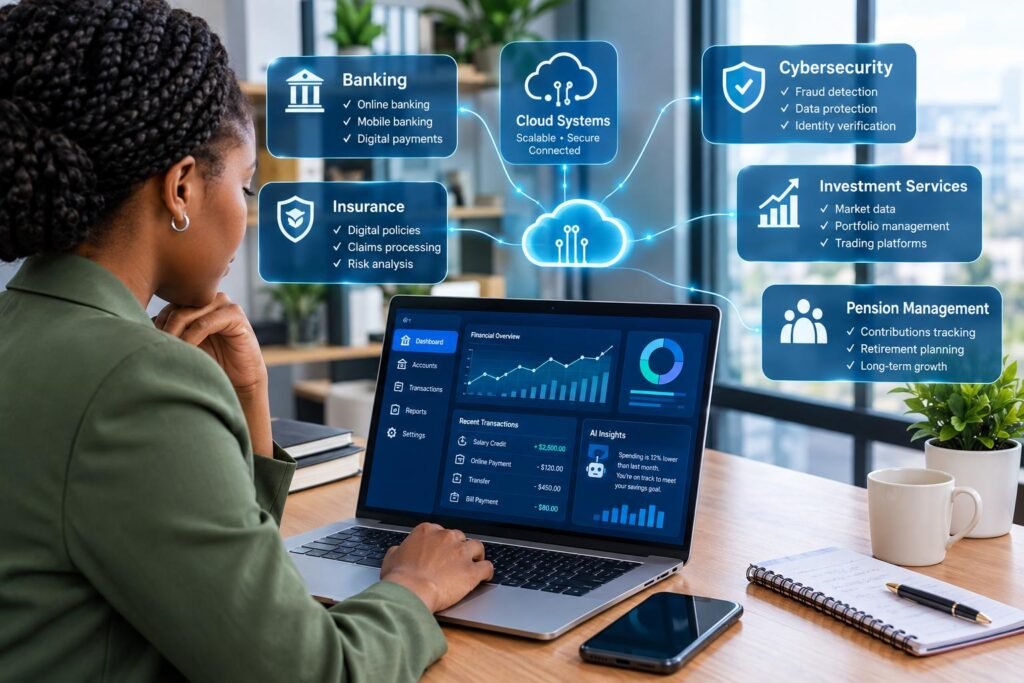
Automation allows software to repeat tasks that are based on rules with little human involvement. Automated systems can assist with bank account opening processes, transaction reconciliation, payment workflows, document classification, compliance verification and loan workflows in banking. Automated systems in insurance are employed to gather data, streamline claims processing, generate policy paperwork, and aid in the underwriting procedure. Investment and pension companies are capable of automating portfolio reporting, contributions, reconciliations and administrative procedures. It’s more than speed that’s the main benefit. Automation can also help standardize the workflow, minimize manual data input errors and give staff the time to work on other tasks which involve judgment, communication, and problem solving. When it’s too costly or problematic to replace older systems with newer applications, RPA can help link the two. Institutions are working on processes that are based in digital workflows and not simply technology being added on top of outdated processes. This can reduce the ‘friction’ of everyday operations and streamline the delivery of services to make it more scalable.
B2B Online Course: Artificial Intelligence and Data-Driven Decision Making
AI can be used to sift through vast amounts of data and uncover patterns that might not be obvious to a human. AI-powered solutions can be deployed in banks to detect odd transactions, help with fraud, assess specific credit risk, and customer-service support via conversational systems. Data analytics and machine learning can be used by insurance companies to aid in the underwriting process, claims review, and risk evaluation. Technology has the potential to help investment firms to quickly process the information in the market, track portfolios, and discover possible indicators to research. For pension managers, insights from analytics can be leveraged to gain insights into contribution trends, predict liabilities, and inform investment decisions. By analyzing customer behavior, AI can tailor financial services to individual customers, presenting relevant information. However, there are challenges to consider, including inaccurate output, biased data, explainability, privacy and regulatory expectations, among others, that financial institutions need to address. When the automated decision impacts the recipient and the impact is material, then it is important that there is human oversight.
Cloud Computing & Connected Financial Infrastructure
One of the ways that cloud computing has impacted financial technology is in changing the way they manage their technology infrastructure. Rather than the institution having to rely solely on physical servers, the institution owns and maintains, it can take advantage of the cloud with computing, storage, databases, and software services. This can be helpful to have more flexibility in resources as they can be added or removed as needed. Cloud systems can also facilitate collaboration between teams, quicker application deployment, and availability of up-to-date analytical tools. Financial institutions, however, have to pay attention to security, data governance and resilience, regulatory and third-party risk aspects when moving workloads to the cloud. Adopting the cloud is not merely a means of moving existing systems. Access, monitoring, backup and recovery controls should be put into place for workloads that are suitable for cloud environments, and these decisions are left up to institutions. With proper application, cloud computing can modernize old infrastructure and help to sustain the growth of digital financial services.
Ease Electronic Payments and Quickened Transactions.
Payment systems have revolutionized the way people and entities pay each other and exchange funds within and across financial institutions and the government. While cash and paper instruments continue to play an important role in many economies, electronic instruments, such as cards, bank transfers, digital wallets, mobile payments, and others, have grown by a great deal. These electronic payment systems enable payments to be made and processed via digital networks, thereby minimizing the need to physically handle cash and facilitating the processing of many everyday payments. Digital payments provide an opportunity to banks and payment providers to provide an integrated service, automate the reconciliation and inform the client about the transactions real-time. Electronic payments can make the collections process easier and streamline record keeping for businesses. As payment technology continues to expand, so has the significance of fraud protection, identity verification, and financial transaction encryption and monitoring as big chunks of financial activity now take place via connected, digital channels. With the evolution of payment systems, collaborative and dependable infrastructure will continue to be key in facilitating seamless and secure transactions.
Technology in Insurance
Technology has revolutionized the insurance industry from a mere digitization of policy documents. They can gain access to customer data, compare risk factors, write policies, collect premiums and settle claims through digital platforms, all while the insurer is covered. Now, insurers can access customer data, compare risk factors, write policies, collect premiums and settle claims, all without leaving anyone vulnerable. Insurers can use data analytics to gain insights from a large customer base and connected devices can offer more information pertinent to certain types of insurance. For instance, telematics can provide driving data for motor insurance applications, or digital tools can be used to assist in property or health risk assessment, as applicable. Submitting photographs, documents, and other information electronically can also speed up the claims processing. Machine learning can be used to flag claims that could be fraudulent or to flag claims for human review. These advancements not only have the potential to enhance efficiency but also introduce privacy, fairness, transparency, and responsible data utilization concerns. A balance, therefore, between better risk assessment and adequate protection of the policyholders, is needed in insurance technology.
Investment Firms, Pension Managers
Technology is also critical for investment companies and pension managers in their research, trading, portfolio management, reporting and risk control functions. Electronic trading platforms are able to send orders quickly, and market data systems are able to send a tremendous amount of price and economic data for analysis. Portfolio-management software can monitor portfolio holdings, performance, exposures and compliance needs for a multitude of accounts. Digital systems can be used by pension managers to keep track of contributions, communicate with members, calculate payouts and track long term investment strategies. The technology has also extended investment services to the Internet via brokerage sites and electronic investment apps. However, with the additional capability come new operational issues. Investment firms need to safeguard trading systems, keep data right, deal with automated systems and make sure that the technology doesn’t create unchecked risks. Financial markets are driven by a variety of factors, including economic conditions, regulation, investor behavior, and unexpected events, which can sometimes not be adequately described by historical data or by algorithms, and therefore require human input.
Cybersecurity, Privacy and Regulatory Issues
There are a number of risks associated with financial technology. The more those institutions hold data on their customers and that they do transactions online, the more appealing they are to malicious actors. These threats can vary from phishing, identity theft, malware, unauthorized access, payment fraud, and attacks to disrupt critical services. Layered security controls such as robust authentication, encryption, access management, monitoring, training and incident response are therefore essential for financial institutions. The digital systems can also handle extensive personal and financial data, so privacy is of critical significance as well. Institutions need to formulate suitable rules to collect, store, share, and keep data. Regulators are also keeping themselves abreast of technological shifts and are prioritizing their operational resilience, third-party technology providers, digital identity, cybersecurity and automated decision-making. The challenge is to foster innovation without compromising consumers’ protection or the financial stability. Governance of technology has thus turned into a strategic issue, rather than a technical one.
The Future of Financial Institutions
The financial landscape will remain in a state of transformation, with technologies increasingly becoming more interwoven. AI could be increasingly integrated into customer service, risk management, compliance and financial analysis. Cloud platforms and application programming interfaces (APIs) can help institutions and financial technology (fintech) organizations integrate services, and the growing maturity of mobile platforms can help deliver deeper financial capabilities to a customer’s experience. Data will continue to be at the heart of things, as institutions require accurate data to better understand their customers, to assess risk, to identify threats and to make decisions. Meanwhile, technology will not be the only determinant of the future. Financial institutions that are successful will require a blend of digital capabilities and proper governance, competent staff, robust cybersecurity measures, adherence to regulation and customer trust. The goal is not to automate all tasks, but to leverage technology in a way that allows for greater accuracy, access, efficiency and decision making while maintaining human oversight.
Conclusion
The financial services industry has become a digital business connected by technology, moving away from the paper, manual and branch-centric model. Banks offer numerous services via the internet and mobile, insurers can use digital technologies for information and claims, investment firms use electronic market infrastructure, and pension managers can use technology to manage long-term savings and investments. The benefits of automation are that repetitive tasks can be cut down, AI can enhance data analysis, cloud computing offers scalable infrastructure, and electronic payments can make numerous transactions more convenient and quicker. While these developments can lead to enhanced efficiency and a better customer experience, they bring with them responsibilities in the areas of cyber security, privacy, resilience, fairness, and regulatory compliance. In the end, technology is transforming financial institutions from the operational and strategic aspects. The institutions most likely to be ready for the future will regard technology as a key capability that has to be supported through governance, implementing positive staff capabilities, cybersecurity and meeting customer needs.
Get more well researched information about Technology in financial institutions here.