Introduction
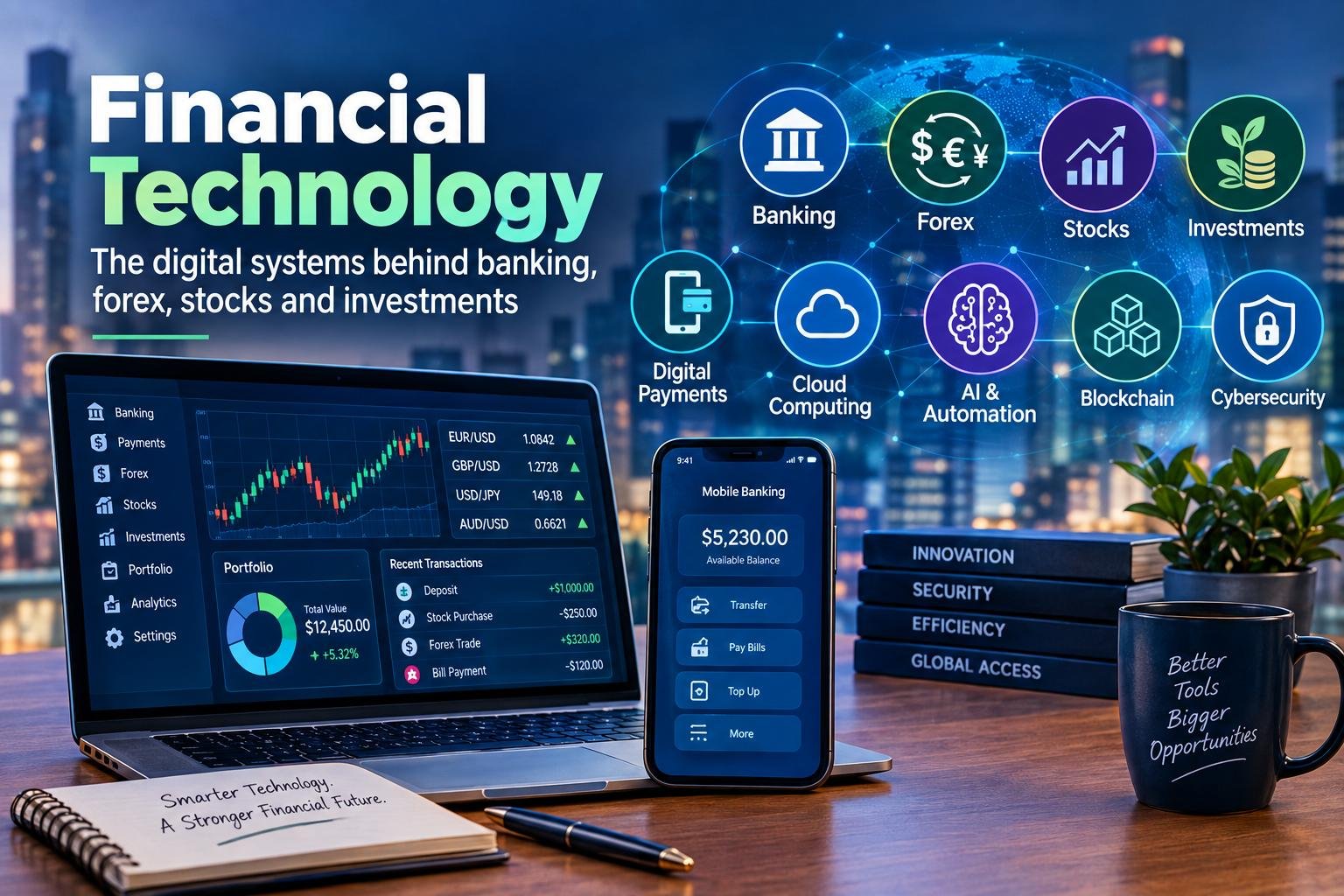
In recent years, financial technology (or fintech) has emerged as the backbone of many financial transactions and activities in today’s digital world. From transferring funds via a banking app to exchanging currencies on a forex platform, from buying shares in an investment app to investing in property via a REIT app, technology is doing all the heavy lifting behind the scenes to process information, make trades, handle risk and secure financial data. Communications, trades, settlements and reporting of these less familiar types of areas like money markets are increasingly being carried out electronically. Once these technologies are understood, it’s easier to understand how banks, stock exchanges, brokerages, investment companies, and others in the financial sector relate to customers, and to each other. The modern financial system is thus not only a system of financial products; it is a highly interconnected digital system that is dependent on data, software, networks, automation and security.
What is Financial Technology?
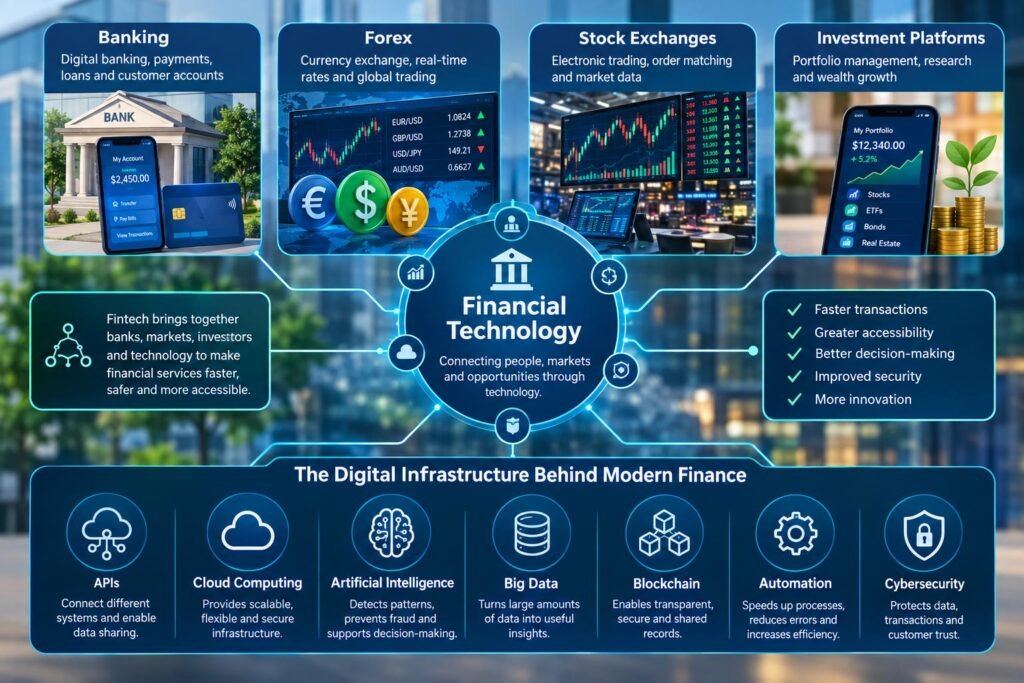
Financial technology is the application of software, computing systems, digital networks and others technological instruments for the provision, enhancement or automation of financial services. While fintech is generally perceived as being with a newer business that’s providing mobile payment or investment applications, technological advancements have long been a part of finance. The computer-based database, the electronic payment system, the automating teller machine and the digital transaction processing system have been essential to the bank for a long time. All that has changed is the scale, pace, reach and sophistication of these technologies. In today’s world, financial institutions are able to process vast amounts of information almost instantaneously, and consumers can access services which would have required a trip to a financial institution or bank branch in the past. Today, the fintech space has expanded to encompass not only banking, payments, lending and insurance, but also financial data, FX, securities settlement, wealth management, and trading, among other fields, and is one of the most significant technological trends within the financial services sector.
Banking Technology: The Digital Foundation of Finance
Many of the fundamental systems that facilitate the transfer of money between individuals, business, governments and financial institutions are facilitated by banking technology. Today’s banks employ either a centralized database or a distributed database to store customer information, account balances, transaction records, loan information, and payment history. Mobile banking applications provide users access to these systems and enable them to access their bank balance, transfer money, paying bills and managing their accounts without having to go to a branch. Additionally, payment gateways and electronic payment networks enable businesses to accept electronic payments with cards, bank transfers and more. Several systems may be involved in the seemingly straightforward transaction, performing functions such as customer authentication, funds validation, suspicious activity and record updates, as well as interacting with another financial institution. The technology used in banking, therefore, brings together databases, networks, application software, authentication mechanisms and security mechanisms to ensure that financial transactions are fast and reliable.
Appliances and Financial Connectivity
APIs, or application programming interfaces, are also a vital component of today’s financial technology, they enable various software systems to talk to each other. APIs are not an application in their own right, but are a way for applications that have been approved to share data or services in a standardized manner. For instance, an investment application could communicate with a brokerage application via an API and a personal finance application could be integrated with a customer’s financial accounts to get transaction data that is permitted. Payment services can also be embedded in a site or app via API, thus avoiding the need to develop an entire payment system. The connectivity has helped foster a financial ecosystem where banks, software, payment providers, fintech companies, and brokerages can collaborate. While APIs can enhance financial services in the way of conveniences and innovations, the use of these APIs should be carefully controlled as financial information is sensitive in nature.
Impact of Cloud Computing on Modern Financial Infrastructure
Cloud Computing has transformed the data storage, application running and computing resource management approaches used by many financial organizations. Rather than relying on all their computing capacity, databases, storage, and software running on physical machines in their facilities, an institution can rely on the cloud to provide access to these resources via secure, virtual digital environments. This can simplify scalability when there are more transactions, enable new applications, and allow customers to be served at varied sites. Cloud technology can also assist financial organizations to minimize reliance on outdated infrastructure and increase flexibility of operations. But, transition of financial systems to cloud does not rule out technological risks. Regulatory protections, backup systems, monitors, encryption and access control systems in banks/financial entities remain important. Nowadays, cloud computing should be seen as a technology that, if managed in a proper way, can enhance scalability and efficiency, but not as a substitute for the financial security and operational controls.
How Technology is Applied in Forex Trading
In the forex market, technology has also revolutionized financial transactions. Forex platforms bring together traders and pricing information, trading interfaces, analytical tools and systems for the currency transactions. Currencies can be traded around the world via numerous financial institutions and market participants, which can cause prices to fluctuate quickly. This means that modern platforms must have systems which can receive and distribute the market data with very low delays. Trading software can provide users with a collection of economic information, charts and currency prices in one interface, as well as account positions and order types. The back of the platform could offer electronic systems to which brokers can hook up to liquidity providers and other financial establishments to facilitate the execution of orders. The risk-management technology is also crucial as fares can be volatile and dealing with high leverage on forex. The growing availability of foreign exchange has made it more accessible to individual traders, but increased accessibility doesn’t mean that there aren’t financial risks involved in currency speculation.
The Stock Exchanges and Systems for Dealing in Stocks Electronically
Stock exchanges have also changed from the old-fashioned days where participants would walk through the market and make orders to the present-day, when they are all electronic and extremely automated. An investor may make an indication of the direction of the transaction (buy/sell) via a brokerage application, which can traverse multiple technological systems before reaching the particular market. Order entry, market rules, matching of buy and sell orders, and order execution information are done by trading engines. Market-data systems then share information on prices, trading volumes and other aspects of the market with the brokers and investors. Important features of these systems include their speed and reliability; sometimes very large numbers of transactions may be processed in a short period of time during a stock market. Today some of the key elements in today’s exchanges are automated trading, electronic order books, algorithmic strategies and the highly developed market-data infrastructure.
Applications of Brokerage Technology and Investment Applications
Brokerages are crucial links between investors and financial markets, and technology transformed the way brokers are connected with investors. Investors have been used to traditional brokerage services, where they have to interact with a broker or finish paperwork before making a transaction. Today, many investors can access their accounts, go through ID verification, fund their accounts, research investments, order them and track their portfolios, all in a digital application. Compliance procedures, security measures, order-management systems, market-data feeds, and account management all need to be integrated into brokerage systems, in addition to customer interfaces. Portfolio info, educational resources, automated alerts and analytical tools can be provided in investment apps as well. Other platforms have automated investment models that create and optimize portfolios based on an investor’s investment goals and risk tolerance. Although digital investment can reduce access to investing, it is important that users know upfront about the fees involved, the risk of investing, the volatility of the market, and the limitations of automated recommendations.
Financial Decision Making using “Big Data”
In the financial sector, a tremendous amount of information is created and handled, making the technology of big data more and more crucial. Examples of data can be transaction records, market data, company financial data, customer activity, economic indicators, and operational data. This information can be condensed and patterns identified with the help of advanced data-processing systems, which would be hard to discern by hand at financial institutions. Data analysis can be employed to know the behavior of the customer and detect unusual transactions in the bank, and to analyze market information when developing research and portfolio strategies for investment companies. Historical data can also be utilized for financial institutions to enhance forecasting, risk analysis, and plan for operational activities. But with more data comes better decisions – not always. Data should be correct, useful, well-managed and respectful. Data management and human oversight are still crucial components of current financial technology, as they can yield false conclusions if the information is poor or inappropriate analytical models are used.
How AI and Automation can Revolutionize the Financial Sector.
AI is increasingly being used in finance for tasks like repetitive decision-making, pattern recognition, prediction and processes that involve a great deal of information. Machine learning systems can review past data to look for trends related to fraud, risk, buying patterns or pattern of market activity. AI tools can also be utilized to automate customer support, provide summaries of information, detect anomalies, and support workers with research and operational activities within financial institutions. While AI is a key part of automation, it also involves rule-based software, such as repetitive processes, that can be completed with minimal human involvement. Examples of automated systems include reconciliation of records, report generation, transaction processing, notification and compliance checks. Both of these technologies can decrease the amount of manual labor as well as enhance processing time but come with their own set of challenges. The errors in the AI model or its underlying rules or data can be amplified by automated systems, and the AI model can generate incorrect or biased results. Therefore, it is important to have effective governance.
The Adoption of Blockchain and Digital Financial Infrastructure
Another way to keep and share financial records is by the use of blockchain technology. A blockchain is a digital ledger where transactions are documented in an orderly fashion and spread throughout the various systems involved in the network, based on the network design. It gained widespread recognition due to cryptocurrencies, but can be used in many other ways like digital assets, transaction records, tokenization and some settlement processes. Blockchain technology can help improve trust in financial systems, where multiple parties need to keep multiple records, by providing them with a shared source of information about transactions. Smart contracts may also specify certain actions to be automatically performed if specific conditions are fulfilled. However, blockchain isn’t always ideal for traditional database applications. But before blockchain can offer real-world benefits in a specific finance sector, issues of scalability, governance, privacy, interoperability, regulation, and system design must be taken into account.
Cybersecurity: Safeguarding the Digital Financial System.
Financial infrastructure is increasingly digital and cybersecurity is one of the key components of it. Financial institutions contain a lot of useful data and transactions are conducted using real money, so cybercriminals know they’re a good target. Security systems, therefore, are built to shield account, network, application, database, payment and delicate client data. These are typical security measures: Encryption – Multi-factor authentication – Identity management – Access controls – Fraud detection – Network monitoring – Incident-response measures. Financial institutions must defend against frauds like phishing, viruses, identity theft, hacking and disruption. Cybersecurity isn’t only the IT department’s problem at an organization; it’s its overall business and risk-management concern. Successful attacks can have a negative impact on customer confidence, disrupt services, cause lost costs, and have a regulatory impact. It is therefore crucial to integrate robust security into financial technology development from initial design stages onward.
Importance of Technology to the Money Markets and Investment Products.
Technology also enables less conspicuous markets and investment products, such as energy markets. Less visible markets and investment products include energy markets, which are enabled by technology. The money-market activity encompasses the short term borrowing, lending and financial instruments, which necessitates systems that can record the transactions, disseminate information, manage risk, and facilitate settlement. Technology is also essential for investment management platforms to manage portfolios, perform valuation, adhere to investment guidelines, execute trades, and inform investors about portfolio updates and information. Another example of technology bringing together investors and investment opportunities related to real estate is REIT platforms. Digital platforms can help investors better research properties, read fund information, keep track of investments, and more. In all of these facets of the financial world, the common theme is the same: Financial information, transactions, participants and records are all tied together by technology. The products may vary, but digital infrastructure is increasingly the key to efficient information flows and facilitating the interaction of participants with financial markets.
Positioning for Securities Settlement and Financial Market Infrastructure
It takes more than bringing a buyer and a seller together in order to complete a trade. Once a transaction is completed, the financial institutions (FI) and market infrastructure providers (MIP) should guarantee the securities and funds are transferred correctly. Settlements systems for securities can facilitate these procedures and keep records of ownership and the obligations for transactions. Technology is a must-have because if you have a huge financial market that needs to process tons of transactions and stay accurate while being resilient, then technology is crucial. Manual settlement/reconciliation can be minimized with automation and digital records can help to ensure transaction information is tracked throughout systems. Shortening the time that the participants are exposed to specific counterparty and operational risks may be possible through faster settlement. The financial markets are, however, complex and rely on complex interactions with many different organizations and institutions, and much of the time, improvements in settlement technology will need to be coordinated between exchanges, brokerages, banks, custodians etc.
The New Generation of Financial Technologies
Financial technology’s future will likely see further integration between the systems that are used across various aspects of finance. AI could find even more significant applications in research, risk management, customer service, and day-to-day operations, and cloud technology will remain integral to the scalable financial infrastructure. APIs can be used to increasingly connect financial ecosystems and blockchain-based systems could have more niche use cases in digital assets and transaction processing. As financial systems become more reliant on software, cybersecurity, regulation, privacy and responsible use of technology will gain traction. What may be the most important thing to note is that it is not a single technology but the technology synergies. APIs link apps, cloud infrastructure serves as the foundation, AI is the information analysis tool, automation is the process worker and blockchain could help with shared records, and cybersecurity is the guard dog.
Conclusion
Financial technology is so ingrained in the systems that enable modern finance, that many would argue it is an integral part of the system. Digital infrastructure is essential in varying capacities to banking applications, forex platforms, stock exchanges, brokerages, investment applications, money markets, REIT platforms and securities settlement systems. The technologies that underpin these services include APIs, cloud-based computing, artificial intelligence, big data, automation, blockchain and cyber security. Having an understanding of these technologies can help the novice to see that financial markets are not all about financial products and human choices, but rely on intricate technological networks that transmit information, facilitate transactions, record the information and manage risks. The financial and digital system connection will get closer as technology progresses. The financial infrastructure is an important piece of the puzzle for investors, businesses, and financial practitioners to grasp, as it offers a framework for the opportunities and challenges that lie within the modern financial system.
Get more well researched information Financial Technology here.