
Introduction
The software development process is complex, and it involves careful planning, collaboration, testing, and continuous improvement to ensure that software applications are reliable and effective. No matter whether they’re developing a mobile app, enterprise software, a web application, or an embedded system, a well-structured approach guarantees that the project delivers user satisfaction, business objectives, security, and technical excellence. If there is no clear process, software projects can have cost overruns, deadlines missed, software that is of poor quality, and is hard to adapt to changing requirements.
The Software Development Life Cycle (SDLC) is a structured approach followed by software development teams to plan, build, test, release, and maintain software applications from inception to retirement. Offers a straightforward process on how to follow to develop software throughout its entire life cycle, covering developers, project managers, analysts, testers, and stakeholders. An organization can benefit from software development through SDLC methodology in various ways, such as increased productivity, risk reduction, cost control, and the creation of software solutions that offer long-term benefits. Have a look at IBM’s overview of SDLC to learn more about the Software Development Life Cycle and its significance for software development today.
The main goal of SDLC is not only to achieve working software, but to find a method that can be repeated to effectively solve problems and manage resources. The life cycle phases have defined objectives, deliverables and responsibilities which support the overall project success. Students entering the software industry, software engineers enhancing their engineering practices, software project managers coordinating project teams, and any business owner investing in technology solutions will need to understand SDLC.
What Is the Software Development Life Cycle?
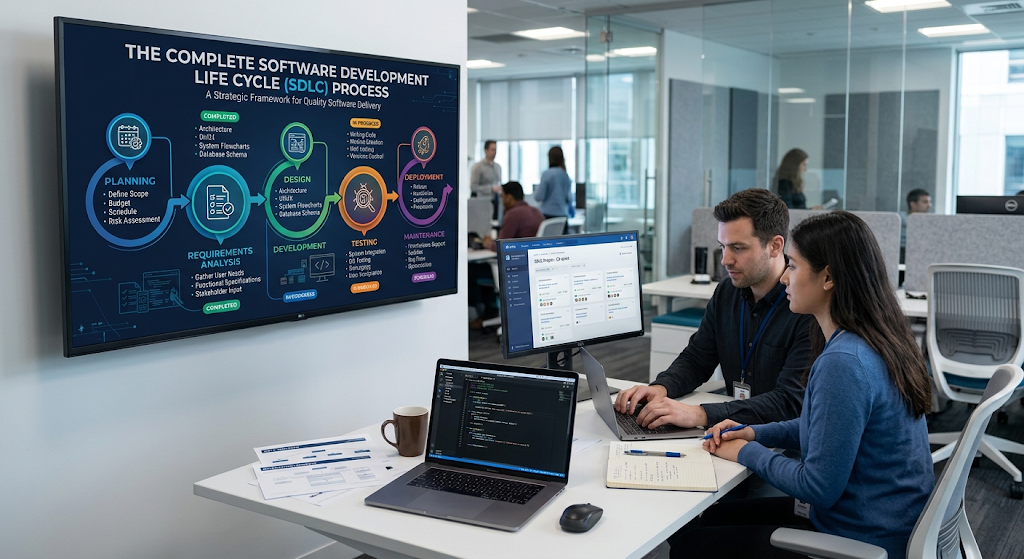
The Software Development Life Cycle is a process with a well-defined structure to design, develop, test, deliver, and maintain software. It takes an idea or a business need and converts that into a working piece of software that can be used. Each organization would tailor the process according to its requirements but most SDLC Models have common phases which are planning, requirements analysis, design, development, testing, deployment and maintenance.
SDLC facilitates effective communication among technical and non-technical stakeholders. Before the coding, teams discuss what they should do with the software, who will use it, what problems the software will solve, and what limitations they need to take into account. This pre-planning reduces miscommunication and the need for expensive changes later in development. A clear Life Cycle also enables teams to track progress, and identify risks, measure performance and keep documentation on the project.
The software systems are becoming complex in nature and this is the reason why software development is heavily dependent on SDLC. Modern applications need to connect to cloud services, databases, AI systems, security solutions, and external services. The development process is structured, so that the development of each component is carefully planned and evaluated that will be released.
Phases of the Software Development Life Cycle
The Software Development Life Cycle is divided into the following phases:

1. Planning Phase
It is the planning phase that is the base of every successful software project. At this stage, project teams draft the goals of the software, establish business goals, estimate resources, review technical needs, and outline project timelines. The aim is to find out if the software solution proposed is feasible, useful and attainable in the given constraints.
The scope of a project and possible issues are typically determined in planning through working with project managers, business analysts, developers, and stakeholders. Teams examine budget, personnel needs, technologies, user base, security considerations and potential risks. It is also usual for a feasibility study to be completed to decide if the project should go ahead, due to various technical, financial and operational factors.
Preventing confusion later in the development process – effective planning. With clear project goals from the start, teams can allocate resources efficiently and set clear expectations. Unclear requirements, changing priorities, delays, and higher costs are common consequences of poor planning. Therefore, the planning phase is an important one in establishing a solid base for the rest of the SDLC process.
2. Requirements Analysis Phase
Requirements analysis is the process of collecting and recording requirements from users, customers and stakeholders. In this phase, the emphasis is on determining what the software is supposed to do, not how. Business analysts and development teams collaborate to determine functional requirements, including features and capabilities, and non-functional requirements, such as performance, security, reliability and scalability.
Teams gather information in the requirements’ analysis phase, using interviews, surveys, meetings, market research, and stakeholder interviews and discussions. The information collected is then compiled into detailed requirement documents which can be used by designers and developers during the project. Everyone involved in the development process or the use of the software understands what they are being requested to do or deliver because there are no misunderstandings.
One of the key issues in this stage is dealing with evolving requirements. As projects develop, businesses are likely to find additional needs, particularly when creating new, innovative products. Today, SDLC models recognize this issue, enabling teams to continually review and adapt their requirements during the process. Good requirements analysis makes sure that the software product is going to address the problem that will be solved and that it will be of value to its users.
3. Design Phase
The design stage transforms software requirements into a precise technical design. At this point, the software architects and developers decide the way the system will work inside. They shape the software architecture, structure of the database, user interface, system components, security systems and communication between various software parts of an application.
Important technical choices are made in the design process that impact the software’s performance, scalability, and maintainability. For instance, teams have to make choices about programming languages, frameworks, databases and infrastructure solutions that are best for the project. A good system design makes life easier when it comes to future enhancements and less troublesome when developing the system.
There is also a need to take users’ experience into consideration when designing. Designers develop interfaces that are accessible, intuitive and meet users’ expectations. Prototypes and wireframes can be created to showcase an application’s design and functionality prior to coding. Good design planning makes the development process more efficient and the outcome is technically and user friendly.
4. Development Phase
The development phase is when the software design is converted to working code. The programming languages, development tools, coding standards and frameworks are used to develop the various components of the application. Development can be of the individual programmer or large teams collaborating on different modules of the project, depending on project size and methodology.
In this stage, developers adhere to best practices like writing clean code, carrying out code reviews, employing version control systems, and observing security protocols. It is crucial that developers, designers, testers and project managers work together to make sure that development is on track to meet project goals.
To enhance efficiency, modern development teams often employ automated tools and adopt continuous integration practices. These tools help developers catch faults early and automatically test changes and maintain quality of code. Technical debt and the development of easier-to-update and maintain software over time are all averted by the use of a disciplined development process.
5. Testing Phase
Testing is a vital part of SDLC as it is used to ensure that the software is of good quality, reliable and secure before it is released. The testers test the application for bugs, performance problems, compatibility issues and security flaws. The goal is to verify that the software operates according to the specified requirements and is user-friendly.
Various testing types can take place at this stage: unit testing, integration testing, system testing, usability testing, and security testing. Repetitive tests are typically performed quickly and precisely using automated testing tools. But human testers also have a vital role to play as they can test software from the user’s point of view and find out issues which would be left out by automated systems.
Testing can not be seen as a last step to be done just prior to deployment. Today, in SDLC the testing is carried on during the development to catch the problem in the early stage. Usually, it’s easier and cheaper to find and fix problems at earlier stages rather than after software release.
6. Deployment Phase
The deployment stage is a phase of software development in which the produced software is disseminated to users or through a production environment. Teams make sure that the application is stable, secure, and ready to use for real-world usage before deployment. Some of the tasks undertaken during deployment can involve software installation, server configuration, data migration, and user training.
Organizations can implement various deployment approaches, depending on project needs. Some applications are distributed directly to all users, others are distributed following a gradual approach like beta release, phased rollout or continuous deployment. These approaches enable teams to track performance and deal with unforeseen challenges promptly.
The deployment of the solution involves coordination of the developer, operations and business stakeholders. After the software is launched, proper documentation, monitoring systems, and support processes ensure that the software is utilized properly.
7. Maintenance Phase
It’s not like software development stops when it comes out. The maintenance phase is concerned with enhancement, updating and support of the software during its operational life. In order to address the bugs, security requirements, performance and new user requests or business needs, developers apply patches, publish security patches, enhance performance and implement new features.
Due to the dynamic nature of technology environments, regular maintenance is required. Operating systems, hardware platforms, security issues, and the expectations of users change. If not maintained, software can become out-of-date, susceptible, or ineffective.
The amount of time software is used is extended with a strong maintenance strategy and safeguards the investment undertaken in software development. Continuous improvement organizations can ensure applications remain competitive and relevant to users’ needs.
Popular SDLC Models Explained
Waterfall Model
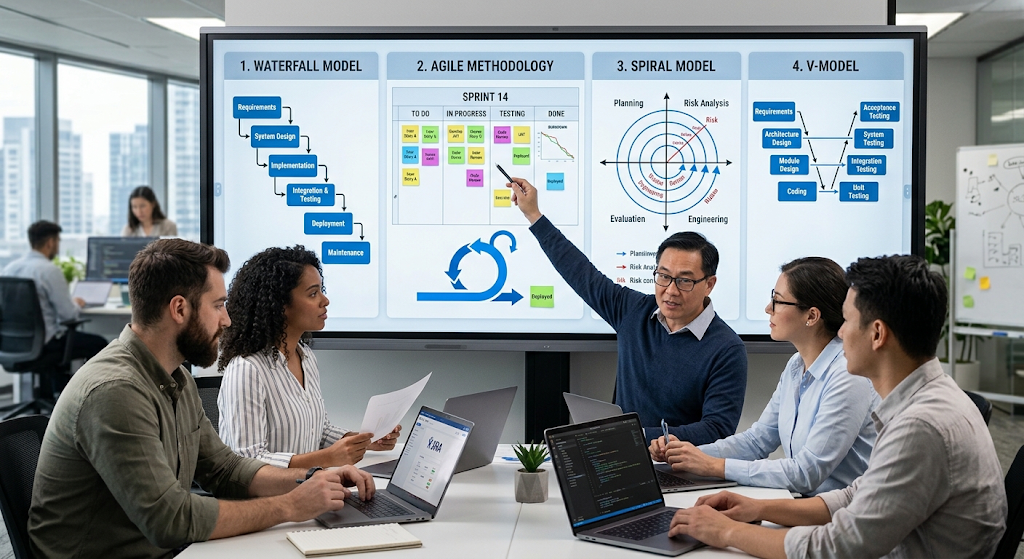
The Waterfall model is a very old and traditional SDLC method. The project is delivered in a sequence meaning that each stage needs to be completed before the next one is undertaken. Requirements come before design, development, testing, deployment, and maintenance.
Waterfall is suitable for projects that have well-defined goals and it is expected that these goals will not change. This could be useful with government projects, controlled industries, or systems that have strict documentation requirements. One major drawback, however, is that alterations of its design become costly and challenging once it is developed.
Agile Model
Agile is an SDLC that is flexible, emphasizing continuous improvement, collaboration, and speedy delivery. Unlike traditional development, Agile takes the development process in shorter cycles, called iterations or sprints. Feedback is gathered on a regular basis and changes are made to the product according to evolving needs.
Agile is appropriate for projects that might change as they are being developed, since it allows customers to participate in the process. Agile is used by software startups, web applications, and digital products, as it enables teams to adapt rapidly to market changes. Popular Agile frameworks include Scrum and Kanban.
The biggest benefit of Agile is that it is flexible. It does need effective communication, engaged stakeholders and committed teamwork to be successful, though.
Spiral Model
Integrating iterative development with risk management, the Spiral model takes these two aspects into consideration. Projects go through cycles of planning, analysis of risks, development of solutions, evaluation of results and then the next cycle repeats.
This method works well with big and complicated projects that require a high level of risk management. Spiral development might be suitable for organizations creating more complex systems, like aerospace software, financial applications, or applications for critical infrastructure.
While Spiral can be effective in managing risks, it can also be time consuming, require a high level of expertise and expertise, and might not be the best option for small projects.
V-Model
The Verification and Validation model (V-Model) emphasizes testing during the development. There is a testing activity for each stage in the development. For instance, the requirement analysis is related to acceptance testing, and system design is related to system testing.
The V-Model is commonly used in industries where reliability and quality are extremely important, such as healthcare, automotive, and aerospace. It has a structured approach which will help quality control but which will not be as flexible if requirements change.
Selecting the Appropriate SDLC Model
The choice of the SDLC model relies on the project size, complexity, budget, time, risk, and requirement changes. No single model is 100% applicable to all software projects.
If there is a product that has stable requirements, then Waterfall might be better suited, but if the product has changing requirements, then Agile may be better suited. Spiral can be used for high-risk systems, and the V-Model’s rigorous testing structure can be advantageous for safety-related applications. Many organisations now use features from various methods to develop their own individual development process.
Best Practices for Successful SDLC Implementation
Choosing a development model is just the beginning of successful SDLC implementation. Good communication between teams, engaging stakeholders throughout the project, recording key decisions and considerations, focus on security, and monitoring performance throughout.
Utilizing contemporary tools like project administration platforms, automated testing systems, version control software, and monitoring systems can enhance efficiency and cooperation. Security should also be spread across the entire life cycle – not just added after development.
Continuous learning is another important practice. The development of software technologies and development methods are continually developing and evolving, and the teams will need to continually upgrade their skills and processes.
Conclusion
SDLC offers a structured methodology to build reliable and secure software solutions that are effective. SDLC facilitates better project organization and enhances the likelihood of success by providing guidance for planning, requirements analysis, design, development, testing, deployment, and maintenance.
By grasping each SDLC model, organizations can select a model that suits their objective and issues best. The Waterfall model is good for predictable projects, the Agile model for flexibility, the Spiral model for risk management and the V-Model for strict quality requirements; whichever methodology you choose helps your team to deliver better software.
With the advancement of technology, SDLC is still a crucial activity for software professionals and organizations. A successful software development life cycle project keeps software successful and continues to deliver value after it’s off the shelf.