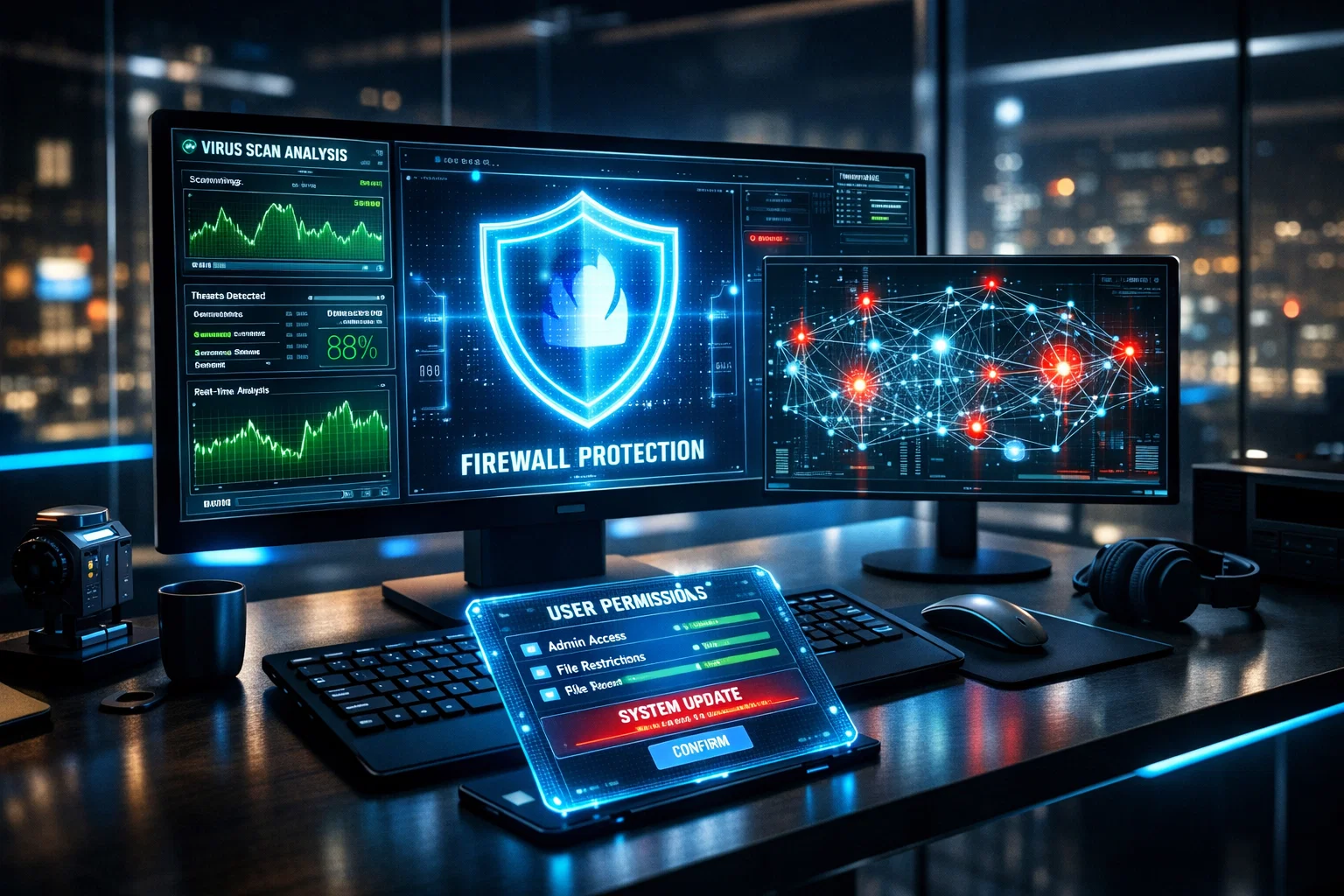
In the contemporary digitized world, computers are at all times vulnerable to diverse cyber-attacks such as malware attacks, unauthorized access, ransomware, and data breaches. In a personal or the professional world, the improper securing of a system can bring about disastrous results including loss of money, loss of identity as well as sensitive information. This renders the process of configuration of security features to be not only an optional undertaking, but also a necessity to ensure integrity as well as confidentiality of a system.
Secure computing environment is a layered environment that is constructed by a combination of various protective mechanisms. These are firewalls, antivirus software, user access controls and regular updates of the systems. All these elements have a specific purpose in the protection against threats and when they are correctly set up, then they form a strong protection stance.
Realizing the Significance of Security Arrangement
Security configuration entails the establishment and maintenance of protective measures in a computer system to reduce the vulnerabilities. It maintains the access to resources by authorized users and prevents the malicious activities by taking advantage of the weaknesses in the systems.
To learn more about configuring security features, it should be noted that one cannot offer a total protection with the help of a single solution. Rather, a set of tools and best practices will have to be used.
A properly set system safeguards:
- Malware infections: Malware is software that is used to damage or interfere with systems.
- Unauthorized access: Hacker or malicious insider intrusions.
- Data breaches: Confidential or sensitive data being revealed.
- Network-based attacks: Attacks on communication channels exploits.
Firewall set up: The Outpost of Defense
Firewall: An Interference between a Trusted and Untrusted Network
A firewall system is a security mechanism that gathers and regulates the incoming and outgoing network traffic, depending on the established regulations. It provides protection against an internal network that is trusted with external untrusted sources like the internet.
Types of Firewalls
- Hardware Firewall: It is installed as a physical device, which is mostly applied in an enterprise environment.
- Software Firewall: This is a software installed on individual computers and it is used to provide host-level security.
- Next-Generation Firewall (NGFW): Intense systems that have deep packet inspection and intrusion prevention.
Best Practices of Firewall Configuration
- Enable Firewall by Default: It should be made a habit to ensure firewall is on all devices.
- Set Tough Conditions: Only the required traffic should be permitted, all the others should be blocked.
- Close Unused Ports: Lessen exposure through the disabling of unused open ports.
- Check Traffic Logs: Check logs with regard to suspicious traffic regularly.
- Application-Level Filtering: This restricts the applications that have access to the network.
An appropriate firewall setup helps a lot to minimize the chances of unjustified entries and attacks via the network.
Antivirus and Anti-Malware set up
Antivirus Software: Viruses, Detection and Removal
The antivirus software is intended to identify, block and eliminate rogue programs. It implements signature based detection, heuristic and behavioral monitoring to detect threats.
Critical Antivirus settings procedures
- Install Reliable Software: Select reliable antivirus software that is well updated.
- Enable Real-Time Protection: One should be able to watch over the system activities.
- Scan Periodically: Scan the system on a regular basis.
- Update Virus Definitions: This is to make sure that the database remains up-to-date.
- Allow Automatic Quarantine: Place the suspect files in quarantine.
Advanced Protection Features
- Heuristic Analysis: New, unknown threats are detected.
- Behavioral Surveillance: Determines suspicious activity in real time.
- Ransomware Protection: Allows the prevention of unauthorized file encryption.
Antivirus software will not be able to track the emerging threats without the necessary settings, and the system will be exposed.
User Permissions and Access Control

Access Control: Resources
The permission of users on a system defines the operations that they are allowed to do on a system. The management of such permissions is crucial in ensuring that there is no unauthorized access and insider threats are reduced.
This is the principle of least privilege (PoLP)
Minimal access to a system is also guaranteed by the principle of least privilege, which implies that users can have access to the least access to the system as possible to execute their duties.
Best Practices of User Permissions
- Make Special User Accounts: Do not use one user account by all users.
- Inhibit Administrative Privileges: Only authorized officials should access the administrative privileges.
- Apply Strong Authentication Techniques: Multi-factor authentication (MFA) is to be implemented.
- Periodically Revise Authorizations: delete the unwarranted access rights.
- Turn inactive Accounts off: Do not allow exploitation of inactive accounts.
Role-Based Access Control (RBAC)
RBAC gives permissions on the basis of roles as opposed to individuals and this makes it easier to manage and increases the consistency of security.
An efficient access control minimises the chances of accidental and deliberate security breaches.
System Updates and Patch Management
System Updates: Sealing Security Divisions
Application and operating systems often update in order to correct the vulnerabilities. The failure to update the systems exposes them to known exploits.
Types of Updates
- Security Updates: Remediate vulnerabilities that can be used.
- Updates on features: Add new features.
- Bug Fixes: Software bugs.
Best Practices of Update configuration
- Turn on automatic updates: This is to make sure that patches are installed on a timely basis.
- Check Update Sources: Only get updates provided by the official sources.
- Test Updates in Controlled Environments: This is of particular importance to enterprise environments.
- Maintain Backup Systems: Eliminate loss of information in updates.
- Schedule frequent Update Cycles: Eliminate patch delays.
Patch Management Strategy
Defined patch management process entails:
- Identification: Location missing updates.
- Analysis: Measure significance and influence.
- Deployment: Update updates in a systematical manner.
- Checking: Check the success of implementation.
One of the easiest but the best means of ensuring the security is by keeping systems up to date.
Securing Network Connections

Network Security: Data Protection on the Move
Network security is employed in ensuring that information that is transmitted between devices is not intercepted and compromised.
The significant Network Security Controls
- Employ Secure Protocols: Employ HTTPS, SSS, and VPNs as opposed to non-secure protocols.
- Block unauthorized access to the data.
- Use Strong passwords and current encryption (WPA3): Use secure Wi-Fi Networks.
- Enable SSID Broadcasting (Optional): Reduce the visibility of the network.
- Lay Network Segmentation: Isolate sensitive systems.
The correct network setup can be used to avoid man-in-the-middle (MITM) and packet sniffing attacks.
Backup Plans and Information Data Protection
Data Backup: Business Continuity
Data loss may still happen because of hacking or malfunction of machinery despite the high security measures. The backup strategies are applied to ensure that the data are restorable.
Backup Best Practices
- Use the 3-2-1 Rule:
- 3 copies of data
- 2 dissimilar storing media.
- 1 offsite backup
- Automate Backups: Minimise human error.
- Backup Data encryption: Sensitive information is kept safe.
- Test Recovery Processes: Backups are required to be running.
- Back-Up to Cloud and Offline: Multiple location back-up.
An excellent backup system is required that can be used to recover it in the event of ransomware attacks and system crashes.
Incident Response and Monitoring
System Monitoring: Threats at the Early Stages
This will be done through constant surveillance to identify any suspicious activity before it escalates to become major incidents.
Monitoring Techniques
- System and network logs.
- Intrusion Detection System (IDS): Identify the threats.
- Security Information and event management (SIEM): Centralization of monitoring.
Incident Response Plan
A successful response plan will consist of:
- Identification: Learn about the incident.
- Containment: Limit damage
- Eradication: remove the threat.
- Return to normal operations: Recovery.
- Following Incident Analysis: Improve future defense.
One of the reasons that assist in minimizing the damage in the event of a security incident is the preparedness.
Common Security Scandals to avoid
The right equipment may produce loopholes in the wrong arrangements.
Frequent Mistakes
- Remaining with the Default Settings: Default settings are not normally secure.
- Switching off Security Features: Reduces the protection.
- Disregard of Updates: Opens up already known vulnerabilities.
- Weak Password Policies: The attackers find it easy compromising.
- Excessive Permissioning of the Users: Raise chances of abuse.
These are the mistakes that should be avoided in order to have a high security posture.
Conclusion: Secure Environment of Computing
The multi-layered approach is only applicable in proactively safeguarding a computer system against the current threats. One can do a lot to reduce exposure to cyber risks by making sure that they have appropriately set security options that contain firewalls, antivirus software, user privileges and system updates.
Security is not a one-time installation but a constant process consisting of constant monitoring and updating of configurations as well as reviewing of configurations periodically. The nature of the threats is constantly evolving and both organizations and individuals should be careful to adapt to them so that they can have a safe environment.
Lastly, a system that would be well secured is one that is integrated in order to consist of preventive, detective, and corrective measures. Having the right strategies, it is possible to protect sensitive information, keep the systems intact, and the operations going on without interruption in an ever digitalized world.