Introduction
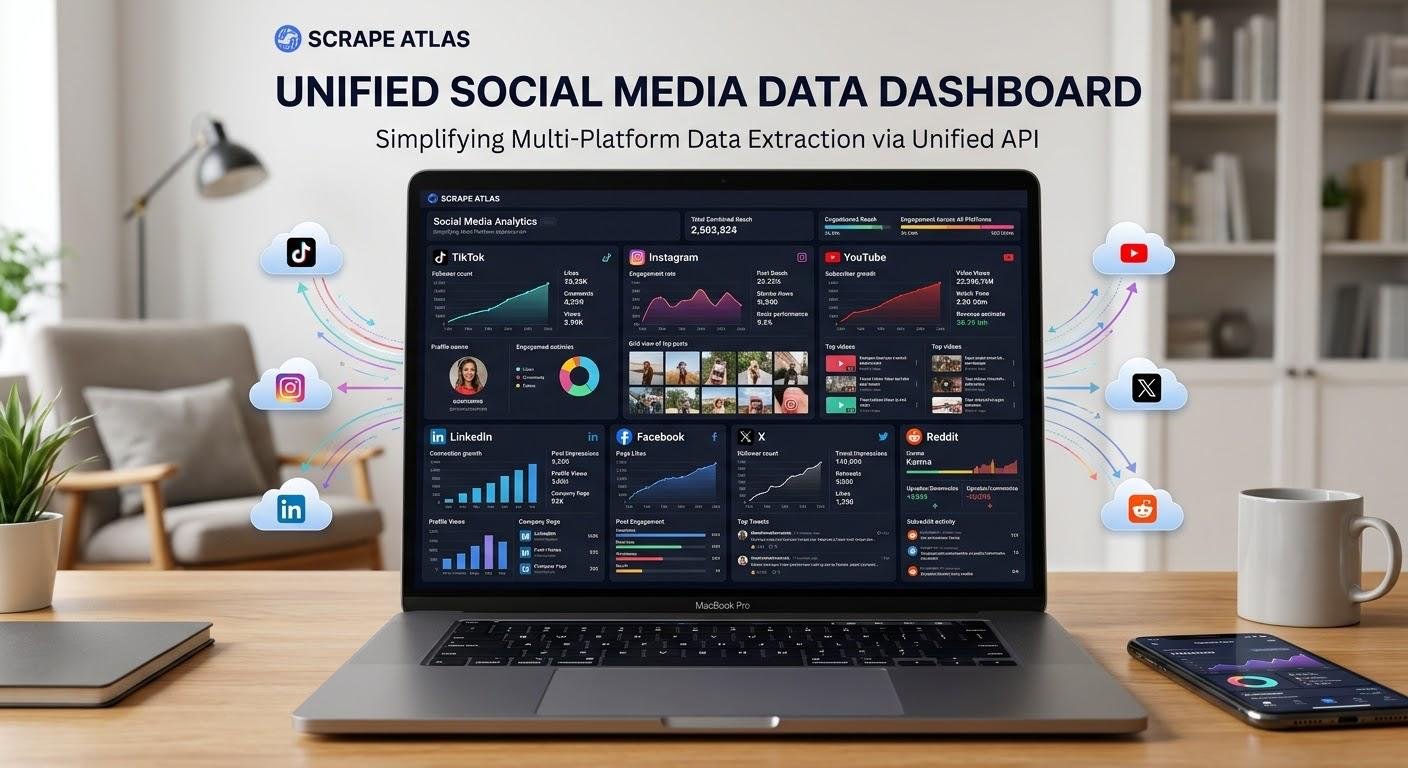
Social media platforms have become a valuable source of information for many businesses, marketers, researchers and developers. Millions of users create posts, videos, talk about products, share opinions and interact with brands daily; providing plenty of public data. This data provides businesses with insight into consumer behavior, trends, competitor analysis and improve marketing campaigns. However, it can be challenging to gather information from multiple social media platforms. Each website has different structures, requirements and ways of retrieving information. Businesses who rely on social media research may require several tools and resources. Scrape Atlas provides a single API to gather public social media information and minimizes separate data extraction processes.
Understanding Social Media Data Extraction
Social media data extraction is a process to gather public information from online platforms and convert this into a form that can be analyzed, stored or used in other applications. This can include public user information, posts, comments, videos, captions, hashtags and engagement statistics. Marketers can look at these records to see what topics attract attention. Researchers can analyze public conversations to see what opinions consumers have. Developers can use the information gathered to create applications which can provide social listening, content discovery or market intelligence. While this provides great opportunities, gathering information from each platform can be challenging. To overcome this, having a single extraction tool helps.
What Is Scrape Atlas?
Scrape Atlas is an application to extract social media data. This allows you to gather public information from online platforms using a single API. Instead of developing separate extractions for each website supported, Scrape Atlas provides specific endpoints for each social media platform. You can provide information such as a username, url, id or search term and Scrape Atlas will gather the information for you. This is converted into structured JSON data so it can be used in applications. This provides a good separation between gathering the information and analyzing it. Scrape Atlas can also be accessed using REST APIs, command line and Model Context Protocol (MCP) according to the documentation. The documentation also provides information on each endpoint, examples of requests and the response that will be received.
Supported Social Media Platforms
One of the main benefits of a single extraction tool is being able to extract information from multiple social media platforms. Scrape Atlas provides integration with some of the main social media platforms, video sharing platforms and online communities. This includes TikTok, Instagram, YouTube, LinkedIn, X, Reddit and Facebook. Each platform will provide different types of information and data. The correct endpoint will depend on what type of information you are looking for. For example, if you are researching short videos, you may want information from TikTok and Instagram. If you are looking at professional conversations, LinkedIn may be the best option. If you are researching public conversations, Reddit could be useful. If you are looking at customer engagement, Facebook and X could be useful. All of this information can be accessed using a single API, making it easier to start with.
TikTok and Instagram
TikTok and Instagram are useful platforms to understand short video trends, creators, visuals and customer engagement. Businesses can look at public information such as user profiles, posts, reels, captions, comments and other supported content. This can help to understand what topics customers are engaging with. For example, a fashion company could research popular hashtags, public creator content and customer conversations to understand what trends are emerging. A marketing agency could also use this information to understand what type of content is engaging within a certain industry. Scrape Atlas provides TikTok endpoints to gather public user information, videos, comments, hashtags, sounds and search results. It also provides Instagram integration to gather public user information, posts, reels, single content and comments. This can help you to extract visual content information in a more organized way. However, this will depend on the endpoints available.
YouTube
YouTube provides another useful option for research. This allows you to look at long videos, Shorts, educational content, reviews, interviews and creator conversations. Businesses can look at public information such as channel information, video details, comments, playlists and search results. This can help you understand what topics are engaging within your industries. For example, if you are creating an educative marketing campaign, you could research videos relating to your products/services to understand what questions are commonly asked. Researchers can also look at the transcripts to understand what topics are being discussed. Scrape Atlas provides YouTube endpoints to gather channel information, videos, Shorts, comments, transcripts, playlists and search results. This can help with content discovery and competitor research. However, this will depend on the transcripts available.
LinkedIn is a useful platform for professional networking, business development, recruitment research and industry research. Unlike other platforms, LinkedIn provides professional user profiles, company pages, industry conversations and business publications. Businesses can look at public company information and posts to see how competitors are communicating, what conversations are happening and what topics are important to professionals. Recruitment and research teams may also use this public information to understand what professionals are doing. Scrape Atlas provides LinkedIn endpoints to gather public user information, company pages, company posts, single posts, articles and search results. This can help you to include professional social media information in your research. However, you should ensure you are following any privacy rules.
X, Reddit and Facebook
X, Reddit and Facebook provide useful information to see what public conversations are happening. X can be useful to look at public posts, trending conversations and reactions to recent developments. Reddit can be useful to look at community conversations, questions, comments and topics. This can help researchers to understand how people are talking about certain products. Facebook can also be useful by providing public user information, posts, reels, comments and groups. Scrape Atlas provides documented endpoints. For example, if you were looking at public reactions to a product launch you could look at relevant posts. This could show you what topics your audiences are interested in and how they are communicating. However, Scrape Atlas cannot guarantee you will be able to access every account, private group, restricted conversation or historical information. This will depend on the endpoints available.

Why Having a Single API Makes It Easier
Having multiple data extraction tools for different social media websites can cause unnecessary complexity. Each website may have different structures for making requests, returning data, pagination and restrictions. This means you will need to understand each difference, update your scripts when websites change and troubleshoot each system. Having a single API provides some relief. You can make requests to the supported endpoints using one API. This means you don’t have to manage multiple scraping systems. You can simply use the API and choose the correct endpoint. Scrape Atlas returns structured JSON responses meaning you can easily process the data. While you will still have differences between each platform, it provides a more consistent base.
Understanding JSON Responses
JSON (JavaScript Object Notation) is a popular data format used to pass information between applications. It is structured in a way that makes it easy to read with key-value pairs. When a supported endpoint is successfully accessed, Scrape Atlas will return structured JSON information. This can be accessed using programming languages such as Python and JavaScript. For example, an application could make a request to gather public user information. The information would be stored in a database with the relevant fields. Developers can also link the responses to dashboards, reporting or internal research applications. Scrape Atlas uses an API key found in the authentication headers. The documentation also explains how to check the status, coverage and failures. This makes it easier for developers to know if they received full information.
Marketing and Audience Research
Structured social media information can help marketers plan their content and research audiences. Instead of simply searching for information manually, marketing teams can gather public information such as posts, comments, hashtags and engagement. For example, if you are launching a new product, you could look at how audiences are talking about similar products on TikTok, Instagram, Reddit and Facebook. This can help to understand what questions are being asked, what features are being talked about and what type of content is engaging. Agencies can also look at public brand activity across different platforms to see how competitors are positioning their products. Using a single API can help reduce the complexity. However, you should consider the engagement data in context of the platform.
Brand Monitoring and Trends
Brand monitoring is the process of looking at public conversations and content relating to a company, product, service or industry. This can help businesses to understand how people are talking about their brand, identify any potential issues with their reputation and see where they can improve customer communication. Social media data extraction can help by gathering relevant public posts, comments and conversations. For example, a company could look at public conversations relating to their product announcement to see what questions are commonly asked. Researchers can also look at hashtags and trends to see how much interest there is for certain topics. Scrape Atlas can provide the underlying public information using the available endpoints. Businesses can build their own brand monitoring systems. By regularly gathering information and comparing it, you may identify some trends. However, you should consider that there may not be full coverage, content may have been removed, information may not be gathered as often and there may be differences in search functionality.
Analytics
While gathering information can be useful, businesses should have a reliable way to organize, analyze and use the information. Scrape Atlas can be included in analytics systems as it provides structured responses. A development team could create scheduled requests to gather the relevant public information. This can then be stored in a database. This database can be linked to an analytics dashboard. Marketing teams can then look at the content activity, compare chosen competitors or monitor specific industry conversations. Researchers could also include this information with survey results or other data sets to look at wider questions. As the API uses HTTP requests, it can be used in applications created in different programming languages. This will depend on the requirements of the business, availability of endpoints, API usage and existing data systems.
Key Considerations
While it is convenient to use automation to gather social media information, businesses should consider what they are responsible for. Just because the information is public, doesn’t mean you can gather, store, share or use it for commercial purposes. Businesses should look at the terms of the relevant platforms, data protection laws, copyright and privacy requirements. You should also avoid trying to gain access to private accounts, restricted conversations or information you shouldn’t have access to. Another thing to consider is the accuracy of the data. Information on social media can change frequently as users update, remove or change their profiles. Some endpoints may only provide partial information and some may not be available due to platform restrictions. The documentation clearly states if the information was successfully retrieved, partially retrieved or failed. This encourages developers to look at the information provided. Responsibility should always be taken when managing data.
Conclusion
Gathering information from multiple social media platforms can be a complicated process. Businesses may rely on consistent research, brand monitoring and audience analysis. Each website will have a different structure and requirements making it difficult to manage separate data extraction systems. Scrape Atlas makes this easier by providing a single API to make requests for public information. This can be done from TikTok, Instagram, YouTube, LinkedIn, X, Reddit and Facebook. It provides structured JSON responses meaning it can easily be linked to existing applications, databases and analytics. This can help marketers, researchers, agencies and developers to reduce the complexity of integrating. However, it is important to consider how responsibly you are using the data.
Get more well researched information about Social media data extraction here.