Picture this: it’s a Saturday morning, and you’re staring up at the steep hillside behind your house, dreading the moment you have to wrestle your push mower across that 30-degree grade. One wrong step, one patch of wet grass, and you could be tumbling downhill alongside a machine with spinning blades. This scenario isn’t just uncomfortable—it’s genuinely dangerous. Every year, approximately 80,000 Americans end up in emergency rooms due to lawn mower injuries, and a disproportionate number of serious incidents occur on sloped terrain where gravity becomes an unpredictable enemy.
The question facing homeowners with hilly properties is no longer whether slope mowing is risky—that’s well established—but rather what alternatives exist. The emergence of remote control lawn mower technology has introduced a fundamentally different approach to maintaining challenging terrain, one that removes the operator from harm’s way entirely. This article compares traditional mowing methods against modern remote-controlled solutions, examining safety outcomes, operational efficiency, and practical considerations for steep landscapes. Along the way, we’ll explore how advances like LiFePO4 battery systems and robotic features are reshaping what safe slope care actually looks like for everyday homeowners.
The Inherent Dangers of Traditional Mowing on Slopes
Mowing on slopes transforms a routine chore into a high-stakes balancing act. When a ride-on mower traverses a grade exceeding 15 degrees, the risk of rollover increases dramatically—and most residential riding mowers are only rated for slopes up to about 15 degrees. Push mowers present a different but equally serious threat: operators must physically brace themselves against gravity while controlling a heavy machine, leading to rapid fatigue that compromises reaction time and footing. Wet conditions, hidden ruts, and loose soil compound these hazards exponentially.
The Consumer Product Safety Commission consistently reports that rollovers and loss-of-control incidents account for a significant share of the most severe mower-related injuries, including amputations and crush injuries. Many of these cases involve slopes that homeowners underestimated. Standard mowing equipment simply wasn’t engineered with steep terrain as a primary use case. Most walk-behind mowers lack aggressive tread or low center-of-gravity designs, while typical lawn tractors have high roll centers that make them inherently unstable on hillsides. For homeowners managing properties with steep grades, this mismatch between equipment capability and terrain demand creates an urgent need for purpose-built safety solutions that don’t rely on the operator’s physical endurance or split-second reflexes to prevent disaster.
Traditional Mowing Methods: Limitations and Safety Gaps
Walk-behind mowers remain the most common tool homeowners reach for when tackling slopes, yet their fundamental design reveals critical shortcomings on uneven terrain. These machines distribute weight unevenly, with heavy engines mounted high on the frame, creating instability the moment the ground angle changes. Operators must simultaneously push forward, maintain lateral balance, and steer around obstacles—a cognitive and physical load that intensifies with every degree of incline. Self-propelled models help somewhat on uphill passes but become dangerously fast on descents, where the drive system can outpace the operator’s ability to maintain control.
Lawn tractors and zero-turn mowers introduce their own set of problems. While they reduce physical exertion, their wheelbase geometry and high center of gravity make them prone to tipping on cross-slopes. Most manufacturers explicitly warn against operating these machines on grades beyond 15 degrees, yet many residential properties feature banks and embankments well exceeding that threshold. Zero-turn models are particularly hazardous because their independent wheel control can cause sudden directional shifts on loose or damp hillside turf. Neither category of traditional equipment incorporates automatic tilt detection, emergency braking on grade changes, or any mechanism that accounts for the dynamic forces acting on a machine traversing steep ground. The safety gap isn’t a minor oversight—it’s a fundamental mismatch between how these tools were designed and how millions of homeowners actually need to use them.
Remote Control Lawn Mowers: A Safer Paradigm for Slope Care
Remote control lawn mowers represent a fundamental rethinking of how steep terrain gets maintained. Instead of placing a human operator directly on a precarious hillside, these machines allow homeowners to stand safely at the bottom—or top—of a slope while guiding a purpose-built mower across grades that would be reckless to walk. The operator remains completely separated from the cutting deck, the unstable footing, and the gravitational forces that make traditional mowing so hazardous. That physical distance isn’t just convenient; it eliminates the primary mechanism through which most serious slope mowing injuries occur.
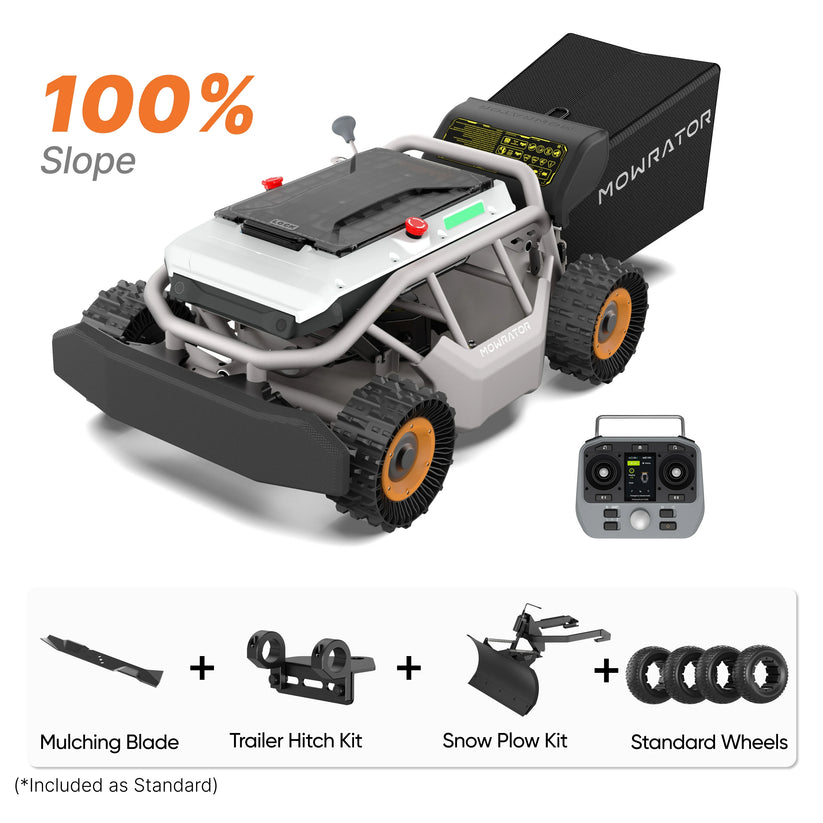
These machines have evolved considerably from early radio-controlled prototypes. Modern remote control mowers from brands like MOWRATOR feature tracked or wide-stance wheeled platforms with extremely low centers of gravity, enabling them to traverse slopes of 30, 40, or even 50 degrees without tipping. Many models now incorporate GPS navigation, obstacle detection sensors, and programmable mowing patterns that edge them closer to fully autonomous robotic lawn care systems. Some can be operated via smartphone apps, blending remote control precision with automated route planning. For homeowners who’ve spent years white-knuckling a push mower across dangerous hillsides, this technology doesn’t just improve the experience—it transforms slope maintenance from a dreaded risk into a manageable task.
Core Technology: How LiFePO4 Batteries Power Safe Operation
At the heart of many modern remote control slope mowers sits a LiFePO4 (lithium iron phosphate) battery, and the choice of this chemistry is deliberate. Unlike conventional lithium-ion cells, LiFePO4 batteries are inherently resistant to thermal runaway—the chain reaction that can cause fires or explosions in damaged battery packs. On rough, jolting terrain where impacts and vibration are constant, this thermal stability provides a critical safety margin that other battery types simply cannot match. A mower bouncing across rocky hillside terrain needs a power source that won’t become a liability when stressed.
Beyond safety, LiFePO4 batteries deliver remarkably consistent voltage output throughout their discharge cycle. This means the mower’s blade speed and traction motors maintain steady performance whether the battery is fully charged or approaching depletion—there’s no gradual power fade that could leave a machine stranded mid-slope or unable to climb a steep section it handled minutes earlier. These batteries also tolerate thousands of charge cycles before significant capacity loss, which translates to years of reliable service without the recurring replacement costs associated with standard lithium-ion packs. For slope care specifically, where the mower works harder against gravity and demands sustained torque, this combination of safety, consistency, and longevity makes LiFePO4 technology a natural fit for equipment that needs to perform reliably in the most demanding conditions a residential lawn can present.
Step-by-Step Guide to Adopting Remote Control Mowing for Slopes
Transitioning from traditional mowing to a remote control system doesn’t require a complete overhaul of your lawn care routine, but it does benefit from thoughtful planning. The following steps walk you through the process from initial assessment to ongoing operation, ensuring you get the safest and most effective results from your investment.
Start by accurately measuring your slope’s grade using a digital inclinometer or a smartphone app designed for angle measurement. Walk the entire area and note the steepest sections, not just the average grade. Identify obstacles like exposed roots, drainage channels, rocks, and fence lines. This terrain map becomes your foundation for choosing the right machine—a property with consistent 25-degree grades has very different requirements than one with isolated 45-degree embankments. Document soil conditions too, since clay-heavy ground behaves differently than sandy soil when wet, and this affects traction demands.
With your terrain profile in hand, research remote control mower models specifically rated for your maximum slope angle, adding at least a 10-degree safety margin above your steepest measured grade. Look for machines with tracked drive systems if your terrain is loose or frequently wet, and wheeled models if your hillside turf is well-established and firm. Confirm that the unit’s cutting width and battery runtime align with the total area you need to maintain in a single session—running out of charge mid-slope creates its own set of complications.
Once you’ve selected a mower, plan your infrastructure. Position the charging station on flat, accessible ground near the base of your slope, protected from direct weather exposure. If your model supports boundary wire or GPS-based virtual fencing, map your mowing zones carefully, keeping a buffer of at least two feet from drop-offs, retaining walls, and water features. Program mowing patterns that run horizontally across the slope face rather than straight up and down, which improves cut quality and reduces soil erosion over time.
Before the first real mowing session, conduct a dry run at reduced speed. Operate the mower across the slope without engaging the blades, testing responsiveness to your controls at various distances and angles. Check for signal dead zones if you’re using radio frequency control, or verify app connectivity if the machine is smartphone-operated. Establish a pre-mow safety checklist that includes inspecting blade condition, confirming battery charge level, clearing debris from the mowing area, and verifying that emergency stop functions respond instantly. Run through this checklist every time—consistency prevents complacency.
Finally, integrate your remote control mower into a broader maintenance schedule. Clean the undercarriage after each use to prevent grass buildup that affects cutting performance. Inspect tracks or wheels for wear monthly during peak mowing season. If you already use a robotic lawn care system for flat portions of your yard, coordinate schedules so boundary zones don’t overlap, and consider models from compatible ecosystems that allow centralized monitoring through a single app. Keeping detailed logs of battery performance over time helps you anticipate replacement needs well before capacity loss affects mid-slope reliability.
Head-to-Head Comparison: Safety, Efficiency, and Cost Analysis
When you place traditional mowing equipment and remote control mowers side by side, the differences become stark across every metric that matters to homeowners managing steep terrain. On safety, the comparison is almost lopsided. Traditional mowers require the operator to share the slope with the machine—exposed to rollover risk, blade contact, and fall injuries. Remote control mowers eliminate all three by keeping the operator on stable ground, often 50 to 100 feet away from the cutting area. Models designed for slopes also incorporate automatic shutoff if the machine exceeds its rated angle or loses signal, a failsafe that simply doesn’t exist on conventional equipment.
Efficiency tells a more nuanced story. A skilled operator on a riding mower can cover flat-to-moderate terrain faster than most remote control units, which tend to move more deliberately on steep grades to maintain traction and cut quality. However, on slopes beyond 20 degrees, traditional mowing slows dramatically as operators make cautious passes, reposition frequently, and take breaks to manage fatigue. Remote control mowers maintain a consistent pace regardless of grade, and tracked models handle wet or uneven ground without the stop-and-restart pattern that plagues walk-behind users on hillsides. Over an entire season, the time savings on genuinely steep properties often favors the remote system because it eliminates downtime caused by operator exhaustion and weather-related safety delays.
Cost is where many homeowners hesitate. Remote control slope mowers carry a higher upfront investment than a standard push mower or mid-range riding tractor. That initial gap narrows considerably when you factor in long-term expenses. LiFePO4 batteries last thousands of cycles, meaning you won’t face battery replacement costs for years. Maintenance demands are lower because electric drivetrains have fewer moving parts than gas engines—no oil changes, spark plugs, or carburetor rebuilds. Insurance and medical costs from slope mowing injuries, while harder to predict, represent a financial risk that remote operation effectively zeroes out. For homeowners who currently hire professional crews to handle dangerous slopes, the payback period on a remote control mower can be surprisingly short, often recouping the investment within two to three mowing seasons while delivering results you control on your own schedule.
Why Remote Control Mowing Is the Future of Safe Slope Maintenance
The evidence is clear: traditional mowing on steep slopes forces homeowners into an uncomfortable gamble where physical endurance, equipment limitations, and gravity converge to create genuinely dangerous conditions. Push mowers and riding tractors were never designed to handle the grades that millions of American properties demand, and the injury statistics reflect that fundamental mismatch year after year. Remote control lawn mowers, powered by thermally stable LiFePO4 batteries, offer a paradigm shift—removing the operator from the slope entirely while delivering consistent cutting performance across terrain that would be reckless to walk behind a conventional machine.
Safety should never be an afterthought in lawn care equipment selection, especially when the terrain itself amplifies every risk. For homeowners managing steep embankments, hillside lots, or properties with mixed grades, remote control mowing technology provides a practical path to maintaining those areas without compromising personal safety or cutting quality. The upfront investment pays dividends through reduced injury risk, lower long-term maintenance costs, and the simple peace of mind that comes from watching your hillside get mowed while you stand on solid ground. As robotic lawn care systems continue advancing—integrating smarter navigation, longer battery life, and greater autonomy—the gap between what traditional mowers can safely handle and what remote-controlled machines accomplish will only widen. The future of slope care isn’t about building a better push mower; it’s about stepping away from the slope altogether.