Introduction
In present day business is so competitive making the right decision what separates success from struggle. Managers are presented with choices to produce in house or out source, to accept a special order, or to discontinue a product line. What is to be noted is that it is not just in making decisions but in making informed decisions. This is where relevant costing principles play a key role.
Relevant cost is what we look at when we are to make a particular decision. Not all costs are relevant in all situations, and we often see poor choices and loss of profitability from this issue. In this article we will look at the topic of relevant cost in detail, we will identify the difference between relevant and irrelevant costs and also we will see how these play out in real world business decisions.
Understanding Relevant Costing Principles
At the base of what relevant costing does is looking at only those costs and revenues which will vary because of a decision. We call these relevant costs. Any cost which stays the same no matter what the decision is going to be irrelevant. This issue is of great importance as we include irrelevant costs which in turn may present misleading results that are not accurate.
Key Characteristics of Relevant Costs
For a cost to be relevant it must meet two main criteria:
1. Future-oriented
Relevant costs are for the future which we expect to pay out. Sunk costs of the past are not relevant as they are beyond our control.
2. Differential (Incremental)
Relevant costs will vary between options. If a cost is the same for all choices, it does not play a role in the decision.
In for instance a business which is determining between manufacturing a product in house or outsourcing it, only the variable costs of each option should be looked at.
Types of Relevant Costs
Understanding various types of relevant costs is key to effective application of relevant costing:
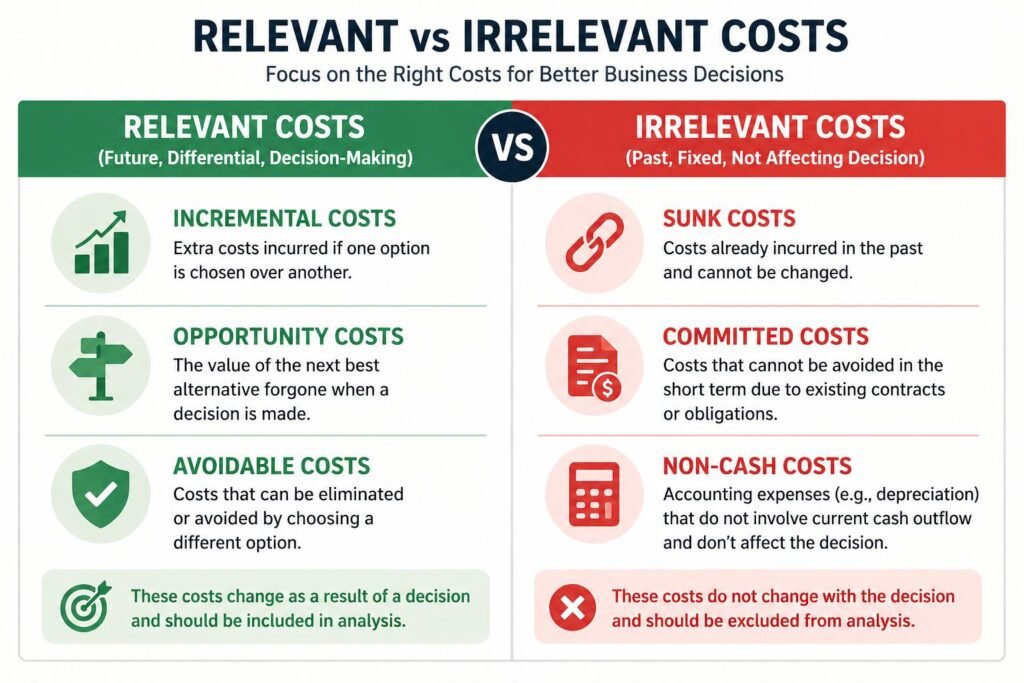
1. Incremental Costs
These also include extra costs which present themselves when we choose one option over another. For example we may see extra labor requirements for increased production.
2. Opportunity Costs
This which is what you give up when you choose one option over the other. Although they may not be reported in financial books, opportunity costs are very much a part of the decision making process.
3. Avoidable Costs
In some cases we can do away with certain costs by making a different decision which may include closing a product line.
Irrelevant Costs Explained
Some costs are not relevant. Including them in your analysis will only produce poor results.
1. Sunk Costs
These are out of pocket expenses in the past which we can’t do anything about. For instance we should not base future decisions on money spent on machinery which we have already bought.
2. Committed Costs
These are the type of costs which in the short term we are stuck with for example lease agreements.
3. Non-Cash Costs
Expenses of depreciation do not always apply unless they impact cash flow.
Why Relevant Costing Matters
Applying proper costing methods allows businesses to:
- Make rational, data-driven decisions
- Avoid letting past or set costs mislead you.
- Focus on profitability and efficiency
- Improve resource allocation
Without proper cost analysis, companies may make decisions based on insufficient or false data.
Application 1: Make or Buy Decisions.
One of the issues which relevant costing deals with is that of make or buy which is when a company has to choose between manufacturing a product in house or buying it from a supplier. Also we see that in many cases companies use relevant costing for which is which to choose between making a product and buying it in from an external supplier. In many business settings we see that companies are presented with the decision of whether to produce a product out of the factory floor or to outsource it to a supplier at which point relevant costing comes into play. We also note that a very wide range of companies use relevant costing to determine if they should manufacture a product in their own plant or else go for an out source option from a third party. In terms of what is perhaps the most frequent application of relevant costing we see that it is in the issue of make or buy that is the decision of which is the more cost effective route for the company to go down. For a very large number of companies out there one of the primary applications of the tool of relevant costing is in support of the make or buy decision that which is better for the bottom line, producing the product themselves or buying it in. Also in the field of business we see that which products to make in house and which to outsource is a very common issue that companies face and at which point relevant costing is very much at the fore front of that decision process.
Example Scenario
A company reports that it is producing a component which cost them:
- Direct materials: $10.00.
- Direct labor: USD 8.
- Variable overhead: Five dollars.
- Fixed overhead: 7 dollars.
Total cost per unit: $ 30
An outside supplier has the same component for $25.
At first it appears that buy is the cheaper option. But upon application of relevant cost principles:
- Fixed costs of $7 may also stay the same if we produce the product or buy it.
- Relevant internal costs= $10+$8+$5=23.
Since $23<$25 it is better to manufacture in house.
Insight
Only variable and avoidable costs are to be looked at. Fixed overhead is out of the question unless it can be done away with.
Application 2: Special Notice Decisions.
Businesses at times get special orders at reduced prices which are below the regular sale price. The issue is do we see these as profitable.
Example Scenario
A firm which puts out a product at $50, for:
- Variable cost: $30.00.
- Fixed cost: $10.00.
A customer is to buy out units for $35.
Analysis
Relevant cost concepts which present to look at only variable costs.
- Selling price: $35.00.
- Variable cost: $30.00.
- Contribution margin: USD 5.
Since the report is positive we see that which orders we take in adds to profit if we have the extra capacity and it doesn’t affect regular sales.
Important Considerations
- Will it affect present customers?
- Are there additional charges for things like packaging and shipping?
- Is there sufficient idle capacity?
Application 3: Phase out of a Product Line.
Managers may choose to remove a product that seems to be unprofitable. But relevant costing may show that this is not a good idea.
Example Scenario
A product line shows:
- Revenue: One hundred thousand.
- Variable costs: 60,000 dollars.
- Fixed costs: Fifty thousand dollars.
- Reported loss: 10 thousand dollars.
At first it appears that way. But:
- If $30,000 of fixed costs are not avoidable.
- Relevant fixed costs = $20,000
Revised analysis:
- Contribution margin = $40,000
- Avoidable fixed costs = $20,000
- Net benefit = $20,000
Insight
The product is also a success and should not be discontinued.
Common Mistakes in Relevant Costing
Even out of the experienced managers some which we see are misapplying cost principles. We see that in:
- Including Sunk Costs: Past spending which does in large part inform present choices also tends to produce poor results.
- Ignoring Opportunity Costs: Failing to look at other uses for resources will understate the true cost of a decision.
- Misclassifying Fixed Costs: Assuming all fixed costs are irrelevant is a mistake some can be avoided.
- Overlooking Qualitative Factors: Relevant costing reports on numbers but also we must pay attention to the like brand image and employee morale.
Integrating Qualitative Factors
While at present relevant costing is of a quantitative nature it also is true that which decisions we make is a result of non-financial factors:
- Customer satisfaction
- Product quality
- Supplier reliability
- Employee impact
For instance we see that while outsource production may lower costs it also may damage product quality or brand reputation.
Practical Steps to Apply Relevant Costing
Managers may do the following to put relevant costing principles into practice:.
Step 1: Determine the Choice
Clearly identify the alternatives being considered.
Step 2: Identify Key Expenses and Income.
Focus in on future and differential items.
Step 3: Remove out of scope costs.
Remove sunk costs and unavoidable expenses.
Step 4: Compare options.
Assess the financial impact of each option.
Step 5: Consider issues of quality.
Incorporate non-financial implications.
Real-World Business Perspective
Relevant cost analysis is a practice which is very much in use in many industries from manufacturing to service. For instance:
- Airlines use that for empty seats.
- Restaurants do that during off peak hours.
- Tech companies turn to it when they are choosing between in-house developments and outsource.
In every instance the focus is on incremental costs and benefits.
Advantages of Relevant Costing
- Reduces choice between options by zeroing in on key data.
- Enhances accuracy in evaluating alternatives
- Prevents emotional or biased decisions
- Supports strategic planning
Limitations of Relevant Costing
Though relevant costing is a useful tool it has limitations:
- Receives precise identification of relevant costs.
- May ignore long-term implications
- Relies heavily on assumptions
- Does not include all qualitative factors.
Managers should use it in conjunction with other tools for best results.
Conclusion
Relevant cost analysis is a very useful tool for business which allows companies to zero in on what is of real import. By identifying which costs are relevant and which are not, managers are able to avoid typical mistakes and do better at decision making. In issues of make or buy, special order acceptance, or product line discontinuation we see that which relevant cost information is applied makes for better decision.
In a world which has scarce resources and high competition the ability to determine the right costs is what it comes down to. Businesses which figure out relevant costing do better in terms of profit, efficiency, and achieving long term success.
Get more well researched information about Relevant Costing here.