
Introduction
Cloud computing is redefining what the banking industry does by which I mean how financial institutions store info, deliver services, process transactions, and go about day to day ops. For years up until now banks have been very much into physical servers and on premise data centers which they used to maintain customer info, run banking software, and process payments. While these systems did the job for a long time they also proved to be a pocket of expense in terms of maintenance and as customer wants grew they became a pain to scale. Cloud computing comes in as a solution which allows banks to put into use computing resources, apps, and storage via secure networks. By weeding into cloud based banking applications financial institutions may see an improvement in service delivery, a push for digital innovation, and a better chance to quickly react to what customers want. But for a successful adoption banks must put in that care in the planning stage which includes protecting sensitive info, to go by financial regulations, to manage cost, and to do all of this in a way that the service is very reliable.
Cloud Computing in Banking
Cloud computing in banking is the application of the remote computing infrastructure, programs, databases, and digital services that can be used to facilitate financial activity. Banks don’t have to buy and administer each technology element; they can get computing resources from cloud providers and use them as and when required. These tools can include everything from customer management systems to transaction processing platforms, data analytics tools, fraud detection systems to digital banking applications. In general, cloud services come in three varieties: Infrastructure as a Service, Platform as a Service and Software as a Service. Depending on the level of security, operational requirement, and regulatory compliance, banks can opt for public, private, or hybrid cloud solutions.
Importance of Cloud Computing in the Field of Banking
1. Scale and Operations Efficiency
One large benefit of cloud computing is scale which allows banks to increase or decrease computing resources as demand changes. Bank activity can see great increases during salary disbursements, holidays, sales promotions and large business transactions. In traditional infrastructure banks may have to buy out extra servers which go under used during slower times. Cloud platforms are able to supply extra processing power when transaction volume goes up and to reduce resources when demand drops. Also this flexibility which is a pro of the cloud helps institutions to better manage their workloads at the same time as it reduces their dependence on expensive hardware. Also in the cloud service providers take care of infrastructure maintenance and software deployment which in turn allows tech teams to put their energy into improving bank products instead of in to manual technical components. At the same time it is also important to note that these savings are based on good resource management, right contracts, and in depth monitoring of cloud spending.
2. Enhanced Customer Experience
Cloud computing is a tool which enables banks to present more convenient and responsive customer experiences through mobile banking apps, internet banking platforms, digital account opening, and personalized financial services. Customers today expect that they should be able to check balances, transfer money, pay bills, and manage accounts from their phones and computers. Cloud infrastructure plays a key role in this by supplying the computing power and data access required to serve large scale user bases. Also banks can put in place cloud based customer relationship management systems which when used with analytics tools allow them to see what customers want, which in turn allows for better customer service. For example a bank may use customer interaction data to put forward relevant product recommendations or to identify issues which come up again and again. But out of all this comes the responsibility of proper data management, stable connectivity, easy to use apps, and secure customer info.
3. Storage and Analysis of Data
Banks produce a great deal of data through deposits, withdrawals, card payments, loan applications, customer communication, and online transactions. In the cloud financial institutions are able to maintain large sets of data without the constant expansion of their physical data centers. Also based on need banks may use structured databases for account info and scalable storage for documents, transaction history, and analysis which also scales. In the cloud based analytics which is a feature of this model helps institutions to determine spending trends, assess credit risk, identify out of the ordinary transactions, and see into customer behavior. Thus this in turn supports faster business decisions and better financial planning. At the same time that is not to say that cloud storage automatically means security and accuracy. Banks have to put in place data ownership rules, put access controls in place, do reliable backups, and put in place proper data retention policies to avoid unauthorized access and unnecessary data storage.
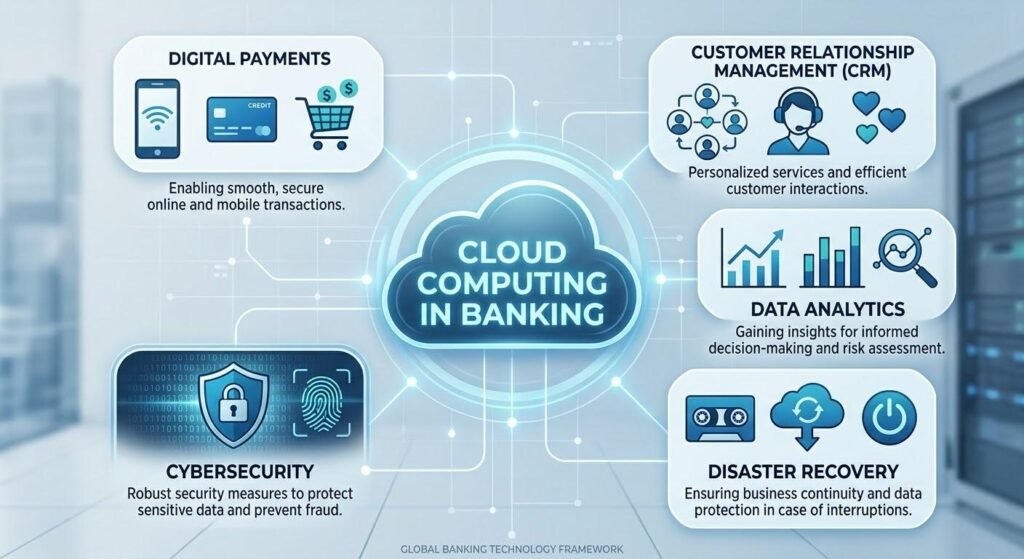
Banking Cloud Applications
1. Digital and Payment Services
Cloud infrastructure which is what digital banking services run on it provides the computing resources for mobile apps, online banking sites and payment systems. Banks use cloud platforms to manage app interfaces, support transaction watch and via controlled API’s to get different services to play nice. For instance a bank may use cloud for mobile pay outs, payment alerts, customer authentication while at the same time working with its present transaction systems. Also cloud tech allows for payment trend analysis and to spot odd patterns in real time. But to put payment processing in the cloud is a complex task. Banks have to secure transaction info, avoid payment duplication, keep records accurate and see to it that key payment functions are up and running during tech outages.
2. Customer Care Management
Customer relationship management tools which banks use to organize customer info, track service interactions, and manage communication across channels. When these tools are delivered via the cloud authorized staffs are able to access the right info which in turn lessens the banks’ dependence on software which is installed per office computer. This in turn improves between branches, call centers, and digital service teams. For example a customer that reports a failed transfer via the mobile app may get more consistent help when support staff can access that customer’s service history. Also in the cloud based CRM tools banks are able to manage customer care, evaluate service quality, and run marketing efforts. To use these systems responsibly institutions should put out access based on what each employee’s role is and also that customer info is used, handled, and shared only for what it is meant for.
2. Disaster Response and Business Continuity
Disaster recovery is also a key aspect of cloud computing which banks use to guarantee that their services will not fail during equipment failures, cyber-attacks, natural disasters, or other outages. In cloud settings we see that they support replicated data, backup storage, recovery systems, and alternate computing resources which help banks to get their services back after an incident. Instead of putting all eggs in one basket in terms of data centers, an institution may put protected copies of key info in separate locations. If its primary environment goes down, recovery procedures can put back in service critical systems within set time frames. Also it is not a standalone solution. Banks must test their recovery plans, secure backup access, clarify what each party is responsible for in the recovery process, and also see to it that when the primary environment goes down the replicated data does not also go with it.
Challenges of Cloud Computing in Banking
1. Operational and Implementation Costs.
Although which is that cloud computing may see a reduction in some infrastructure spend, at the same time there is the issue of large scale investment in implementation. Banks do well to modernize out dated applications, transition large databases, retrain staff, bring in specialist staff and at the same to also work out the issues of integration with present systems. Also some of their applications will need in depth work before they really see the benefit of a cloud environment. As for which is charged out of the subscription model, data transfer charges, software licensing, security tools, and tech support all add to the long term expense. Also by going with one provider you tie yourself in and switching out may be very expensive. Thus it is to the benefit of banks to do cost benefit analysis prior to migration, compare what is put forward by different service models, watch your use and also play at estimating future costs. A phased approach to migration also has its benefits in which tech issues may come up early and also you don’t throw at it a large amount of resource before you see what the benefits will be.
2. Compliance and Data Privacy
Banks have to adhere to a set of rigid rules which include financial record keeping, customer confidentiality, data protection, and operational resilience. Going to the cloud does not let up on these issues. What they have to do is know where info is stored, who has access to it, how it is processed, and that service providers are in fact meeting legal requirements. Also they may have to keep audit logs, report on risk management practices, and put in place contracts which cover data access and incident reporting. In Nigeria for instance banks have to look at what the Central Bank of Nigeria requires and also the Nigeria Data Protection Act in addition to other related regulations. Before going with a cloud service solution institutions should do due diligence on the provider, document responsibilities out, and make sure that what they have chosen will in fact support regulatory compliance at every step of the data life cycle.
3. Cyber security Issues and Third Party Risks
Cloud computing brings with it a number of security issues which banks need to address on a 24×7 basis. Threats include stolen credentials, phishing, ransomware, insecure application interfaces, misconfigured storage and unauthorized access by employees and/or external attackers. Third-party providers also can pose risks if their security controls, subcontractors or incident response measures are not adequate. Banks should adopt multifactor authentication, encryption for data stored and transmitted, robust identity management, constant monitoring and periodic security evaluations. They should also implement the concept of least privilege so that each user only has access to information and systems that are required for their role. With the cloud, security is not just the responsibility of the vendor; banks are accountable for a myriad of application security, access management, data protection and regulatory compliance issues.
4. Service Disruptions and Provider Dependence
Cloud services that go down may be due to tech issues, outages, software glitches, cyber-attacks, or issues in a provider’s base structure. In the case of key banking systems which turn to these services for support what we see is failed transfers, locked out accounts, or delayed payments. Also when banks put all their eggs in one cart with a single provider they may have a hard time moving apps or getting back up and running on their own. To reduce these issues banks should do due diligence on the provider’s track record, put in place clear service level agreements, design for some degree of redundancy, and have tested out recovery plans. Also some may go with a hybrid or multi cloud strategy which in turn spreads the load out to different environs. But at the same time running many platforms also increases comp and cost. What works best is based on the importance of each banking service, the risk that the institution is willing to take, and their ability to manage the extra infrastructure.
Best Practices for Successful Cloud Adoption
Successful cloud adoption is a structured play which balances innovation with security and performance. Banks may start out by defining business goals, looking at present systems, and which apps are best for migration. For sensitive workloads they may require more isolation or special hosting solutions, less critical apps may go into other environs. We see that institutions should put in place clear governance policies, classify data by how sensitive it is, encrypt key info, and do regular security and compliance checks. Also we see the need for staff training to recognize cyber threats and to follow set procedures. Also banks should do continuous spend analysis, test disaster recovery plans, check third party providers, and set out what performance will look like in numbers. A phased approach to implementation allows institutions to learn from what works in initial stages, fix what doesn’t, and grow cloud use without at the same time disrupting core banking services.
Conclusion
Cloud computing presents banks with great chances to transform their operations, better customer experience, manage growing financial data sets, and put out more adaptable digital products. We see in digital banking, payment processing, customer relationship management, data analysis, and disaster recovery its uses. Also these features may improve operational performance and help financial institutions to react to change in the market. At the same time however cloud adoption brings in issues of implementation cost, cyber security, regulatory compliance, third party dependency, and service availability. Thus banks must very carefully assess their requirements, pick out the right partners, put in place strong governance, and put forward effective security and recovery measures. In the end cloud computing is not just a tech upgrade it is a strategic investment which requires constant attention. Those financial institutions which put in a thought out implementation plan with responsible risk management can use cloud tech to develop more resilient, efficient and customer focused banking services.
Get more well researched information about Cloud Computing in Banking here.