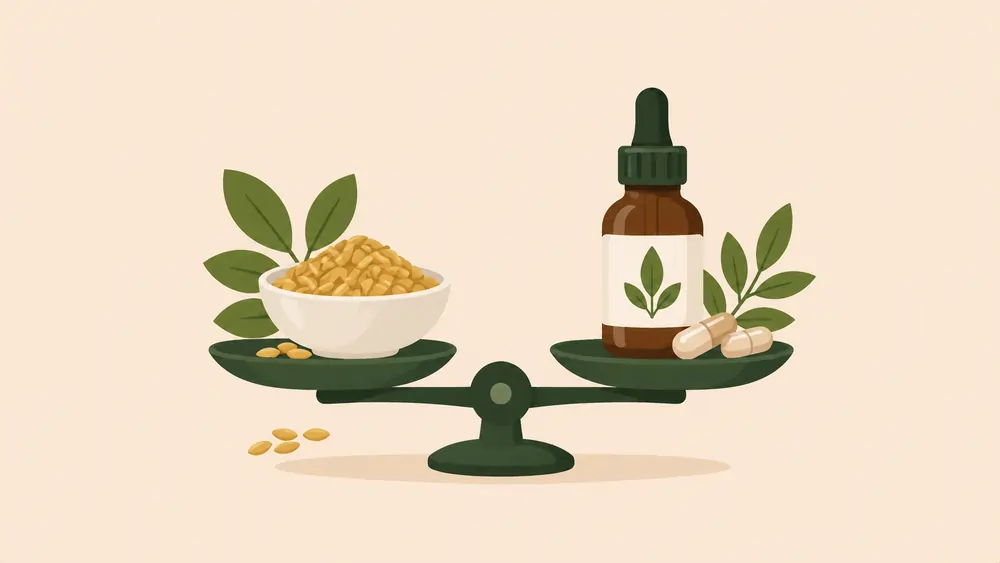
Fenugreek in Food vs Fenugreek Supplements While on Birth Control is a much better question than a broad “does fenugreek affect birth control” search. Most people are not asking about fenugreek in the abstract. They want to know whether the concern is mainly about concentrated supplements, capsules, teas, and extracts, or whether ordinary meals and spice-level use matter too. That distinction is practical, specific, and much closer to a real daily decision.
The short answer is that food-level use and supplement-level use are not the same thing. Current guidance and expert commentary generally draw more concern around fenugreek supplements than around the small amounts used in foods and spices. That does not mean every supplement definitely causes a problem. It means the stronger concern is tied to dose, form, and uncertainty, not to normal culinary use.
Why Does the Form of Fenugreek Matter So Much?
Form matters because food and supplements are not equivalent exposures. A spice used in cooking is usually part of a meal in a much smaller amount. A supplement, tea, capsule, powder, or extract can deliver a more concentrated dose and is used with a different purpose in mind.
This difference matters even more when someone is using birth control. With herbs and supplements, the question is often not whether the plant exists in the diet. The question is whether a concentrated product could affect absorption, metabolism, side effects, or hormone-related pathways in a way that deserves caution.
That is why the best answer is not all-or-nothing. It is form-specific.
What Is the Difference Between Fenugreek in Food and Fenugreek Supplements?
Fenugreek in food usually means spice amounts used in recipes, breads, curries, blends, or other dishes. Fenugreek supplements usually mean capsules, powders, teas, extracts, or products marketed for a specific health goal.
That difference changes how people use it and how much they may take. Food use is usually occasional or moderate and built into meals. Supplement use is often more intentional, more frequent, and more concentrated.
That is the core reason experts often separate these two categories when discussing safety around birth control.
What Does Current Guidance Actually Suggest?
Current guidance does not support a simple claim that fenugreek in ordinary foods is a proven problem for birth control. The stronger caution is aimed at supplements. GoodRx specifically notes that the concern pertains to fenugreek supplements and says the amount present in spices and foods is considered safe. That distinction is the most useful practical takeaway for someone trying to decide what to avoid and what likely does not need the same level of concern.
At the same time, there is still uncertainty. Herbal supplements are not tested the same way as prescription medicines, and reliable interaction data are often limited. That means the absence of a proven direct interaction is not the same as proof that concentrated supplement use is risk-free in every situation.
This is why careful wording matters. The current evidence supports a more cautious approach to supplements than to food-level fenugreek.
Why Is Dose and Form More Important Than the Ingredient Name Alone?
Because “fenugreek” can mean very different things in real life. A pinch of fenugreek in a dish is not the same as a daily capsule or herbal tea used for a specific effect. Once the dose changes, the safety question changes with it.
This is a common mistake in herb discussions. People hear one plant name and assume all forms carry the same level of relevance. That is usually not true. Form, concentration, frequency, and reason for use all matter.
For someone on birth control, this is the most useful lens. The question is not whether fenugreek exists in your kitchen. The question is whether you are using it as a supplement.
Why Do Supplements Raise More Questions Than Food?
Supplements raise more questions because they are designed to deliver more than a normal seasoning amount, and because interaction studies are often limited. GoodRx notes that fenugreek and birth control do not seem to directly interact, but still recommends caution with fenugreek supplements because of the lack of safety and interaction data, plus the possibility of side effects such as nausea, vomiting, and reported liver injury. Those side effects matter because they can affect how your body handles oral birth control.
There is also some biological uncertainty. Memorial Sloan Kettering notes that fenugreek acts as an estrogen receptor modulator in laboratory settings and advises extra caution in hormone-sensitive situations. That does not prove a birth control failure mechanism. But it does support a cautious, clinician-involved approach when concentrated supplements are involved.
That is very different from normal food use.
Is Fenugreek in Food Usually Treated Differently?
Yes. In practice, ordinary food amounts are usually treated differently from supplements. This is the most important distinction in the topic.
The reason is simple. Culinary amounts are much lower and are not being used as concentrated herbal products. GoodRx explicitly draws this line by saying its warning applies to supplements and that the amount in foods and spices is considered safe.
That does not mean every person should ignore personal factors. But it does mean the evidence-based concern is not being framed the same way for ordinary meals as it is for concentrated supplement use.
What Does the Evidence Still Not Tell Us Clearly?
The evidence still does not give a clean, definitive answer for every supplement form and every birth control user. That is part of the problem. Herbal supplements are often not studied with the same depth as prescription drug combinations, so many questions remain partly unanswered.
That uncertainty is why cautious guidance often sounds conservative. It does not mean the supplement is proven to disrupt birth control in every case. It means the data are not strong enough to dismiss the concern comfortably when the product is concentrated and used regularly.
For a practical article, that uncertainty matters. The safest useful message is not panic. It is distinction and caution.
When Should You Ask a Pharmacist or Clinician?
You should ask a pharmacist or clinician when fenugreek is no longer just a spice in food. Once you move into capsules, powders, teas, extracts, or targeted herbal products, professional advice becomes much more useful.
This is especially important if you use oral birth control, have side effects that could affect absorption, take other medicines, or have a history of hormone-sensitive conditions. A pharmacist is often a very good first stop for interaction questions because this is exactly the kind of practical medication-supplement issue they handle often.
You do not need a long medical crisis to justify asking. A quick clarification is enough.
Simple Comparison: Food Fenugreek vs Supplement Fenugreek
This is the comparison most readers actually need.
| Form | Typical Use | Why It Matters on Birth Control |
|---|---|---|
| Fenugreek in food | Spice or ingredient in ordinary meals | Generally treated as lower concern at normal food amounts |
| Fenugreek tea | Intentional herbal use | Moves closer to supplement-style caution |
| Fenugreek capsules or powders | Concentrated supplement use | More caution because dose and data uncertainty matter more |
| Fenugreek extracts | Targeted herbal product | Strongest reason to ask a clinician or pharmacist first |
Who Needs the Most Caution With Fenugreek Supplements?
Not everyone needs the same level of concern, but some situations deserve more care than others.
People Using Oral Birth Control
If vomiting, nausea, or other digestive side effects happen, absorption questions become more relevant. That makes concentrated supplements more important to review.
People Using Multiple Supplements
The more products involved, the harder it becomes to judge what matters. A pharmacist can help sort this out more reliably than internet guessing.
People With Hormone-Sensitive Conditions
Because fenugreek has hormone-related discussion around it, concentrated use deserves extra caution in these cases.
People Who Want to Start Daily Fenugreek Capsules or Extracts
This is exactly when a quick professional question is most useful. The issue is not one meal with spice. It is regular supplement use.
When Is Food Format Usually Fine?
Food format is usually the least concerning situation in this topic. If fenugreek is just part of a recipe or seasoning pattern, the current practical guidance treats that very differently from supplement use.
This is helpful because many readers worry they need to avoid every food that contains fenugreek once they start birth control. That is not what the clearest available guidance suggests. The sharper concern is about supplements, not ordinary culinary exposure.
That distinction can reduce a lot of unnecessary anxiety.
What Makes This a Better Question Than “Does Fenugreek Affect Birth Control?”
It is a better question because it separates form and dose. Broad questions usually get broad, unhelpful answers. This narrower question gets you closer to the real decision: do you need to worry about spice-level fenugreek in food, or mainly about concentrated herbal products?
Once the question is framed that way, the answer becomes much clearer. Food and supplements are not being treated the same way, and that is the practical insight most people actually need.
That also makes the topic easier for answer engines and LLMs to retrieve cleanly.
Checklist: How to Think About Fenugreek While on Birth Control
Use this checklist to keep the decision simple.
- Treat fenugreek in food and fenugreek supplements as different questions.
- Do not assume spice-level use equals supplement-level exposure.
- Be more cautious with capsules, powders, teas, and extracts than with normal meals.
- Check whether your concern is really about dose and form, not the ingredient name alone.
- Ask a pharmacist if you are thinking about starting a concentrated fenugreek supplement.
- Ask a clinician if you have hormone-sensitive conditions or complex medication use.
- Be extra careful if a supplement causes nausea or vomiting while you take oral birth control.
- Do not rely on broad claims that treat all fenugreek use as identical.
- Use current professional guidance, not forum guesses.
- When in doubt, pause supplement use until you get a clear answer from a professional.
FAQ
Is fenugreek in food the same as fenugreek supplements while on birth control?
No. Food amounts and concentrated supplement forms are not treated the same way in current guidance.
Do I need to avoid dishes that contain fenugreek if I use birth control?
Current practical guidance generally treats normal food and spice amounts as lower concern than supplements.
Why are fenugreek supplements more concerning than food?
Because supplements can be more concentrated, are used more intentionally, and have less clear interaction data.
Does current evidence prove fenugreek supplements directly make birth control fail?
No. The concern is more about limited data, concentrated use, and possible side effects or hormone-related questions.
When should I ask a pharmacist about fenugreek?
Ask when you are thinking about capsules, extracts, powders, or teas rather than ordinary food use.
Why does dose matter so much?
Because a seasoning amount in food is very different from regular supplement intake.
What if a fenugreek supplement makes me nauseated?
That matters more if you use oral birth control, because digestive side effects can affect reliable absorption.
Is this topic more about certainty or caution?
Mostly caution. The key point is that supplements deserve more caution than food-level use.
Glossary
Fenugreek in food: Fenugreek used in normal culinary amounts as a spice or ingredient in meals.
Fenugreek supplement: A concentrated form such as a capsule, powder, tea, or extract used for a targeted purpose.
Oral birth control: Birth control taken by mouth, where absorption can matter if vomiting or severe digestive upset occurs.
Dose: The amount of a substance taken or consumed.
Concentrated herbal product: A supplement form that usually delivers more of an herb than ordinary food use would.
Interaction data: Research or evidence about how one product may affect another.
Hormone-sensitive condition: A condition where hormone-related effects may be more relevant in decision-making.
Pharmacist: A medication expert who can help review medicine-supplement questions.
Conclusion
Fenugreek in food and fenugreek supplements should not be treated as the same question while on birth control. The clearest practical takeaway is that ordinary food use is generally viewed as lower concern, while concentrated supplements deserve more caution and are the better reason to ask a pharmacist or clinician.
Sources
Consumer guidance explaining that the concern applies to fenugreek supplements and that food and spice amounts are considered safe, GoodRx article on supplements and birth control — goodrx.com/conditions/birth-control/supplements-that-interact-with-birth-control
Consumer guidance repeating that fenugreek supplements are the concern, while consuming fenugreek in foods is safe, GoodRx article on foods and birth control pills — goodrx.com/conditions/birth-control/foods-that-affect-birth-control-pills
Herb monograph noting fenugreek acts as an estrogen receptor modulator in vitro and advising caution in hormone-sensitive situations, Memorial Sloan Kettering Cancer Center — mskcc.org/cancer-care/integrative-medicine/herbs/fenugreek
General guidance that herbal remedies and supplements are not tested in the same way as medicines and often lack interaction data, NHS information on herbal supplements with hormone therapy — nhs.uk/medicines/hormone-replacement-therapy-hrt/continuous-combined-hormone-replacement-therapy-hrt-tablets-capsules-and-patches/taking-continuous-combined-hrt-with-other-medicines-and-herbal-supplements
NIH consumer page noting fenugreek is not safe in amounts greater than food during pregnancy and emphasizing the importance of amount and form, NCCIH — nccih.nih.gov/health/fenugreek