
Studying Natural Language Processing and Its Development Through the Years
Every day we see a great many digital interactions all over the world which range from those which are casual like text messages and customer support chats to the more personal like voice commands given to smart home devices. At the core of what we are seeing in this digital age is Natural Language Processing which is a specialized field of artificial intelligence that closes the large gap between how humans communicate and how machines understand. Human language is very complex, structured in many different ways, and full of ambiguity which makes it very hard for traditional computer systems to make sense of. What Natural Language Processing does is it uses the principles of computational linguistics, statistical machine learning, and deep neural networks to get computers to read, analyze, interpret and generate human language in a way that is very natural and easy to use.
The history of modern language models is a story of ongoing tech improvement which has seen the transition from what were very basic rule based algorithms to very complex statistical and neural network structures. In the first days of computer use for language we had very strict rules which were mostly of our own design grammar rules which in turn did not do a great job of representing the many real world differences in how people speak and write. What we see today is a total transformation of that which has brought in machine learning techniques that allow our algorithms to learn from large scale data sets. By this models are able to recognize fine tuned patterns, semantic relationships, and context within large amounts of text which in turn greatly improves their performance in interpreting very complex language structures. This in turn is changing how businesses and also individuals interface with software systems world wide.
Natural Language Processing and Natural Language Generation
In NLP machines do the analysis which includes parsing through raw text and verbiage to determine the main idea, user intent, and key entities. As for NLG it is the expressive component of AI which takes in structured data from within the system and puts out coherent, grammatical and on point human language.
Together these basic elements form a full cycle which sees software systems take in a message and reply with great clarity and precision.
Decoding Speech: AI Conversion of Audio to Text
In today’s AI systems we see the base element of what turns oral voice into usable digital info. As a user talks into a mic, audio processing algorithms take the continuous sound and break it out into what we call phonemes which are the basic acoustic elements. To see how AI interprets speech out of that we must look at both the acoustic models which take care of mapping sound waves to certain phonetic elements and the language models which determine the stats of word groups. By the very fact that complex audio is turned into a structured digital text as it happens, these background algorithms make it possible for software platforms to transcribe large recordings, process verbal commands, and put in place the first step for voice into digital interaction.

In practice while the conversion of speech to text may appear simple, in the real world we see that acoustic environments present great technical issues which our AI systems have to constantly work through. Very few sounds are crystal clear; they are also a mix of background noise, echoes, simultaneous talkers, regional accents, and a wide range of pitch. What we see in advanced neural speech networks is the use of very complex noise cancellation tools and adaptive acoustic models. Also by using large diverse audio data sets which include thousands of different speakers, regional dialects, and various environmental settings modern speech systems are able to do a good job at isolating human voice from background noise, thus improving the accuracy of the transcriptions no matter the geography or what is going on in the background audio.
Sentiment Analysis: Reading Between the Human Lines
The Mechanics of Sentiment Analysis
Today’s language processing systems do better than just identifying separate words, they are also very good at determining the fine emotional tonalities present in text which we term sentiment analysis. Via complex text tokenization, part of speech tagging and use of semantic vectors AI models break down sentences to determine the overall sentiment which is positive, negative or neutral. Also what we see in advanced sentiment models is that they go beyond basic positive negative classification to also identify more subtle emotions like frustration, enthusiasm, urgency, or sarcasm.
By turning qualitative human input into quantitative data points these smart algorithms are able to measure what was once very subjective human feedback at large scale and in doing so they uncover very useful operational insights from the large amount of unstructured text based communication which takes place on digital platforms.
Business and Operational Value
Sentiment analysis has transformed what we see in practice within brand management, market research, and customer success at large. We see companies which are into continuous deployment of sentiment tools which track social media talk, online customer reviews, survey responses, and support ticket notes in real time. This, which goes on constant analytical watch, enables businesses to report on product issues as they come up, to measure how the public receives new brand campaigns, and to put out urgent customer issues before they blow up.
By turning millions of casual digital interactions into usable, action oriented market intelligence, sentiment analysis gives business leaders an objective, data driven picture of what consumers think which in turn informs strategy and improves long term customer relationships.
Neural Machine Translation: Breaking Down Global Communication Barriers
Language translation has been a very complex issue in the history of AI. We see that which is in part due to the great variation in grammar, syntax, and cultural expressions between languages. At first translation devices used to do simple word for word trade in or apply statistical rules which were large at the time but which in fact produced poor results which were awkward, disjointed and free of context. But with the advent of Neural Machine Translation we saw a revolution in this field which instead of breaking up sentences into independent parts went to a more holistic approach. By putting words into high dimensional vector spaces in which we mathematically represent semantic meaning, modern neural translation models are able to preserve theme, structure, and style across dozens of global languages at once.
At the core of what is today’s best practice in translation we have the Transformer architecture which we see as a very innovative neural model that uses self-attention mechanisms to determine the importance of each word in a sentence in relation to the others. We see that as a break from past sequential models which would go through text one element at a time; instead attention mechanisms look at all the words at once which in turn allows the network to identify long distance relationships and context between elements. Also we see that which is put forth by modern neural translation systems is that they are very fluid in their translation of complex technical reports, literary works, and also everyday conversations across languages without at the same time losing the fine tuned idiom. This tech breakthrough has greatly reduced global communication gaps which in turn has allowed international business, educational forums, and cross border digital communities to put forward and share content across language barriers.
Interactive Systems: Digital Assistants and Chat Robots
Customer Service Chatbots and Conversational Agents
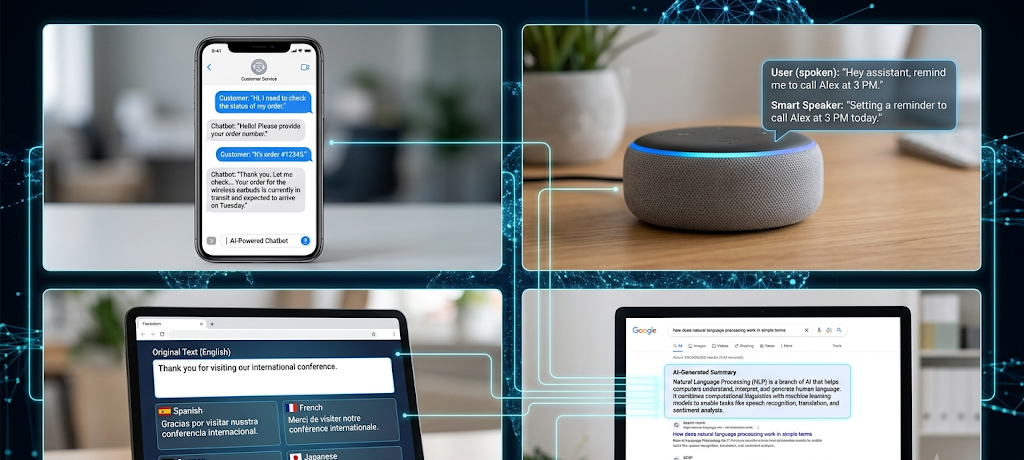
Customer service models have gone in a very large degree of change with the adoption of conversational artificial intelligence and automated chatbot structures. Present day virtual assistants go well past the which was put out by early out there web bots, we see now very advanced intent recognition and named entity extraction in which also includes handling of a very wide range of customer issues. At the time a customer puts out a query the virtual agent in question will determine the real intent, pull out important information like account numbers, dates and then present relevant answers from the enterprise databases.
By way of running 24/7 on the routine support issues these smart systems also at the same time are reducing wait times, cutting down on operating costs and also allowing human support staff to focus on the very complex customer issues.
Voice Assistants and Smart Home Integrations
Voice assistants like Siri, Alexa, and Google Assistant are the epitome of speech recognition, natural language processing, and dynamic voice synthesis. We see these digital devices which have become very much a part of our lives constantly out for activation phrases, interpreting voice commands, running cloud based searches, and back with very natural sounding responses.
As the center of smart home and mobile ecosystems, voice assistants perform a large variety of functions which include setting up calendar reminders, performing web searches, home automation control, and playing media. Also in their constant evolution they use continuous learning models which over time adapt to the individual user’s preferences, speech patterns, and daily routines.
Practical Applications Powering Modern Enterprise Tools
Semantic Search Engines
Search engines have transformed from simple keyword match tools into very advanced contextual search systems which largely run on natural language models. Today’s search algorithms look at the meaning of what users are putting in rather than just exact words. That in turn allows us to return very accurate and very relevant results even when the queries are not precisely put together, are full questions in a conversational format, or use terms that may be out of the ordinary.
Through the use of in depth language analysis search platforms are able to put out summaries of what is asked right on the results page, to pull out very specific information from large web documents, and to take what is for the most part unstructured online data and present it in very easy to understand knowledge graphs.
Enterprise Workflow Automation
In present day business settings natural language software is a large driver for workflow automation, information extraction, and employee productivity. Companies produce large amounts of unstructured documents daily which include legal contracts, financial reports, technical manuals, and also internal emails. We see that with the use of automated language processing tools which in turn extract key data points, condense large reports into short executive summaries, which also do the task of classifying incoming communications and routing out of the ordinary messages to the right internal teams.
By reducing manual data entry and speeding up document review we see that these automated language tools improve the flow of administrative processes, also improve our customers’ compliance with regulations and in the end we see that enterprise knowledge workers are able to make better informed decisions faster.
Current Issues and Future Directions in NLP
Despite great progress in the field of language technology, what we see is that we still have large issues in creating models which truly master the complexity of human interaction. Human communication is a very rich medium which includes a lot of unspoken assumptions, regional expressions, cultural metaphors, and vocal irony. It is in these areas that our current computational models fall short. Also we see that large language models are also at risk of putting out biased material which comes from the biased data they are trained on which in turn may produce off-target or unfair results. To overcome these issues which are technical as well as ethical in nature we require continuous innovation in model development, better data curation, and also very close algorithmic audit in order that language systems do in fact work well, fair and ethically in a wide range of cultural settings.
In the years ahead we will see that which is to come in Natural Language Processing is the development of very integrated multi modal AI systems which will process text, voice, visual media and context at the same time. We won’t see models which process words in a vacuum; instead we will have models which are aware of the environment, which interpret body language, and which enter into very context rich empathetic dialogue. As these systems get more and more into education, health care, access tools and personal software they will transform human computer interaction from a structured task into a fluid conversational partnership. This ongoing tech evolution will put computational power in the hands of people all over the world in a more accessible, intuitive and beneficial way.


🥰🥰🥰🥰🥰