
Introduction
One of the principles of computer science is logic, as information must be processed with exact rules in computers. In all decisions made in a program, no matter which, there is some logical reasoning going on – search for records that match multiple criteria in a database, evaluation of potential conclusions in an artificial intelligence system, or output from a digital circuit based on electronic inputs. A systematic approach for representing statements, exploring relationships between concepts, checking that conclusions are drawn from the information, and checking whether different expressions mean the same thing is called Logic. Learning logic, in turn, leads to more adept problem solving skills and more precise thinking for students and computing professionals.
It is closely related to computational thinking, which is a process of dividing up problems into manageable parts, recognising patterns, designing procedures and creating solutions that can be systematically followed. Predicate logic and propositional logic give learners an understanding of how computers represent information and how computers make decisions using logical operators, truth tables, inference and the logical laws.
What is Logic in Computer Science?
Logic is a formal way of reasoning about information. In normal conversation, one speaker may make a statement that leads the listener to make assumptions, or that is only partially complete, but computers need the information to be more precisely stated. Input to a computer program cannot be a human interpretation of the instruction alone; there must be distinct conditions, relationships and rules defining what should occur in each situation. This precision is achieved in mathematical logic through the use of symbols and formal structures to represent statements and relationships.
Logic is used in computer science in programming languages, algorithms, databases, software verification, artificial intelligence, computer architecture and digital electronics. For instance, a programmer might need a program to run an instruction only when a user is logged in and is an administrator. This is a logical condition with several statements that can represent this requirement. Formally stating such requirements allows developers to analyze, test, simplify and minimize the chances for wrong decisions.
Propositions
A proposition is a statement that could be either true or false, but not both. They are things like “5 is more than 3”, “The Earth goes round the Sun”, or “10 is an even number”. These statements are definitely true or false. The usefulness of propositions in computer science is that they give basic units of representation for information which can be evaluated by a system. A proposition may be written using a letter, for example P, Q and R.
Suppose, for instance, that P is the statement “The user is logged on at the system” and Q is the statement “The user has administrator privileges.” After the statements are defined, they can be conjunctively or disjunctively combined with logical operators to form a more complex condition. Notice that a proposition is differentiated from a question, a command, or an expression without a truth value. “Is the user logged in?” is a question and can’t be evaluated as true or false, whereas “The user is logged in” is an evaluation and can be true or false.
Logical Operators
Symbols or words used to join or alter propositions. Common operators include NOT, AND, OR, implication and exclusive OR, which is also significant in many computing applications. The NOT function inverts the truth value of a proposition, NOT P is true if P is false and vice versa. The AND operator returns true if both propositions to which it is connected is true. If either of its propositions is true, then the OR operation normally returns a true result. Implication is a conditional relationship that is usually presented as an “if P then Q” statement.
These operators can be used to make simple statements into more complicated logical statements. For instance, if one has a valid account AND entered the correct password, then a site will allow access. Likewise, if a temperature is set to be too high, a warning can be displayed in a program, OR if an error occurs in a sensor, a warning can be displayed. Many computational decisions are based on these logical structures.

Truth Tables
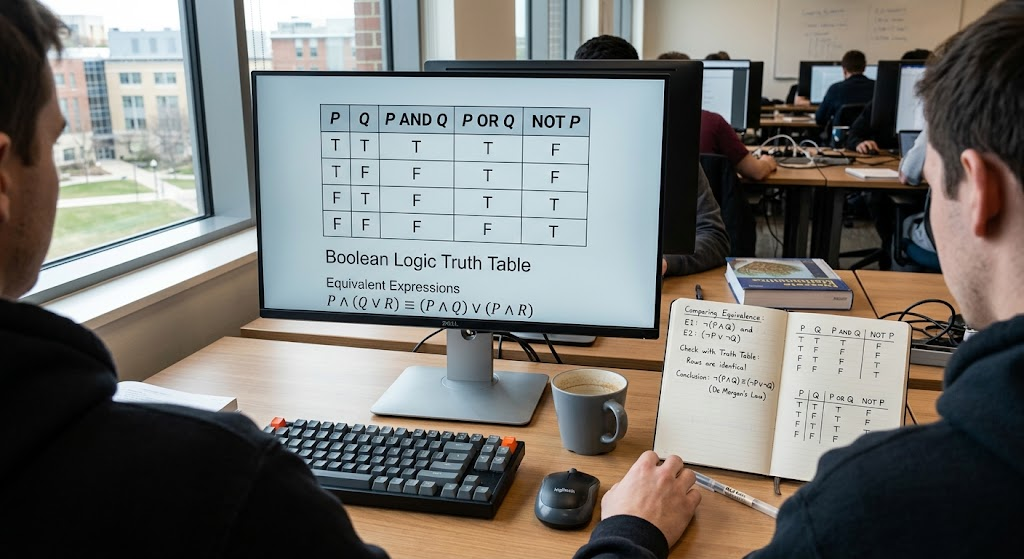
A truth table is a tabular display of the truth value of a logical expression, for all possible combinations of the truth values of its components. There is great value in truth tables as they take out the ambiguity and enable a logical expression to be considered in a thorough and systematic manner. Think about the AND operation on propositions P and Q. When P is true and Q is true, then the answer is true. If P is false and Q is false, the answer is false. For OR, the result will be false if both P and Q are false.
As more propositions are added to the truth tables they may get larger, but they will be a good way to test logical expressions. Truth tables are used in computer science to design and test digital circuits and to study the conditions in a program, verify the truth of a logic statement and learn about Boolean operations. They also might help students identify patterns that may not be obvious if they were dealing with multiple conditions together.
Logical Equivalence
Two logical expressions are semantically equal if they have the same value for all possible values of their variables. Logical equivalence is useful because it enables you to rewrite a complicated expression in a simpler one that has exactly the same meaning. For instance, the statement “NOT (P AND Q)” is equivalent in logic to the statement “NOT P OR NOT Q.” This is called one of De Morgan’s Laws. Logical equivalence can be shown using truth tables and comparing the two expressions, line by line, in the truth table.
Equivalence in software development and the design of digital circuits can be used to optimize conditions, make them easier to read, and eliminate unnecessary operations. A developer may start from a complex condition, and then simplify it into another condition that has the same meaning but is more readable or more efficient to achieve.
Predicates
Many problems in Computer Science involve statements whose truth value is dependent on one or more objects; propositional logic is useful for statements that have definite truth values. These statements can be represented using predicate logic. A predicate is a sentence with variables that can be turned into a proposition if values are given to the variables. Look at the sentence, “x is larger than 10.” This can be represented as P(x): x > 10. This expression is not a proposition, but a predicate before the variable x is given a value. When x = 15, P(15) is true and P(7) is false.
Particularly useful predicates for the representation of properties of objects and relations between objects are predicates. They have many applications, such as databases, artificial intelligence, formal reasoning, and mathematical descriptions of algorithms. Predicate logic enables a computer scientist to state rules that hold true for many values or objects rather than a single fact.
Quantifiers
The quantifiers are extensions to predicate logic that tell how many objects in a specific domain satisfy a predicate. The universal quantifier and existential quantifier are the two most frequent quantifiers. The universal quantifier ∀ translates as ‘for all’ or ‘for every. For instance, the sentence ∀x P(x) would mean that P(x) is true for all x in the given domain. The existential quantifier is “there exists at least one,” which is written as ∃. So, ∃x P(x) is “There exists at least one x for which P(x) is true.
In computing, particularly in databases, mathematical properties and rules in artificial intelligence, quantifiers are very useful in describing records, properties, and rules. For example, a customer’s requirement might be “there is a customer that orders more than a specific quantity of money”. One general guideline may be that each registered user has to have a unique identifier. Quantifiers are helpful for computer scientists to make general requirements more specifically than using natural language statements.

Inference and Logical Reasoning
Inference is drawing a conclusion from information that has already been given or assumed as true. In computer science, inference is essential, as systems often rely on the information they have to make decisions about what should logically follow. One type of inference is modus ponens. This can be represented as: If P, then Q; P, therefore Q. If there were a rule in a system that “If a user presents valid credentials, then access is granted”, then that is an example of a rule. If the system thinks they’re legitimate, it can conclude that access should be granted.
The other significant form is modus tollens, where the falsity of the consequence leads to the falsity of the condition. Automated reasoning, expert systems, programming logic, database queries and AI make use of logical inference. Correct inference is vital because an invalid step in the reasoning process can lead to an incorrect conclusion, even if the information in the system is valid.
Common Logical Laws
There are some standard methods for simplifying and transforming expressions, based on several logical laws. These Laws are helpful because they enable computer scientists to change logical statements without altering their meaning. The laws of identity are that true AND P is equal to P, and false OR P is also equal to P. The domination laws make P OR true always true and P AND false always false. The idempotent laws are that P OR P is equal to P and P AND P is equal to P. The complement laws illustrate that P or NOT P is always true and that P and NOT P is always false. De Morgan’s laws are particularly useful as a way of manipulating expressions with NOT, AND and OR. The commutative, associative, distributive, absorption, and double-negation laws are other useful laws. These rules form a toolbox for analysing and simplifying logical expressions.
Logical reasoning is used in programming whenever a program needs to make a decision, based on one or more conditions. Boolean expressions can be used in statements like if, else if and while, and these expressions evaluate to either true or false. The application could, for instance, verify that the user is of an appropriate age to use a specific feature, and that the user has gone through the necessary registration procedure. Using AND, OR, and NOT, conditions can be used to help determine which parts of the program to run. Logical reasoning also helps programmers to prevent too general, too specific, and/or mis-ordered conditions from resulting in errors. Think about a system that would pop up an alert if a file is missing or if the file can’t be opened. This requirement can be expressed with a logical OR statement. Truth tables and logical laws can be used by programmers to try out such expressions before putting them into practice. This in turn improves the correctness and clarity of software conditions, leading to better knowledge of logic.
Logic in Databases
In a database, logical conditions are crucial for searching, filtering, sorting, and pulling data from the database. The same way as an SQL query can have multiple conditions, the query object can have multiple conditions, which is very similar to the logical AND operation. Some other queries may return records that meet one of the conditions OR the other, and NOT may be used to exclude records with specific characteristics. For instance, the query might ask for customers residing in a certain city OR who have ordered in a given time frame. The other query might return products of either category OR another category.
Predicates and quantifiers give more conceptual depth to the expression of properties and relationships among data. While different practical database query languages have their own syntax, their operations are based on concepts that are similar to those in formal logic. Knowing these logical relationships can guide the database designers and developers in building precise queries, recognizing conflicting demands and reasoning about what the database system would return as the result of a query.
Logic in Artificial Intelligence
Artificial intelligence uses logic as one of several approaches for representing knowledge and making decisions. An AI system may need to represent facts about objects, relationships between objects, and rules that determine what can be concluded from those facts. Predicate logic is particularly useful because it can describe properties and relationships in a structured form. For example, an AI knowledge base might contain information stating that a particular object belongs to a category and that all objects in that category possess a particular property. An inference mechanism can then use these statements to derive additional conclusions.
Logic has also played an important role in expert systems, automated theorem proving, knowledge representation, and rule-based decision systems. Modern AI includes many approaches that do not depend primarily on formal logic, such as machine learning and neural networks, but logical reasoning remains valuable for tasks that require explicit rules, explainable conclusions, consistency checking, or structured knowledge representation.

Logic in Digital Circuits
Digital circuits provide one of the clearest physical examples of mathematical logic in computer science. Modern digital systems use electronic components that operate with discrete signal states, commonly represented as binary values such as 0 and 1. Logic gates implement operations corresponding to logical functions. An AND gate produces an output of 1 only when its required inputs are 1, while an OR gate produces an output of 1 when at least one input is 1. A NOT gate reverses its input. More complex circuits can be constructed by combining these basic gates.
Truth tables are used to describe and verify how a circuit should behave for every possible input combination. Logical equivalence can also help engineers simplify circuits while preserving their behavior. These principles are used in processors, memory systems, calculators, communication devices, and countless other digital technologies. Studying logical expressions therefore provides a conceptual bridge between mathematical reasoning and the physical operation of computing hardware.

Why Logic Matters for Computational Thinking
Logic is important for computational thinking because it encourages people to approach problems using precise rules, structured decisions, and clearly defined relationships. Computational problems often contain several possible conditions, and a successful solution must determine which conditions matter, how they interact, and what conclusions can be reached from them. Propositional logic helps represent simple true-or-false statements, while predicate logic makes it possible to describe objects, properties, and relationships in greater detail.
Truth tables help examine all possible combinations of conditions, logical equivalence helps simplify expressions, and inference provides a method for deriving conclusions from known information. These abilities are useful beyond programming because they encourage careful analysis and reduce reliance on vague assumptions. A student who understands logic can more easily break a complex problem into smaller components, identify rules, test possible outcomes, and construct a solution that can be implemented systematically.
Conclusion
Logic provides computer science with a precise language for representing information, analyzing conditions, and reaching valid conclusions. Propositions form the foundation by representing statements that can be classified as true or false, while logical operators allow these statements to be combined into more complex expressions. Truth tables provide a systematic way to evaluate those expressions, and logical equivalence makes it possible to transform them without changing their meaning. Predicate logic extends these ideas by representing properties and relationships involving variables, while quantifiers describe whether statements apply to all objects or at least one object.
Inference allows systems to derive conclusions from known information, and logical laws provide reliable techniques for simplifying and transforming expressions. These principles appear in programming conditions, databases, artificial intelligence, and digital circuits, demonstrating that logic is not merely an abstract mathematical subject. It is a practical foundation for understanding how computational systems represent information, make decisions, solve problems, and operate according to precise rules.



This was beautiful Admin. Thank you for your reflections.
You’re so awesome! I don’t believe I have read a single thing like that before. So great to find someone with some original thoughts on this topic. Really.. thank you for starting this up. This website is something that is needed on the internet, someone with a little originality!