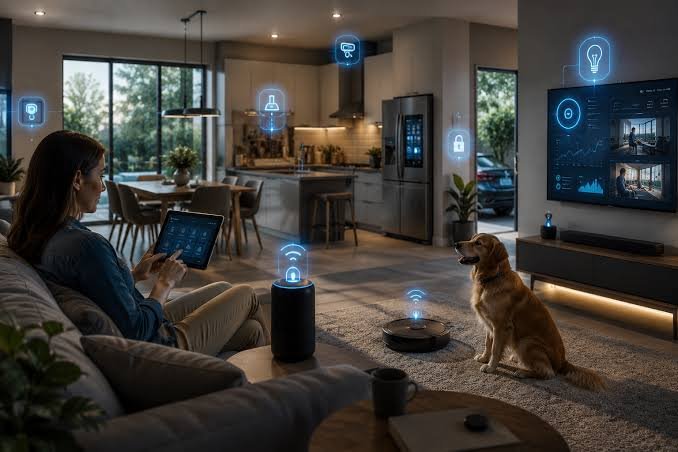
For many people, the phrase “smart home” still conjures a slightly gimmicky image: a voice-activated speaker, a light that changes colour, a refrigerator with a screen. The reality in modern residential design is quieter and more practical. The best smart features are the ones residents barely notice, because they make ordinary tasks a little easier or a little cheaper without demanding attention.
Understanding what these technologies actually do, and where they fall short, helps buyers separate useful features from decoration.
What “Smart” Really Means
At its simplest, a smart home connects devices so that they can be monitored, scheduled or controlled remotely. Lights, air-conditioning, door locks, curtains and appliances can be linked through a central app or hub. Some systems respond to rules you set, such as dimming lights in the evening. Others respond to sensors, such as switching off a fan when a room is empty.
The value lies in convenience and information. Convenience means doing less manual work. Information means seeing patterns, such as how much electricity the air-conditioner uses or when the front door was last opened.
Lighting: The Easiest Starting Point
Smart lighting is often the most approachable entry into home automation. Dimmable fixtures allow residents to adjust brightness to suit different activities, softer for dinner, brighter for study. Scheduling features can turn on a hallway light at a set time or switch everything off at bedtime.
Beyond convenience, lighting affects mood and sleep. Warmer tones in the evening can support a calmer atmosphere, while brighter, cooler tones during the day suit work and cooking. Programmable lighting makes these shifts effortless rather than something to remember.
Energy Monitoring and Cooling Control
In a tropical city, cooling is a major part of household energy use. Smart controls can help manage it. Programmable thermostats or connected air-conditioning units can cool a room shortly before you arrive and reduce activity when you are away. Some systems provide usage data, helping residents see which appliances consume the most.
The point is not to chase perfect efficiency but to gain awareness. When people can see their consumption, they often adjust habits naturally. A household that discovers its evening cooling pattern is more expensive than expected may choose to use fans first, or raise the temperature by a degree.
Security and Access
Digital door locks, video doorbells and entry sensors are among the most visible smart features. They offer convenience, such as letting in a family member without carrying keys or allowing a delivery to be received while you are out. They can also provide a record of who has come and gone.
These tools have trade-offs. Battery-powered devices need maintenance. Cloud-connected cameras raise questions about data storage and privacy. Residents should understand how their systems work, who has access to recordings and what happens if the internet goes down. Good security design usually keeps a reliable mechanical fallback.
Flexibility and Future-Readiness
A home with sound technical groundwork is easier to update as technology changes. Practical steps include:
- Adequate power outlets in sensible locations, including near entry points and in kitchens.
- Network cabling or strong wireless coverage throughout the home.
- Conduit or access points that allow future wiring without major renovation.
- Neutral wiring in switches, which many smart switches require.
These are the unglamorous details that determine whether a home can adapt in five or ten years. A buyer reviewing specifications should ask what infrastructure is provided, not only which devices are included.
Technology and Daily Routines
The best smart-home features support routines rather than replace them. Examples include a “leaving home” scene that switches off lights and appliances with one tap, or a “good night” routine that locks doors and dims the living area. For households with children or older family members, simple automation can add reassurance, such as a gentle night light that activates on the way to the bathroom.
It is important not to overcomplicate. A system that requires frequent troubleshooting quickly becomes a burden. Many residents find that a small number of reliable automations deliver more value than a house filled with connected gadgets.
Evaluating Smart Features in a New Home
When assessing a new residential project, it is worth asking precisely what is included. Marketing materials sometimes use broad language, and a showflat may be fitted with equipment that does not form part of the standard specification. Developments such as the low-rise scheme near Berlayar Creek in Telok Blangah publish information through their sales channels, and a visit to the Berlayar Drive Residences Showflat is a reasonable opportunity to ask which smart features, if any, are provided as standard and which are optional.
The same approach applies to larger developments. Anyone researching the integrated scheme planned in the Bayshore area, for instance, can use the Bayshore Drive Residences Showflat as a starting point for questions about technical specifications, then compare the answers against the official documents.
Neither project’s materials, as reviewed for this article, give details of smart-home packages, so buyers should confirm specifics directly rather than assume.
Privacy and Data Considerations
Connected devices collect information, including when you are home, which rooms you use and what you watch or say. Before installing any device, read the privacy policy, check where data is stored and set strong, unique passwords. Keep firmware updated, since manufacturers regularly release security fixes. Where possible, choose systems that can function locally without constant cloud access.
Cost, Compatibility and Longevity
Smart devices come in many ecosystems, and not all of them work together. Before buying, check compatibility with the systems you already use. Open standards are generally preferable to proprietary platforms that may be discontinued.
Cost matters too. It is tempting to buy many devices at once, but it is often wiser to start with one or two that address clear needs, such as lighting control or cooling management, and expand gradually. A modest system you actually use is more valuable than an elaborate one that sits idle.
Comfort Redefined
The meaning of residential comfort has shifted. It once centred on space, finishes and furniture. Today it also includes responsiveness: a home that adjusts to your routines, shares useful information and reduces small frictions. These qualities are not limited to expensive homes. Even simple measures, such as programmable lighting, reliable network coverage and efficient cooling controls, can improve daily life.
Conclusion
Smart home technology is most valuable when it is practical, reliable and modest in its ambitions. The goal is not to turn a home into a laboratory but to make it a little more comfortable, a little more efficient and a little more adaptable.
Buyers who ask clear questions, insist on documented specifications and focus on infrastructure as much as gadgets will be best placed to enjoy the benefits. A genuinely comfortable smart home is one where the technology fades into the background and the residents simply feel at ease.