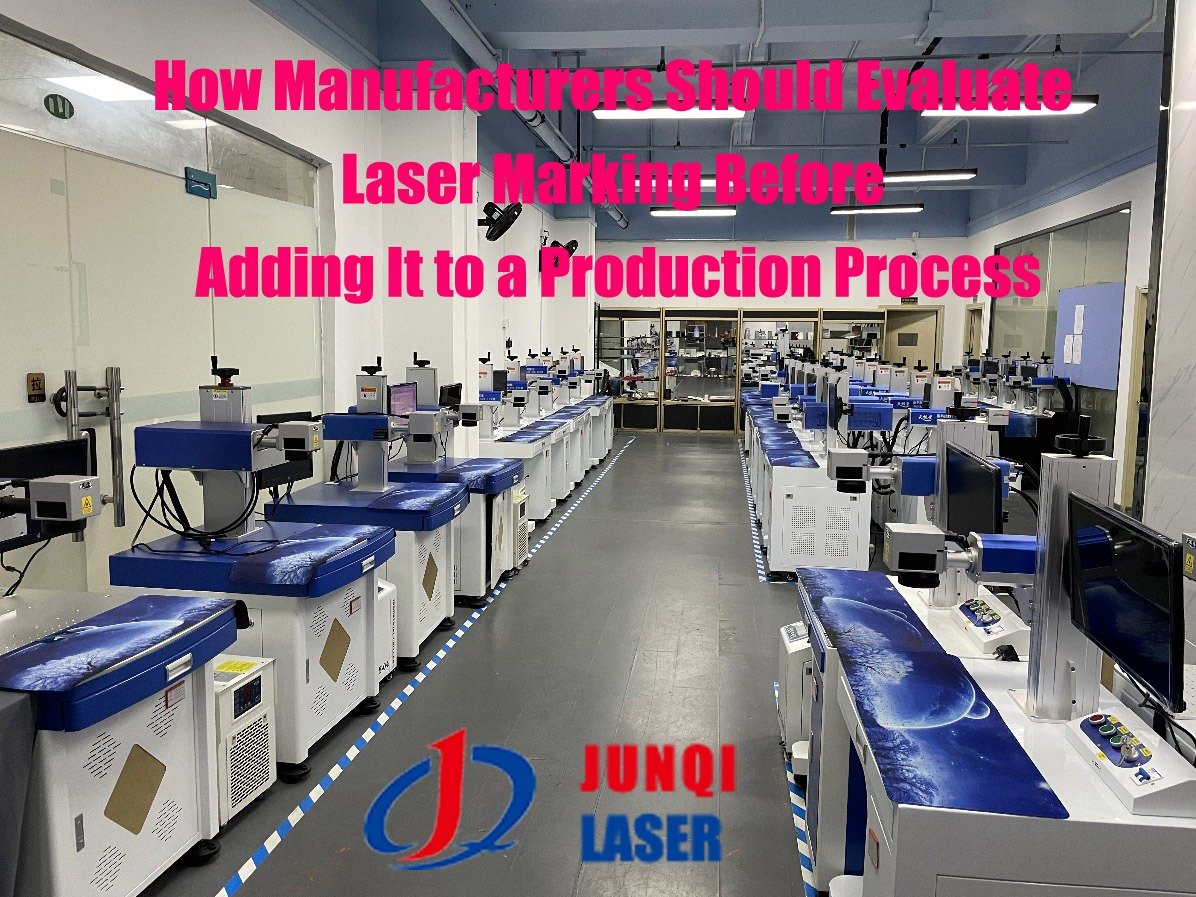
Laser marking is often introduced to manufacturing as a simple identification operation: put a serial number, logo, QR code, or product specification on a component.
In reality, selecting a laser marking system for production can involve much more than choosing a laser with a certain wattage.
Manufacturers need to consider the material, marking objective, production speed, durability, positioning, data management, inspection requirements, and the way the marking station will interact with the rest of the production process.
This is especially important when a company is moving from manual or low-volume production toward repeatable manufacturing.
Start With the Production Requirement
The first mistake manufacturers can make is starting with a machine specification instead of the production problem.
A buyer may begin by asking whether a 20W, 30W, 50W, or 100W laser is required. That is an understandable question, but it is not enough information to determine the correct system.
A better starting point is to define what the production process actually needs.
- What material is being processed?
- What information needs to be marked?
- How large is the marking area?
- How much contrast is required?
- Is surface marking sufficient, or is engraving required?
- How many parts must be processed per hour?
- How permanent must the mark be?
- Does every product require unique data?
- Will the marking station operate manually or automatically?
These questions determine the technical requirements much more effectively than laser power alone.
Material Determines the Starting Point
Laser marking is a material-processing technology, so the material should be identified before the laser is selected.
Fiber lasers operating around 1064 nm are widely used for many metal-marking applications, including stainless steel, aluminum, carbon steel, brass, copper, and titanium.
However, this does not mean that every metal should be processed using identical parameters.
Surface finish, alloy composition, coatings, reflectivity, thermal conductivity, and the required marking effect can all influence the result.
Other materials may require different laser wavelengths. UV systems can be useful for certain plastics, electronics, and heat-sensitive applications, while CO? systems are commonly considered for materials such as wood, acrylic, leather, paper, and selected plastics.
Therefore, the first engineering question should not be “Which laser is the most powerful?”
It should be “Which laser-material interaction is appropriate for the required result?”
Wattage Is Only One Parameter
Laser power is important, but it should not be treated as a complete measure of machine performance.
For example, a 50W system may have advantages for deep engraving or higher-throughput applications, while a 20W or 30W system may already be sufficient for many serial-number, logo, QR-code, and general identification tasks.
The final result also depends on parameters such as:
- laser wavelength;
- pulse characteristics;
- pulse frequency;
- pulse width where applicable;
- scanning speed;
- beam quality;
- focusing optics;
- lens selection;
- hatch spacing;
- number of passes.
This is why two systems with similar nominal power can produce different results on the same component.
Manufacturers evaluating technical configurations can refer to this technical guide to fiber laser marking for an overview of the relationship between laser source characteristics, optical configuration, material behavior, and marking performance.
Define What “Good Marking” Means
Another common problem is approving a laser process simply because it creates a visible mark.
A visible mark is not necessarily a production-quality mark.
Depending on the application, the manufacturer may need to define acceptance criteria such as:
- minimum contrast;
- maximum marking depth;
- minimum character size;
- barcode or Data Matrix readability;
- surface appearance;
- acceptable heat-affected area;
- abrasion resistance;
- chemical resistance;
- repeatability.
For traceability applications, for example, the important question may not be whether a QR code looks good to the human eye. The important question may be whether an automated scanner can read it reliably under actual production conditions.
Measure Complete Cycle Time
Manufacturers sometimes compare laser systems using the maximum scanning speed shown in a specification sheet.
That number can be useful, but it does not necessarily represent real production throughput.
A complete production cycle may include:
- Loading the component.
- Positioning the component.
- Detecting the product.
- Loading or receiving the marking data.
- Focusing or confirming the marking position.
- Laser processing.
- Inspection.
- Unloading the component.
If the laser requires two seconds to mark a part but the operator spends eight seconds positioning and handling it, increasing the scanning speed will not solve the main production bottleneck.
For this reason, cycle-time testing should be performed using the actual product and the actual marking content.
Test the Actual Production Material
Sample testing is one of the most useful steps before purchasing industrial laser equipment.
Material names can be misleading because two products described with the same general material category may behave differently.
Different alloys, coatings, surface treatments, pigments, additives, and manufacturing processes can influence laser interaction.
A proper application test should therefore use the actual production material whenever possible.
The manufacturer should also provide the actual artwork or marking data that will be used during production.
This allows the test to evaluate the real process rather than an artificially simple demonstration sample.
Repeatability Matters More Than One Perfect Sample
A successful test on one component is encouraging, but it does not prove that the process is ready for production.
Industrial equipment must produce repeatable results across many cycles.
Manufacturers should therefore test multiple consecutive samples and compare:
- marking position;
- contrast;
- dimensions;
- code readability;
- surface condition;
- processing time.
If the application is particularly sensitive, the samples should also be evaluated after downstream operations such as cleaning, coating, assembly, sterilization, abrasion testing, or other real production processes.
When Automation Becomes Necessary
A manual laser marking workstation may be perfectly suitable for small production volumes.
As production increases, however, repetitive manual tasks can become bottlenecks.
Automation can include relatively simple improvements, such as a positioning fixture or sensor, or more advanced integration involving conveyors, PLCs, machine vision, variable data, and production-management systems.
The appropriate level depends on the application.
A company producing highly customized components in small quantities may value flexibility more than automation.
A manufacturer producing thousands of similar components may benefit from automated positioning and variable-data marking.
Variable Data Changes the Requirements
Marking the same logo on every product is relatively simple.
Marking a unique serial number on every product creates a different engineering challenge.
The system needs to receive the correct information, associate it with the correct product, and prevent errors such as duplicate or incorrect codes.
This is where laser marking can become part of a broader manufacturing information system.
A production line may use sensors to detect the product, a PLC to control the sequence, software to provide the required data, and a vision system to verify the final result.
The laser is then only one component within the larger process.
Consider Traceability From the Beginning
Traceability is particularly important for industries such as automotive, electronics, medical devices, industrial equipment, and battery manufacturing.
A permanent identification code can connect a physical component with information stored in a production database.
Depending on the manufacturing system, that information could include a production batch, manufacturing date, component model, inspection result, or service history.
Designing this system early can be easier than adding traceability after production volumes have already increased.
Do Not Select Equipment Only by Price
The cheapest machine is not necessarily the lowest-cost production solution.
Manufacturers should consider the complete cost of ownership, including:
- equipment purchase price;
- installation;
- training;
- maintenance;
- spare parts;
- operator time;
- rework;
- downtime;
- automation integration;
- future expansion.
A slightly more expensive system may be economically better if it reduces labor, increases throughput, improves repeatability, or integrates more easily with the existing production line.
Questions to Ask a Laser Equipment Supplier
Before making a purchasing decision, manufacturers should ask suppliers several practical questions.
- Can you test our actual material?
- Can you use our actual marking artwork?
- What laser source model is being proposed?
- What lens and marking field are included?
- What is the measured cycle time for our product?
- Can the system process variable serial numbers?
- Can it communicate with a PLC?
- Can machine vision be integrated?
- What happens if the marking fails?
- What technical support is available after installation?
These questions help move the conversation away from marketing specifications and toward the actual manufacturing process.
Production Readiness Is More Than a Successful Demonstration
A production-ready laser marking process should satisfy several conditions simultaneously.
The material must respond appropriately. The mark must meet the quality requirement. The cycle time must be acceptable. The result must be repeatable. The marking must survive the required downstream process. And, where necessary, the system must communicate with the manufacturing environment.
In other words, the goal is not simply to prove that a laser can create a mark.
The goal is to prove that the marking process can become a reliable part of production.
Conclusion
Laser marking can be a relatively simple operation or a sophisticated automated manufacturing process, depending on the application.
The difference comes from how the manufacturer defines the problem.
Instead of choosing equipment by wattage or price alone, manufacturers should begin with the material, marking objective, production volume, cycle time, durability requirement, and automation needs.
Actual sample testing should then be used to validate the proposed process.
This approach reduces the risk of purchasing equipment that can produce a good demonstration sample but cannot meet the requirements of continuous production.
For modern manufacturing, the best laser marking system is not necessarily the one with the highest specification. It is the one that produces the required result consistently, at the required speed, on the actual product, while fitting into the wider production process.
Author Bio
JQ Laser is a laser marking technology company specializing in fiber, MOPA, UV, and CO₂ laser marking solutions for industrial identification, traceability, material processing, and manufacturing applications.



Pretty! This has been a really wonderful post. Many thanks for providing these details.
Awesome! Its genuinely remarkable post, I have got much clear idea regarding from this post
Hi there to all, for the reason that I am genuinely keen of reading this website’s post to be updated on a regular basis. It carries pleasant stuff.
I just like the helpful information you provide in your articles
I am truly thankful to the owner of this web site who has shared this fantastic piece of writing at at this place.