
In computer science, trees are one of the most significant structures employed for the organization of information at different levels, where the relationship between the elements is naturally represented by them. A tree is similar to a list except that each item in a list is accessed by a single item; each item in a tree could be related to multiple items and thus forms a hierarchy. Such a structure may be applied to various sorts of folders and files on a computer, database indexes, search strategies, programming language expressions, and decision making processes.
The trees have a close relationship with discrete mathematics in computer science as they serve as a mathematical model of the relationships, connections, paths and hierarchical arrangements. Knowing about trees provides a basis for programming with a variety of practical data structures and algorithms used to store, search, organize and process data efficiently in the real world.
Understanding Tree Structures
A tree is a non-linear data structure made up of a collection of nodes connected by edges. Typically there is one node that is designated the root of the structure, and from which it starts. Other nodes can be added below at different levels and achieve parent-child relationships. A node with no children will be a leaf node and a node that has children below will be an internal node. The number of edges that can be attached to a node can change with different trees. The reason why trees are useful is that they have a hierarchical structure similar to many situations in the real world, outside of computer science. For instance, an organization may have a chief executive at the top, managers below the executives, and employees below managers. A computer directory can also have subfolders, folders and files. A naturally formed relationship between these entities can be achieved on a tree.A natural relationship between these entities can be expressed on a tree.
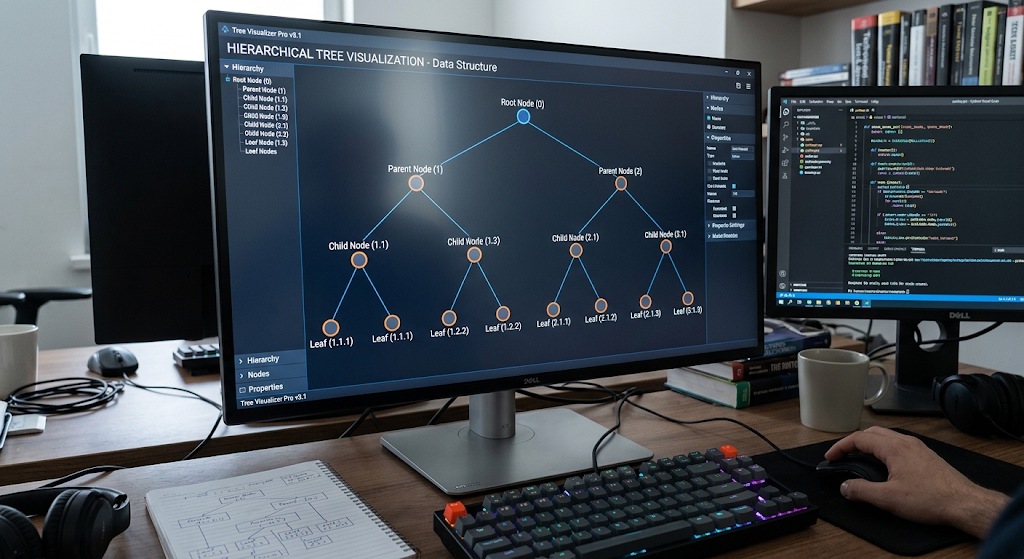
Mathematical trees in discrete structures make the theoretical basis of understanding the behavior of these structures. In discrete mathematics, a tree is typically defined as a connected graph with no cycles, which means that two nodes of the tree are connected by a path, but not by a cycle that passes through them again. It’s a mathematical definition that’s crucial because it is why tree structures are particularly suited to expressing hierarchy. In programming, more can be added to a tree to make it more useful to specific operations. For instance, in a binary tree, each node may have at most two children; in a binary search tree, the values are stored in a sequence that is sorted by their relative size. The differences illustrate how a basic mathematical concept can be implemented as a useful programming tool.
Binary Trees
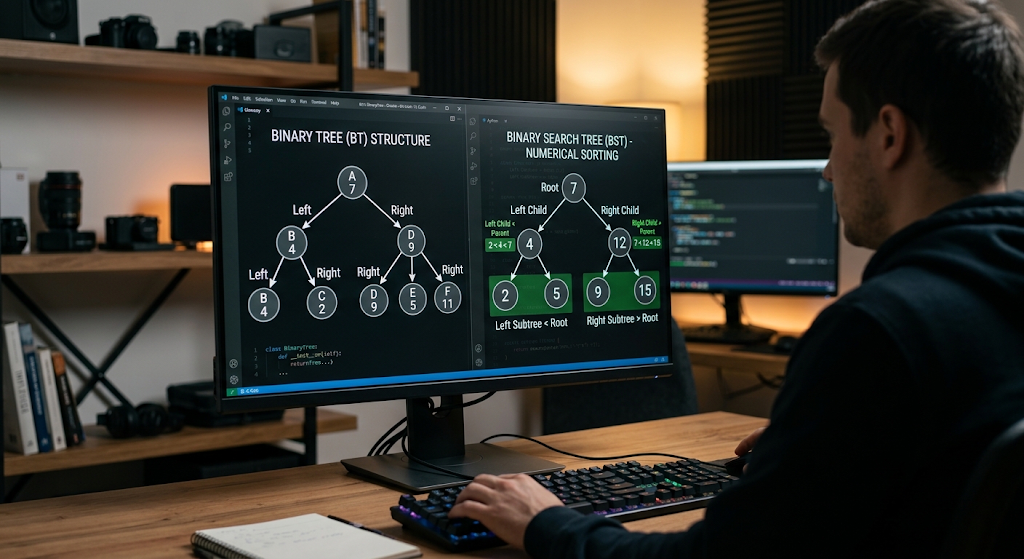
A binary tree is a tree data structure where each node can have no more than two children. Such a tree is frequently used to represent information that is naturally split into two possible branches, such as the left child and right child. A node doesn’t have to have two children – it can have just a left child, just a right child, or no children at all. By limiting the number of children to two, binary trees are relatively simple to implement and understand, and the foundation for several other more specialized trees. Often binary trees are implemented with nodes containing a value and left and right child references/pointers. A node can also contain other information like metadata, indexes, or links to other objects.
The shape of binary trees can vary extensively, and can greatly influence the performance of algorithms. A complete binary tree is a tree that is as full as possible; a full binary tree is a binary tree in which every node that is not a leaf has two children. A perfect binary tree is a tree in which each internal node has two children and all the leaves are on the same level. On the other hand, a binary tree can suffer from extreme imbalance, and look like a long chain of nodes instead of a wide tree structure. The difference is significant because many tree algorithms are sensitive to the height of the tree. The operations will take less time to go from the root to a target node as the tree is shorter, and they will take more time if the tree is very tall.
Binary Search Trees
A binary search tree or BST is a binary tree that is used to provide more efficient searching and ordered data maintenance operations. A binary search tree is a special case of a binary tree where the values in the left subtree are all less than the value in the node and the values in the right subtree are all larger than the value in the node. With this ordering rule, it is possible to prune off a lot of the tree in a search. An algorithm compares the current node to the target and selects the branch that is suitable. If the target is smaller, the algorithm goes left, if bigger, goes right. This continues until the target is located or it hits an empty position. This approach will work best for trees that have a ‘scooped’ shape.
If the binary search tree is fairly balanced, the searching, insertion and deletion of values may be very efficient since it is related to the height of the tree. Ideally, every decision reduces the number of options by about half, resulting in a logarithmic distribution. But, it is possible to make a binary search tree unbalanced if the elements are added in an unlucky order. If the values to be inserted are already sorted, for instance, a structure that looks like a linked list may result, so searches may be much longer. This deficiency is one of the reasons for the development of balanced search trees. Balanced trees will perform more predictably even if the data is continually being added and removed from the tree.
Balanced Trees
Balanced trees are trees designed to prevent the tree’s height from growing unnecessarily high. The principle is to keep the branches more or less at the same height and not make one side of the tree grow much taller than the other. The two popular examples are AVL Trees and Red-Black Trees. An AVL tree has a strict balance requirement: The difference in height between left and right subtrees of any node does not exceed a constant. Rotations can be used to reorganize the tree if there is an imbalance caused by an insertion or deletion. Red-Black trees use a different approach to balancing – each node in the tree has a property or color assigned to it, and the rules imposed restrict the tree’s height. In both cases, the search operations continue to be efficient.
Balanced trees are particularly useful in software programs where many insertions and deletions occur over time, with many searches. Balancing operations reorganize the nodes without letting the structure become a long chain, and maintain ordering properties. Such changes increase the processing required during updates, but in most cases are appreciated from the point of view of search and other operations’ worst case performance. Another important point to consider in algorithm design is that the structure of the data is as crucial as the data itself, as shown in balanced tree concepts. The same simple operations can be used in an efficient algorithm in a poorly organized structure, or in a well organized structure, scale to much larger datasets.
Heaps and Priority Based Processing
Another important tree-based data structure, but different from a binary search tree, is a heap. A binary heap is typically stored as a complete binary tree and has a special ordering property called the heap property. A min-heap means that the key in each parent is not greater than the keys in the children, that is, the minimum key is always at the root. The opposite relationship is implemented in a max-heap, where the largest value is at the root. The heap need not be sorted. Rather, it assures an efficient access to the most critical element. This is very handy if a program is processing the smallest or largest item many times over.
Priority Queues are often implemented as heaps, in which every element comes with a priority that dictates the order of processing the element. It can be used for operating systems, scheduling systems, simulations, graph algorithms, and more. For instance if the application has to process tasks based on their urgency, then it can store the tasks in a priority queue backed by a heap. The most critical one can then be retrieved efficiently, and new tasks can be inserted without having to sort through the whole collection. When using an appropriate priority queue, heaps have significance in algorithms like Heap Sort and Dijkstra’s shortest-path algorithm. They provide examples of different structures of trees that are used to solve different types of problems.
Tree Traversal Methods
Traversing a tree is the task of visiting the nodes in a tree in a specific order. A tree is not a sequence, so programmers must have systematic ways to process each node or to find specific information. Preorder, Inorder, and Postorder traversal are the three important depth-first traversal methods of binary trees. Preorder traversal: Visits the current node first, then the left subtree, and finally the right subtree; typically root, left, right. The left subtree is processed first, current node is processed second, and right subtree is processed last in Inorder traversal. Postorder Traversal does the processing of both the left and right subtrees before the current node. The type of information being processed and the desired output determine the different uses of each method.
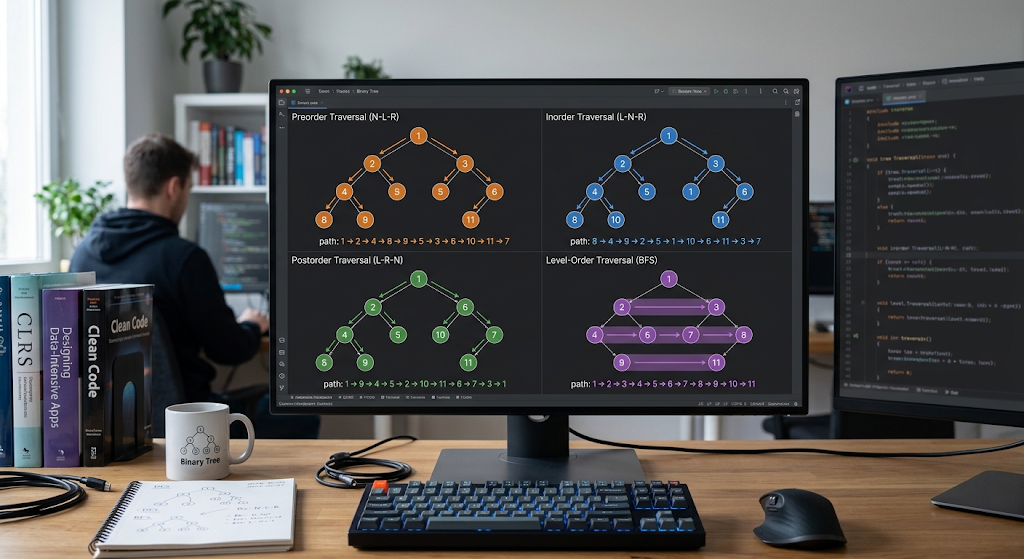
Another important method is ‘breadth first traversal’ also known as ‘level order traversal’. Level-order traversal visits nodes by distance from the root node, rather than descending to the deepest node first and then going up to visit other nodes. Uses a queue typically to remember nodes that have yet to be processed. Traversal methods are important because they enable programs to execute operations throughout the entire tree without having to use an arbitrary, or inefficient way to traverse it. For example, if a binary search tree adheres to the standard binary search property, then an inorder traversal of the binary search tree can be performed in sorted order. The preorder traversal may be useful if the parent structure must be processed before the children. The postorder traversal may be used if the elements of the children must be processed before their parent.
Trees in File Systems
A common example of the use of trees is the computer file system, in which files and directories are arranged in a tree. A typical file system is hierarchical, with a main directory that may have subdirectories, which may have more subdirectories, and so on until the very bottom, where the files are placed. It is similar to a tree; there is a root and a chain of parent-child relationships going downward. If they open a folder, and then click on a subfolder, the operating system is traversing a hierarchy. The tree model allows to organize a tremendous amount of data files without storing all of them in one flat collection. It also enables the user and software applications to locate files based on their position in the hierarchical file structure.
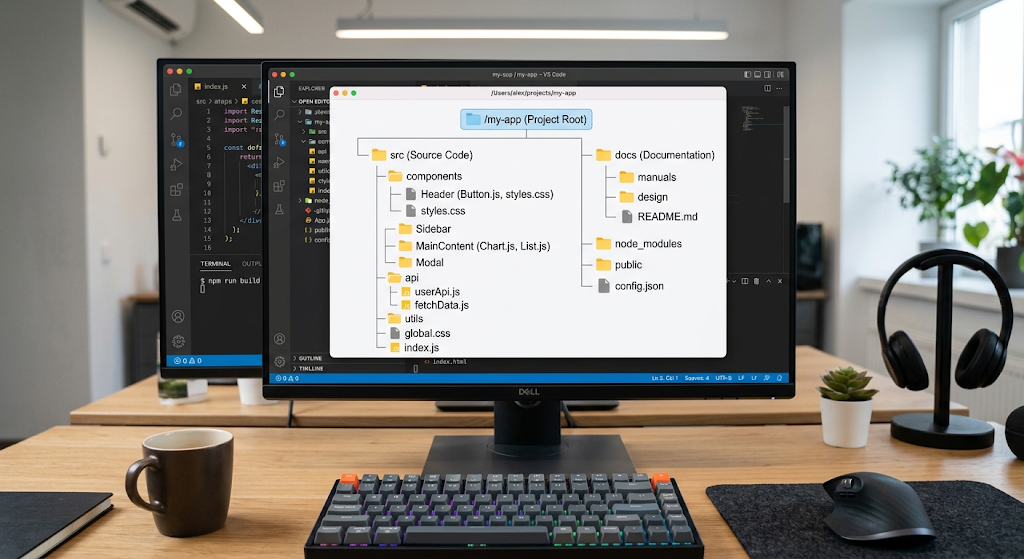
These are the reasons that hierarchical data structures are useful in real software, and why file systems have emerged. There may be several children in a directory and each child can have other children of its own that are also files or directories. Searching through a directory, calculating the size of a directory, displaying the contents of a directory and managing permissions, etc., can then be done with a tree-oriented approach. Recursive algorithms are well suited to this kind of work since the same operation can be performed on the directory and then the same operation can be performed on all the subdirectories of that directory. While other mechanisms and complexities are possible with a real file system, the concept of a tree is an important model for understanding the hierarchical organization of a file system.
Trees in Databases and Search Algorithms
A tree is important in a database system because it is often necessary to efficiently search, insert, update and retrieve large amounts of information. B-trees and B+ trees are commonly used in database indexing and storage systems. These are different to simple binary trees, as a node may have many children, so that they can be used to represent large amounts of data with heights that are relatively short. This is especially useful if the data is being stored on secondary storage as fewer disk or storage accesses will make this much better. Using a tree structure can help identify records more efficiently than to scan each record individually in a database. Therefore, a smart index can help keep search operations much faster for large amounts of data.
Tree structures also aid in search algorithms, as many problems can be broken up into smaller branches. A search process can start from a root and then choose a branch repeatedly for each node according to the information available at the node. The concept is used in binary search trees, decision trees, game playing algorithms, and other search algorithms. For a problem, trees can also be used to represent states of the problem with each node representing a state and each of its children representing a possible action to take next. In such an algorithm, a system of branches can be explored to see if they lead to a particular outcome or to determine if a desired one has been found. Its efficacy relies on the construction of the tree, number of branches and if possible, the use of methods like pruning to remove redundant paths.
Trees in Compilers
A tree data structure can be utilized to analyze and manipulate source code and to generate executable or lower level instructions, as done in compilers. When a programmer writes an expression of a mathematical function, or a programming statement, the compiler has to know how to connect different parts of the expression. For source code, the structured representation is provided by an abstract syntax tree also known as an AST. For instance, an arithmetic expression with several operators might be expressed as a tree in which the nodes are operators, and the leaves are the values and identifiers. The compiler can read this representation to know what corresponds to what and the sequence of operations. The compiler can use a meaningful hierarchical representation of source code rather than an unstructured sequence of characters.
The use of tree structures during compilation is helpful at various phases of the process. The abstract syntax tree can be used during the semantic stage and can be used for checking the semantics of the source code, identifying the variables, analyzing expressions, optimizing code and generating an appropriate representation of the target code. The structure may be processed in various ways using different tree traversals. For example, if a compiler must visit child expressions for some reason to evaluate or transform an expression, it can do so here. Trees are thus the link between the program written in a computer-friendly language and its internal program representation.
Tree Structures in Decision-making Systems.
Tree structures are also useful in a number of practical applications, particularly in systems that need to take decisions in light of a sequence of conditions, for which decision trees are useful. The root of a decision tree is a starting question or condition, branches are the answer or outcome choices, and the leaf nodes are the final decisions. This architecture can be utilized for classification, recommendation systems, automated decision-making, and machine learning applications. One system could start with the consideration of one characteristic and go down the appropriate branch, then consider another characteristic and proceed down the appropriate branch, and so on until it arrives at an outcome. The tree structure allows the decision-making process to be more readily understood and visualised, and can aid the developers in interpreting the output that was generated.
Decision Trees also illustrate that logic can be represented in the form of tree structures as well as merely data being stored. Each branch is a possibility based on the information at a certain point. Decision trees can be built from data using algorithms to find features of the data that can be used to split examples into groups. This leaves a structure that can be used to classify new examples. While decision trees can be too complicated if they are not carefully designed or controlled, the basic structure of a decision tree is still helpful because it outlines a sequence of decisions. The principle behind the above idea can be utilized outside of machine learning anywhere where we want a system to navigate multiple states to arrive at a decision.
Importance of Trees in Computer Science
The reason trees are important is that they can be used to represent hierarchy and they are useful for efficient information searching, sorting, organizing, and processing. Tree structures are for solving different problems. A binary tree is a simple tree with two branches, a binary search tree adds an ordering rule, a balanced tree makes the search more reliable, and a heap has an access rule that gives the smallest or largest element access. There are other structures such as B-trees, B+ trees, syntax trees, and Decision Trees which are extensions of the basic structure used to meet particular needs. By learning the structures, the programmer is able to appreciate the importance that the selection of a proper data structure can have on the efficiency and maintainability of software systems.
Trees are also a crucial link between theoretical computer science and programming. The mathematics of trees is used to describe concepts like connectivity, paths, hierarchy, depth, height and branching, and programming is how these concepts are realized as concrete tree structures that hold and manipulate information. In many different applications, tree concepts can be found under the hood, such as developing a database index, analyzing source code, searching a collection, managing files, scheduling tasks, or creating a decision-making system. There are several reasons for avoiding this: Trees must not be considered just one more data structure. They form the basic concept of how information is organized and are an integral knowledge of the way in which modern software systems process and organize complex information.



I truly appreciate your technique of writing a blog. I added it to my bookmark site list and will